A page can rank in search results and still be absent from the answer a user receives.
That is becoming a familiar problem as Google’s AI features, Microsoft’s AI-powered search experiences, and ChatGPT Search respond directly to questions instead of presenting only a list of links. These systems may summarize several sources, cite selected pages, or answer follow-up questions without requiring the user to begin another search.
So, what is AEO? Answer engine optimization is the process of making information easier for search engines and AI systems to find, interpret, verify, and use in a direct answer.
AEO is not a new technical standard, and no platform offers an “AEO score.” It is an industry term for a collection of editorial and technical practices. Much of the work is familiar SEO: crawlable pages, clear site structure, useful content, dependable evidence, and a close match with the reader’s intent.
The difference is emphasis. AEO pays closer attention to whether an answer remains clear when it is extracted from the full article, summarized by a system, or combined with information from other sources.
What Is AEO in Practical Terms?
Traditional search optimization often focuses on rankings, impressions, clicks, and conversions. AEO adds another question:
Could this page provide a reliable answer without forcing the reader—or an answer system—to reconstruct the point from several vague paragraphs?
In practice, that means:
- Answering the main question close to the relevant heading
- Explaining the condition that could change the answer
- Supporting important claims with appropriate evidence
- Keeping essential information available as readable text
- Using headings, lists, and tables only when they make the subject easier to follow
- Showing who published, reviewed, or updated the information when trust matters
- Correcting prices, features, policies, and other time-sensitive details when they change
None of this guarantees a citation. Answer systems select sources dynamically, and their methods differ. A page can be technically sound and editorially strong without appearing in a particular generated answer.
That limitation is worth stating plainly. AEO improves a page’s usefulness and eligibility. It does not create a permanent position that can be bought, reserved, or reliably tracked like a conventional ranking.
AEO Extends SEO Rather Than Replacing It
Some AEO advice makes ordinary SEO sound obsolete. That is misleading.
A page still needs to be discovered, crawled, indexed, and understood before it can support an answer. Internal links still matter. Canonical signals still matter. A page blocked by noindex will not become visible because it contains a polished 50-word definition.
The opposite mistake is treating AEO as a formatting exercise. Adding question headings, shortening every paragraph, or converting an article into dozens of fragments does not automatically make the information more useful.
For most teams, the distinction is simple:
SEO helps a page become eligible and competitive in search. AEO improves the quality, clarity, and reliability of the answers contained on that page.
The two disciplines share the same foundation. AEO merely exposes weaknesses that traditional SEO reporting can sometimes hide. A page may receive impressions while answering the question poorly. It may rank because of domain strength while relying on outdated facts. It may attract clicks but fail to provide a passage that another system can quote without creating confusion.
AEO is therefore less of a replacement for SEO than a stricter editorial test.
What Makes Content Useful to an Answer Engine?
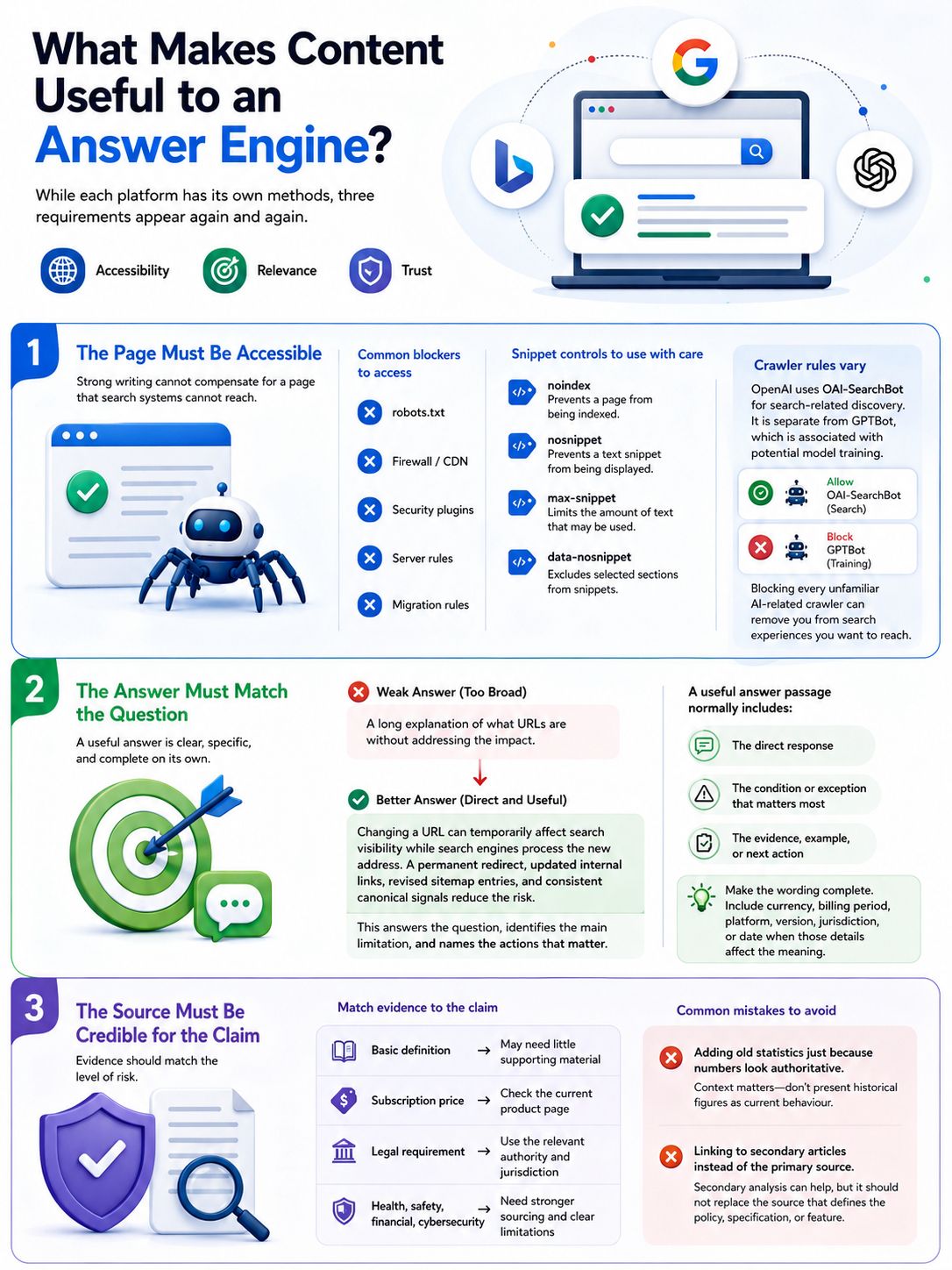
No universal citation formula exists. Google, Bing, ChatGPT Search, and other systems do not use identical retrieval or ranking methods, and their full selection processes are not public.
Still, three requirements appear repeatedly: accessibility, relevance, and trust.
The Page Must Be Accessible
Strong writing cannot compensate for a page that search systems cannot reach.
For Google’s AI search features, a page generally needs to be indexed and eligible to appear with a search snippet. A crawler may be blocked by robots.txt, a firewall, a content delivery network, a security plugin, or a server rule added during a site migration.
Snippet controls also deserve care:
noindexprevents a page from being indexed.nosnippetprevents a text snippet from being displayed.max-snippetlimits the amount of text that may be used.data-nosnippetexcludes selected sections from snippets.
These settings have legitimate uses, but sitewide implementation can remove more visibility than intended. A publisher trying to protect one section of a page may accidentally restrict the material that search systems need to understand it.
Crawler rules also vary by platform. OpenAI uses OAI-SearchBot for search-related discovery. It is separate from GPTBot, which is associated with potential model training. A publisher can allow one while blocking the other.
That distinction is easy to miss. Some sites block every unfamiliar AI-related crawler in one rule and later discover that they also removed themselves from a search experience they wanted to reach.
The Answer Must Match the Question
A page does not become useful merely because the correct information appears somewhere in the text.
Suppose the reader asks, “Does changing a URL affect SEO?” A weak article may begin with a long explanation of what URLs are. A better answer starts with the consequence:
Changing a URL can temporarily affect search visibility while search engines process the new address. A permanent redirect, updated internal links, revised sitemap entries, and consistent canonical signals reduce the risk.
That passage does three jobs. It answers the question, identifies the main limitation, and names the actions that matter. The article can then explain redirect chains, migration testing, analytics, and recovery.
A useful answer passage normally includes:
- The direct response
- The condition or exception that matters most
- The evidence, example, or next action
The wording must also survive outside the surrounding paragraph. Phrases such as “it costs 20,” “this feature works on newer devices,” or “the policy changed last year” are incomplete once extracted.
Name the currency, billing period, platform, version, jurisdiction, or date when those details affect the meaning.
The Source Must Be Credible for the Claim
Evidence should match the level of risk.
A basic software definition may need little supporting material. A claim about a subscription price should be checked against the current product page. A legal requirement should come from the relevant authority and jurisdiction. Health, safety, financial, and cybersecurity advice needs stronger sourcing and clearer limitations.
One common mistake is adding old statistics simply because numbers make an article look authoritative. A historical figure may still be correct, but it should not be presented as evidence of current behaviour without context.
Another is linking to a secondary article when the primary documentation is available. Secondary analysis can be useful, but it should not replace the source that defines the policy, specification, or feature.
Write Answers That Remain Clear on Their Own
AEO does not require reducing every subject to a two-sentence answer. It does require better placement and cleaner wording.
The strongest structure for many informational pages is:
- Give the direct answer.
- Explain when it changes.
- Add the evidence, process, or comparison.
- Address the next decision the reader will face.
Consider someone searching for the best customer relationship management software for a small construction company. A thin article may compare generic features such as dashboards, automation, and reporting.
The real questions are more specific:
- Can staff update jobs from a phone at a worksite?
- Does the software handle estimates and follow-up reminders?
- Can it connect with the accounting system already in use?
- How quickly do per-user costs rise as the team grows?
- Will a small business need a consultant to set it up?
That context is more useful than publishing separate pages for every minor keyword variation.
Support requests, sales calls, customer reviews, on-site search terms, community discussions, and product documentation often reveal these follow-up questions better than a keyword tool alone.
Original Information Matters More Than Perfect Formatting
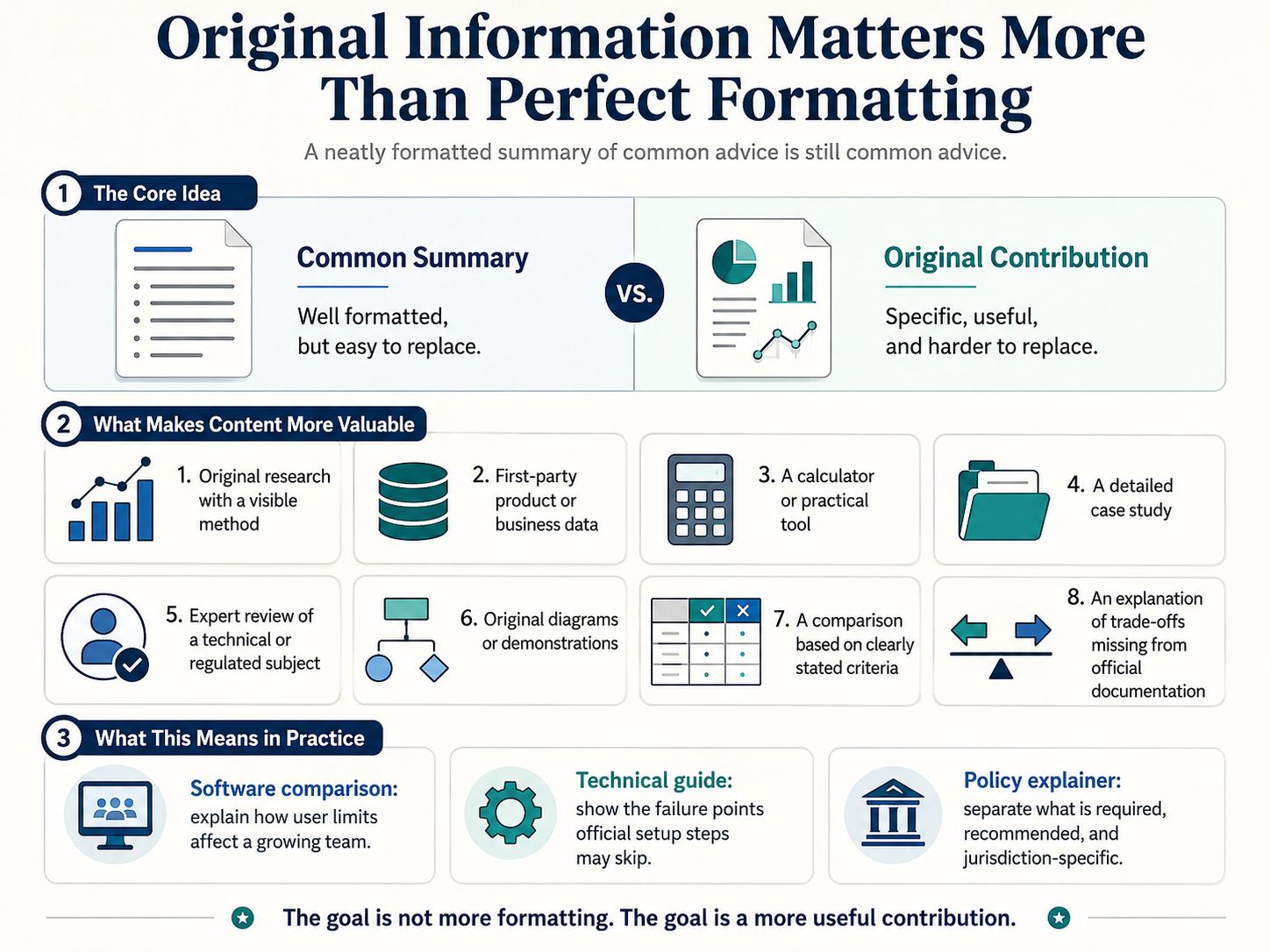
A neatly formatted summary of common advice is still common advice.
Content becomes harder to replace when it includes something specific:
- Original research with a visible method
- First-party product or business data
- A calculator or practical tool
- A detailed case study
- Expert review of a technical or regulated subject
- Original diagrams or demonstrations
- A comparison based on clearly stated criteria
- An explanation of trade-offs missing from official documentation
This does not mean every article needs a survey or an interactive tool. It means the page should contribute more than a rearranged version of information already available elsewhere.
For a software comparison, that contribution might be a clear explanation of how user limits affect a growing team. For a technical guide, it might be the failure points that official setup instructions skip. For a policy explainer, it might be a distinction between what is required, what is recommended, and what varies by jurisdiction.
Strong AEO content is not merely concise. It is useful enough to be worth citing.
Structured Data Has a Supporting Role
Structured data can help search systems understand what a page describes. Appropriate markup may include Article, Organization, LocalBusiness, Product, or another supported type.
It should reflect information visible on the page. It should not contain hidden claims, fabricated ratings, or details that contradict the article.
Structured data may make a page eligible for certain rich-result formats, but it does not guarantee that those results will appear. Nor is there a special schema type that secures inclusion in AI-generated answers.
The sensible approach is to use structured data where it accurately describes the page and supports an established search feature. Teams should not delay more important work—such as correcting outdated facts, fixing crawling problems, or improving weak answers—to add markup that does not fit the content.
The same priority applies to llms.txt. Some website owners maintain the file for systems that may choose to use it, but it should not be treated as a substitute for technical SEO or better content. For Google Search, it is currently a low-priority task compared with indexing, internal links, metadata, and reliable page copy.
A Practical AEO Workflow
Most websites do not need a sitewide AEO project. A smaller, more selective approach is usually more productive.
Start With Pages That Already Matter
Choose pages that receive search impressions, answer frequent customer questions, support revenue, or influence an important decision.
A pricing explainer, product comparison, service page, troubleshooting guide, or policy page is often a better starting point than a low-traffic glossary entry.
Inspect the First Useful Answer
Read the page as someone looking for a decision, not as the person who wrote it.
How far must the reader scroll before receiving a usable answer? Does the opening clarify the issue, or merely repeat the title? Can the central paragraph be understood without the rest of the article?
Move the answer closer to the question, but do not strip away necessary nuance.
Check the Next Question
A page about cancelling a software subscription may also need to explain:
- When access ends
- Whether stored data remains available
- What happens to other team members
- Whether billing stops immediately
- Whether the account can be restored
These details are often more useful than another paragraph defining cancellation.
Verify the Claims That Can Expire
Review:
- Prices and billing periods
- Subscription tiers
- Product features
- Platform policies
- Technical requirements
- Dates and statistics
- Regulatory information
- Availability by country or device
Do not change the update date unless the page has been meaningfully reviewed. Refreshing the timestamp while leaving old screenshots, discontinued features, or expired prices in place damages trust.
Check Technical Eligibility
For priority pages, confirm that:
- The URL returns a successful status
- The page is not unintentionally marked
noindex - Relevant crawlers are not blocked
- The canonical URL is appropriate
- Internal links point to the page
- Important information appears as readable text
- Snippet restrictions are intentional
- Structured data matches the visible content
A sitemap can support discovery, particularly on large or frequently updated websites, but submitting one does not guarantee crawling, indexing, or citation.
Measuring AEO Without Misreading the Numbers
AEO reporting is still fragmented. Different platforms expose different information, and none provides a complete view of how a brand appears across every AI-generated answer.
Google’s Search Console reporting can help teams examine visibility connected with its search experiences. Bing Webmaster Tools has added AI-performance reporting for supported Microsoft experiences, including citation activity and cited URLs. ChatGPT Search referrals can sometimes be identified through referral data in analytics.
These signals are useful, but citation totals should not become the headline metric.
A page may receive many citations for a broad definition and produce little commercial value. Another may appear less frequently but send a small number of highly qualified visitors who request a quote, begin a trial, or buy a product.
A practical AEO scorecard should include:
- AI-search visibility or citation activity
- Pages receiving that visibility
- Identifiable referral visits
- Engagement from those visitors
- Leads, subscriptions, sales, or assisted conversions
- Branded-search growth
- Crawl and indexing problems
- The number of priority pages reviewed for factual accuracy
Treat citation data as evidence of discovery, not proof of success.
AEO Mistakes That Waste Time
Several tactics create visible activity without improving the source:
- Publishing hundreds of near-identical question pages
- Breaking coherent articles into disconnected answer fragments
- Adding statistics without checking their date or method
- Treating schema markup as an AI-ranking shortcut
- Paying for artificial mentions or citations
- Prioritizing
llms.txtwhile important pages remain unindexed - Blocking search crawlers without reviewing the effect
- Leaving discontinued features and expired prices on evergreen pages
- Reporting citation counts without measuring qualified outcomes
Generative tools may assist with research, outlining, or drafting, but they do not remove the need for editorial review. The risk is not simply that a sentence may sound mechanical. The larger risk is that an unsupported claim, outdated feature, or invented source becomes part of a page that readers are expected to trust.
Final Thoughts
The useful answer to what is AEO is less dramatic than much of the surrounding marketing.
Answer engine optimization makes a page easier to discover, understand, verify, and use in a direct answer. It starts with established SEO work and demands stronger editorial discipline: clearer answers, better evidence, visible context, and timely updates.
Most teams should not rebuild their content strategy around every possible AI query. Start with a small number of pages that already matter. Check whether search systems can access them, place the main answer where readers can find it, remove weak claims, and add the detail needed to make a decision.
Then measure more than citations. The useful result is not simply appearing inside an answer. It is being selected as a credible source and helping the right reader take the next step.