Most people notice language technology when it gets something wrong.
A search tool misses the document sitting in plain sight. A support request reaches the wrong department. A transcript turns a product name into nonsense. A chatbot answers a different question from the one the customer asked.
These are all language-processing problems.
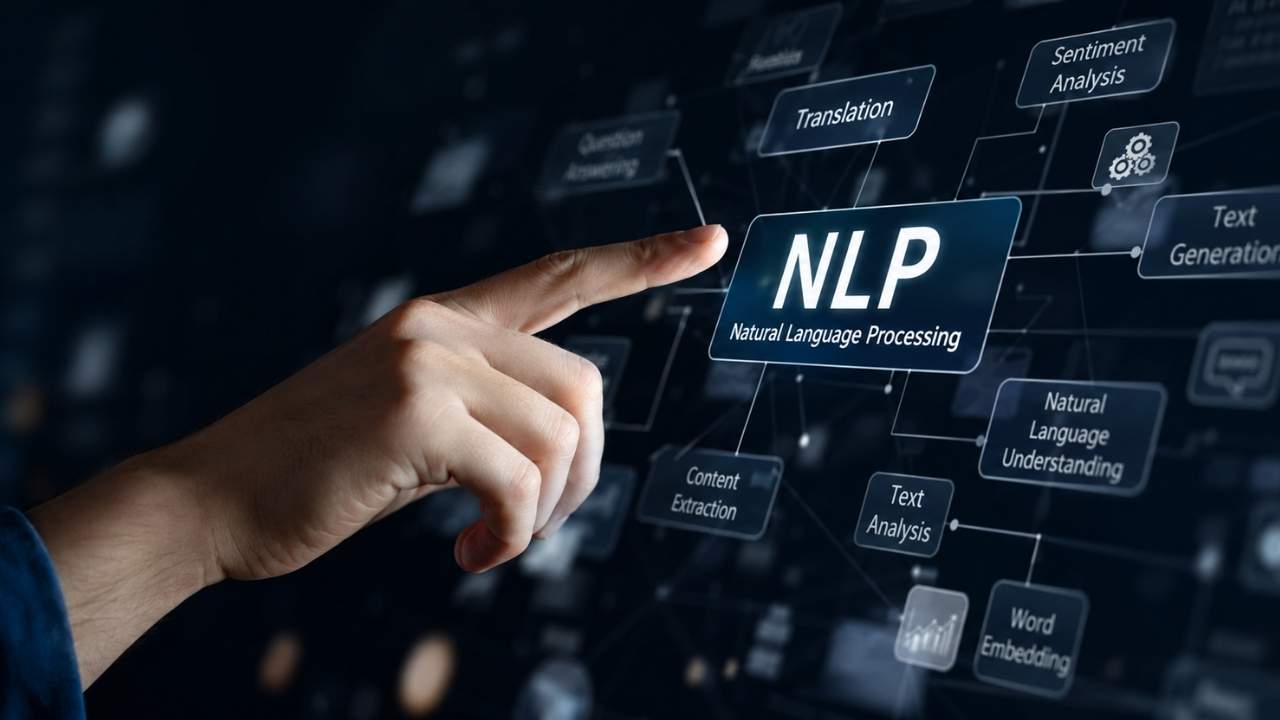
So, what is natural language processing? Natural language processing, usually shortened to NLP, is the field concerned with helping computers process, analyze, retrieve, and generate human language. It covers tasks such as text classification, search, translation, speech recognition, information extraction, summarization, and question answering. It draws from artificial intelligence, machine learning, linguistics, and software engineering.
Chatbots are one part of NLP, not the whole field. Many useful systems never generate a sentence. They return a category, extracted name, search ranking, sentiment label, transcript, or warning that a document may contain sensitive information.
What NLP Is Trying to Solve
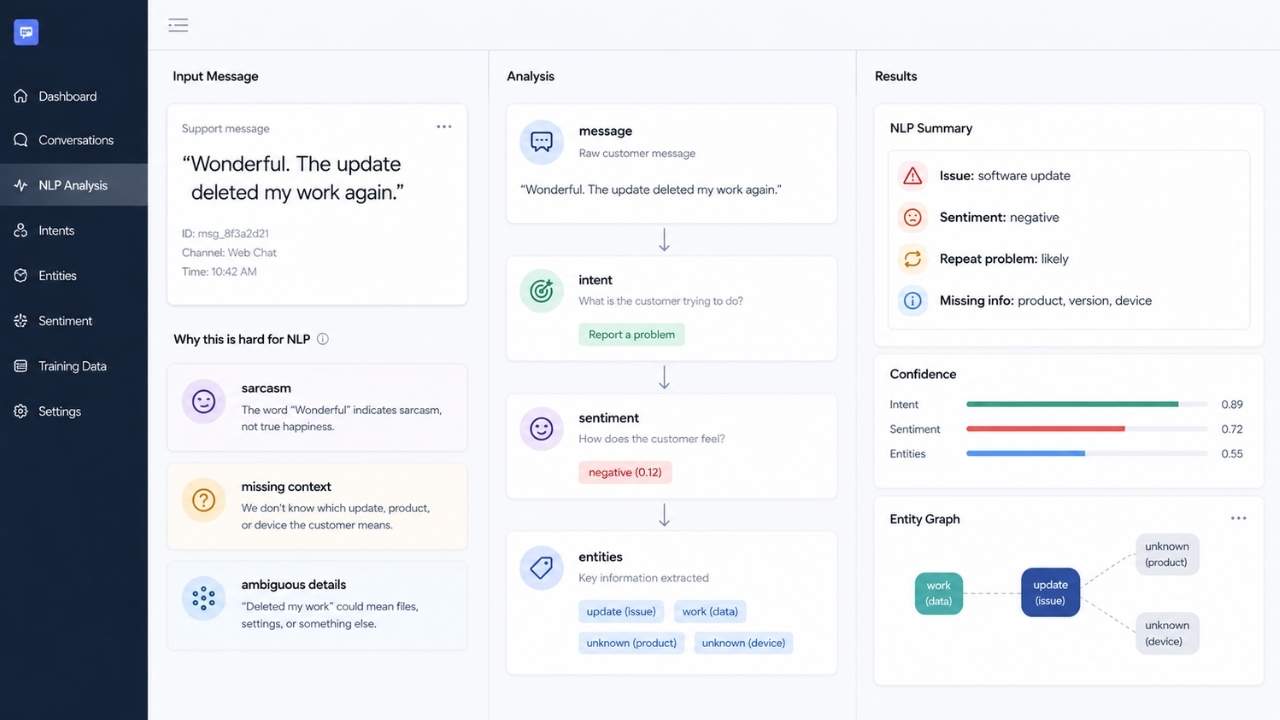
Human language was created for people, not databases.
We leave out context, misspell names, use several meanings for the same word, switch languages midway through a sentence, and refer to things mentioned much earlier. Tone can reverse the apparent meaning of the words.
Consider this support message:
“Wonderful. The update deleted my work again.”
A simple keyword system may notice the positive word “wonderful.” A more capable system should recognize the likely sarcasm, identify a software-update problem, and perhaps detect that it has happened before.
Even that interpretation is incomplete. The message does not name the product, version, device, or affected file. No model can reliably extract information that the customer never supplied.
NLP turns this flexible, incomplete language into an output that software can use. That output might be a support category, a detected account number, a translated sentence, a list of relevant documents, or a draft response.
How Natural Language Processing Works
There is no single method behind every NLP product. A five-category email router is much simpler than a large conversational assistant.
Most systems, however, have to solve a similar series of problems.
First, the System Needs Usable Language
The input may come from an email, search box, PDF, review, medical note, support chat, call recording, or voice command.
Typed text is not always clean. Scanned documents can contain optical character recognition errors. Speech systems may mishear names, acronyms, or speakers talking over one another. Those mistakes pass into every later stage.
Speech recognition and NLP are related but distinct. Speech recognition converts audio into words or another language representation. NLP then works with those words to identify meaning, intent, topics, or entities.
This distinction matters in practice. A complaint-classification model may be working correctly while receiving a bad transcript. Replacing the classifier will not repair an error introduced by the microphone or speech-recognition system.
Text Is Split Into Tokens
Language models do not usually process a paragraph as one undivided block. They split it into units called tokens.
A token may be a complete word, part of a word, punctuation, or another symbol. Many modern systems use subword tokenization, which allows them to represent uncommon names and new terms without storing every possible word in a fixed vocabulary.
One written word does not always equal one token. The result varies by tokenizer, spelling, language, and writing system. Space-based splitting is especially unreliable across languages because not every writing system marks word boundaries in the same way.
This is more than a technical detail. Services often limit input by tokens rather than words. A document that appears short to a reader may consume more of a model’s input capacity in one language than in another.
Tokens Become Numerical Representations
Machine-learning models work with numbers rather than dictionary entries.
Earlier NLP systems relied heavily on word counts, dictionaries, grammar rules, statistical probabilities, and features selected by developers. A spam filter might learn that particular terms appear frequently in unwanted messages. A document parser could use a regular expression to find an account number with a fixed format.
Modern neural systems commonly use embeddings, which represent tokens or larger passages as numerical vectors. These representations capture patterns from the contexts in which language appears. They are useful for classification, clustering, semantic search, and retrieval.
An embedding is not a human definition stored inside the model. It is a learned mathematical representation. That difference helps explain why a system can connect related phrases while still misunderstanding an unusual or highly contextual sentence.
Context Changes the Meaning
The word bank means one thing in “call the bank” and another in “walk along the bank.” The surrounding language provides the evidence.
Older neural systems often processed text sequentially with recurrent architectures. The Transformer, introduced in the 2017 paper Attention Is All You Need, used attention to model relationships among positions in a sequence without relying on recurrence or convolution in the same way. Its design also allowed more parallelized training.
BERT, published at NAACL in 2019, showed how a Transformer-based model could learn bidirectional contextual representations from unlabeled text and then be adapted to tasks such as question answering and language inference.
These developments made flexible language systems much more practical. They did not make older methods useless. A carefully written rule remains a sensible option when the pattern is stable, the consequence of an error is clear, and the output must be easy to audit.
The Output Becomes Part of a Workflow
An NLP result usually feeds another system.
A detected category routes a support ticket. An extracted invoice number populates accounting software. A search ranking determines which documents an employee sees. A generated summary may appear inside a meeting or reporting tool.
This final step is often where a technically impressive project loses its value.
Labeling a message as “negative” may be interesting, but it does not resolve the complaint. Identifying it as a duplicate-payment issue, extracting the order number, and sending it to the payments team creates a useful workflow.
Common NLP Tasks Without the Technical Fog
Most natural language processing systems don’t perform generic “understanding”—they solve specific, repeatable tasks. Strip away the industry jargon, and almost every commercial NLP tool falls into one of four fundamental jobs: organizing text, pulling out facts, gauging opinions, or working across languages.
Text Classification
Classification assigns text to one or more categories.
Companies use it to filter spam, organize documents, moderate comments, and route customer messages. The difficult part is often defining the categories rather than training the model.
Suppose a support team uses “account issue,” “login issue,” and “security issue.” A locked account could fit all three. If employees cannot label those messages consistently, the model will inherit that confusion.
A good category should lead to a meaningful action. Categories created only because they sound tidy tend to produce messy data.
Entity Recognition and Information Extraction
Named entity recognition finds specific pieces of information in text, such as people, organizations, locations, or dates. Specialist systems may look for claim numbers, medications, equipment codes, legal parties, or product models.
Information extraction goes further by placing selected details into structured fields.
An invoice workflow might extract:
- Supplier name
- Invoice number
- Date
- Currency
- Tax
- Total amount
A generic model may recognize London as a location while failing to recognize an internal product name or component code. Domain-specific extraction often needs labeled examples, custom rules, or both.
Commercial services currently provide prebuilt and customizable tools for entities, classification, sentiment, key phrases, personally identifiable information, and related tasks. The exact capabilities and supported languages differ by provider and feature.
Sentiment and Opinion Analysis
Sentiment analysis estimates whether language is positive, negative, neutral, or mixed. Opinion-mining systems may connect the sentiment to a particular feature or entity.
Consider this review:
“The screen is excellent, but the battery barely lasts until lunch.”
A single negative or positive label throws away useful information. A product team needs to know that the display received praise and the battery received criticism.
Amazon Comprehend, for example, distinguishes document-level sentiment from targeted sentiment tied to particular entities. Its current documentation also shows that language availability differs between features; targeted sentiment is more limited than general sentiment analysis.
Sentiment analysis is most useful for finding broad patterns across many reviews or conversations. It is a weak basis for making a consequential decision about one person, especially when the text includes sarcasm, indirect criticism, or mixed opinions.
Search, Translation, Summarization, and Generation
Semantic search tries to retrieve relevant material even when the search query and document use different wording. Translation converts meaning between languages. Summarization condenses longer material, while question-answering and generative systems produce responses based on a request and available context.
These tasks can produce fluent output that looks more reliable than it is.
A summary may omit a legal qualification. A translation may mishandle a clinical term. A generated answer may invent a policy or cite a document that does not support its claim.
Fluency should be evaluated separately from factual accuracy.
NLP Examples in Real Life
Many NLP examples in real life are hidden inside ordinary workplace software.
A customer sends:
“I was charged twice for order 4821.”
A practical system could classify it as a billing issue, extract the order number, detect dissatisfaction, and route it to the payments team. A separate response tool might retrieve the correct refund procedure for an employee to review.
Other common natural language processing applications include:
- Spam and abuse filtering
- Email and document search
- Call and meeting transcription
- Review and survey analysis
- Translation and captioning
- Sensitive-data detection
- Autocomplete and writing suggestions
- Contract and invoice extraction
- Document summarization
- Voice-controlled interfaces
The strongest projects usually involve a large amount of repetitive language and a clear next action.
“Understand every customer conversation” is not a workable requirement. “Identify cancellation requests, extract account numbers, and flag urgent cases” can be tested.
NLP vs LLM: The Difference Matters
The NLP vs LLM distinction has become blurred because many newer language products are marketed around large language models.
NLP is the broader field. It includes rules, tokenization, search, classification, entity recognition, sentiment analysis, translation, speech-related processing, and language generation.
A large language model is one type of model used within that field.
Not every NLP task needs an LLM. A regular expression may be sufficient for finding a consistently formatted customer ID. A small classifier can be a better choice for routing a handful of stable ticket categories. A dedicated entity model may extract names and dates without generating unwanted prose.
LLMs make more sense when the language varies widely, people ask open-ended questions, or the product needs to produce flexible responses. They can also bring higher computing costs, variable output, prompt sensitivity, privacy concerns, and plausible statements that are not supported by evidence.
NIST refers to confidently presented false or erroneous generative output as confabulation and recommends evaluating such systems in the context where they will actually be used.
Using the largest available model for a narrow classification job is usually unnecessary. Model choice should follow the task, risk, response time, volume, and review process.
Where NLP Still Goes Wrong
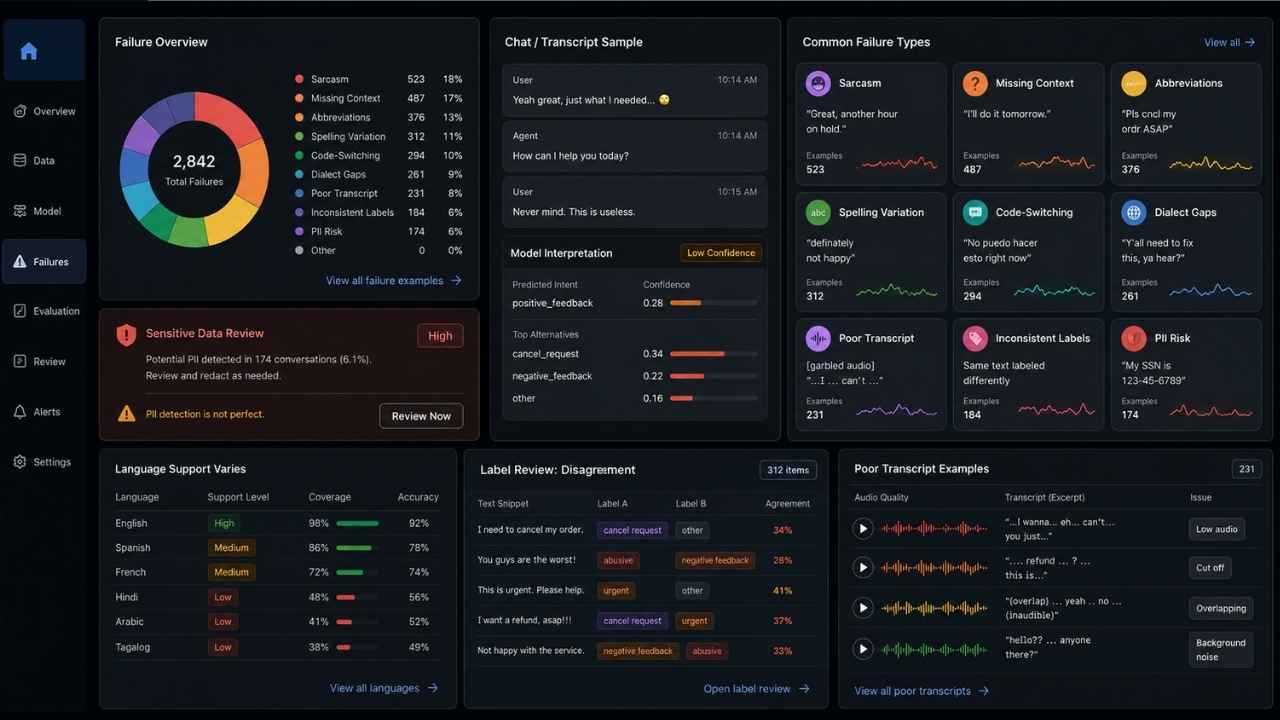
Language meaning is rarely contained in the words alone.
A system may struggle with sarcasm, missing conversational history, specialist abbreviations, spelling variation, code-switching, new company names, regional dialects, or poor speech transcripts.
Labels can be another weak point. Two employees may interpret “urgent,” “abusive,” or “cancellation request” differently. A sophisticated model trained on inconsistent decisions will reproduce them more efficiently, not correct them.
Multilingual support also needs scrutiny. A provider may list a language as supported without offering the same features or quality across every task, dialect, and script. A 2025 EMNLP study found links between tokenization and representation differences and performance gaps on dialectal NLP tasks.
Privacy creates a separate problem. Support chats, medical notes, contracts, and transcripts can contain personal or commercially sensitive details. Before sending that material to an external service, an organization needs to examine access, retention, security, data location, and contractual terms.
PII detection can reduce exposure, but it should be treated as a screening control rather than proof that every sensitive detail has been removed.
What to Decide Before Choosing an NLP Tool
The most useful first step is not comparing model sizes. It is writing down the decision the system must support.
A team should be able to answer:
- What exact output is required?
- What happens after that output is produced?
- Which languages, dialects, and document types will appear?
- Which mistake causes more harm?
- Can the data be sent to an outside provider?
- Which cases need human review?
- How will declining performance be detected?
Testing should use realistic material, including typos, short messages, unusual terminology, long documents, mixed topics, and ambiguous requests.
Overall accuracy can hide the failure that matters. A support classifier may route most messages correctly while repeatedly missing fraud reports or misclassifying requests written in one language.
Monitoring must continue after launch. Policies change. Products gain new names. Customers adopt new phrasing. A model can keep returning technically valid results while becoming steadily less useful.
Final Thoughts
Understanding what is natural language processing means looking beyond chatbots and generated paragraphs.
NLP includes the tools used to classify, search, extract, translate, summarize, and generate human language. LLMs have widened those possibilities, but they have not replaced smaller models, retrieval systems, or straightforward rules.
For most organizations, the better starting point is a narrow language problem with a measurable outcome. Define the output, test the difficult examples, examine the costly mistakes, and preserve a route for human review. A modest system attached to a clear workflow will usually create more value than an impressive language model attached to a vague ambition.