Trying to sort through Free open-source LLMs in 2026 without wasting days on hype, broken demos, and half-explained benchmarks?
I know the feeling. You want strong reasoning, low inference cost, and real control, but plenty of AI models still arrive with API limits, fuzzy licensing, or deployment rules that only show up after you start building.
I reviewed the latest model cards, local runtimes, and release notes through July 2026, then boiled it down to what matters for AI developers: model quality, local fit, tool use, licensing, and the friction of getting from test prompt to production workflow.
Read on for a curated breakdown of the top free open-source LLMs, their best use cases, and a clear guide on when to deploy locally, spin up a private server, or rely on a cloud API.
What Are Open-Source LLMs in 2026?
In 2026, the phrase open-source llm usually mixes together two different ideas. The strict version means the system is open enough to study, modify, and reproduce in a meaningful way. The looser version, which most developers use in conversation, is open-weight: you can download the weights, run the model yourself, and tune it for your own use case.
I still use the phrase because that is what most teams search for, but I do not treat every “open” release as equal. Some models give you broad rights under Apache 2.0 or MIT. Others ship with community terms, separate weight terms, or extra commercial conditions.
For AI developers, a useful open model usually gives you these practical building blocks:
- Weights you can run yourself, on a laptop, workstation, private cloud, or hybrid stack.
- Clear inference support, through tools like Ollama, llama.cpp, Transformers, or vLLM.
- Fine-tuning paths, so you can adapt the language model for coding tasks, internal data, or domain workflows.
- Inspectability, which makes debugging, evaluation, and governance much easier than a pure black-box API.
That freedom is why these models now power agentic workflows, internal copilots, and custom AI agents. I can switch inference engines, benchmark different prompts, and keep sensitive code or documents inside my own environment instead of shipping everything to a vendor.
Why Open-Source LLMs Dominate in 2026
The big shift is simple: open models are no longer side projects for researchers. As of July 2026, the best open-weight releases from DeepSeek, Meta, Google, Qwen, Moonshot, MiniMax, and Z.ai cover serious coding, multimodal, and long-context work.
That changes the buying decision. Instead of asking, “Can open source compete?” most teams now ask, “Which model is good enough for this job, and where should I run it?”
- Costs are easier to predict. You stop tying every feature to per-token or per-seat billing, which matters fast once your app has steady traffic.
- Privacy is easier to control. Self-hosting lets you keep source code, logs, tickets, and internal docs in-house.
- Deployment is flexible. The same model family can often run in Ollama for local tests, in vLLM for team serving, and in a private cluster for production inference.
- Customization is real. You can tune prompts, system behavior, adapters, tool schemas, and eval suites without waiting on a provider roadmap.
- The ecosystem moves fast. Open repos, model ports, quantized builds, and coding-agent integrations often show up within days of a release.
I also like that open models now plug into familiar developer tooling. Ollama, for example, can connect open models to agent-style apps such as Claude Code, OpenCode, Codex, and similar local workflows, which makes testing much faster than it used to be.
The tradeoff is that you now own more of the stack. That is a fair deal for most engineering teams, but it still means you need to think about hardware, evals, and licensing before you commit.
Top 7 Open-Source LLMs for 2026
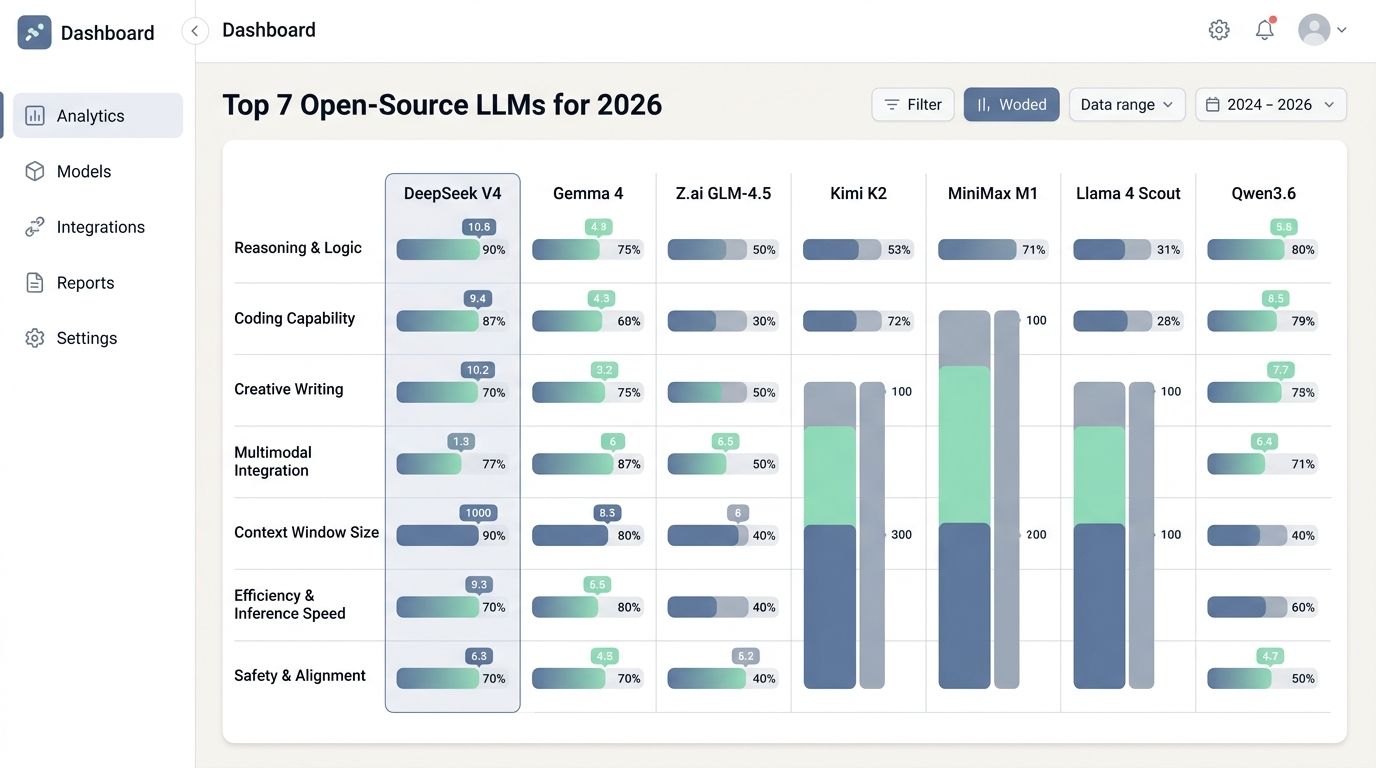
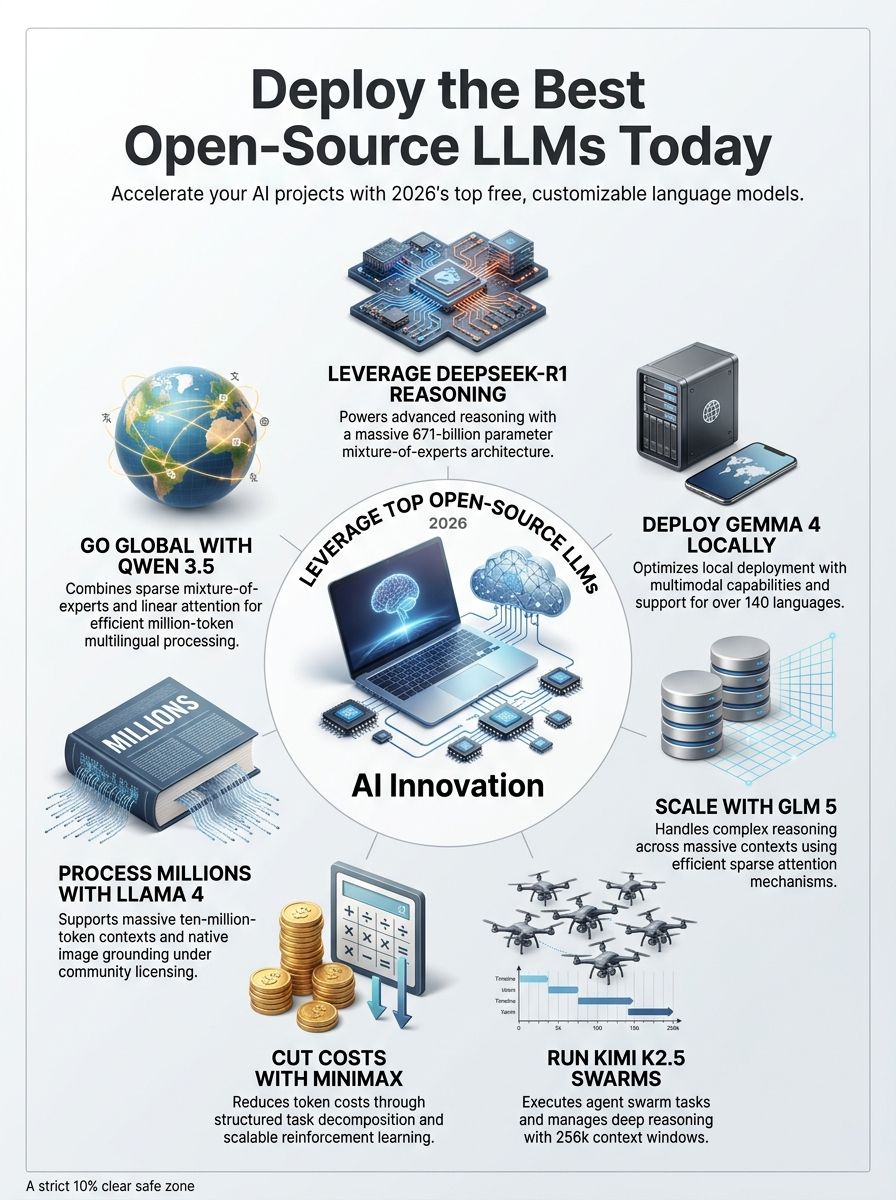
If you want the short answer, these are the seven model families I would test first in 2026. I’m using “open-source” in the market sense here, but I still separate truly open-source systems from open-weight releases before production rollout. I will also keep the model picks grounded in coding, deployment reality, and the kind of prompt engineering tradeoffs AI developers actually face.
| Model | Best For | What Stands Out | Local Reality |
|---|---|---|---|
| DeepSeek V4 / V4-Flash | Frontier reasoning, coding agents, long-context analysis | 1M context, tool calls, MIT licensing, very strong coding benchmarks | Best on server GPUs or through a managed endpoint, not a casual laptop model |
| Gemma 4 | Efficient local multimodal work | Apache 2.0, strong size-to-quality ratio, 128K to 256K context | One of the easiest serious families to run locally |
| Z.ai GLM-4.5 family | Agentic coding and hybrid reasoning | Thinking and non-thinking modes, strong tool use, commercially usable releases | More at home on multi-GPU infrastructure than on a solo machine |
| Kimi K2 | Agent workflows and coding assistance | 1T total parameters, 32B active, strong native tool calling | Best for teams already building agent loops, not for tiny hardware |
| MiniMax M1 | Long-horizon reasoning and long context | 1M context, hybrid attention, reinforcement-learning-heavy training | Great for deep tasks, less appealing if you only need snappy short chat |
| Llama 4 Scout / Maverick | Multimodal work and huge context windows | Scout reaches 10M context, Maverick pushes higher capability | Scout is already a workstation-class model, Maverick is heavier still |
| Qwen3.6 | All-around coding, tool use, and practical deployment | Apache 2.0, 27B and 35B open-weight builds, strong agentic coding focus | One of the most realistic top-tier families for local and team use |
DeepSeek V4 / V4-Flash
DeepSeek is still one of the first names I check when I need raw capability. The current V4 line pushes a 1 million-token context window, supports tool calls, and ships under MIT, which is about as friendly as it gets for teams that want to run, modify, and deploy their own stack.
The catch is scale. DeepSeek V4 is fantastic for repo-level coding agents, multi-document analysis, and heavy reasoning, but it is not the model I hand to someone with a consumer laptop and a weekend. If your team wants frontier behavior without proprietary lock-in, this is one of the strongest places to start.
DeepSeek’s earlier reasoning work also helped normalize deliberate, multi-step chain-of-thought-style behavior in open models, which is why the family remains so relevant for coding agents and verification-heavy workflows.
Gemma 4
Gemma 4 is the family I recommend when a team wants something powerful but still realistic to run. Google’s current lineup includes edge-oriented E2B and E4B models, plus workstation-class 12B, 26B, and 31B variants, with context windows topping out at 256K on the medium models.
The 26B MoE variant is especially interesting because it uses about 3.8B active parameters, which gives you a very nice balance between quality and serving cost. For local multimodal development, short agent loops, and tighter hardware budgets, Gemma 4 is one of the best open-source llms in 2026 to test first.
Z.ai GLM-4.5 Family
GLM is worth your attention if your work centers on agents, code, and structured tool use. The GLM-4.5 line combines reasoning and action in the same family, which makes it a natural fit for task chains where the model needs to think, call tools, then continue.
I would not pitch GLM-4.5 as a lightweight local model. Z.ai’s own guidance makes it clear that the full model is aimed at serious infrastructure. That matters because a lot of roundup articles list GLM beside smaller local models as if they belong in the same hardware class. They do not.
Kimi K2
Kimi K2 is one of the most interesting agentic releases in the open-weight space. The official repo describes it as a 1 trillion-parameter MoE model with 32 billion activated parameters, a 128K context length, and strong tool-calling support.
I like Kimi K2 most for coding agents that need to plan, call functions, and keep moving through multi-step work. If your workflow is closer to “take this issue, inspect the repo, run a tool, then patch the code” than plain chat, Kimi deserves a spot in your eval set.
MiniMax M1
MiniMax M1 is built for long thinking, long context, and long jobs. The official release describes a 1M-token context window and a hybrid attention design meant to keep long-horizon reasoning more efficient than older brute-force approaches.
This is the kind of model I would test for large codebase review, multi-file refactors, or deep research pipelines where the model has to stay coherent for a while. If your app mostly answers short user prompts, M1 is probably more model than you need. If your workflow is long and messy, it gets much more attractive.
Llama 4 Scout / Maverick
Llama 4 still matters because Meta pushed context length into a very different category. Scout advertises a 10 million-token context window, while Maverick targets higher capability with a 1 million-token window and a heavier profile.
The practical issue is hardware. Meta’s own tools note that full-precision Llama 4 inference needs at least four GPUs, and even the common Ollama Scout build is about 67GB. So yes, it is a serious open-weight option, but no, it is not a casual local install for most developers.
Qwen3.6
Qwen3.6 may be the most practical “start here” family for many AI developers. The current open-weight release focuses on stability, coding, and thinking preservation, and the local builds are much less intimidating than the giant frontier MoE models.
In Ollama, the 27B build sits around 17GB and the 35B build around 24GB, both with 256K context. That makes Qwen3.6 one of the clearest examples of a model that feels high-end without demanding cluster-scale hardware. If I had to recommend one family for fast prototyping, private coding help, and flexible deployment, Qwen would be near the top.
Key Features of Leading Open-Source LLMs
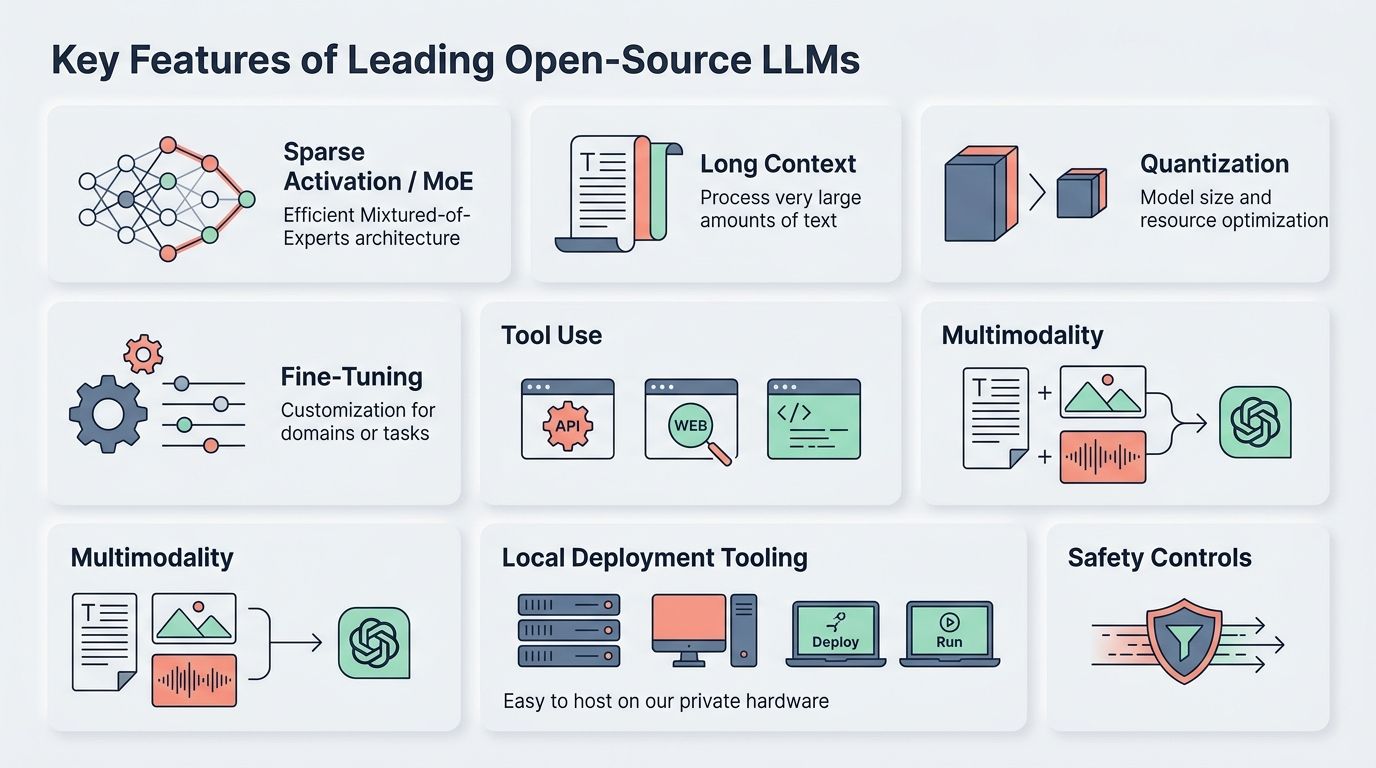
These are the features I care about most when I compare llm models for production work. A good benchmark score is nice. A model that fits your hardware, respects your privacy boundary, and survives real tool use is better.
| Feature | What it Does | Example Tools / Models | Why I Care |
|---|---|---|---|
| Sparse Activation / MoE | Activates only part of the model per token, which cuts serving cost compared with a dense model of similar total size. | DeepSeek V4, Gemma 4 26B A4B, Kimi K2, MiniMax M1 | This is how bigger open models stay usable without acting like full dense giants every time you send a prompt. |
| Long Context | Keeps larger codebases, logs, and document sets in one pass. | Llama 4 Scout, MiniMax M1, DeepSeek V4, Gemma 4, Qwen3.6 | Huge context is great for repo analysis, but I only pay for it when the task actually needs it. |
| Quantization | Reduces memory use so models fit on smaller hardware. | llama.cpp GGUF builds, Ollama, vLLM FP8 and INT4 paths | Quantization is usually the first lever I pull before I buy more GPUs. |
| Fine-Tuning | Adapts the base model to your domain, style, or task. | LoRA adapters, PEFT, Qwen fine-tuning stacks, DeepSeek recipes | For most teams, a targeted adapter beats retraining a giant model from scratch. |
| Tool Use | Lets the model call functions, query search, execute code, or operate agent steps. | Qwen3.6, Kimi K2, DeepSeek V4, GLM family | This is the difference between a chatbot and a useful coding agent. |
| Multimodality | Handles text plus images, and in some families audio as well. | Gemma 4, Llama 4, Qwen3.6 | Very helpful for OCR, UI debugging, document parsing, and screenshot-driven workflows. |
| Local Deployment Tooling | Makes it easier to run the same model family on laptops, workstations, or servers. | Ollama, llama.cpp, vLLM, ONNX Runtime | Good tooling shortens the gap between “interesting model” and “useful product.” |
| Safety Controls | Adds filters, policies, or usage constraints around risky outputs. | Llama policy stack, Gemma usage terms, runtime guardrails | I do not assume open means ungoverned, especially for enterprise or regulated work. |
If a 256K model feels forgetful after a few pages, check your runtime before blaming the weights. In Ollama, the default context is still 4,096 tokens unless you raise it.
Open-Source vs Proprietary LLMs: The Core Differences
I like compact comparisons, so here is the version I use with engineering teams. The short version is that proprietary models still win on convenience, but open source models win on control.
| Aspect | Open-Source / Open-Weight LLMs | Proprietary LLMs |
|---|---|---|
| Transparency | You can inspect weights, configs, prompts, and often the inference code. | You work through an API and infer behavior from outputs. |
| Customization | You can fine-tune, quantize, wrap tools, and change the serving stack. | You usually customize around the model, not inside it. |
| Cost Model | Higher setup cost, lower marginal cost once usage grows. | Fast to start, but recurring token spend can grow quickly. |
| Deployment | Local, private cloud, air-gapped, hybrid, or vendor-hosted. | Usually vendor-hosted, with fewer self-hosted options. |
| Privacy | Easier to keep source code, tickets, and logs inside your own boundary. | Depends on provider terms, retention policy, and data handling rules. |
| Performance | Now strong enough for many real apps, but hardware tuning matters. | Still often strongest out of the box, especially on managed stacks. |
| Support | Community help, GitHub issues, and optional paid vendors around the model. | Formal support, SLAs, and managed upgrades are more common. |
| Best Fit | Use when you need control, private inference, lower long-run cost, or deeper customization. | Use when you need speed to market and do not want to own the serving layer. |
Optimizing LLM Inference Performance

I optimize inference by matching the engine to the job instead of forcing one stack to do everything.
- Use vLLM for shared serving. It gives you continuous batching, chunked prefill, prefix caching, and broad quantization support. That is exactly what I want for a team endpoint or internal gateway.
- Use quantization before buying more hardware. vLLM supports formats like FP8, INT8, and INT4, while llama.cpp supports GGUF quantization from very low-bit builds up to 8-bit.
- Keep context honest. A 1M-context model is amazing for repo or document analysis, but the KV cache cost grows with the prompt. For short chat or small coding tasks, I trim context aggressively.
- Pick the right decoding setup. For structured workflows, constrained outputs, JSON modes, and function calling usually improve reliability more than just scaling to a larger model.
- Warm your models. Preloading a model and keeping it in memory cuts the painful first-request delay that makes local demos feel slower than they need to.
For domain work, I usually test retrieval and adapters before any heavy fine-tune plan. A focused adapter pass with LoRA, good evals, and a clean system prompt often beats a more expensive training project.
The cheapest latency win is often boring: reduce context, quantize the weights, and use a serving engine that batches well.
Running Open-Source LLMs Locally
Running open-source llms locally is much easier in 2026 than it was even a year ago, but hardware reality still matters. I do not judge a model by the marketing page. I judge it by whether I can load it, keep it stable, and get useful latency on the box I actually have.
Hardware Requirements
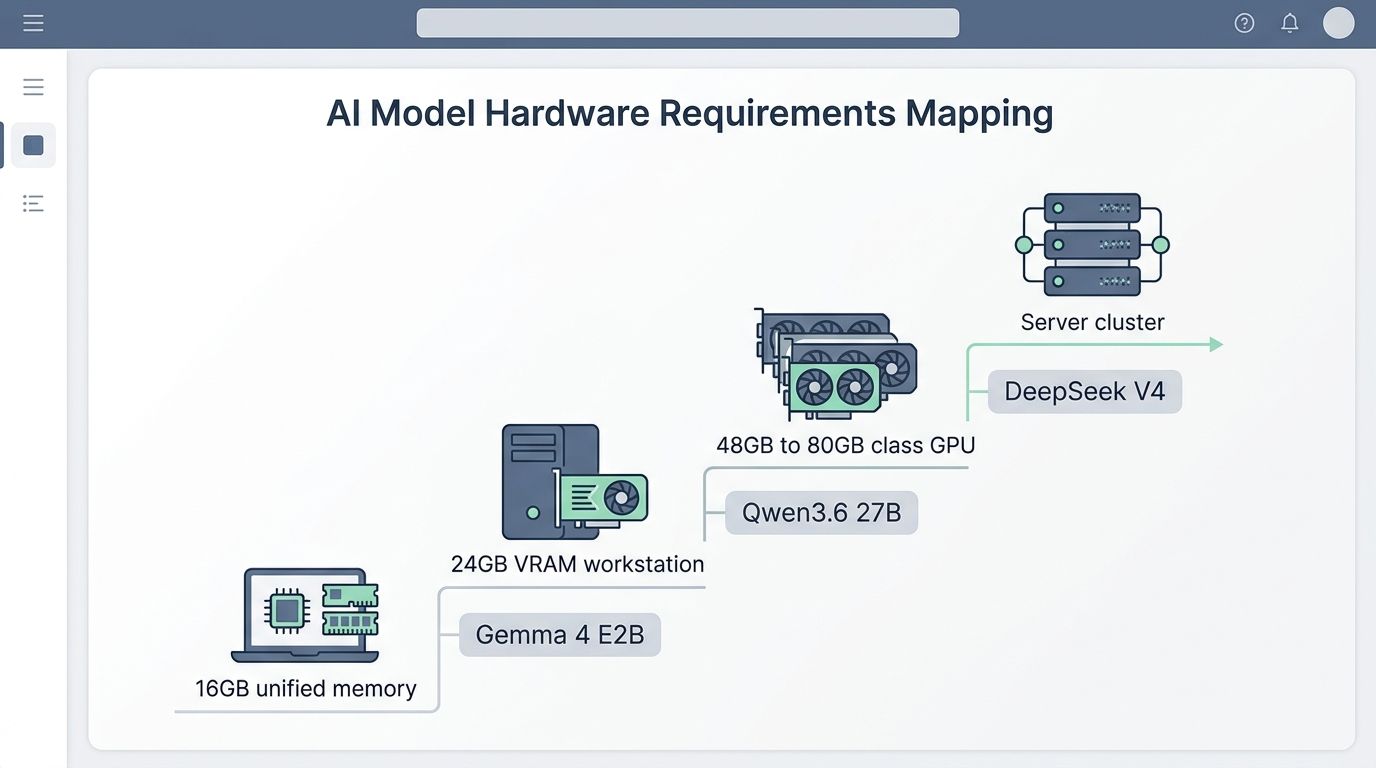
The fastest rule of thumb is to look at the package size of the local build you plan to run, not just the parameter count. A quantized Qwen3.6 27B build around 17GB is a real 24GB-card candidate. A Llama 4 Scout build around 67GB is not.
| Your Hardware | What I Would Run First | Why |
|---|---|---|
| 16GB unified memory or light GPU | Gemma 4 E2B or E4B, smaller Qwen variants | Fast experimentation, low friction, good enough for assistants and light coding help |
| 24GB VRAM workstation | Qwen3.6 27B, Gemma 4 26B quantized | This is where local work starts feeling serious instead of toy-sized |
| 48GB to 80GB class GPU or multi-GPU workstation | Gemma 4 31B, heavier Qwen builds, some Llama 4 experiments | Good for private coding assistants and richer multimodal work |
| Server cluster | DeepSeek V4, Kimi K2, MiniMax M1, GLM-4.5 full | These models shine when you can afford real serving infrastructure |
One practical detail I always check: Ollama’s hardware docs currently call for Nvidia GPUs with compute capability 5.0 or newer and driver version 531 or newer. That saves time when a box “should” work but does not.
Another easy miss is context configuration. A lot of developers load a long-context model, then unknowingly test it at 4K because they never changed the runtime setting.
Popular Tools for Local Deployment
- Ollama: My default for quick local testing, model switching, and simple team demos.
- llama.cpp: Best when I want tight control, low overhead, GGUF quantization, or CPU-friendly experiments.
- vLLM: Best for high-throughput serving once a model graduates from solo testing to shared use.
- Transformers: Good for direct research workflows, custom pipelines, and deeper debugging.
- ONNX Runtime: Useful when cross-platform inference or edge deployment matters more than raw frontier capability.
A small but useful pitfall from the docs: after Linux suspend and resume, Ollama can sometimes miss the Nvidia GPU and fall back to CPU. If your local speed suddenly collapses, check the processor status before assuming the model or quantization is bad.
Cloud-Based Access to Open-Source LLMs
Cloud access still makes sense, especially for larger models that are technically open but not realistically local. I use cloud deployment when I need burst capacity, big context windows, or a team endpoint that multiple developers can share without fighting over one workstation.
This is also where the “best open-source llm” question becomes more honest. A model may be open-weight and commercially usable, but if it wants a serious GPU cluster for comfortable inference, then cloud is the sane way to start.
- Use cloud first for DeepSeek V4, GLM full-size releases, Kimi K2, and other server-class models.
- Use local first for Gemma 4, Qwen3.6, or smaller distilled and quantized families.
- Use hybrid when you want private local prototyping and a bigger shared endpoint for the hardest requests.
I also like cloud for evaluation runs. It lets me compare models on the same benchmark set before I make a hardware decision, which is much cheaper than buying the wrong box and realizing later that the model does not fit.
Licensing and Commercial Use of Open-Source LLMs

This is the part too many articles rush past. “Open” is not a legal answer. Before I ship anything, I check the repo license, the weight license, and any model-specific commercial terms.
- Apache 2.0 is the easiest path for product teams. Gemma 4 and Qwen’s open-weight releases are attractive partly because of that.
- MIT is also very friendly. DeepSeek V4 is a strong example.
- Custom community licenses need extra care. Llama 4, for example, uses the Llama 4 Community License rather than Apache or MIT.
- Modified licenses need reading, not guessing. Kimi K2 uses a Modified MIT license, so I check the exact terms before rollout.
One concrete example: Meta’s Llama 4 terms add extra obligations around redistribution and require separate approval for products above 700 million monthly active users. That does not block most teams, but it is exactly the kind of detail procurement wants before you wire a model into a commercial product.
My licensing checklist is simple: what covers the code, what covers the weights, and what happens if I redistribute or host this model for customers?
Best Use Cases for Open-Source LLMs
I work with llms every day, and these are the use cases where open models usually give the best return.
- Private coding assistants: Great for code review, patch generation, test writing, and repo Q&A when source code cannot leave your environment.
- Internal knowledge agents: Strong fit for ticket search, docs chat, runbook lookup, and developer support bots tied to internal systems.
- Long-document summarization: Excellent for legal packets, incident reports, research bundles, and policy comparison when context length matters.
- Multimodal document parsing: Gemma 4, Llama 4, and Qwen3.6 are useful for screenshots, forms, OCR-heavy tasks, and UI debugging.
- Code-generation workflows: Open models now do real work in IDE helpers, pull request review, and agent pipelines for repetitive engineering tasks.
- Customer support with strict privacy rules: Self-hosted or private-cloud inference helps when data handling matters as much as model quality.
- Translation and multilingual products: Qwen families remain especially useful when you need wide language coverage and local control, including multilingual support.
- Custom AI agents: Open models are ideal when you want to control tool calling, retries, evals, and the surrounding workflow instead of accepting a fixed vendor pattern.
Challenges of Using Open-Source LLMs
Open models are powerful, but they are not magic. The biggest mistake I see is treating “free to download” as “free to operate.”
- Hardware still costs real money. A giant MoE model may be open, but that does not make it a laptop model.
- Serving is an engineering problem. Batching, queueing, model loading, GPU memory pressure, and monitoring still matter.
- Licensing is uneven. Some releases are clean and permissive, others need a careful legal read.
- Safety is now your job too. If you self-host, you own more of the guardrails, auditing, logging, and rollback plan.
- Model churn is fast. The open-source llm space changes month to month, so your benchmark set needs regular refreshes.
I also think teams underestimate evaluation work. A model that looks brilliant in a benchmark chart can still miss your exact workflow, fail on your code style, or produce bad tool calls at the worst moment.
The good news is that these are manageable problems. With a small eval suite, sane hardware targets, and honest licensing review, using open-source llms is far more practical now than it was even recently.
Final Thoughts
My take on open-source llms in 2026 is simple: most AI developers should test open models first, then pay for closed models only where the gap is proven.
If I were building today, I would start with Qwen3.6 for all-around development, Gemma 4 for efficient local work, DeepSeek V4 for frontier reasoning, and Llama 4 Scout for giant-context jobs.
Pick one model, run a real eval set, measure latency and cost, and ship the cheapest model that clears your quality bar. That is still the fastest way I know to turn open source ai into a working product.
FAQs About Free Open-source LLMs
1. What are open-source LLMs and why will they matter in 2026?
Open-source LLMs are foundation models, free to use by developers and teams, they run as open-source software in the open-source llm space. By 2026-01-01T00:00:00.000+00:00 the list of free llms available will grow, and the open-source community will drive powerful open-source llms for many projects.
2. How do they stack up against proprietary software like Claude (language model) or Gemini (language model)?
Open-source models can match or beat proprietary software on some tasks, but benchmarks, like Benchmark (computing), will show gaps in latency (engineering) and raw scale. You can switch between models, pick fine-tuned models, and trade off speed for cost.
3. Can I run these LLMs on my own computer hardware?
Yes, some family of models and smaller Llama (language model) variants run on modest computer hardware, with simple Computer programming work. For big models, you will need beefy GPUs, and attention (machine learning) patterns affect memory and speed.
4. Are they safe for private data and business use?
Open-source gives Transparency (behavior) and code access, that helps with Information privacy checks, but it is not a magic shield. Companies like Massachusetts Institute of Technology study risks, and teams must test models before they handle secrets.
5. What are common use cases for these ai models?
They power natural language chatbots like Kimi (chatbot), content tools, search, and custom agents, across different use cases. Developers use them to prototype, fine-tune models, and build product features fast.
6. How much do they cost and where do I find them?
Many are free to use or have limited free tiers, though larger options may cost to host or tune; check the current list of free llms available on github and vendor sites. Start small, switch between models as needed, and watch community pages for new open-source releases and mistral models.