

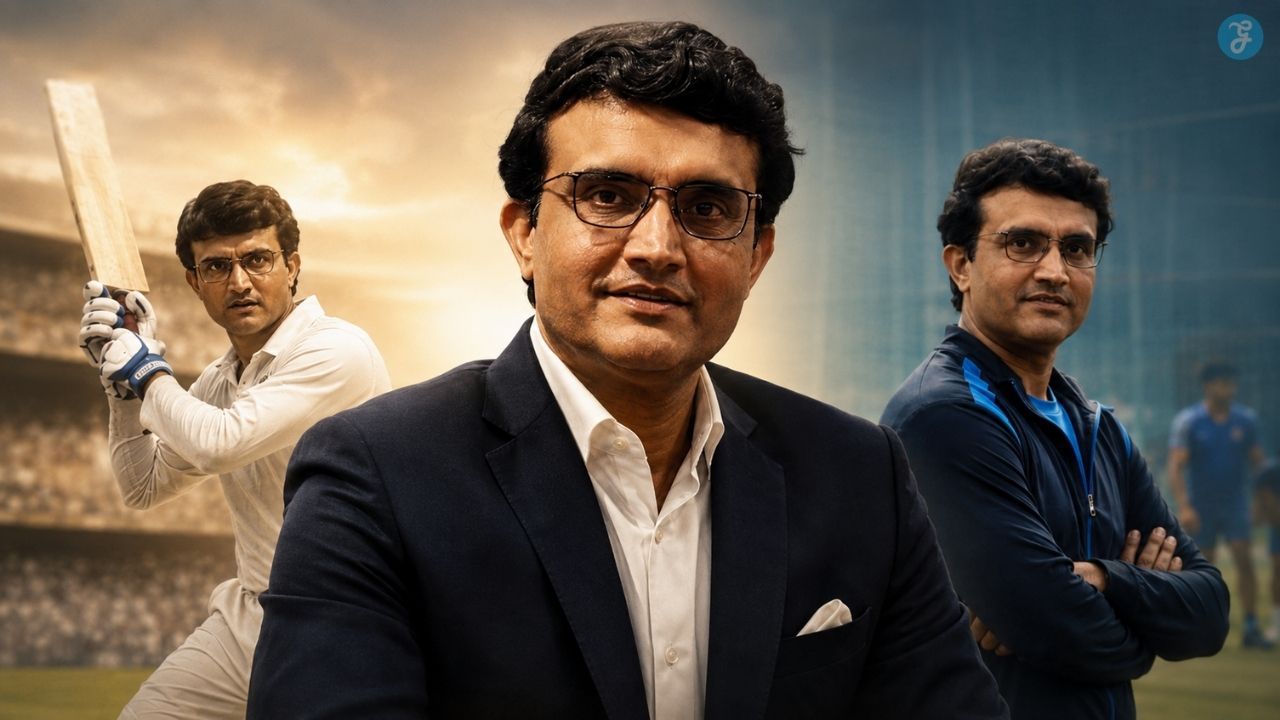
Indian cricket did not always look this fearless. There was a time when India had great batters, packed stadiums, emotional fans, and unforgettable individual performances, but the team often looked smaller overseas than its talent suggested. India could dominate at home, yet belief did not always travel well. Then Sourav Ganguly arrived as captain.
Not quietly. Not politely. Not with the body language of someone asking for approval. He walked in with that raised collar, sharp stare, and stubborn belief that Indian cricket did not need to behave like a grateful guest in someone else’s backyard. That is why any serious Sourav Ganguly biography has to go beyond his cover drives, ODI runs, captaincy numbers, and famous Lord’s balcony celebration.
Those things matter. But Ganguly’s bigger legacy is mental. He changed how Indian cricket carried itself. He backed young players. He made aggression acceptable. He helped India compete harder away from home. Most importantly, he gave a generation of Indian cricketers permission to stare back.
In 2026, Ganguly’s name returned to public conversation with the first-look poster of Dada: The Sourav Ganguly Story, starring Rajkummar Rao. The poster was unveiled on Ganguly’s 54th birthday and recreated his famous Lord’s balcony celebration, with the film scheduled for a May 14, 2027 theatrical release.
But before the biopic arrives, the real story is worth revisiting: how a gifted left-handed batter from Kolkata became one of Indian cricket’s great culture-shifters.
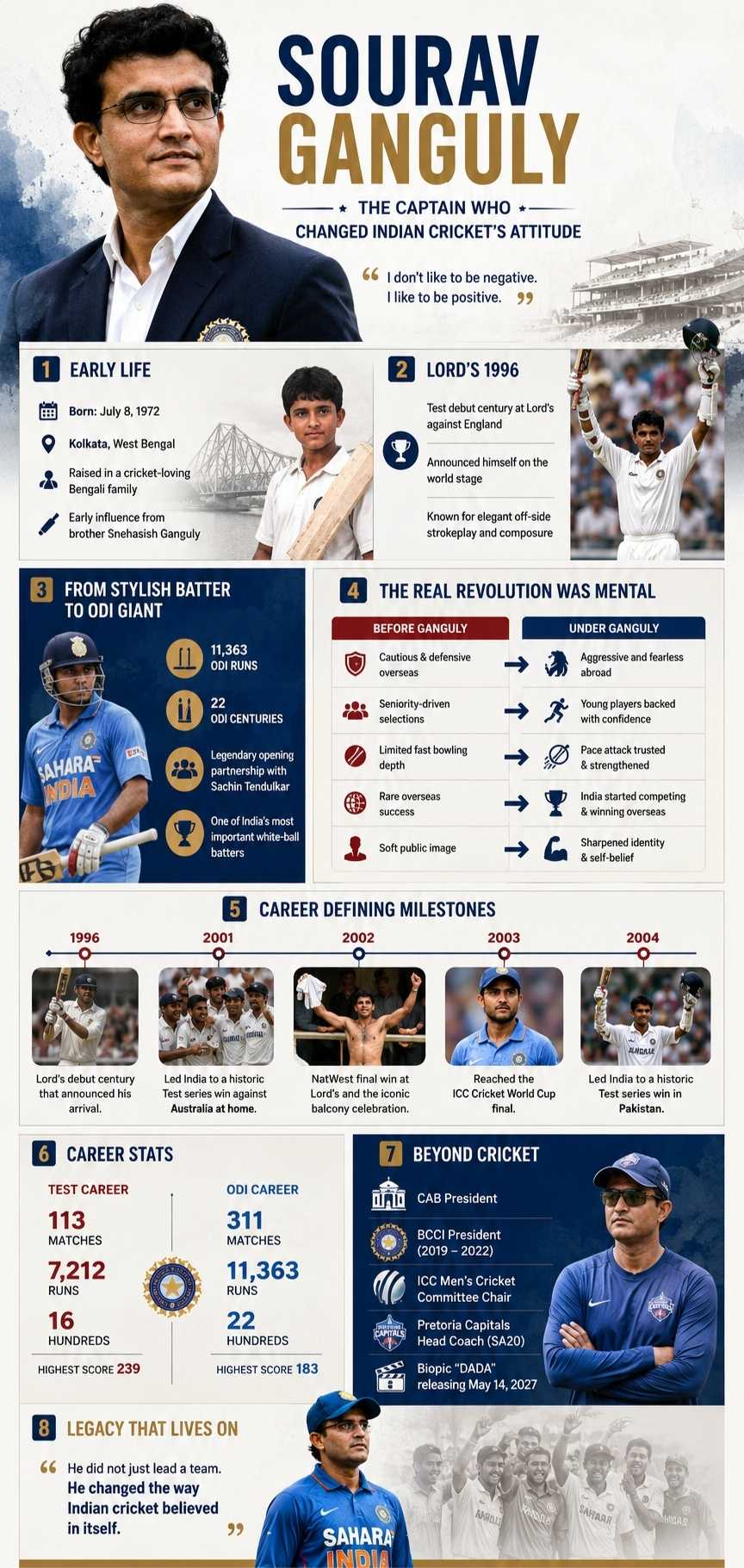
Sourav Ganguly Biography at a Glance
| Detail | Information |
| Full Name | Sourav Chandidas Ganguly |
| Nicknames | Dada, Prince of Calcutta, Bengal Tiger |
| Date of Birth | July 8, 1972 |
| Birthplace | Calcutta, now Kolkata, West Bengal, India |
| Batting Style | Left-handed |
| Bowling Style | Right-arm medium |
| Primary Role | Top-order batter |
| Test Career | 113 Tests, 7,212 runs, 16 centuries |
| ODI Career | 311 ODIs, 11,363 runs, 22 centuries |
| Major Captaincy Era | 2000 to 2005 |
| Major Post-Retirement Roles | CAB President, BCCI President, ICC Men’s Cricket Committee Chair, Pretoria Capitals head coach |
Still, the numbers are only the entry point. Ganguly remains emotionally important because of what he changed around those numbers.
Early Life and Cricket Beginnings in Kolkata
Sourav Ganguly was born in Calcutta, now Kolkata, and grew up in a Bengali sporting culture where cricket and football both had a strong hold. Ganguly belonged to the larger Bengali cultural world. His verified public biography is firmly tied to Kolkata, especially the city’s cricketing environment and his family’s influence.
His elder brother, Snehasish Ganguly, who played first-class cricket for Bengal, had a major influence on his early cricket path. That family connection mattered. Sourav did not enter cricket as an outsider discovering the game late. He grew around it, watched it closely, and then slowly shaped himself into one of Bengal’s most gifted batting talents.
What stood out was not brute force. It was timing. Ganguly’s batting always had a certain ease. His off-side play looked almost casual, as if the ball had already agreed to go where he wanted it to go. That elegance later became one of his trademarks.
Lord’s 1996: The Debut That Announced Him
Some Test debuts are about survival. Ganguly’s was about arrival. In June 1996, he made his Test debut against England at Lord’s and scored a century. That innings did not look like a lucky beginning. It looked like a player who had waited long enough and knew exactly what to do with the chance.
The setting helped the legend, of course. A left-hander scoring fluently at Lord’s already creates a beautiful cricket image. But Ganguly added something more: calmness. He did not look overwhelmed by the occasion. He looked like he belonged there.
That innings introduced the world to one of the finest off-side players of his generation. A well-informed source notes that Ganguly burst into collective memory in 1996 with back-to-back Test hundreds in England.
The nickname “God of the Off Side” was not just decoration. It was a fair description of what he did best.
From Elegant Batter to ODI Giant
Ganguly’s captaincy often overshadows his batting, but it should not. In ODIs, he was one of India’s most important batters before the modern white-ball era fully changed scoring patterns. He could open the innings, build long partnerships, clear the infield, attack spin, and contribute useful medium pace when needed.
His partnership with Sachin Tendulkar became one of the defining opening combinations in ODI cricket. A verified source describes their ODI opening pair as one of the most dangerous opening partnerships in ODI history.
Ganguly was not a flawless batter. High-quality short bowling troubled him at times, and his form dipped during difficult phases. But his overall record still stands tall: more than 11,000 ODI runs, 22 ODI hundreds, and a career built in an era when white-ball batting was not as heavily protected by conditions and fielding rules as it often is today.
That matters because Ganguly the captain was built on Ganguly the batter. He had earned the dressing room’s respect before he asked players to follow him.
Taking Over After Indian Cricket’s Darkest Phase
Ganguly became captain when Indian cricket needed more than a cricketing brain. The match-fixing scandal around 2000 had damaged public trust. Fans were angry. The team’s image had taken a hit. Indian cricket needed someone who could rebuild belief inside the dressing room and outside it.
Ganguly was not a soft leader on the field. He was emotional, proud, occasionally difficult, and visibly combative. Those traits sometimes created controversy, but at that particular moment, they also gave India something it badly needed.
Edge. He did not want India to look harmless. He wanted India to compete like a team that expected respect. A verified source sums up that captaincy period by noting that Ganguly took over after the match-fixing saga and helped build a team that was formidable at home and more competitive overseas.
The Real Revolution Was Mental
The biggest mistake people make with Ganguly is reducing his captaincy to one shirt-waving celebration at Lord’s. That moment was iconic. But it was a symbol, not the whole story. The real revolution was mental.
Before Ganguly, India had great individual players. Under Ganguly, India began to develop a stronger team personality. The side did not suddenly become unbeatable overseas, but it became harder, louder, and more willing to fight.
| Before Ganguly’s Captaincy | Under Ganguly’s Leadership |
| India often looked cautious overseas | India began playing with visible aggression abroad |
| Selection often leaned on safer choices | Young players received stronger backing |
| Fast bowling depth was limited | Pace options received more trust and attention |
| Overseas wins felt rare | India started competing harder away from home |
| India’s public image was softer | The team became more assertive and self-believing |
This is why Sourav Ganguly captaincy is remembered as cultural leadership as much as tactical leadership. He gave Indian cricketers permission to be aggressive. And once that permission entered the dressing room, it did not leave.
The Young Players He Backed
Ganguly’s greatest leadership strength was not that he personally discovered every great player. That would be too simplistic. Selectors, domestic coaches, timing, and player quality all mattered. His real strength was that he backed young players with conviction.
Yuvraj Singh and Mohammad Kaif brought athleticism and fearless middle-order batting. Zaheer Khan gave India a serious left-arm pace option. Harbhajan Singh became a match-winner. MS Dhoni’s international journey also began during Ganguly’s captaincy period.
Ganguly gave young players room to fail, and that is a bigger deal than it sounds. In Indian cricket, one bad series can become a national trial. Ganguly knew that. He still chose to protect players he believed in. That created loyalty, and it helped build the next phase of Indian cricket.

NatWest 2002: More Than a Shirt-Waving Moment
The 2002 NatWest Series final at Lord’s remains one of Indian cricket’s most emotional wins.
England made 325. At that time, chasing such a total in a final at Lord’s felt enormous. India stumbled, recovered, stumbled again, and then Yuvraj Singh and Mohammad Kaif dragged the chase back from the edge.
Kaif stayed until the end. India won. Ganguly removed his shirt on the Lord’s balcony. It was raw, imperfect, and unforgettable. But the deeper meaning was not the shirt. It was the message. India could chase. India could win in England. India could celebrate loudly too.
That moment remains so strongly associated with Ganguly that the first-look poster of his upcoming biopic recreates the Lord’s balcony celebration.
2003 World Cup: India Started Believing Bigger
India did not win the 2003 World Cup, but Ganguly’s team changed what Indian fans expected from global tournaments.
India reached the final, where Ricky Ponting’s Australia proved too strong. The result hurt, but the campaign mattered because India looked like a serious tournament side again. The team had pace, experience, young energy, and a captain who believed it could go deep.
Ganguly also made practical tactical calls. Rahul Dravid’s wicketkeeping role gave India better batting balance. Young players were trusted in pressure situations. The team was not perfect, but it had direction.
That World Cup run helped raise national expectation. After Ganguly, fans did not want India to merely compete. They wanted India to win. That pressure shaped the teams that followed.
Overseas Test Cricket and the Pakistan 2004 Breakthrough
Ganguly’s Test captaincy had several landmark moments.
The 2001 home series against Australia remains one of Indian cricket’s greatest turning points. India ended Australia’s famous winning streak and won the series 2-1. That series was not only about VVS Laxman, Rahul Dravid, and Harbhajan Singh. It was also about a captain who refused to let India mentally surrender.
The 2002 Headingley Test win in England was another important result. India won by an innings and 46 runs in conditions where Indian teams were not expected to dominate. The full Test series in England finished 1-1, but the Headingley victory showed that Ganguly’s India could compete with belief outside the subcontinent.
Then came Pakistan in 2004. India won a historic Test series there, a result that carried huge cricketing and emotional weight.
That is where Ganguly’s overseas legacy becomes strongest. He made ambition away from home feel normal.
The Greg Chappell Rift and Ganguly’s Hardest Phase
One of the hardest phase of Sourav Ganguly biography is Greg Chappell chapter. Their relationship became one of the most controversial player-coach conflicts in Indian cricket. Ganguly’s form was questioned. His captaincy came under pressure. The dressing room atmosphere became tense. Eventually, he was dropped.
A well-informed source confirmed that Chappell’s critical email to the BCCI about Ganguly’s leadership was leaked to the media, and that Ganguly’s poor batting form weakened his position before he was eventually dropped and Rahul Dravid was named his successor.
For a while, it looked like Ganguly’s India career might end badly. But he came back. That comeback is important because it showed another side of him. The same stubbornness that made him a difficult opponent also helped him survive embarrassment, criticism, and selection pressure.
Not every great leader gets a clean final act. Ganguly did not. But the difficult phase does not erase the transformation he had already helped create.
What Ganguly Got Right and What He Did Not
Ganguly got many things right. He backed youth. He gave India a stronger overseas voice. He supported fast bowlers. He built loyalty in the dressing room. He gave Indian cricket a tougher public personality. He made the team believe that aggression was not arrogance if performance backed it up.
But he was not perfect. His batting form declined during parts of his captaincy. The Chappell conflict became damaging. Some claims about his administrative impact are often exaggerated. He contributed to Indian cricket after retirement, but not every reform or success can be credited to him alone.
That balance matters. Ganguly was not a superhero. He was a strong, flawed, influential cricket figure whose timing, personality, and leadership changed Indian cricket at a critical moment. That is more interesting than a perfect myth.
Sourav Ganguly Records and Career Stats
| Format | Matches | Runs | Average | 100s | Highest Score |
| Test | 113 | 7,212 | 42.18 | 16 | 239 |
| ODI | 311 | 11,363 | 40.73 | 22 | 183 |
These Sourav Ganguly records show why his career deserves respect even before the leadership discussion begins. A verified source records him with 113 Tests, 311 ODIs, 7,212 Test runs, 11,363 ODI runs, 16 Test hundreds, and 22 ODI hundreds.
Ganguly was once the fastest to 9,000 ODI runs and remains one of the major ODI batting names of his generation.
Post-Retirement: CAB, BCCI, ICC, and Coaching
Ganguly stayed close to cricket after retirement. He moved into commentary, cricket administration, and later coaching. Reuters reported that Ganguly served as BCCI President from 2019 to 2022 and later became head coach of Pretoria Capitals, marking his first venture into coaching.
The Sourav Ganguly BCCI President period remains an important part of his post-playing identity, but it should be written with balance. He was an influential administrator, not the sole architect of every later Indian cricket success.
Ganguly has also remained active in global cricket governance. In April 2025, the ICC confirmed that Sourav Ganguly was re-appointed as Chair of the ICC Men’s Cricket Committee.
He has returned to Bengal cricket administration as well. The Cricket Association of Bengal’s official site currently refers to him as CAB President.
That post-retirement path fits Ganguly’s larger story. He was never likely to become a distant former player. He has stayed involved in cricket’s systems, decisions, and dressing-room environments.
The Sourav Ganguly Biopic Update
The upcoming film Dada: The Sourav Ganguly Story has brought Ganguly’s legacy back into wider public conversation. Rajkummar Rao plays Ganguly in the biopic, and the first-look poster was unveiled on Ganguly’s 54th birthday. Reports say the film is scheduled to release on May 14, 2027.
The poster’s use of the Lord’s balcony moment is obvious, but it is also fitting. That one image still carries the emotional shorthand of Ganguly’s career: pride, defiance, risk, and a little bit of madness. It was not polished. It was not diplomatic. It was very Ganguly. That is why fans still remember it.
Why Sourav Ganguly Still Matters
Ganguly matters because modern Indian cricket still carries parts of his personality. Today’s Indian cricket is richer, fitter, deeper, and more professionally supported than the team Ganguly inherited. The IPL changed the system. Sports science improved. The bench became stronger. Indian cricket’s financial and political power grew. But attitude has a lineage.
The expectation that India should compete anywhere did not appear from nowhere. The idea that young players deserved backing did not appear overnight. The belief that Indian cricketers could speak back, stare back, and still perform was strengthened under Ganguly.
He did not build modern Indian cricket alone. No one person does that. But he changed its emotional grammar. Before Ganguly, Indian cricket had greatness. Under Ganguly, it found a sharper edge.
Wrapping Up
Sourav Ganguly’s story is not only about runs, records, or famous celebrations. It is about timing.
He became captain when Indian cricket needed someone stubborn enough to absorb pressure. He backed young players when safer choices were available. He made India more aggressive when politeness had become a habit. He helped the team believe that winning abroad was not fantasy.
That is why Sourav Ganguly biography should not treat him as just another former captain. He was one of Indian cricket’s great culture-shifters. And sometimes, changing a team’s mind is just as important as changing its scorecard.
Frequently Asked Questions About Sourav Ganguly
1. Why is Sourav Ganguly called Dada?
Sourav Ganguly is called Dada because “Dada” means elder brother in Bengali. The nickname reflects both his Bengali identity and the senior, protective role he played in Indian cricket.
2. What is Sourav Ganguly most famous for?
Sourav Ganguly is most famous for changing Indian cricket’s aggressive mindset as captain, leading India to the 2003 World Cup final, winning the 2002 NatWest final, backing young players, and celebrating famously on the Lord’s balcony.
3. What are Sourav Ganguly’s major records?
Ganguly scored 7,212 runs in 113 Tests and 11,363 runs in 311 ODIs. He made 16 Test hundreds and 22 ODI hundreds, with a highest Test score of 239 and highest ODI score of 183.
4. Was Sourav Ganguly the BCCI President?
Yes. Sourav Ganguly served as BCCI President from 2019 to 2022. Reuters notes that period while reporting his later appointment as Pretoria Capitals head coach.
5. What is Sourav Ganguly doing now?
Ganguly remains active in cricket administration and coaching. He was re-appointed Chair of the ICC Men’s Cricket Committee in 2025, is listed by CAB as its President, and became head coach of Pretoria Capitals in SA20.
6. Is there a Sourav Ganguly biopic?
Yes. Dada: The Sourav Ganguly Story, starring Rajkummar Rao, has been announced. The first-look poster was unveiled on Ganguly’s 54th birthday, and the film is scheduled to release on May 14, 2027.





















