Most founders do not need a prettier document library. They need fewer blank pages.
The early months of building a company are full of decisions that look simple until they pile up: who the product is for, what problem matters most, how the first version should work, what to say to customers, when to hire, how much money is left, and whether the team is making the same decision twice in different meetings.
That is where the best templates founders can use become practical tools, not paperwork. A good template forces clarity. It slows down vague thinking before vague thinking becomes expensive. A bad template does the opposite. It makes a startup look organized while hiding weak assumptions.
This list focuses on founder templates, startup templates, and business templates that help early-stage founders make better decisions, communicate clearly, and avoid rebuilding the same document every week.
Our Selection Criteria
Before looking at the list, it helps to define what belongs here. A founder does not need a template for every tiny task. Too many templates can create process theater, especially when a small team still needs speed.
The templates below were selected because they solve repeated founder problems:
| Selection Point | Why It Matters |
|---|---|
| Decision value | The template should help the founder make or explain a real decision |
| Startup usefulness | It should fit early-stage startups, not only mature companies |
| Practical repeatability | Founders should be able to reuse it across weeks, hires, customers, or investors |
| SaaS and service relevance | It should work for product-led, SaaS, agency-style, or tech-enabled businesses |
| Low process burden | The template should reduce confusion, not create more admin |
| Team clarity | It should make work easier for co-founders, employees, advisors, or investors |
| Founder judgment | It should expose assumptions, trade-offs, and risks |
The best startup templates are not the longest ones. They are the ones a founder actually returns to when the company gets mess
Quick Comparison of the Best Templates Founders Need
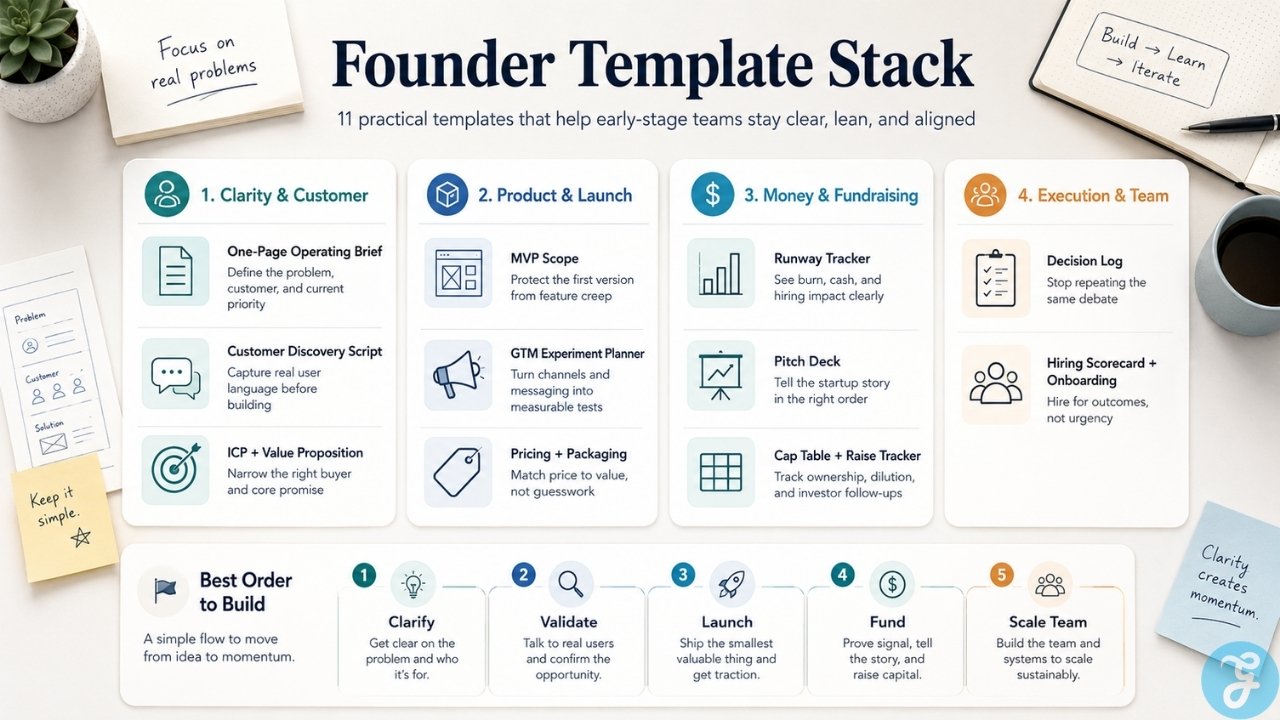
The list below gives a practical map before going deeper into each template. Not every founder needs all 11 on day one, but most will need them as the company moves from idea to execution.
| Template | Best Used For | Founder Mistake It Prevents |
| Founder One-Page Operating Brief | Clarifying what the company is building and why | Explaining the startup differently every week |
| Customer Discovery Interview Script | Talking to users before overbuilding | Asking leading questions or pitching too early |
| ICP and Value Proposition Template | Defining the right customer and pain | Selling to everyone |
| MVP Scope Template | Deciding what the first useful version includes | Building too much too soon |
| Go-to-Market Experiment Planner | Testing channels and messaging | Confusing activity with traction |
| Pricing and Packaging Worksheet | Thinking through plans, value, and willingness to pay | Copying competitor pricing blindly |
| Financial Model and Runway Tracker | Managing cash, revenue, burn, and hiring choices | Discovering runway problems too late |
| Pitch Deck Template | Structuring the fundraising story | Building a deck before the business story is clear |
| Cap Table and Fundraising Tracker | Tracking ownership, dilution, and investor conversations | Losing control of equity details |
| Decision Log Template | Recording major decisions and owners | Repeating debates and forgetting context |
| Hiring Scorecard and Onboarding Checklist | Hiring with clearer criteria | Hiring impressive people for unclear roles |
Now the useful part is not simply naming these templates. It is knowing when each one should be used and when it becomes unnecessary process.
11 Best Templates Founders Need for Startup Execution
1. Founder One-Page Operating Brief
The first template every founder needs is not a 40-page business plan. It is a one-page operating brief that explains the company clearly enough for the team, advisors, early hires, and investors to understand the same thing.
This template should answer a few hard questions: what problem are we solving, who has it, why now, what are we building first, how will we know it is working, and what are we refusing to do yet? That last part matters. Early startups often lose time because every interesting idea feels urgent.
A strong founder operating brief usually includes:
- One-line company description
- Target customer
- Pain point or workflow problem
- Current solution or workaround
- Proposed product or service
- Main assumption being tested
- Current stage
- Next 30-day priority
- What the company is not doing yet
This is one of the best templates founders can keep updating because it reveals drift. If the one-line description changes every week, that may be learning. If it changes because the founder cannot explain the business clearly, that is a problem.
The mistake is treating this like a public pitch. It should be honest before it is impressive.
2. Customer Discovery Interview Script
A customer discovery template protects founders from one of the most common early mistakes: pitching instead of listening.
When founders are excited, they often ask questions that secretly beg for validation. “Would you use this?” “Does this sound useful?” “Would your team pay for it?” These questions produce polite answers, not reliable evidence. A better interview script keeps the founder focused on the customer’s current behavior, pain, budget, workflow, and failed alternatives.
A useful customer discovery script should include:
- Who the person is and why they fit the target group
- What problem or workflow the founder wants to understand
- Open questions about current behavior
- Questions about frequency and urgency
- Questions about tools, costs, workarounds, or failed attempts
- A section for exact customer language
- A space for evidence, not opinions
- A follow-up action
The best version of this template leaves room for surprise. Founders should not force every interview into the answer they wanted before the call. Y Combinator’s Startup Library emphasizes learning how to talk to users, and that is still one of the highest-return habits a founder can build early.
This template is worth using before product work, before a landing page, before pricing, and before fundraising. If a founder cannot fill it with real customer language, the startup may still be guessing.
3. ICP and Value Proposition Template
Once a founder has spoken to real users, the next step is narrowing the customer. This is where an ideal customer profile and value proposition template becomes useful.
A weak founder tries to sell to “small businesses,” “creators,” “students,” “marketers,” or “busy professionals.” Those groups are too broad. A stronger founder defines the customer by pain, urgency, budget, buying process, and context. The right question is not only “Who could use this?” It is “Who feels this problem badly enough to change behavior?”
This template should include:
- Primary customer segment
- Job title, role, company type, or user situation
- Trigger event that makes the problem urgent
- Current workaround
- Cost of doing nothing
- Buying authority or influence
- Main promise
- Proof needed before trust
- Reasons this customer may still say no
The value proposition part should not become fluffy messaging. It should connect the customer’s job, pains, and desired gains to the product’s practical value. Strategyzer’s Value Proposition Canvas is useful here because it separates customer jobs, pains, and gains from the product’s pain relievers and gain creators.
This is one of the startup templates founders should revisit after sales calls. If the best buyers look different from the original ICP, the template should change.
4. MVP Scope Template
The MVP scope template is where founders protect the product from ambition.
An early product does not need to show everything the company may become. It needs to prove that a specific customer will use a specific solution for a specific problem. Without a scope template, teams often keep adding features because every edge case feels like a reason to delay launch.
A useful MVP scope template should include:
- Target user
- Core problem
- Main user action
- Must-have feature
- Nice-to-have feature
- Explicitly excluded feature
- Success metric
- Launch deadline
- Manual workaround allowed
- Risk being tested
The most useful field is often “excluded feature.” It forces the founder to say no in writing. That matters because product creep rarely feels dangerous in the moment. It feels like quality.
For SaaS founders, this template can prevent early versions from becoming bloated dashboards no one understands. A narrow workflow that solves one painful problem is usually better than a wide product that looks more complete but does nothing sharply.
Use this template before design, before engineering sprints, and before promising features to early users.
5. Go-to-Market Experiment Planner
Founders often say they are “doing marketing” when they are really posting randomly, sending cold messages without tracking, testing channels without a hypothesis, or copying another startup’s playbook. A go-to-market experiment planner helps turn activity into learning.
This template should be built around one experiment at a time. For example, a founder may test whether CFOs at 50-person SaaS companies respond better to a compliance pain point or a reporting time-saving angle. That is clearer than “try LinkedIn.”
A practical GTM experiment template should include:
- Target audience
- Channel
- Message angle
- Offer or call to action
- Hypothesis
- Time period
- Sample size
- Cost
- Conversion metric
- Result
- Next decision
The important part is the next decision. If the experiment works, does the founder double down, improve the message, or build a repeatable motion? If it fails, was the channel wrong, the audience wrong, or the offer weak?
This is one of the best founder templates for avoiding false momentum. It makes a founder separate work from evidence.
6. Pricing and Packaging Worksheet
Pricing is one of the easiest places for founders to hide uncertainty. They look at competitors, choose a lower number, and call it strategy.
That rarely works for long.
A pricing and packaging worksheet helps founders think about value, customer segment, willingness to pay, cost to serve, usage pattern, and buying friction. For SaaS companies, it also helps separate the product from the plan. A feature may be valuable, but that does not mean it belongs in the cheapest package.
This template can include:
- Customer segment
- Main value driver
- Current alternative cost
- Pricing model
- Free trial or freemium logic
- Plan tiers
- Included usage
- Upgrade trigger
- Support level
- Gross margin considerations
- Objections heard in sales calls
Founders should be careful with this template because pricing can become too theoretical. The best pricing evidence comes from actual buying behavior, not internal debate. If customers keep saying the product is useful but no one pays, the template needs real data, not prettier tiers.
For early companies, the goal is not perfect pricing. It is pricing clear enough to test whether the product creates value people will pay for.
7. Financial Model and Runway Tracker
A financial model does not need to impress a banker on day one. It needs to stop the founder from lying to themselves.
The simplest version should show cash in the bank, monthly burn, revenue, expected expenses, payroll, runway, and hiring impact. For SaaS founders, it should eventually include MRR, ARR, churn, CAC, gross margin, expansion revenue, and payback assumptions. Tomasz Tunguz’s SaaS startup metrics template breaks startup metrics into areas such as people, bookings and revenue, cash, sales, marketing, and customer success, which is a useful reminder that finance is not only a bank balance.
A founder-friendly runway template should include:
- Starting cash
- Monthly revenue
- Monthly fixed costs
- Variable costs
- Payroll
- Contractor spend
- Marketing spend
- One-time expenses
- Net burn
- Runway in months
- Hiring scenarios
- Fundraising deadline
The mistake is making the spreadsheet too complicated too early. A model full of assumptions is not more accurate because it has more tabs. Early founders should start with something simple, update it often, and use it before making hiring or fundraising decisions.
This is one of the business templates that becomes more important when things are going well. Growth can hide bad cash discipline.
8. Pitch Deck Template
A pitch deck template helps founders tell the fundraising story in the right order. It does not create the story for them.
A strong early-stage deck usually needs to explain the problem, customer, solution, market, traction, business model, competition, go-to-market plan, team, and fundraising ask. Y Combinator’s guidance on seed decks emphasizes a simple structure that helps investors understand the company quickly.
The useful version of this template should include:
- Company one-liner
- Problem
- Customer
- Solution
- Why now
- Market
- Product
- Traction
- Business model
- Competition
- Go-to-market
- Team
- Fundraising ask
The real danger is building the deck too early. If the customer is unclear, the deck will sound vague. If the traction is weak, the slides will over-explain. If the founder does not understand the business model, the template will not save it.
A pitch deck template is best used after the operating brief, customer discovery, MVP scope, pricing, and GTM thinking have some shape. Otherwise, it becomes design over substance.
9. Cap Table and Fundraising Tracker
A cap table template is not glamorous, but founders ignore equity details at their own risk.
At the earliest stage, founders need to track ownership, founder shares, vesting, option pool plans, advisor grants, SAFEs, convertible notes, investor commitments, valuation caps, discounts, and expected dilution. Y Combinator provides Safe financing documents for US companies, and Carta’s cap table resources explain ownership, equity types, valuations, and vesting concepts. Founders should still use lawyers or qualified advisors before signing financing documents, especially across jurisdictions.
A fundraising tracker should sit beside the cap table. It should show:
- Investor name
- Firm or fund
- Check size range
- Stage fit
- Warm intro source
- Status
- Last contact date
- Next step
- Concerns raised
- Commitment probability
- Notes from call
The cap table tells founders what ownership could become. The fundraising tracker tells them whether the raise is real or just a collection of friendly meetings.
This template is especially important when founders start using SAFEs, advisor equity, or early employee options. Small decisions can compound.
10. Decision Log Template
A decision log sounds boring until a startup starts repeating the same debate every month.
Founders make decisions under uncertainty. That is normal. The problem is not being wrong. The problem is forgetting why the team chose something, who owned it, what assumption mattered, and when the decision should be reviewed.
A decision log template should include:
- Decision title
- Date
- Owner
- Context
- Options considered
- Chosen direction
- Main trade-off
- Assumption behind the decision
- Review date
- Result or learning
This template is useful for pricing changes, product cuts, hiring decisions, customer segment shifts, fundraising timing, technical architecture, and partnership choices. Atlassian’s DACI framework is one useful model for decision clarity because it separates roles such as Driver, Approver, Contributors, and Informed.
Do not turn this into bureaucracy. A five-person team does not need formal documentation for every tiny choice. It does need a record for decisions that will be painful to revisit later.
The best decision logs are short, honest, and easy to search.
11. Hiring Scorecard and Onboarding Checklist
Hiring becomes dangerous when founders hire for relief instead of clarity.
A founder feels overwhelmed, meets someone impressive, and creates a vague role around them. Three months later, no one knows what success looks like. That is not always the employee’s fault. Often, the company never defined the role properly.
A hiring scorecard template should include:
- Role mission
- Outcomes expected in 30, 60, and 90 days
- Must-have skills
- Nice-to-have skills
- Interview questions
- Practical test or work sample
- Score criteria
- Red flags
- Compensation range
- Reporting structure
The onboarding checklist should connect directly to the scorecard. It should include access setup, product education, customer context, team rituals, first assignments, key documents, and early success markers.
First Round Review publishes tactical advice for founders and startup leaders on topics such as hiring, management, product-market fit, and company-building, which is a useful reminder that hiring is not just recruitment. It is operating design.
This is one of the best templates founders should create before they feel desperate to hire. A scorecard written under pressure usually becomes a wishlist. A scorecard written early becomes a filter.
What Most Template Lists Get Wrong
Many template lists treat founders like students completing assignments. They suggest business plans, marketing calendars, investor decks, and hiring sheets without asking whether the startup has enough real information to fill them properly.
That is how founders end up with polished documents and weak companies.
A template should not replace customer conversations, product testing, founder debate, or financial discipline. It should capture what the team is learning and make the next decision cleaner.
The strongest business templates for founders usually do one of three things:
- Turn vague ideas into testable assumptions
- Turn repeated work into a reusable system
- Turn private founder thinking into shared team clarity
If a template does none of those, it is probably decoration.
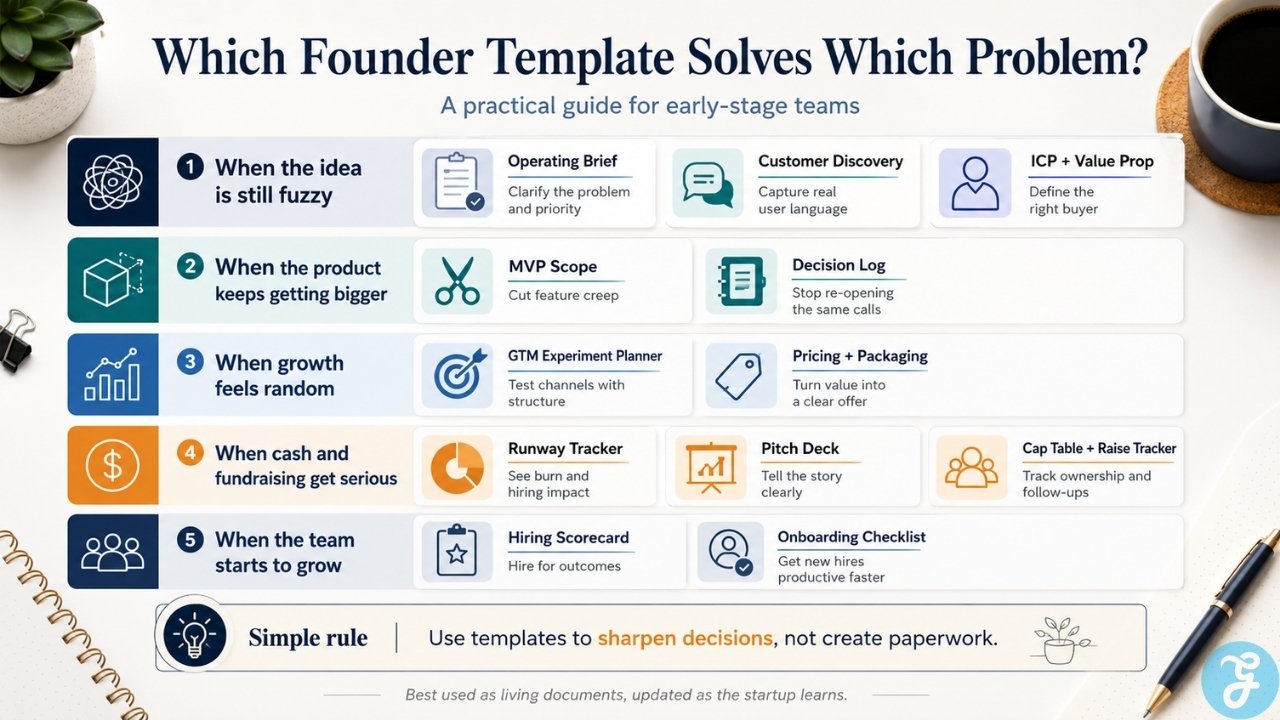
Which Template Should Founders Build First?
After reviewing all 11, the best starting point depends on the company’s current stage.
If the startup is still at idea stage, start with the founder one-page operating brief, customer discovery script, and ICP template. These force the founder to define the problem before building too much.
If the product is already being built, move to the MVP scope template, GTM experiment planner, and pricing worksheet. These help the team launch with discipline rather than pile on features and vague marketing activity.
If the company is raising money or hiring, the financial model, pitch deck, cap table, fundraising tracker, hiring scorecard, and onboarding checklist become more urgent.
The decision log is useful throughout. It becomes more valuable as the team grows, because memory gets worse when more people join the company.
How to Keep Templates From Slowing the Startup Down
Templates should make the company faster, not heavier.
A good rule is to keep each template short enough that a founder can update it without turning the task into a project. If a template needs 20 fields, most founders will stop using it. If it captures the five things that matter, it can become part of the company’s operating rhythm.
Founders should also avoid creating a template before the problem repeats. One messy customer call does not require a full CRM process. Ten confusing customer calls probably do. One hiring conversation does not require a full talent system. The first serious role does need a scorecard.
The practical test is simple: does this template help the team decide, learn, or repeat something better?
If not, delete it.
The Practical Takeaway
The best templates founders can use are not fancy documents. They are thinking tools.
A founder operating brief keeps the company clear. A customer discovery script keeps the team honest. An ICP template narrows the buyer. An MVP scope template protects the product. A GTM planner turns motion into evidence. Pricing, finance, pitch, cap table, decision, and hiring templates help the founder avoid expensive confusion as the company grows.
Start with the template that solves today’s mess. Keep it simple. Update it when reality changes. The goal is not to look organized. The goal is to build with fewer avoidable mistakes.
Frequently Asked Questions (FAQs)
What are the best templates founders should create first?
The best templates founders should create first are a one-page operating brief, customer discovery interview script, ICP template, MVP scope template, and simple financial runway tracker. These cover the earliest risks: unclear problem, unclear customer, overbuilt product, and weak cash visibility.
Are startup templates useful for solo founders?
Yes, but solo founders should keep them lighter. A solo founder does not need heavy process, but templates can still help with customer interviews, weekly priorities, product scope, pricing, and runway planning.
Should founders use free templates or build their own?
Free templates are useful starting points, but founders should adapt them quickly. A generic pitch deck, financial model, or hiring scorecard only becomes useful when it reflects the company’s actual customer, product, market, and stage.
What is the most overrated founder template?
A long traditional business plan is often overrated for early-stage startups. Founders usually need clearer assumptions, customer evidence, pricing logic, GTM tests, and runway visibility before they need a polished long-form plan.
How often should founder templates be updated?
Core templates should be updated when new evidence changes the company’s thinking. The operating brief, ICP, MVP scope, pricing, financial model, and GTM planner should not sit untouched for months if the startup is actively learning.