

The Word Gets Misused More Than Almost Any Other Lighting Term
Part of the confusion is that farmhouse style itself went through a strange cultural moment about a decade ago — shiplap, barn doors, and a very specific Pinterest aesthetic took a regional architectural style and turned it into a national decorating trend almost overnight. Lighting brands responded the way they always do, slapping “farmhouse” on anything with black iron or visible wood grain, regardless of whether it actually fit the spirit of the style.
The result is a category that’s gotten muddier over time, not clearer. You’ll see wagon wheel chandeliers, antler-style fixtures, heavy wrought iron pieces with candle arms, and clean wood-and-metal rings all filed under the same farmhouse label, even though they read completely differently once they’re hanging in an actual room. Understanding what separates these is the difference between buying something that looks right in a product photo and buying something that looks right above your own dining table.
The Real Definition: It’s About Restraint, Not Just Materials
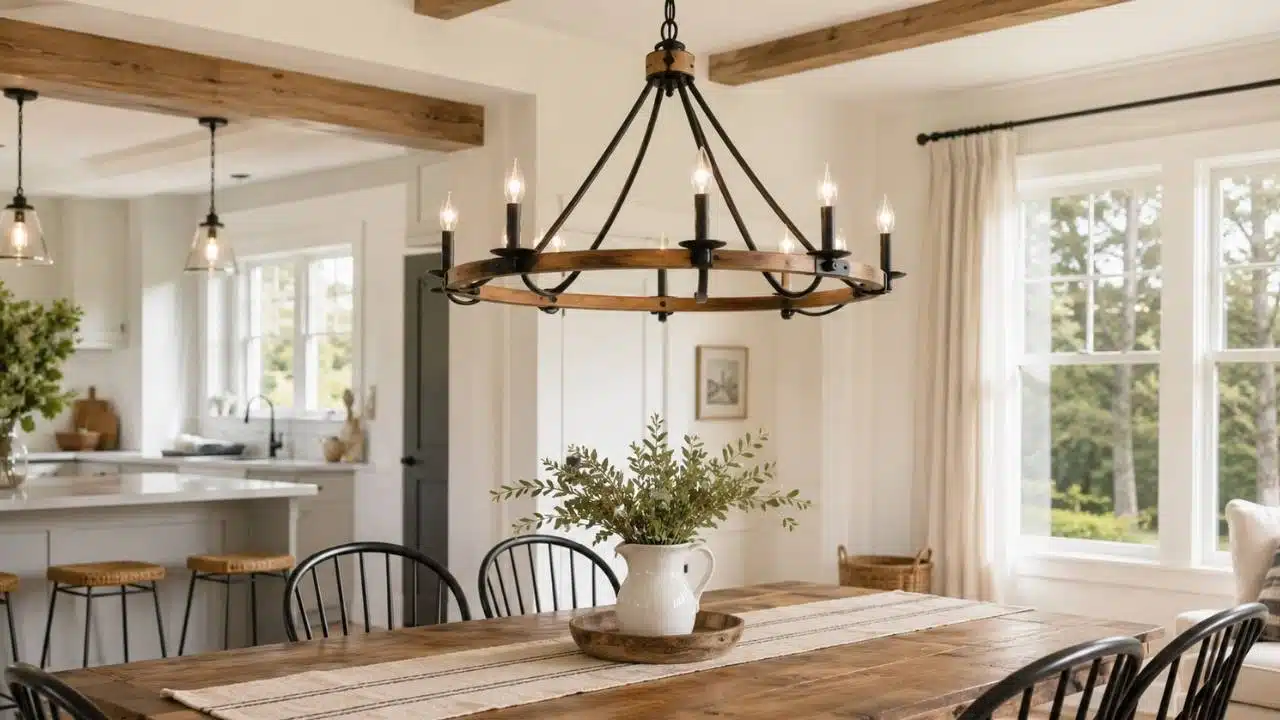
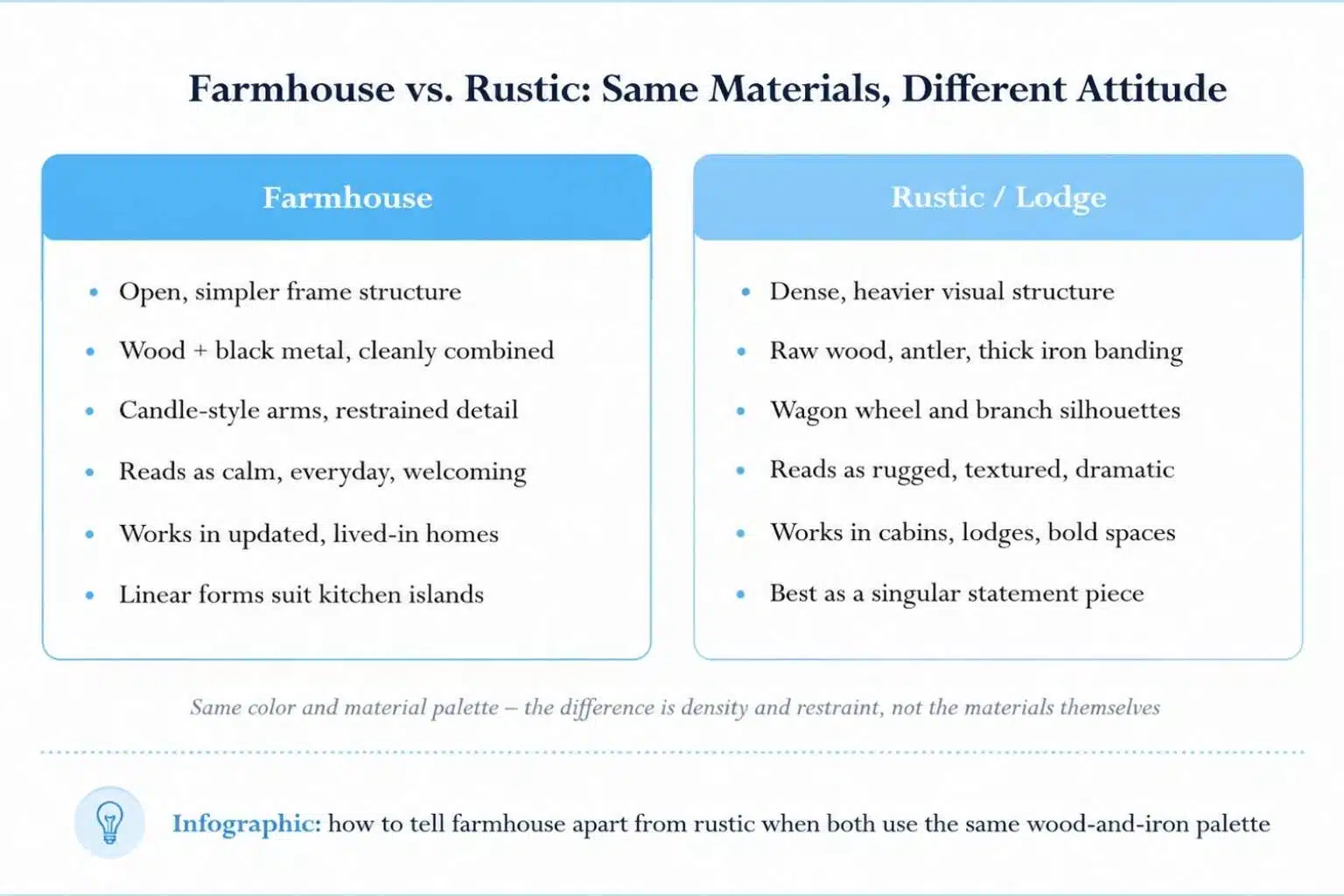
If there’s one thing that actually separates farmhouse from its rustic and lodge-style cousins, it’s restraint. A true farmhouse chandelier uses the same warm materials — wood, black iron, aged metal — but applies them with a lighter hand. The structure tends to be simpler. The silhouette is usually more open. There’s less going on visually, even when the fixture is a reasonable size.
Rustic and lodge-style fixtures lean the opposite direction. They want you to notice the texture, the heaviness, the raw material quality. Antler chandeliers, dense wagon wheel forms with thick metal banding, anything that looks like it was salvaged from an actual barn — these are doing something different than farmhouse, even when they share a color palette. Farmhouse is the version that’s been cleaned up just enough to live comfortably in a regular house rather than a hunting lodge.
This is genuinely useful to know before you start shopping, because it means the deciding factor usually isn’t “does this have wood or black metal” — almost everything in this broad category does. The deciding factor is how much visual weight and texture the piece is carrying. Less weight and a more open frame, you’re in farmhouse territory. More density, more raw texture, more “look how rugged I am,” you’ve drifted into rustic.
Where Farmhouse Fixtures Actually Earn Their Keep
Kitchens are probably the single best application, and it’s not close. Something about the relaxed, slightly imperfect character of farmhouse lighting matches how kitchens actually get used — they’re working rooms, gathering rooms, the place where people end up standing around even when there’s a perfectly good living room ten feet away. A linear farmhouse fixture running the length of an island does double duty: it lights the workspace properly and it doesn’t feel precious about getting a little flour dust or steam in its general direction, the way a crystal piece might.
Dining rooms are the second strongest fit, particularly in homes that are otherwise pretty contemporary. There’s a specific move that works well here — a clean wood-and-black-metal chandelier over a table in a room with white walls and simple furniture, where the fixture becomes the one piece in the room doing something warm and textural. It keeps the space from feeling sterile without requiring you to commit to a fully rustic interior.
Foyers and entryways work too, though with a slight caveat — this is the one place where a farmhouse fixture is competing with a lot of other strong options, crystal and modern geometric pieces especially. Farmhouse wins out in entries attached to homes that are genuinely casual throughout, where a more formal fixture would feel like it walked in from a different house. If your front door opens into a foyer with a lot of stone, white oak, and black hardware already established, farmhouse fits right into that conversation.
The Sizing Math Doesn’t Change, But the Visual Reading Does
The underlying formula is the same one that applies to basically every chandelier category — add your room’s length and width in feet, and that number becomes a rough diameter guide in inches. Over a dining table specifically, a lot of people start by sizing the fixture to roughly half to three-quarters of the table’s width, then nudge from there based on how visually heavy the piece reads.
Where farmhouse changes the calculation slightly is in that density question again. An open, airy farmhouse ring with thin metal framing can run a touch larger than the formula suggests without overwhelming anything, because there’s so much negative space built into the design. A denser piece — heavier wood beam construction, a tighter wagon wheel form — needs to stay closer to the formula number or it starts to dominate the room the way a rustic piece would.
Height above the table follows the standard range most people land on for dining fixtures generally: 30 to 36 inches above the tabletop in a typical 9-foot room, adjusting upward a few inches for every additional foot of ceiling height beyond that.
| Fixture Type | Visual Density | Best Room Fit | Sizing Tendency |
|---|---|---|---|
| Open wood-and-iron ring | Light | Dining room, living room | Can size slightly up |
| Linear / rectangular island form | Light to moderate | Kitchen islands, breakfast nooks | Match to island length |
| Candle-style arm chandelier | Moderate | Dining room, foyer | Standard formula |
| 2-tier wagon wheel | Moderate to heavy | Dining room, great room | Size to formula, not above |
| Dense iron banded fixture | Heavy | Large rooms only | Size down slightly if uncertain |
Finish Decisions Do More Work Than People Expect
Black metal is the finish that pulls a farmhouse fixture toward something a little more modern and a little sharper — it reads as more current and pairs naturally with the matte black hardware that’s already everywhere in newer kitchens. Wood tones do the opposite job, softening everything and pushing the fixture toward a warmer, more traditional farmhouse feeling. Brass or warm gold accents mixed in with either of those bases add a layer of polish without dragging the piece out of farmhouse territory entirely, as long as the proportions stay reasonable.
One thing worth saying plainly: more than two finishes on a single fixture starts to look busy fast. A black iron frame with wood accents is a clean combination. Add brass detailing, glass shades, and exposed bulbs all at once and the chandelier stops reading as farmhouse and starts reading as undecided.
A simple test if you’re stuck between farmhouse and rustic
Mixing Farmhouse Lighting Across a Whole House
A common mistake is treating every fixture in the home as needing to match exactly — same wood tone, same black finish, same candle-arm detailing in every room. That tends to feel less like a coherent style and more like a theme park. A better approach is picking one or two consistent elements (the metal finish is usually the easiest one to repeat) and letting the actual form vary by room: a linear piece in the kitchen, a rounder open ring over the dining table, simpler sconces in the hallway. The shared finish keeps everything feeling related without forcing every room into an identical mold.
Worth Considering Before You Commit
If the rest of your home leans more polished, contemporary, or minimal, it’s worth being honest about whether a farmhouse fixture is actually the right move versus just a familiar one. The category works best when there’s already some warmth in the room to connect to — wood furniture, a stone surface, woven texture somewhere nearby. Dropping a farmhouse chandelier into a very sleek, all-white, high-gloss kitchen can feel more like a mismatch than a contrast.
For anyone shopping with a specific room and table or island in mind, Modern Chandelier’s farmhouse chandeliers collection is organized in a way that makes it easy to compare the open wood-and-metal designs against the denser wagon wheel and candle-arm styles side by side, which is honestly the fastest way to see which end of the farmhouse spectrum actually fits your space.
Frequently Asked Questions
What’s the actual difference between farmhouse and rustic chandeliers?
They share a lot of the same materials — wood, black iron, aged metal — but farmhouse fixtures use them with more restraint and a simpler, more open structure. Rustic and lodge-style pieces lean into raw texture and heavier visual density, things like antler forms or thick wagon wheel banding. Farmhouse is the cleaned-up, everyday version of that same material language.
Are farmhouse chandeliers going out of style?
The very trend-driven, shiplap-heavy version of farmhouse decorating has cooled off from its peak, but the underlying combination of warm wood and black metal lighting has held up better than the broader trend because it’s genuinely versatile and works in a lot of different home styles, not just the specific farmhouse aesthetic it came from.
Can a farmhouse chandelier work in a modern kitchen?
Yes, and it’s actually one of the more common pairings designers use. A clean black metal farmhouse fixture, especially a linear one over an island, adds warmth and texture to a modern kitchen without fighting the existing hardware or cabinetry, as long as the rest of the fixture stays fairly restrained.
What size farmhouse chandelier do I need over my island?
Linear or rectangular farmhouse fixtures generally work best when sized close to the island’s length, leaving a bit of room on each end rather than running edge to edge. For a typical 6 to 8 foot island, a fixture in the 36 to 60 inch range usually reads as proportional.
How many finishes is too many for farmhouse lighting?
Two is the practical ceiling. A black metal frame with wood accents, for instance, stays clean and readable. Adding a third metal finish, plus glass, plus exposed bulb styling, usually pushes the fixture from farmhouse into something that just looks unresolved.






















