
Bootstrap vs funded startup is one of those founder decisions that sounds simple from the outside and feels heavy when you are actually building. Some people will tell you to raise money as fast as possible. Others will tell you to avoid investors and keep full control. Both sides can sound convincing. Both can also be wrong for your situation. The truth is less dramatic.
Bootstrapping and venture funding are not personality labels. They are business paths. Each one changes how fast you can move, how much control you keep, how much pressure you carry, how you hire, how you price, and what kind of exit you may need later.
A self-funded startup can give founders more independence and discipline. A funded startup can give founders speed, hiring power, investor networks, and a shot at a larger market. But neither path is automatically smarter. The right funding path choice depends on your market, product, margins, growth speed, personal risk tolerance, and long-term goals.
This guide compares both paths in a practical way so founders can make a clearer decision before following the loudest advice in the room.
What Is a Bootstrapped Startup?
A bootstrapped startup is built mostly with the founder’s own money, early customer revenue, savings, consulting income, or operating cash flow. In simple terms, the business grows from what it can earn or personally afford.
A bootstrapped founder may use:
- Personal savings
- Customer prepayments
- Revenue from early sales
- Consulting or services income
- Founder salary sacrifice
- Small loans or grants
- Friends and family support
- Profits reinvested into growth
The biggest advantage is control. You do not have to sell equity early. You do not have investor pressure to grow at a specific speed. You can build around profitability, customer fit, and long-term independence. But bootstrapping has real constraints.
You may hire slowly. You may delay product development. You may have less room for paid acquisition. You may carry personal financial stress. You may lose speed if competitors raise large rounds and move faster.
Bootstrapping rewards discipline, but it can punish founders who need capital before the business can generate enough cash.
What Is a Funded Startup?
A funded startup raises money from outside investors to grow faster.
This can include:
- Angel investors
- Venture capital firms
- Accelerators
- Seed funds
- Corporate investors
- Strategic investors
- SAFE agreements
- Convertible notes
- Priced equity rounds
In exchange, investors usually receive equity or a right to future equity. A funded startup can use capital to hire faster, build product faster, enter markets sooner, run experiments, invest in sales, and survive longer before profitability. But funding changes the game.
You now have other people on the cap table. You may have board involvement. You may need to raise future rounds. You may face pressure to grow into a venture-scale outcome.
Funding is useful when speed matters. But it is not free money. It comes with dilution, expectations, reporting, and often a different definition of success.
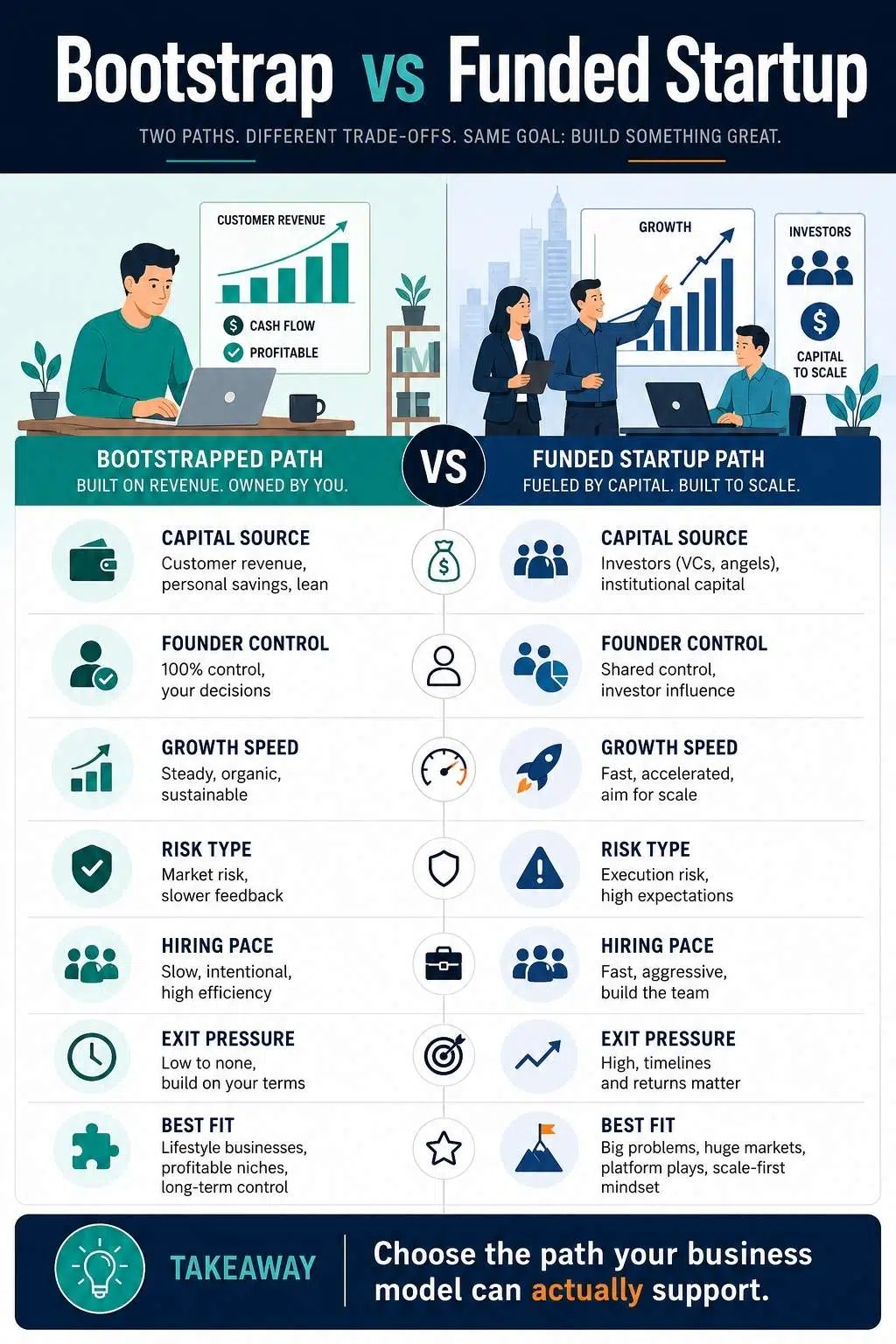
Bootstrap vs Funded Startup: Quick Comparison
Here is the cleanest way to compare both paths.
| Factor | Bootstrapped Startup | Funded Startup |
| Capital source | Founder money, revenue, small loans, customer cash | Angels, VCs, accelerators, investors |
| Control | The founder keeps more control | Control is shared with investors over time |
| Growth speed | Usually slower and more disciplined | Usually faster and more aggressive |
| Risk | More personal financial risk | More dilution and investor expectation risk |
| Hiring | Slower, based on cash flow | Faster, based on available capital |
| Profit focus | Often earlier | Often delayed for growth |
| Best fit | Niche, profitable, capital-efficient businesses | Large markets needing speed and scale |
| Exit pressure | More optionality | Higher pressure for large exits |
| Decision style | Customer and cash-flow driven | Growth, milestones, and investor-driven |
The better path is not the one that sounds more impressive. It is the one that fits the business model.
Why Founders Choose Bootstrapping
Founders choose bootstrapping when they want control, independence, and financial discipline. This path works well when the business can reach customers without huge upfront spending. It also works when the founder wants to build a sustainable company rather than chase a massive venture outcome.
Bootstrapping can be a strong fit for:
- Niche SaaS products
- Agencies turning into products
- Developer tools with low infrastructure cost
- Content-led businesses
- Profitable B2B software
- Marketplaces that can start locally
- Solo founder businesses
- Productized services
- Small but valuable vertical tools
A bootstrapped founder can make decisions based on customers, not investor timelines. You can stay small if small is profitable. You can grow slowly if slow is healthy. You can turn down markets that do not fit your values. You can decide not to exit.
That freedom is valuable. But freedom does not remove pressure. It simply changes the pressure. Instead of investor pressure, you face cash-flow pressure.
Why Founders Choose Funding
Founders raise funding when the opportunity requires more speed, capital, hiring, or market capture than the business can support alone.
Funding can make sense when:
- The market is large and competitive.
- Speed matters more than early profit.
- The product requires heavy engineering.
- Customer acquisition needs upfront investment.
- The company needs enterprise sales capacity.
- The business needs regulatory or compliance work.
- Network effects matter.
- A winner-takes-most market is forming.
- The founder wants to build a venture-scale company.
For example, a deep-tech startup, AI infrastructure company, biotech platform, fintech product, or enterprise SaaS company may need capital before revenue catches up. In these cases, bootstrapping may slow the company down too much.
Funding can buy time, talent, credibility, and distribution. But it also raises the bar. Investors usually expect the company to pursue a large market and return a meaningful multiple on their investment. That expectation should not be ignored.
Control: The Biggest Emotional Difference
Control is one of the clearest differences in bootstrapping vs VC.
Bootstrapped founders usually keep more control over:
- Product direction
- Hiring pace
- Profit decisions
- Customer segment
- Company culture
- Exit timing
- Pricing choices
- Personal lifestyle
- Long-term vision
Funded founders still lead the company, but they are no longer the only stakeholders.
Investors may influence:
- Fundraising strategy
- Executive hiring
- Board decisions
- Budget planning
- Growth targets
- Future rounds
- Exit expectations
- Strategic direction
This does not mean investors are bad. Good investors can help a company grow faster and avoid mistakes. But founders should understand the trade-off before accepting money. Once equity is sold, the company is not the same kind of company anymore.
Dilution: What Founders Need to Understand
Dilution happens when new shares are issued, and existing shareholders own a smaller percentage of the company. This usually happens during fundraising rounds, option pool creation, SAFE conversion, convertible note conversion, or employee equity grants. Dilution is not always bad.
A founder may own a smaller percentage of a much larger company. That can be a good trade if funding helps the company grow significantly.
But dilution becomes dangerous when founders raise without a clear plan, give away too much too early, accept poor terms, or fail to understand future rounds.
Founders should ask:
- How much ownership am I selling?
- What milestones will this money help us reach?
- Will this round make the next round easier?
- What happens after option pool expansion?
- What happens when SAFEs convert?
- What level of dilution is acceptable?
- Will I still be motivated after several rounds?
The best funding decision is not only about valuation. It is about ownership, control, speed, and probability of success.
Speed vs Discipline
Funding gives speed. Bootstrapping forces discipline. That is the simple version. But founders should be careful with both.
Speed without discipline can lead to waste. A funded startup may hire too fast, spend too much on weak channels, build too many features, and chase growth before retention is healthy.
Discipline without speed can also be risky. A bootstrapped startup may move too slowly, miss a market window, underinvest in product, or lose to funded competitors.
The real question is:
Does this business need speed more than control?
If the answer is yes, funding may be reasonable. If the business can grow through careful execution, customer revenue, and strong margins, bootstrapping may be better.
Bootstrapping Works Best When Revenue Can Come Early
A self-funded startup needs a path to revenue. That does not mean it must be profitable immediately. But it should have a believable way to earn before cash runs out.
Bootstrapping usually works better when:
- Customers can pay early.
- The product is not too expensive to build.
- The founder can sell directly.
- The market does not require massive paid acquisition.
- The team can stay small.
- The product has clear value.
- Margins are strong.
- Support costs are manageable.
- Growth can come from SEO, referrals, community, or founder-led sales.
For SaaS founders, bootstrapping often works when the product solves a specific, painful problem for a narrow audience. A small B2B SaaS with 200 paying customers can become a strong business without venture capital if pricing, retention, and acquisition are healthy.
Funding Works Best When the Market Rewards Scale
VC funding works best when the company can become very large. That is because venture investors do not invest for small, steady returns. They need a few companies to create large outcomes.
Funding may fit when:
- The market is huge.
- The product can scale fast.
- The company can grow much bigger with capital.
- The category is competitive.
- Network effects or platform effects matter.
- The business can support large revenue later.
- The founder wants to build a high-growth company.
- The exit potential is significant.
This is why many small profitable businesses are not good VC investments. They may be excellent companies, but not venture-scale companies. That distinction matters. A company can be successful and still be a poor fit for VC.
Bootstrapped Startup Advantages
Bootstrapping has several real advantages.
1. More Founder Control
You keep more ownership and decision-making power.
You can build the company around your values, customers, and preferred pace.
2. Stronger Financial Discipline
Limited capital forces focus.
You learn to sell, price carefully, avoid waste, and build only what customers value.
3. More Exit Optionality
You may not need a huge exit to win.
A profitable small or mid-sized company can create strong founder outcomes.
4. Customer-First Pressure
Bootstrapped companies survive because customers pay.
That pressure can make the product sharper.
5. Less Fundraising Distraction
Fundraising takes time.
Bootstrapped founders can spend more time building, selling, and supporting customers.
Bootstrapped Startup Challenges
Bootstrapping is not easy.
1. Slower Hiring
You may not be able to hire the people you need when you need them.
2. Personal Financial Risk
Using savings or unpaid founder labor can create stress.
3. Limited Experimentation
You may not have enough budget to test multiple growth channels.
4. Slower Product Development
A small team may take longer to ship key features.
5. Competitive Pressure
Funded competitors may outspend you in product, marketing, sales, and hiring.
Bootstrapping is powerful, but it requires patience and strong prioritization.
Funded Startup Advantages
Funding can create meaningful advantages.
1. Faster Growth
Capital helps you hire, build, sell, and market faster.
2. Bigger Market Push
Funding can help you capture a market before competitors do.
3. Access to Investor Networks
Good investors can open doors to customers, hires, partners, and future investors.
4. More Room for Experimentation
A funded company can test more channels, features, and markets.
5. Talent Attraction
Funding can help recruit experienced employees who expect salary and equity.
Funding can be a strong tool when speed and scale matter.
Funded Startup Challenges
Funding also creates real pressure.
1. Ownership Dilution
You give up part of the company.
Future rounds can dilute ownership further.
2. Higher Growth Expectations
Investors usually expect aggressive growth.
A slow, profitable business may not be enough.
3. Less Strategic Freedom
Investor expectations may affect product direction, hiring, and exit choices.
4. Fundraising Cycles
Raising money can become a repeated burden.
Founders may spend months pitching instead of operating.
5. Exit Pressure
VC-backed companies usually need large outcomes to satisfy investors.
That can limit smaller but healthy exit options.
Funding can accelerate a company, but it also raises the stakes.
Bootstrapping vs VC: Which Is Better for SaaS?
For SaaS, both paths can work. A bootstrapped SaaS company can grow through:
- Founder-led sales
- SEO
- Content marketing
- Product-led growth
- Referral loops
- Niche communities
- Customer revenue
- Annual plans
- Low-cost distribution
A VC-backed SaaS company can grow through:
- Larger engineering teams
- Paid acquisition
- Enterprise sales
- Partnerships
- Brand campaigns
- Faster product expansion
- International hiring
- Competitive market capture
The best choice depends on the SaaS model.
| SaaS Situation | Better Fit |
| Niche B2B product with early revenue | Bootstrap |
| Large enterprise platform with long build time | Funding |
| Product-led tool with low support cost | Either |
| AI infrastructure product needing heavy compute | Funding |
| Founder wants control and profitability | Bootstrap |
| Market is moving fast and winner-takes-most | Funding |
| Consulting business turning into SaaS | Bootstrap first |
| Product needs expensive compliance work | Funding may help |
For SaaS, the smart path is often staged. Start bootstrapped to validate the problem. Raise later only if capital clearly increases the size or speed of the opportunity.
The Hybrid Path: Bootstrap First, Raise Later
Founders do not always have to choose one path forever. A hybrid path can work well.
You can bootstrap early to:
- Validate demand
- Build an MVP
- Get first customers
- Learn positioning
- Improve retention
- Prove willingness to pay
- Avoid weak early dilution
Then raise funding later when:
- The market opportunity is clearer.
- Customers are paying.
- Retention looks healthy.
- Growth channels are working.
- Capital can accelerate what already works.
This gives founders more leverage. Raising before validation often means selling uncertainty. Raising after traction means selling momentum. A hybrid path can reduce risk and improve fundraising terms.

How to Choose Your Funding Path
Use these questions before deciding.
1. How Big Is the Market?
If the market is small but profitable, bootstrapping may be better.
If the market is huge and fast-moving, funding may help.
2. How Expensive Is the Product to Build?
If you can build with a small team, bootstrap may work.
If the product needs heavy engineering, compliance, data, hardware, or research, funding may be necessary.
3. How Soon Can Customers Pay?
If customers can pay early, self-funding becomes easier.
If revenue will take years, outside capital may be needed.
4. How Fast Are Competitors Moving?
If speed matters, underfunding can hurt.
If differentiation comes from focus and customer trust, bootstrapping can work.
5. What Kind of Life Do You Want?
This matters more than founders admit.
A venture-backed company can become intense. A bootstrapped company can also be stressful, but the pressure is different.
6. What Exit Would Feel Like a Win?
If a $5 million or $20 million exit would be life-changing, bootstrapping may preserve more optionality.
If the goal is to build a billion-dollar company, venture funding may fit better.
Common Mistakes Founders Make
Mistake 01: Raising Because It Looks Impressive
Funding is not successful.
It is a tool. The real question is whether the money helps you build a stronger company.
Mistake 02: Bootstrapping When the Business Needs Capital
Some markets require speed, hiring, or infrastructure.
Refusing funding can be risky if capital is truly needed.
Mistake 03: Taking Money Without Understanding Dilution
Founders should understand how each round, SAFE, note, and option pool affects ownership.
Do not outsource this completely.
Mistake 04: Copying Another Founder’s Path
A bootstrapped SaaS, a consumer app, a biotech company, and a marketplace may need very different funding paths.
Copying blindly creates bad decisions.
Mistake 05: Raising Before Knowing the Customer
Funding can hide weak demand for a while.
But eventually, the market tells the truth.
Mistake 06: Ignoring Profitability Forever
Even funded companies need a path to efficient growth.
Capital markets change. Growth without discipline can become dangerous.
Mistake 07: Treating Bootstrapping as Morally Superior
Bootstrapping is not automatically more noble.
Funding is not automatically reckless. The right path depends on the business.
Final Thoughts
Bootstrap vs funded startup is not a debate about which founder is smarter. It is a decision about fit. Bootstrapping gives you control, discipline, and optionality. It works best when the business can reach revenue early, stay capital-efficient, and grow through customer demand.
Funding gives you speed, resources, and scale potential. It works best when the market is large, competitive, and worth pursuing aggressively.
Neither path removes risk. Bootstrapping concentrates risk on the founder. Funding spreads financial risk but adds dilution, expectations, and pressure. The best founders do not choose based on hype. They choose based on the business they are building.
If capital helps you reach a meaningful milestone faster, funding may be the right tool. If customer revenue can support your growth, bootstrapping may give you a stronger and more independent company.
The right answer is not “bootstrap always” or “raise always.” The right answer is the path that gives your startup the best chance to become the company you actually want to build.
Frequently Asked Questions About Bootstrap vs Funded Startup
1. What is the difference between a bootstrap and funded startup?
A bootstrapped startup grows using founder money, customer revenue, or operating cash flow. A funded startup raises outside capital from investors such as angels, venture capital firms, or accelerators in exchange for equity or future equity.
2. Is bootstrapping better than VC funding?
Bootstrapping is better when founders want control, can reach revenue early, and can grow without large upfront capital. VC funding is better when the market is large, speed matters, and the company needs capital to build, hire, or scale quickly.
3. What is a self-funded startup?
A self-funded startup is a company financed mostly by the founder’s own resources, early revenue, or business cash flow instead of outside investors. It is commonly called a bootstrapped startup.
4. What are the disadvantages of bootstrapping?
The main disadvantages of bootstrapping include slower hiring, limited marketing budget, personal financial risk, slower product development, and less room for experimentation.
5. What are the disadvantages of venture funding?
The main disadvantages of venture funding include ownership dilution, investor expectations, fundraising pressure, reduced control, and pressure to pursue a large exit.
6. Can a startup bootstrap first and raise funding later?
Yes. Many startups bootstrap early to validate demand, build an MVP, get customers, and improve retention. They may raise funding later when capital can accelerate a proven opportunity.
7. How should founders choose between bootstrapping and VC?
Founders should consider market size, product cost, speed needed, customer willingness to pay, personal risk tolerance, desired control, exit goals, and whether outside capital clearly improves the company’s chances.