AI-generated audio has reached a strange point. It can sound polished, believable, emotional, and sometimes close enough to a real human voice that the average listener may not question it at first.
That creates a serious problem.
A synthetic podcast clip can spread without context. A cloned voice can make a person appear to say something they never said. A brand can publish AI-generated narration without clear disclosure. A training video, ad, audiobook, or customer support recording can be copied, edited, reposted, and separated from its original source.
This is where audio watermarking AI becomes important.
Audio watermarking is not a magic truth machine. It will not solve every problem around deepfakes, voice cloning, copyright, or misinformation. But it can add a hidden or machine-readable signal to audio so platforms, tools, publishers, or rights holders have a better way to identify whether a file came from an AI system or approved production workflow.
Used well, audio watermarking AI can support transparency, accountability, and content tracking. Used carelessly, it can create a false sense of safety. The real goal is not to pretend watermarking solves everything. The goal is to understand where it helps, where it fails, and how it fits into a broader trust system for AI-generated content.
What Is Audio Watermarking AI?
Audio watermarking AI is the use of watermarking techniques to mark, identify, or verify AI-generated audio.
A watermark is a signal embedded into an audio file. In most professional systems, the signal is designed to be hard for normal listeners to notice but detectable by a matching tool or system. The watermark may indicate that the audio was generated by AI, created by a specific model, produced through a certain platform, or linked to a known provenance record.
In simple terms, the audio carries a hidden clue about where it came from.
Audio watermarking AI may be used for:
- AI-generated voices
- Synthetic narration
- Voice cloning
- AI music
- AI sound effects
- AI dubbing
- AI podcast clips
- Generated ads
- Educational audio
- Customer support voice agents
- Audiobook narration
- Social media audio
The main purpose is to make AI-generated audio easier to identify later. That identification may help with disclosure, moderation, rights management, forensic review, or brand protection.
But there is an important limit. A watermark can help answer whether a detectable mark is present. It does not automatically prove that every unmarked file is human-made, safe, ethical, or authentic.
How Audio Watermarking Works
Audio watermarking usually works by embedding a subtle signal into the audio itself.
That signal may be placed in parts of the sound that listeners are unlikely to notice. It may survive normal edits such as compression, re-exporting, trimming, or small changes in volume. A detector later checks the file and looks for the watermark pattern.
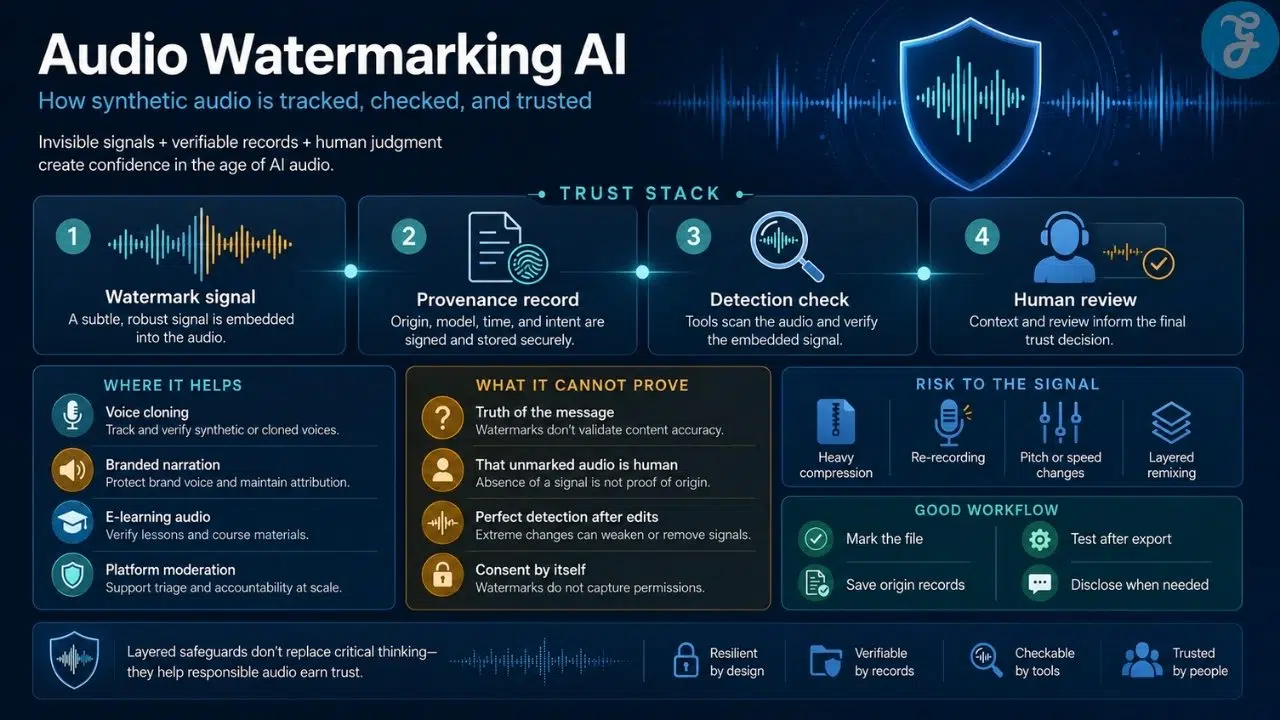
A basic workflow looks like this:
- An AI system generates audio.
- A watermark is embedded into the output.
- The audio is published, stored, shared, or distributed.
- A detection system checks whether the watermark is present.
- The result helps identify the audio as AI-generated or linked to a known source.
Some systems may also embed a small message, such as an ID or metadata reference. Others may only signal that the audio likely came from a watermarked generation system.
The strongest watermarking systems try to balance three things: the mark should be hard to hear, hard to remove, and reliable to detect. That balance is difficult. If the watermark is too strong, it may affect quality. If it is too weak, it may disappear after editing or compression.
Good audio watermarking AI has to work in the real world, not just in a lab sample.
Watermarking Is Not the Same as AI Audio Detection
Audio watermarking and AI audio detection are related, but they are not the same thing.
Audio watermarking looks for an embedded signal. It works best when the audio was generated or processed by a system that intentionally added a watermark.
AI audio detection tries to decide whether audio is synthetic based on patterns in the sound itself. It may analyze voice artifacts, spectral clues, timing, pitch behavior, compression traces, or model-like signatures.
Both approaches have limits.
Watermarking may fail if the audio was generated by a system that does not watermark outputs, if the watermark was damaged, or if the audio was heavily edited. AI audio detection may produce false positives or false negatives, especially as synthetic voices become more realistic and audio is compressed, mixed, or modified across platforms.
This is why serious verification should not depend on one signal only.
A better trust system combines watermarking, AI audio detection, audio provenance, platform records, metadata, human review, and context. No single layer is enough.
Why Audio Provenance Matters
Audio provenance means information about where an audio file came from, how it was created, and what happened to it over time.
For AI-generated content, provenance can help answer questions like:
- Who created this audio?
- Was it generated, recorded, edited, or cloned?
- Which tool or workflow produced it?
- Was it modified after creation?
- Is there a trusted source attached to it?
- Does the file match its claimed origin?
A watermark can be part of audio provenance, but it is not the whole system. Provenance may also include metadata, cryptographic signatures, content credentials, publishing records, platform logs, and editorial documentation.
This matters because AI audio often loses context when it moves online. A voice clip may be cut from a video, reposted without attribution, compressed by a platform, or stripped of metadata. Once that happens, it becomes harder to know whether the clip is real, synthetic, edited, or misleading.
Audio watermarking AI can help preserve a connection to origin, but it works best when paired with stronger provenance practices.
Where Audio Watermarking AI Helps Most
Audio watermarking AI is most useful when there is a clear production chain and a need for later verification.
Good use cases include:
- AI voice platforms marking synthetic speech
- Brands tracking approved AI narration
- Newsrooms labeling generated audio assets
- E-learning teams managing AI voiceovers
- Audiobook publishers verifying synthetic narration
- Platforms detecting generated voice clips
- Companies controlling approved voice clones
- Ad teams managing AI-generated audio campaigns
- App developers labeling synthetic voice responses
- Content owners tracking licensed AI audio outputs
In these cases, watermarking adds a useful layer of accountability. It can help distinguish approved generated audio from unknown or manipulated copies. It can also help teams enforce internal policies, especially when many people are producing audio across departments, vendors, or markets.
For example, a brand using AI voiceovers may want every approved narration file to carry a detectable mark. If an unapproved clip later appears online, the team can check whether it came from the official workflow or somewhere else.
That is a practical use of watermarking: not as a public-relations badge, but as part of operational control.
Where Audio Watermarking Can Fail
Watermarking has limits, and those limits matter.
A watermark may be weakened or removed by aggressive editing, heavy compression, noise addition, format conversion, re-recording through speakers, pitch changes, speed changes, or adversarial attacks. Some watermarking systems are more robust than others, but no method should be treated as impossible to damage.
There is also a coverage problem. Watermarking only works when the audio was watermarked in the first place. If a tool does not embed a mark, a detector for that watermark will not find one. That does not prove the audio is human-made. It only proves that this specific detectable mark was not found.
Another issue is trust. If watermarking systems are closed, fragmented, or platform-specific, it may be difficult for outside reviewers to verify results. If too many companies use different watermarking methods, the ecosystem becomes confusing.
Common failure points include:
- Watermarks damaged by editing or compression
- Unmarked AI audio from other tools
- False confidence in negative results
- Lack of standardization
- Limited public verification
- Metadata being stripped by platforms
- Difficulty handling short clips
- Challenges with mixed audio, music, noise, or speech overlays
- Attempts to remove or forge watermarks
The practical lesson is simple: use watermarking as evidence, not as the whole case.
Voice Watermarking and Voice Cloning
Voice watermarking is especially important because synthetic speech can imitate real people.
A voice clone can be used for helpful purposes, such as audiobook narration, accessibility, multilingual dubbing, or approved brand communication. It can also be misused for impersonation, scams, fake endorsements, harassment, or political misinformation.
A voice watermark can help mark audio that was produced through an approved voice-cloning system. This may help platforms or organizations identify whether a clip came from a legitimate synthetic voice workflow.
But voice watermarking does not replace consent.
If a real person’s voice is cloned, the person should clearly approve how that voice is used. The production team should document permission, allowed languages, allowed platforms, duration of use, and whether the voice can be reused or modified later.
A watermark can help trace audio. It cannot make unethical voice cloning ethical.
For brands, executives, actors, educators, and public figures, this matters. The voice is not just a sound file. It is identity.
Watermarking AI Music and Sound Effects
Audio watermarking AI is not only about spoken voice.
AI music and AI sound effects can also raise questions about origin, licensing, and disclosure. A generated track may appear in a video, ad, game, podcast, or social clip. A generated sound effect may become part of an app, game, or brand asset.
Watermarking can help identify whether an asset came from an AI generation system. It may also support licensing records, platform review, or internal content management.
Still, audio assets are often edited heavily. Music may be mixed with voiceover. Sound effects may be layered with other sounds. Tracks may be compressed, shortened, looped, or altered. Those changes can make watermarking harder.
That is why production records still matter. Save the prompt, tool name, license terms, generation date, downloaded file, and final edited version. The watermark may help, but the paper trail protects the workflow.
What Good Audio Watermarking Should Do
A useful audio watermark should meet several practical standards.
It should be hard for listeners to hear. If the watermark damages quality, creators will resist using it.
It should survive common edits. Compression, trimming, volume changes, and normal publishing workflows should not destroy it too easily.
It should be detectable with a reliable tool. A watermark is not useful if detection is slow, fragile, or unclear.
It should minimize false results. False positives can wrongly label real audio as AI-generated. False negatives can miss marked content.
It should work across realistic audio conditions. Social platforms, messaging apps, video editors, and streaming services all change audio in different ways.
It should support privacy and security. A watermarking system should not expose sensitive production data to the wrong people.
It should fit into a wider provenance system. Watermarking is stronger when connected to metadata, content credentials, editorial records, and platform policies.
The goal is not only to mark audio. The goal is to make the mark useful when the file leaves the original production environment.
How Creators and Brands Should Use Audio Watermarking AI
For creators and brands, audio watermarking should be part of a larger publishing workflow.
Start by deciding which audio needs marking. Not every draft, test, or internal clip needs the same process. Public-facing audio, voice clones, ads, branded narration, training material, and customer-facing synthetic speech deserve stronger controls.
Then decide how provenance will be documented. Keep records of the tool used, prompt or script, generation date, license, approval status, and final file version.
If the audio uses a cloned or synthetic version of a real person’s voice, document consent. Do not treat this as a minor admin task. It is the foundation of trust.
Before publishing, decide whether disclosure is needed. In many cases, audiences should know when a voice, narration, or audio asset is AI-generated, especially if it could be mistaken for a real person or real recording.
A practical workflow may look like this:
- Generate or record the audio.
- Add or confirm the watermark.
- Save production and license records.
- Review the audio for quality and accuracy.
- Document consent for cloned voices.
- Add disclosure where appropriate.
- Store the final approved file.
- Test detection after export or platform upload.
- Keep a version history.
This may sound like extra work. It is. But it is less painful than trying to prove origin after a file has already spread without context.
How Platforms Can Use AI Audio Detection and Watermarking
Platforms have a harder job than individual creators.
They may need to detect AI-generated clips at scale, review reported audio, identify impersonation attempts, manage policy enforcement, and handle appeals. Watermarking can help, but only if detection is reliable and the platform knows how to interpret results.
A platform should not treat watermark detection as a single yes-or-no judgment. It should be one signal among many.
For example, a marked clip may require labeling, review, or policy checks. An unmarked clip may still need AI audio detection if there are signs of impersonation or manipulation. A suspicious voice clip may need human review, source comparison, user reporting, and context.
Platforms should also be careful with false accusations. Incorrectly labeling someone’s real voice as AI-generated can create serious harm.
Good policy needs technical signals and human judgment.
Common Mistakes With Audio Watermarking AI
Treating Watermarks as Proof of Truth
A watermark can show that a file carries a detectable mark. It does not prove the message is accurate, ethical, or safe.
Assuming Unmarked Means Human
An unmarked file may still be AI-generated. It may come from a tool without watermarking or from a workflow that damaged the mark.
Ignoring Provenance Records
A watermark is stronger when paired with records. Save tool names, dates, licenses, prompts, scripts, consent files, and approved versions.
Forgetting About Editing
Compression, trimming, remixing, noise, pitch shifts, and re-recording can affect watermark detection. Test the watermark after export, not only before editing.
Skipping Consent for Voice Cloning
Voice watermarking does not replace permission. If a real voice is cloned, consent must come first.
Overpromising Detection
AI audio detection and watermarking both have limitations. Avoid claiming that a system can catch everything.
Best Practices for Audio Provenance
Use audio watermarking AI where the stakes justify it, especially for public synthetic speech, branded audio, voice cloning, ads, education, and high-reach media.
Pair watermarking with metadata and content records. A hidden signal is useful, but a documented workflow is stronger.
Keep original and final files. If a dispute appears later, having both matters.
Test detection after editing and export. A watermark that works before compression but fails after upload may not help much.
Disclose AI-generated audio when the audience could reasonably be misled. This matters most for voices, realistic recordings, news-like content, endorsements, and public figures.
Avoid cloning voices without clear consent and defined usage rights.
Do not rely only on AI audio detection. Use detection, watermarking, provenance, human review, and context together.
Treat negative results carefully. “No watermark found” is not the same as “this is real.”
The Real Role of Audio Watermarking AI
The real role of audio watermarking AI is not to solve trust by itself.
Its role is to add a traceable layer to synthetic audio. That layer can help creators manage assets, platforms review content, brands protect voice identity, and audiences get more context about what they are hearing.
But trust is never built by a watermark alone.
Trust comes from clear consent, honest disclosure, careful production records, strong platform policies, and realistic expectations about what detection can and cannot prove.
AI-generated audio will only become easier to create. That makes origin and accountability more important, not less.
Audio watermarking AI is one part of that answer. The rest is human responsibility.
Frequently Asked Questions (FAQs) About Audio Watermarking AI
What is audio watermarking AI?
Audio watermarking AI is the use of watermarking methods to mark, identify, or verify AI-generated audio. The watermark is usually designed to be difficult for listeners to notice but detectable by a matching system.
Is audio watermarking the same as AI audio detection?
No. Audio watermarking looks for an embedded signal, while AI audio detection analyzes audio for signs that it may be synthetic. Both can help, but neither is perfect.
What is audio provenance?
Audio provenance is information about where an audio file came from, how it was created, and whether it was edited or generated. It may include metadata, watermarks, content credentials, platform records, and production documentation.
What is a voice watermark?
A voice watermark is a hidden or detectable signal added to synthetic speech or voice-cloned audio. It can help identify whether the audio came from a known AI voice generation workflow.
Can audio watermarks be removed?
Some watermarks may survive common edits, but no watermark should be treated as impossible to damage or attack. Compression, editing, re-recording, noise, and adversarial changes may affect detection.
Does no watermark mean audio is real?
No. If no watermark is found, it only means that a specific detectable watermark was not detected. The audio could still be AI-generated, edited, or produced by an unmarked system.