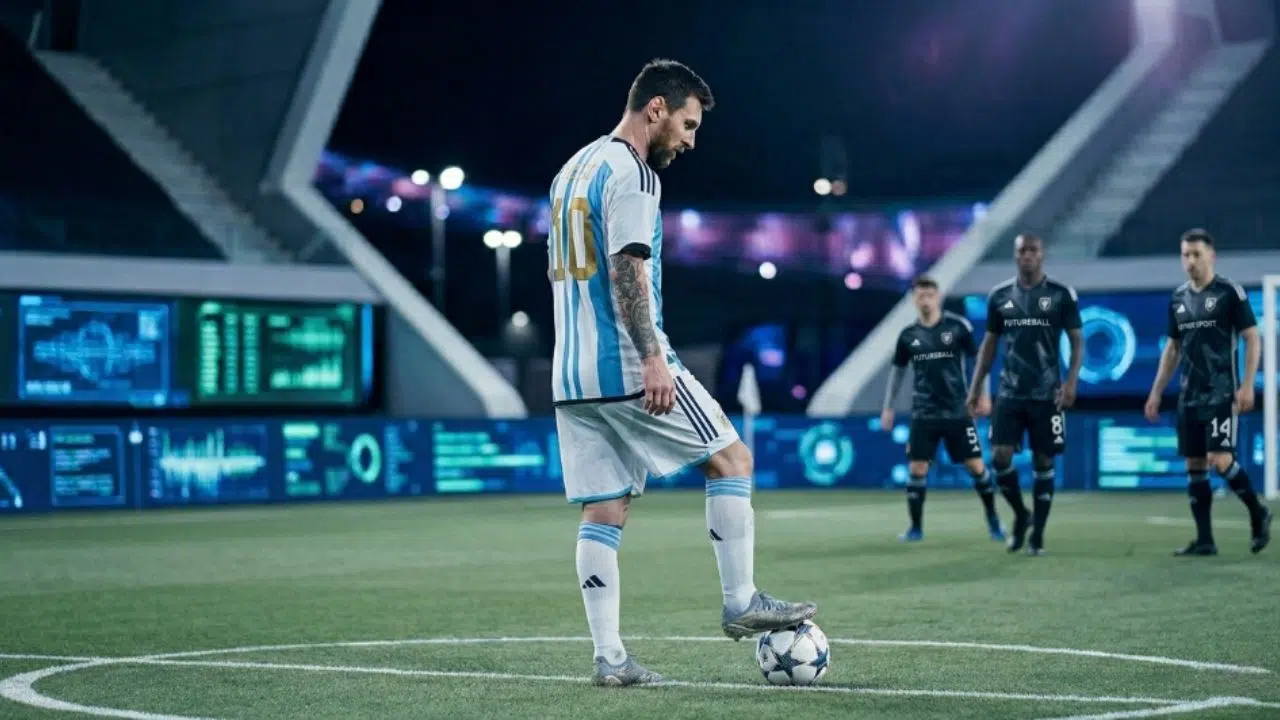
Most football debates eventually end in arithmetic.
How many goals?
How many FIFA world cup goals in total?
How many trophies?
How many Ballons d’Or?
How many records?
The problem is that arithmetic is often the least interesting way to understand greatness.
As Lionel Messi turns 39, football finds itself in a familiar cycle of celebration. The goals are replayed. The trophies are counted. The records are listed. The World Cup triumph in Qatar is revisited once again as the crowning achievement of a career many consider unmatched.
Yet the most important thing about Messi was never a number.
Not the goals.
Not the assists.
Not the trophies.
Not even the World Cup.
His greatest achievement was changing the way football understands greatness itself.
That may sound like an ambitious claim. It is also the strongest explanation for why Messi’s influence continues to grow even as his career approaches its final chapter.
Football has always celebrated winners. Messi became something rarer. He became a reference point.
The sport now evaluates greatness differently because of him.
The World Cup Finished the Story. It Did Not Create It.
For more than a decade, the World Cup hovered over every conversation about Messi.
The logic seemed simple. To stand alongside football’s most celebrated legends, he needed to win the sport’s biggest prize.
When Argentina lifted the trophy in December 2022, that argument largely disappeared.
The victory mattered. Any honest assessment must acknowledge that.
International football carries a unique emotional weight. Club success can make a player famous. World Cup success can make a player immortal.
That is precisely why Qatar became such a powerful moment.
But it is also why the tournament has sometimes distorted the conversation around Messi.
A single competition, no matter how prestigious, cannot explain a career that reshaped football for nearly two decades.
Imagine the World Cup final had ended differently.
Would Messi suddenly have become a less intelligent footballer?
Would his vision have mattered less?
Would the years of brilliance at Barcelona disappear?
Would the countless moments that altered matches, seasons, and football history somehow lose value?
The answer is obvious.
The World Cup strengthened Messi’s legacy.
It did not create it.
His influence on football was already secure long before Qatar.
The tournament completed a narrative. It did not define one.
Football’s Shift Toward Efficiency
Part of what makes Messi’s career so remarkable is the era in which it unfolded.
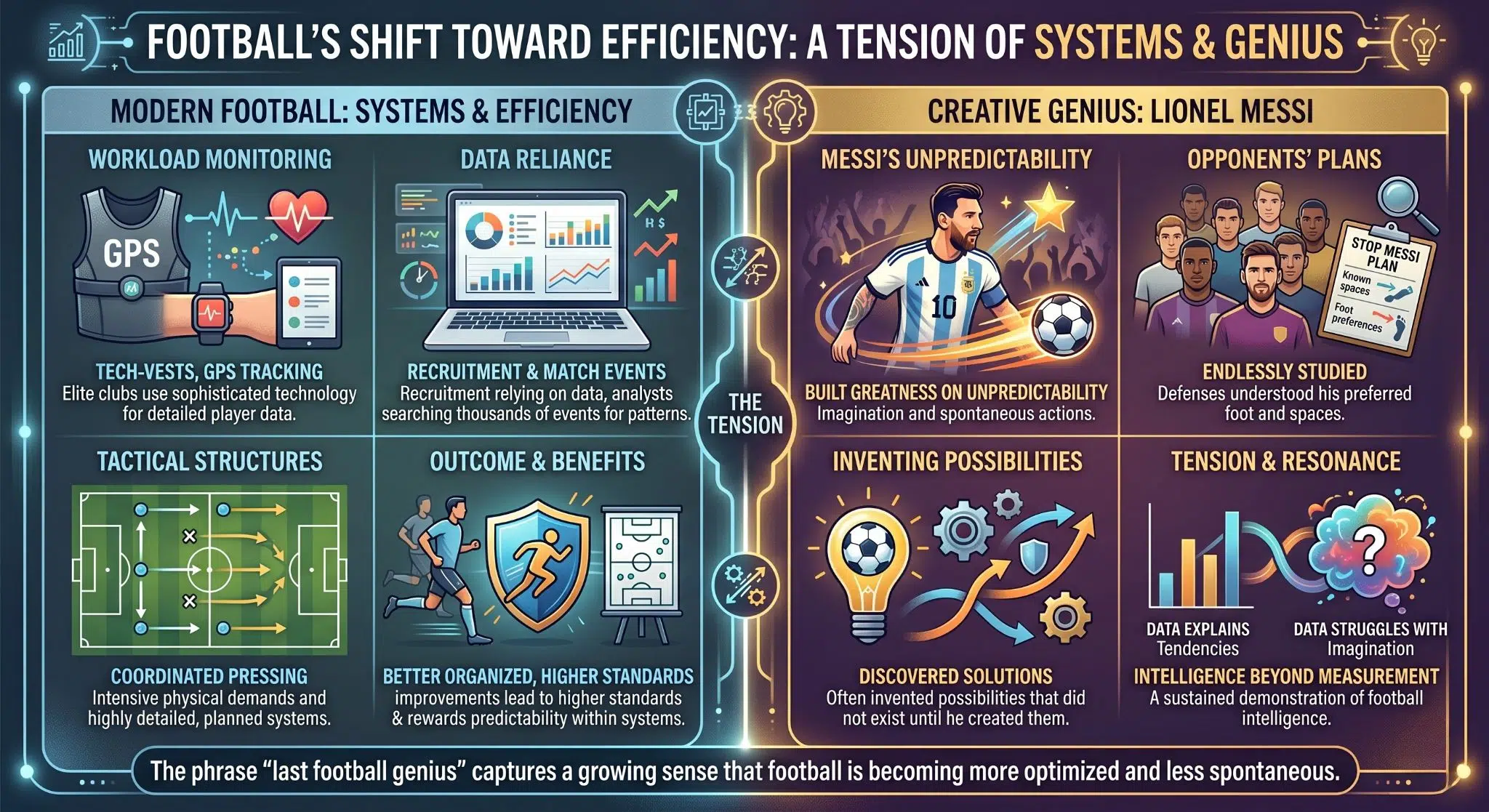
Modern football is increasingly shaped by systems.
Elite clubs monitor player workloads through sophisticated tracking technology. Recruitment departments rely heavily on performance data. Analysts examine thousands of match events searching for patterns and advantages. Tactical structures have become more detailed, pressing systems more coordinated, and physical demands more intense.
These developments have improved the sport.
Players are fitter.
Teams are better organized.
Coaching standards are higher.
But football’s growing focus on efficiency creates an interesting tension.
The game increasingly rewards predictability within systems.
Messi built his greatness on unpredictability.
Opponents studied him endlessly.
Defenders knew his preferred foot.
Analysts understood his favorite spaces.
Coaches spent entire weeks preparing plans designed specifically to stop him.
Yet he repeatedly discovered solutions that preparation alone could not anticipate.
That distinction matters.
Many elite footballers execute instructions brilliantly.
Messi often seemed to invent possibilities that did not exist until he created them.
The available evidence from modern football suggests that data can explain many things about performance. It can explain where chances emerge. It can identify patterns. It can reveal tendencies.
What it still struggles to explain fully is imagination.
Messi’s career became a sustained demonstration of football intelligence operating beyond conventional measurement.
That is why the phrase “last football genius” resonates with so many supporters. Whether one agrees with it or not, it captures a growing sense that football is becoming more optimized and less spontaneous.
The Last Link in a Special Lineage
Every generation believes its heroes are unique.
Usually, that belief is exaggerated.
In Messi’s case, there is a stronger argument.
Football has produced extraordinary creative figures before him.
Pelé expanded what the sport could become on a global stage.
Johan Cruyff changed how football could be played and understood.
Diego Maradona showed how individual brilliance could bend entire matches around one player.
Zinedine Zidane brought elegance to football’s biggest occasions.
Messi belongs within that lineage.
But he achieved his greatness under conditions that were arguably more demanding.
Modern defenders are faster than those of previous generations.
Modern tactical preparation is far more detailed.
Video analysis exposes habits and tendencies almost instantly.
The margins are smaller.
The spaces are tighter.
The scrutiny is relentless.
Despite those realities, Messi consistently produced moments that felt immune to football’s increasing standardization.
That is what separates him from many great players.
He was not simply effective.
He was surprising.
And surprise has become one of the sport’s rarest resources.
The Three Standards Messi Changed
The most lasting influence of Lionel Messi at 39 may not be found in any record book.
It may be found in the standards he established.
First, he demonstrated that greatness does not require constant self-promotion.
Modern sports culture often rewards visibility as much as performance. Messi followed a different path. His influence emerged primarily from what happened on the pitch.
Second, he reinforced the value of creativity at a time when football increasingly celebrates measurable outputs. Goals, assists, expected goals, progressive carries, and pressing statistics all matter. Yet Messi reminded the sport that the hardest skill to quantify may still be the most valuable: seeing possibilities others cannot see.
Third, he showed that longevity is about adaptation rather than preservation.
The explosive teenager who emerged at Barcelona was not the same player who lifted the World Cup in his mid-thirties.
His game evolved.
His movement changed.
His responsibilities shifted.
Yet his influence remained extraordinary.
That ability to reinvent himself may prove every bit as impressive as the records themselves.
What the Other Side Gets Right
Any serious discussion of Messi’s legacy must acknowledge the strongest counterargument.
Football is ultimately about winning.
The World Cup is football’s highest achievement.
Therefore, winning it should be considered the defining accomplishment of any player’s career.
There is genuine merit in that position.
World Cups shape how history remembers players.
They create moments that transcend sport.
The emotional significance of international success cannot be dismissed.
Critics of this article would reasonably argue that separating Messi from the World Cup misunderstands football’s competitive nature.
That criticism deserves respect.
Where the argument becomes less convincing is when it assumes that achievement and legacy are identical concepts.
They are related, but they are not the same.
Achievement concerns what a player wins.
Legacy concerns what a player changes.
The World Cup was Messi’s greatest trophy.
His influence on football’s understanding of greatness remains his greater contribution.
Both statements can be true simultaneously.
What Most People Get Wrong About Lionel Messi at 39
Most people think Messi’s legacy is fundamentally about records.
The stronger argument is that it is about standards.
Records eventually fall.
Someone may score more goals.
Someone may win more trophies.
Someone may even collect more individual awards.
History tends to produce new statistical leaders.
Changing standards is harder.
Messi changed expectations.
He showed that intelligence could dominate a sport increasingly obsessed with physicality.
He showed that humility and greatness were not mutually exclusive.
He showed that leadership could be quiet.
Most importantly, he showed that imagination still mattered.
That may prove more durable than any record.
A Better Way to Think About This
Football will continue evolving.
Data analysis will become more sophisticated.
Artificial intelligence will play a larger role in scouting, preparation, and recruitment.
Tactical systems will become more refined.
Players will become faster, stronger, and more efficient.
None of that is necessarily bad.
Progress is part of every sport.
The question is whether football can continue making room for imagination alongside optimization.
That is why Lionel Messi at 39 remains such a fascinating figure.
The World Cup completed his career story, but it is not the reason that story matters.
His lasting contribution was reminding football that greatness cannot be reduced to a spreadsheet, a trophy cabinet, or a collection of records.
Years from now, supporters will still debate who scored more, won more, or achieved more.
A more interesting question will remain.
When football became increasingly obsessed with systems, who reminded the sport to keep believing in genius?
For an entire generation, the answer was Lionel Messi.
Happy birthday, Leo Messi! Throughout this glorious 39-year journey, you haven’t just won trophies and records—you have kept alive the deep emotions of millions and the fairytale of beautiful football. Endless gratitude for those magical moments on the pitch; the football world will forever remain indebted to your magic.