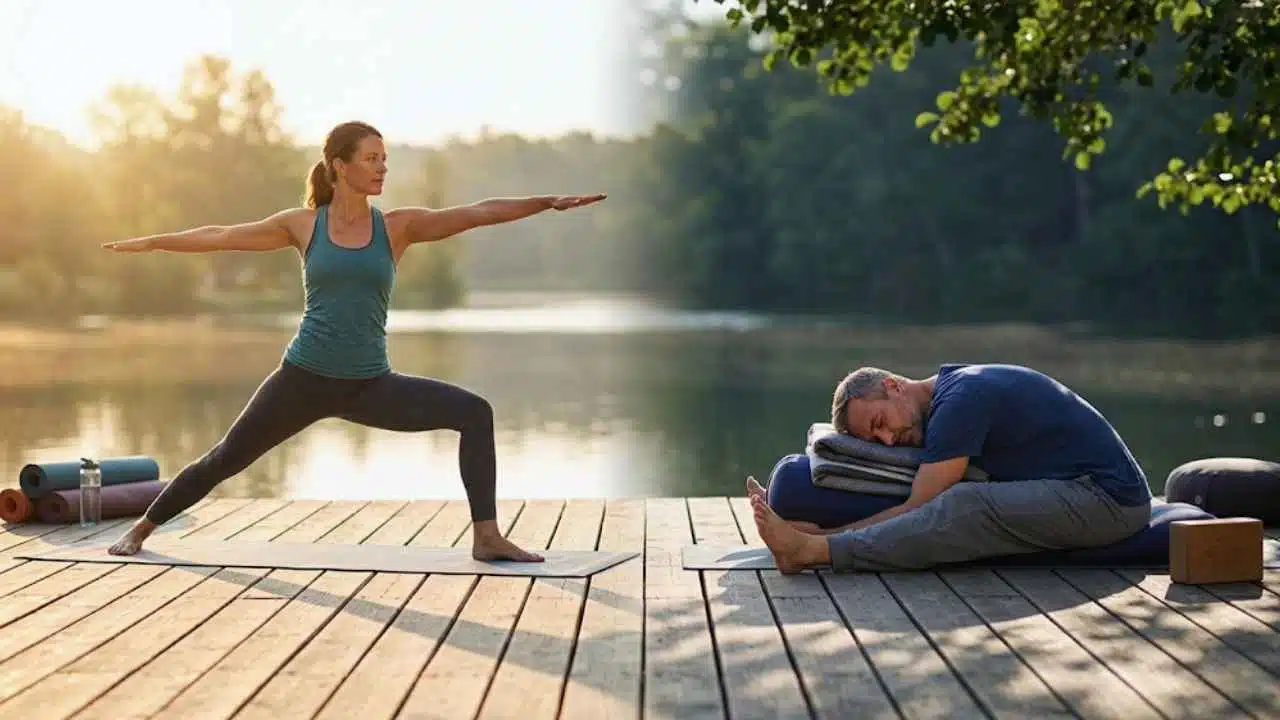
Yoga styles compared side by side can help beginners avoid one of the biggest early mistakes: choosing a class that does not match their body, schedule, stress level, or fitness goal. Some people walk into a fast Vinyasa class when they actually need gentle mobility. Others try Yin yoga and feel confused because they expected a workout.
For busy professionals, the right yoga practice should support posture, breathing, recovery, stress management, flexibility, and mental clarity without becoming another pressure-heavy routine. This guide explains the major types of yoga in a practical way, including Hatha, Vinyasa, Yin, Restorative, Iyengar, Ashtanga, Power Yoga, Hot Yoga, Chair Yoga, and Yoga Nidra. It also connects naturally with the broader Mental Wellness Guide because yoga sits at the center of mind-body health.
For Editorialge Media LLC’s Corporate Athlete audience, and for readers of HappinessFit.com, the goal is simple: choose a yoga style that fits real life, supports recovery, and helps the body and mind work better together.
Why Comparing Yoga Styles Matters Before You Start?
Yoga can look simple from the outside, but the experience changes completely depending on the style. One class may feel slow, quiet, and restorative. Another may feel sweaty, athletic, and challenging. Another may focus heavily on alignment, props, breath, or meditation. This is why comparing yoga styles matters before you commit to a practice. The wrong class can make a beginner feel like yoga is too hard, too slow, too spiritual, too boring, or too intense, even when the real issue is simply a poor match.
I have seen this mistake often with beginners and desk-heavy professionals. Someone hears that yoga helps stress and joins a fast flow class after a long workday. Instead of feeling calmer, they feel rushed, unstable, and frustrated. Another person wants flexibility and joins a very passive restorative class, then wonders why it does not feel like stretching enough. Both people may quit too early because they judged yoga from one mismatched experience.
A practical yoga styles guide should start with your goal. Do you want stress relief? Better posture? More mobility? A stronger body? A calmer evening routine? Help with desk stiffness? A gentle recovery day? A movement practice that fits between work blocks? The answer changes the best style.
For the corporate athlete, yoga should not become another performance test. It should support the body that sits, types, thinks, meets deadlines, manages pressure, and carries tension. That means choosing yoga practice based on real needs, not trend pressure.
| Your Main Goal | Better Yoga Style to Consider |
| Learn basics | Hatha or beginner Iyengar |
| Reduce stress | Restorative, Yin, Yoga Nidra |
| Improve flexibility | Yin, Hatha, mobility-focused yoga |
| Build strength | Vinyasa, Power Yoga, Ashtanga |
| Improve posture | Iyengar, Hatha, Chair Yoga |
| Desk-worker recovery | Chair Yoga, Hatha, Restorative |
| Better sleep support | Yoga Nidra, Restorative, gentle evening yoga |
| Active workout feel | Vinyasa, Power Yoga, Hot Yoga |
The best yoga style is not the most advanced one. It is the one you can repeat safely and actually enjoy.
What Yoga Really Offers for Mind-Body Health?
Yoga is not only stretching. That is the first thing beginners need to understand. Yoga combines movement, breathing, attention, posture, balance, strength, mobility, stillness, and body awareness. Some styles are more physical. Some are more relaxing. Some feel almost like meditation. But the common thread is connection between the body and mind. This is why yoga fits naturally inside a mental wellness system. Stress is not only mental. It shows up in the shoulders, jaw, breath, back, hips, stomach, sleep, and mood. A yoga practice can help people notice those body signals earlier. When someone slows down enough to feel where tension lives, they often make better choices during the day.
For busy professionals, this matters because desk work creates a specific pattern. The hips tighten. The chest closes. The neck leans forward. The upper back stiffens. Breathing becomes shallow during focused work. By evening, the body may feel locked while the mind feels overstimulated. Yoga can help interrupt that pattern when practiced consistently and safely.
Yoga also teaches pacing. This is valuable for people who are used to forcing productivity. In yoga, pushing harder is not always better. Sometimes the useful choice is to breathe, modify, use a prop, hold less deeply, or rest. That lesson carries into stress management, fitness, and recovery. The goal is not to become flexible enough for impressive poses. The goal is to build awareness, control, calm, strength, and recovery capacity. That is why yoga works so well as part of a Corporate Athlete wellness routine.
| Yoga Element | How It Supports Wellness |
| Breath awareness | Helps regulate stress response |
| Gentle movement | Reduces stiffness from sitting |
| Strength holds | Builds control and stability |
| Balance work | Improves focus and coordination |
| Slow stretching | Supports mobility and relaxation |
| Body scanning | Improves awareness of tension |
| Stillness | Helps mental decompression |
| Recovery poses | Supports rest and nervous system calm |
Yoga is not a cure-all. But as part of a balanced system, it can become one of the most practical mind-body tools.
Hatha Yoga: Best for Learning the Basics
Hatha yoga is often one of the best starting points for beginners because it usually moves at a slower pace than more athletic flow styles. The word “Hatha” can be used broadly, so classes may vary, but in many modern studios it means a gentler class focused on basic poses, breathing, and alignment. This makes it useful for people who want to understand yoga without feeling rushed.
For desk workers, Hatha can be a strong entry point because it gives time to notice posture and tension. You can feel how tight your hips are, how your shoulders sit, how your breath changes in different positions, and where balance feels weak. That awareness matters more than people think. Many professionals are disconnected from their bodies until discomfort becomes obvious.
In practice, Hatha usually includes standing poses, seated poses, gentle stretches, simple balance work, and breathing. It may not feel like a heavy workout, but it can still build strength and control if you are new. Holding basic poses with good form can be challenging in a quiet way.
The advantage of Hatha is that it gives beginners time. You are not constantly moving from one pose to the next. You can learn what a pose is supposed to feel like. You can adjust. You can breathe. You can ask for modifications if needed. The downside is that some classes may feel too slow for people who want intensity. That does not mean Hatha is ineffective. It means the goal is different. Hatha is about foundation, not speed.
| Hatha Yoga Factor | What to Expect |
| Pace | Slow to moderate |
| Intensity | Beginner-friendly to moderate |
| Best for | Basics, posture, breath, mobility |
| Good for desk workers | Yes |
| Main benefit | Learning control and alignment |
| Watch out for | Classes vary by teacher |
Hatha is a smart first step if you want yoga to feel understandable instead of intimidating.
Vinyasa Yoga: Best for Flow, Energy, and Movement
Vinyasa yoga connects movement with breath. Instead of holding each pose for a long time, you usually move through sequences in a flowing rhythm. This can feel energizing, athletic, and creative. Many people enjoy Vinyasa because it feels less static than slower yoga styles.
For beginners, Vinyasa can be both exciting and challenging. The movement can build heat, strength, coordination, and stamina. It can also feel fast if you do not know the poses yet. This is where many new students struggle. They look around the room, try to keep up, forget to breathe, and end the class feeling behind. That is not failure. It usually means the class level was too advanced or the teacher moved quickly.
Vinyasa can work well for people who enjoy movement and want yoga to feel like exercise. It may suit professionals who sit all day and need to move energy through the body after work. It can also help people who find stillness difficult because the flowing structure gives the mind something to follow.
The key is choosing the right class label. Look for beginner Vinyasa, slow flow, gentle flow, or foundations flow if you are new. Avoid jumping straight into advanced power flow classes if you do not yet know basic poses. A good Vinyasa class should not feel like punishment. It should challenge you while still allowing steady breath and safe movement. If you are constantly rushing, collapsing form, or holding your breath, slow down or choose a gentler class.
| Vinyasa Yoga Factor | What to Expect |
| Pace | Moderate to fast |
| Intensity | Moderate to high depending on class |
| Best for | Energy, flow, strength, coordination |
| Good for desk workers | Yes, if paced properly |
| Main benefit | Dynamic movement and breath connection |
| Watch out for | Can feel too fast for beginners |
Vinyasa is useful when you want yoga to feel active, but beginners should start with slower versions.
Yin Yoga: Best for Deep Stretching and Slowing Down
Yin yoga is slow, quiet, and often misunderstood. In Yin, poses are usually held for longer periods, often targeting areas like hips, hamstrings, lower back, and shoulders. The focus is not muscular effort in the usual workout sense. The focus is time, stillness, and gentle stress on connective tissues within a safe range. For busy professionals, Yin can be surprisingly useful. Desk work often creates stiffness in the hips, back, chest, and neck. Yin gives the body time to soften into positions rather than rushing through quick stretches. It also gives the mind time to notice discomfort, impatience, and tension.
That said, Yin is not the same as forcing deep stretches. Beginners often think longer holds mean they should push deeper. That is a mistake. Yin should feel like a manageable stretch, not sharp pain. Props are helpful. Blocks, bolsters, blankets, and cushions can make positions more sustainable.
Yin is also mentally challenging for people who are used to constant stimulation. Holding a pose quietly for several minutes can bring up restlessness. That is part of the practice. You learn to stay present without needing constant movement or input. The downside is that Yin may not satisfy someone looking for a workout. It supports mobility, recovery, and calm more than cardio or strength. For a balanced routine, Yin pairs well with strength training, walking, or Vinyasa.
| Yin Yoga Factor | What to Expect |
| Pace | Very slow |
| Intensity | Low to moderate, depending on depth |
| Best for | Flexibility, stillness, recovery |
| Good for desk workers | Very useful |
| Main benefit | Deep stretching and mental slowing |
| Watch out for | Do not force deep positions |
Yin is a strong choice when your body feels tight and your mind feels overstimulated.
Restorative Yoga: Best for Recovery and Stress Relief

Restorative yoga is one of the gentlest types of yoga. It uses props to support the body in restful positions. The goal is not to stretch as deeply as possible or build strength. The goal is to create comfort, quiet, and relaxation. This makes it useful for stress relief, recovery days, and evening routines. Many beginners confuse Restorative yoga with Yin yoga. They are not the same. Yin can involve long-held stretches that create moderate sensation. Restorative yoga is usually more supported and less intense. You should feel held by the props, not challenged by the pose.
For corporate athletes, Restorative yoga can be a strong antidote to constant output. Professionals spend the day producing, solving, responding, leading, editing, designing, analyzing, and communicating. Restorative yoga asks the body to stop performing. That can feel strange at first, especially for people who measure every wellness habit by productivity.
In practical terms, Restorative yoga may include supported child’s pose, legs up the wall, supported reclining poses, gentle twists, and long relaxation. A class may feel quiet and slow. Some people leave feeling calm, sleepy, or emotionally softer. The downside is that people who expect exercise may think Restorative yoga is “not doing enough.” But recovery is not nothing. For stressed professionals, learning to downshift is a skill. Restorative yoga trains that skill directly.
| Restorative Yoga Factor | What to Expect |
| Pace | Very slow |
| Intensity | Very low |
| Best for | Stress relief, recovery, sleep support |
| Good for desk workers | Excellent |
| Main benefit | Nervous system calming |
| Watch out for | May feel too passive at first |
Restorative yoga is useful when your system needs recovery more than another hard workout.
Iyengar Yoga: Best for Alignment, Props, and Precision
Iyengar yoga focuses strongly on alignment, structure, and precision. It often uses props such as blocks, straps, bolsters, blankets, and chairs. This makes it useful for beginners who want detailed instruction and for people who need modifications. For desk workers, Iyengar can be especially helpful because posture issues are often subtle. Many people do not realize how their shoulders, ribs, pelvis, knees, or feet behave in basic positions. Iyengar-style teaching can help you see those details. This does not mean the practice is easy. Holding a pose with attention can be demanding.
I like Iyengar as a learning style because it slows down the ego. You may discover that a basic standing pose becomes challenging when alignment matters. You may also learn that props are not signs of weakness. They are tools that help the body experience a pose more safely and clearly.
Beginners who feel lost in fast classes may appreciate Iyengar because the teacher usually explains more. You get time to adjust. You learn where the body should be stable, where it should lengthen, and where it should not force. The downside is that some people find it too technical or slow. If you want music, sweat, and flow, Iyengar may not feel exciting. But if you want to understand your body and build a safer foundation, it is one of the strongest options.
| Iyengar Yoga Factor | What to Expect |
| Pace | Slow and precise |
| Intensity | Low to moderate, sometimes challenging |
| Best for | Alignment, posture, safe modifications |
| Good for desk workers | Yes |
| Main benefit | Technical understanding of poses |
| Watch out for | Can feel detail-heavy |
Iyengar is a good choice if you want yoga to feel like careful body education.
Ashtanga Yoga: Best for Structure, Discipline, and Challenge
Ashtanga yoga is a more structured and physically demanding style. It follows a set sequence of poses and links movement with breath. Some people love it because the routine is consistent. You return to the same sequence, track progress, and build discipline through repetition. For beginners, Ashtanga can be challenging. It often includes strength, flexibility, endurance, and coordination demands. That does not mean beginners can never try it, but they should enter carefully. A beginner-friendly Ashtanga class or foundations class is a better starting point than jumping into a full traditional sequence without preparation.
Ashtanga may appeal to people who like clear systems. If you enjoy structure, repetition, and seeing progress over time, this style can feel satisfying. You are not wondering what comes next every class. The sequence becomes familiar, and the work becomes deeper.
For the Corporate Athlete, Ashtanga can support discipline and strength, but it should not become another perfection project. The risk is turning yoga into a competitive checklist. If someone already pushes too hard in work and fitness, Ashtanga should be approached with patience and strong self-awareness. The downside is intensity. People with injuries, poor recovery, or very high stress may need a gentler style first. Good instruction matters.
| Ashtanga Yoga Factor | What to Expect |
| Pace | Structured and steady |
| Intensity | Moderate to high |
| Best for | Discipline, strength, progression |
| Good for desk workers | Yes, with proper level and recovery |
| Main benefit | Repeatable structure and physical challenge |
| Watch out for | Can be too intense for some beginners |
Ashtanga is best for people who want a disciplined practice and are willing to build gradually.
Power Yoga: Best for Strength and Fitness-Focused Practice
Power Yoga is a fitness-oriented style influenced by more athletic yoga traditions. It is usually stronger, faster, and more physically demanding than gentle Hatha or Restorative yoga. Classes often include flows, balance work, core strength, standing poses, and sweat. This style can be appealing for people who want yoga to feel like a workout. It may build muscular endurance, balance, mobility, and confidence. For professionals who already enjoy training, Power Yoga can be a strong complement to strength workouts or cardio.
But Power Yoga is not always the best first class for complete beginners. It can move quickly and require body control. If someone lacks basic mobility or has never practiced yoga, a beginner flow or Hatha class may be a safer starting point. Learning basic alignment first makes Power Yoga more useful later.
The practical advantage is efficiency. A busy person may like that Power Yoga combines movement, strength, breath, and focus in one session. It can be a good option when time is limited and the body wants a stronger practice. The downside is that it can feed the “more intensity is better” mindset. If you are already exhausted, stressed, or under-recovered, Power Yoga may not be what you need that day. Sometimes the better choice is Yin or Restorative.
| Power Yoga Factor | What to Expect |
| Pace | Moderate to fast |
| Intensity | High |
| Best for | Strength, sweat, active movement |
| Good for desk workers | Yes, if recovery is good |
| Main benefit | Fitness-focused yoga practice |
| Watch out for | May be too intense when tired |
Power Yoga works best when it is chosen as training, not punishment.
Hot Yoga: Best for Heat, Sweat, and Focused Intensity
Hot yoga is practiced in a heated room. It can vary by class type. Some hot yoga classes follow a fixed sequence. Others may be heated Vinyasa, Power Yoga, or slower styles. The heat changes the experience. You may sweat more, feel looser, and need more attention to hydration and pacing. Some people love hot yoga because the heat helps them focus. The environment is intense enough that the mind has less room to wander. Others find it uncomfortable, draining, or too much. Both reactions are valid.
Beginners should approach hot yoga carefully. Heat can make the body feel more flexible, but that can also tempt people to overstretch. Sweating more does not mean a better workout. It mainly means the body is cooling itself. Hydration, rest, and listening to your body matter.
Hot yoga may not be appropriate for everyone, especially people with certain medical conditions, heat sensitivity, pregnancy-related concerns, cardiovascular issues, or dizziness. When in doubt, get professional guidance before trying heated classes. For desk workers who enjoy intensity, hot yoga can feel like a strong mental reset. But it should not be used to “detox” or punish the body. The body already has systems for waste processing. The real benefit is movement, focus, breath, and consistency.
| Hot Yoga Factor | What to Expect |
| Pace | Varies by class |
| Intensity | Moderate to high due to heat |
| Best for | Sweat, focus, active practice |
| Good for desk workers | Possibly, if tolerated well |
| Main benefit | Intense environment and body awareness |
| Watch out for | Heat stress, dehydration, overstretching |
Hot yoga can be useful, but it requires humility. The heat is not something to fight.
Chair Yoga: Best for Desk Workers and Limited Mobility

Chair Yoga is one of the most practical types of yoga for professionals who sit long hours. It uses a chair for support and can include seated stretches, gentle twists, shoulder mobility, breathing, ankle movement, and supported standing poses. It is accessible, low-friction, and easy to fit into the workday. Some people dismiss Chair Yoga because it looks too simple. That is a mistake. For desk workers, the best practice is often the one they will actually do. A five-minute chair routine between work blocks can reduce stiffness, improve posture awareness, and create a mental reset.
Chair Yoga is also useful for beginners, older adults, people with limited mobility, or anyone returning after inactivity. It removes the pressure of getting up and down from the floor. It can be practiced in office clothes. It does not require a studio. That makes it realistic. A simple chair routine might include neck stretches, shoulder rolls, seated cat-cow, seated spinal twist, wrist mobility, ankle circles, and slow breathing. These are not dramatic movements, but they address the exact areas desk workers often neglect.
For Editorialge Media LLC’s Corporate Athlete audience, Chair Yoga fits perfectly because it brings wellness into the desk environment. It supports the body before discomfort becomes a bigger issue.
| Chair Yoga Factor | What to Expect |
| Pace | Slow and accessible |
| Intensity | Low |
| Best for | Desk breaks, mobility, beginners |
| Good for desk workers | Excellent |
| Main benefit | Low-friction movement during the day |
| Watch out for | Still use good posture and gentle range |
Chair Yoga proves that a practice does not need to be intense to be useful.
Yoga Nidra: Best for Deep Rest and Sleep Support
Yoga Nidra is often called yogic sleep, but it is not the same as regular sleep. It is a guided relaxation practice usually done lying down. The teacher leads you through body awareness, breathing, visualization, or structured relaxation. The body rests while the mind follows gentle guidance. For stressed professionals, Yoga Nidra can be powerful because it requires almost no physical effort. If you are too tired for a workout and too restless for silent meditation, Yoga Nidra may be a good middle ground. You simply lie down and follow the practice.
This can support sleep routine wellness because it helps the body practice downshifting. Some people use it before bed. Others use it after work as a transition. It may also be useful on recovery days when the nervous system feels overloaded.
The challenge is staying awake, and that is not always a problem. If you fall asleep during Yoga Nidra, your body may have needed rest. But if the goal is awareness, try practicing earlier in the evening or during a break rather than only at bedtime. Yoga Nidra is not a replacement for sleep, therapy, or medical care. But it can be a useful relaxation tool in a broader mental wellness routine.
| Yoga Nidra Factor | What to Expect |
| Pace | Still and guided |
| Intensity | Very low |
| Best for | Deep rest, stress relief, sleep support |
| Good for desk workers | Excellent |
| Main benefit | Nervous system recovery |
| Watch out for | May lead to sleep if very tired |
Yoga Nidra is a strong choice when your body needs rest and your mind needs structure.
Kundalini Yoga: Best for Breath, Energy, and Spiritual Practice
Kundalini yoga often includes breathwork, chanting, repetitive movement, meditation, and spiritual elements. It can feel very different from a standard fitness-style yoga class. Some people find it energizing and emotionally powerful. Others may feel uncomfortable if they expected a simple stretching class. This style is not only about poses. It often focuses on energy, awareness, and internal experience. That can be meaningful for people who want more than physical movement. It can also be confusing for beginners who prefer practical, anatomy-focused instruction.
For a corporate athlete audience, Kundalini may appeal to people interested in breath, focus, and mental reset. But it should be chosen knowingly. If you want a straightforward mobility routine after desk work, Hatha or Chair Yoga may feel more practical. If you want a deeper spiritual or meditative practice, Kundalini may be worth exploring with a qualified teacher.
The breathwork component deserves care. Some Kundalini practices may include stronger breathing techniques. If you have anxiety, dizziness, pregnancy-related concerns, cardiovascular issues, or medical conditions, it is wise to be cautious and ask for modifications. The biggest advice is this: do not enter Kundalini expecting it to feel like a normal stretch class. It has its own culture and purpose.
| Kundalini Yoga Factor | What to Expect |
| Pace | Varies |
| Intensity | Low to moderate, sometimes strong internally |
| Best for | Breath, meditation, spiritual exploration |
| Good for desk workers | Possibly, if it matches preference |
| Main benefit | Energy and awareness practices |
| Watch out for | May feel unfamiliar or intense |
Kundalini can be valuable, but it is best for people who want that specific style of practice.
Quick Comparison of Popular Yoga Styles
Choosing yoga practice becomes easier when the styles are placed side by side. A beginner does not need to memorize every tradition. They only need to understand the practical difference between slow, active, restorative, technical, and intense classes.
This comparison is especially useful if you are choosing classes from a studio schedule, app, YouTube channel, or workplace wellness program. Class names can be confusing. “Flow” usually means movement. “Restorative” usually means supported rest. “Power” usually means intensity. “Foundations” usually means beginner-friendly. “Hot” means heat is part of the challenge.
Before joining, read the class description. Look for words like beginner, gentle, slow, heated, advanced, alignment, restorative, or power. Those words tell you more than the label alone.
| Yoga Style | Pace | Intensity | Best For | Beginner Friendly? |
| Hatha | Slow to moderate | Low to moderate | Basics and posture | Yes |
| Vinyasa | Moderate to fast | Moderate to high | Flow and energy | Yes, if beginner class |
| Yin | Very slow | Low to moderate | Flexibility and stillness | Yes |
| Restorative | Very slow | Very low | Recovery and stress relief | Yes |
| Iyengar | Slow and precise | Low to moderate | Alignment and props | Yes |
| Ashtanga | Structured | Moderate to high | Discipline and strength | Better with guidance |
| Power Yoga | Faster | High | Fitness and strength | Not ideal first class |
| Hot Yoga | Varies | Moderate to high | Sweat and focus | Use caution |
| Chair Yoga | Slow | Low | Desk workers and accessibility | Yes |
| Yoga Nidra | Still | Very low | Deep rest and sleep support | Yes |
| Kundalini | Varies | Low to moderate | Breath and spiritual practice | Depends on preference |
The best style depends on your goal, body, health status, energy level, and personality.
How to Choose the Right Yoga Practice for Your Goal?
Choosing yoga practice should start with honesty. Do not choose the style you think sounds impressive. Choose the one that solves the real problem. If your body is stiff from sitting, you may need Hatha, Yin, or Chair Yoga. If your mind is overstimulated, Restorative or Yoga Nidra may help. If you want strength and sweat, Vinyasa or Power Yoga may fit. If you want technical guidance, Iyengar may be better.
Your current energy matters too. A stressed and under-slept person may not need the hardest class. They may need recovery. A restless person who cannot sit still may benefit from Vinyasa before trying meditation. A beginner with low confidence may need a foundations class where the teacher explains slowly.
Also consider your schedule. A practice that requires a studio commute may not last if your workdays are unpredictable. Home practice may work better. A 10-minute chair sequence may be more useful than a 75-minute class you never attend. This is where practical wellness matters more than ideal wellness.
The right yoga style should feel supportive, not punishing. You may still feel challenged, but you should not feel unsafe, humiliated, or pressured to force your body. A good teacher will offer modifications and encourage listening to the body.
| Your Situation | Yoga Style to Try |
| New to yoga | Hatha, beginner Iyengar, Chair Yoga |
| Stiff from desk work | Hatha, Yin, Chair Yoga |
| High stress | Restorative, Yoga Nidra, gentle Hatha |
| Need energy | Vinyasa, Power Yoga |
| Want better alignment | Iyengar |
| Like structure | Ashtanga foundations |
| Want sleep support | Restorative, Yoga Nidra |
| Limited mobility | Chair Yoga |
| Already athletic | Vinyasa, Power, Ashtanga |
| Mentally restless | Slow flow or beginner Vinyasa |
Choosing the right practice is not about identity. It is about usefulness.
How Yoga Fits Into a Corporate Athlete Routine?
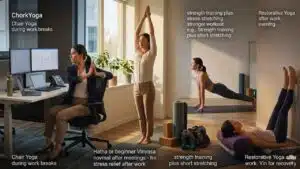
For the Corporate Athlete, yoga should work with the demands of desk-heavy professional life. It should not compete with every other health habit. It should support posture, recovery, breathing, mobility, strength, stress relief, and sleep. The best approach is to use yoga strategically throughout the week.
A professional who lifts weights may use Restorative or Yin yoga on recovery days. Someone who sits for long hours may use Chair Yoga during work breaks. Someone who feels stressed after meetings may use gentle Hatha or breathing-focused yoga after work. Someone who wants a stronger workout may use Vinyasa once or twice a week.
Yoga does not have to replace strength training, walking, or cardio. In many cases, it works best beside them. Strength training builds load capacity. Walking supports daily movement. Yoga improves mobility, control, breath awareness, and recovery. Together, they create a stronger wellness system.
This is where HappinessFit.com can fit naturally as part of the broader health and recovery ecosystem. A practical fitness routine should not separate movement from recovery. Yoga can become the bridge between training, stress management, and mental wellness.
| Day | Corporate Athlete Practice |
| Monday | Strength training plus short stretching |
| Tuesday | Chair Yoga during work breaks |
| Wednesday | Hatha or beginner Vinyasa |
| Thursday | Walk and 10-minute mobility |
| Friday | Restorative Yoga after work |
| Saturday | Strength, walk, or Vinyasa |
| Sunday | Yoga Nidra or Yin for recovery |
The goal is not to do yoga every day. The goal is to use the right style at the right time.
Beginner Safety Tips Before Starting Yoga
Yoga is generally accessible, but that does not mean every pose is right for every body. Beginners should treat yoga like any other movement practice. Start gradually. Choose appropriate classes. Tell the teacher about injuries or limitations. Use props. Stop if pain feels sharp, electrical, or joint-based. Avoid comparing your range of motion with others. One of the biggest beginner mistakes is forcing flexibility. Yoga photos often show extreme positions, but real practice does not require that. You do not need to touch your toes, bind your arms, or fold deeply to benefit. For many people, a modified pose is the smarter pose.
Breathing should stay steady. If you are holding your breath, shaking aggressively, or pushing through pain, the pose may be too intense. Back off. Yoga should challenge you, but it should not make you feel unsafe.
People with medical conditions, pregnancy-related concerns, severe pain, recent surgery, balance problems, or cardiovascular issues should ask a healthcare professional what is appropriate. Heated or intense classes require extra caution. Props are not cheating. Blocks, straps, blankets, bolsters, chairs, and walls can make poses safer and more effective. A good practice respects the body you have today.
| Safety Issue | Better Choice |
| Sharp pain | Stop and modify |
| Tight hamstrings | Use blocks or bend knees |
| Wrist discomfort | Try fists, forearms, or props |
| Balance problems | Use wall or chair support |
| Low back discomfort | Reduce depth and focus on control |
| Heat sensitivity | Avoid or modify hot yoga |
| Neck strain | Skip risky head or shoulder positions |
| Pregnancy or medical concerns | Get qualified guidance |
Yoga should build trust with your body, not fear.
Common Mistakes People Make When Choosing Yoga
The first mistake is choosing by trend. A style becomes popular online, and beginners assume it must be the best. But the best yoga style depends on the person. A high-energy class may be wrong for someone exhausted. A very slow class may be wrong for someone who needs movement before stillness. Trend is not strategy.
The second mistake is judging all yoga from one class. Teachers vary. Studios vary. Class levels vary. A bad first class does not mean yoga is not for you. It may mean the style, teacher, pace, or environment was not right.
The third mistake is treating yoga as only stretching. Some styles build strength. Some support stress relief. Some improve balance. Some are closer to meditation. If you only look for flexibility, you may miss the broader benefits.
The fourth mistake is competing. Yoga is not a room where your body has to prove something. The person beside you may have practiced for years, have different anatomy, or be pushing unsafely. Your job is to practice your version.
The fifth mistake is ignoring recovery. Even yoga can be too much if you choose intense classes every day without listening to the body. More is not always better.
| Mistake | Better Approach |
| Choosing by trend | Choose by goal and body need |
| Starting too intense | Use beginner classes first |
| Comparing flexibility | Focus on your own range |
| Ignoring props | Use support when needed |
| Thinking slow means useless | Understand recovery value |
| Trying one class and quitting | Test different teachers and styles |
| Forcing poses | Modify before pain appears |
| Doing only intense yoga | Balance with recovery styles |
The right yoga practice should make you more connected to your body, not more critical of it.
Simple 14-Day Yoga Starter Plan
A starter plan helps beginners test yoga without overcommitting. The goal is not to master poses in two weeks. The goal is to discover which style your body responds to best. Keep sessions short. Notice how you feel before and after. Pay attention to sleep, mood, stiffness, energy, and stress.
This plan is built for busy professionals. Most sessions can be 10 to 30 minutes. You can use a studio, app, video, or simple home sequence. The important part is variety with awareness. Try different styles, then choose what fits.
Days 1 to 3: Learn the Basics
Start with Hatha or beginner yoga. Focus on breathing, basic standing poses, gentle stretching, and learning how your body moves. Do not chase depth. Notice posture, balance, and stiffness.
Days 4 to 6: Add Desk-Worker Recovery
Try Chair Yoga or short mobility sessions. Use them during work breaks or after long sitting. Notice whether your neck, hips, back, and shoulders feel better.
Days 7 to 9: Try a Slow Recovery Style
Test Yin or Restorative yoga. These may feel slow, but stay with the experience. Notice whether your body relaxes and whether your sleep feels different.
Days 10 to 12: Try a Gentle Flow
Use beginner Vinyasa or slow flow. See whether movement with breath gives you energy without overwhelming you. Keep the pace controlled.
Days 13 to 14: Review and Choose
Ask what helped most. Which style made you feel calmer? Which made your body feel better? Which one can you repeat next week? Choose one active style and one recovery style if possible.
| Day Range | Practice Focus | Goal |
| Days 1 to 3 | Hatha basics | Learn poses and breath |
| Days 4 to 6 | Chair Yoga | Reduce desk stiffness |
| Days 7 to 9 | Yin or Restorative | Practice recovery |
| Days 10 to 12 | Gentle Vinyasa | Test flow and energy |
| Days 13 to 14 | Review | Choose a repeatable style |
A good starter plan teaches you what fits, not what looks impressive.
Final Thoughts
Yoga styles compared clearly show one thing: there is no single best yoga practice for everyone. The right style depends on your body, stress level, schedule, fitness background, recovery needs, and personality. A beginner who needs calm may not need Power Yoga. A restless professional may not start well with long stillness. A desk worker with stiff hips may need Hatha, Yin, or Chair Yoga before intense flow.
For the Corporate Athlete, yoga should support performance and recovery without becoming another perfection game. Use it to breathe better, move better, sit with less tension, sleep more easily, recover from work stress, and build a better relationship with your body.
Start simple. Try different types of yoga. Notice what helps. Use props. Modify poses. Respect pain. Avoid comparison. Build slowly.
Yoga is not about proving flexibility. It is about creating a practice your body and mind can return to.
That is where the real benefit begins.
Frequently Asked Questions (FAQs) About Yoga Styles Compared
What Is the Best Yoga Style for Beginners?
Hatha, beginner Iyengar, Chair Yoga, and gentle Vinyasa are often good starting points for beginners. They usually give enough time to learn basic poses, breathing, and modifications. The best choice depends on your goal, fitness level, mobility, and comfort.
Which Yoga Style Is Best for Stress Relief?
Restorative yoga, Yoga Nidra, Yin yoga, and gentle Hatha are strong options for stress relief. These styles usually move slowly and give the nervous system time to settle. For people who feel mentally restless, a gentle flow class may also help before stillness.
Which Yoga Style Is Best for Strength?
Vinyasa, Power Yoga, Ashtanga, and some Hatha classes can build strength and muscular endurance. They use bodyweight holds, transitions, balance, and core control. For significant muscle building, yoga can support strength but may work best alongside resistance training.
Is Yin Yoga the Same as Restorative Yoga?
No. Yin yoga usually uses long-held stretches that create gentle to moderate sensation. Restorative yoga uses props to support the body in restful positions with very little effort. Yin focuses more on stillness and flexibility. Restorative focuses more on deep rest and relaxation.
Can Desk Workers Benefit From Yoga?
Yes. Desk workers may benefit from Chair Yoga, Hatha, Yin, Restorative, and mobility-focused yoga because these styles can address stiffness, posture, shallow breathing, and stress. Short practices during the workday can be especially useful.