The global competitive gaming ecosystem relies on structured competition to deliver fair gameplay, athletic storylines, and sustainable business models. Understanding the full list of esports leagues and tournaments requires looking at both publisher-owned franchised leagues and open-circuit, third-party tournament operators.
Whether a game uses regional split leagues leading to a singular World Championship or relies on year-round point circuits, each title maintains a distinct competitive structure. This guide organizes the premier international leagues and tournaments by game genre and structural format.
Multiplayer Online Battle Arena (MOBA) Competitions
MOBAs represent some of the most-watched competitive gaming circuits globally, featuring deep regional league infrastructures and massive annual championship events.
1. League of Legends (LoL) Regional Leagues and Worlds
Developer Riot Games operates a tightly regulated regional league model. Teams compete in domestic splits across premier circuits such as LCK (South Korea), LPL (China), LEC (EMEA), and LCP (Asia-Pacific). The top performers qualify for international events, including the Mid-Season Invitational (MSI) and the annual League of Legends World Championship (Worlds), which stands as one of the most prestigious events in competitive gaming.
2. Dota 2: The International and Tier-1 Circuits
Unlike its MOBA competitors, Valve’s Dota 2 features an open circuit managed by independent operators such as ESL, BLAST, and PGL. Teams compete across major global tournaments like the BLAST Slam series and DreamLeague to earn direct invitations and qualifier spots for The International (TI), an event historically famous for record-breaking crowdsourced prize pools.
3. Mobile Legends: Bang Bang (MLBB) MPL and M-Series
As the dominant mobile MOBA title in Southeast Asia and Latin America, MLBB relies on regional franchised leagues known as the Mobile Legends: Bang Bang Professional League (MPL). Premier teams from regions like the Philippines and Indonesia earn qualification for the mid-season MSC and the end-of-year M-Series World Championship.
First-Person and Tactical Shooter Circuits
Tactical FPS titles balance high-frequency regional league play with major international LAN tournaments.
4. Counter-Strike 2 (CS2) Majors and Tier-1 Premier Events
Counter-Strike operates on a open-circuit model anchored by Valve-sponsored Majors organized by third-party contractors like PGL, BLAST, and ESL. Outside of the bi-annual Majors, the competitive calendar is filled with premier multi-stage tournaments such as the ESL Pro League, Intel Extreme Masters (IEM Cologne and IEM Katowice), and the BLAST Premier circuit.
5. VALORANT Champions Tour (VCT)
Riot Games structures VALORANT around the VCT ecosystem, which splits partner teams into international leagues (Americas, EMEA, Pacific, and China). Teams earn circuit points across domestic stages to secure berths at VCT Masters events and the end-of-season VALORANT Champions tournament. Lower-tier talent competes in regional VCT Challengers leagues to earn ascension into the top flight.
6. Call of Duty League (CDL)
ActiVision Blizzard operates the CDL as a city-based franchised league featuring twelve permanent team spots. Teams compete in regular-season Major tournaments throughout the year, culminating in the CDL Championship Playoffs.
Battle Royale and Hero Shooter Leagues
Battle royale formats feature high participant counts per match, requiring specialized scoring systems that combine placement points and kill metrics.
7. Apex Legends Global Series (ALGS)
EA and Respawn Entertainment organize the ALGS into regional Pro Leagues across North America, EMEA, APAC North, and APAC South. Teams accumulate points across split qualifiers to advance to physical LAN Playoff events, culminating in the ALGS Championship.
8. Fortnite Champion Series (FNCS)
Epic Games hosts the FNCS as an accessible, open-entry competitive circuit. Players advance through weekly in-game divisional lobbies and regional Major finals, aiming to earn spots at the annual FNCS Global Championship.
9. Overwatch Champions Series (OWCS)
Launched as the open-circuit successor to the Overwatch League, the OWCS operates across NA, EMEA, and Asia. Managed in partnership with ESL FACEIT Group, it allows open qualification alongside regional main events, feeding into international mid-season and championship LANs.
Fighting Games and Sports Simulation
Fighting games and sports simulators generally favor open, community-driven bracket systems over closed franchised leagues.
10. Fighting Game Community (FGC) World Tours
The FGC relies on individual tour circuits backed by game publishers. Major examples include:
-
Evolution Championship Series (EVO): The world’s largest open-bracket fighting game tournament.
-
Capcom Pro Tour (CPT): A global ranking circuit for Street Fighter 6 leading to Capcom Cup.
-
Tekken World Tour (TWT): A points-based global tour culminating in the TWT Finals.
11. Rocket League Championship Series (RLCS)
Psyonix operates the RLCS as an open circuit divided into seasonal splits. Teams accumulate points in regional open tournaments to qualify for international RLCS Majors and the RLCS World Championship.
Multi-Title Flagship Events
Beyond single-game ecosystems, multi-title international festivals bring together organizations from across the entire industry.
12. Esports World Cup (EWC)
Held annually, the Esports World Cup is a massive multi-genre tournament festival featuring cross-club competitions across titles like CS2, Dota 2, League of Legends, Mobile Legends, Apex Legends, and Street Fighter. It features individual game prize pools along with a Club Championship bonus for the best overall performing esports organization.
Structural Frameworks and Tournament Models
Understanding a list of esports leagues and tournaments requires examining how these events are structured operationally.
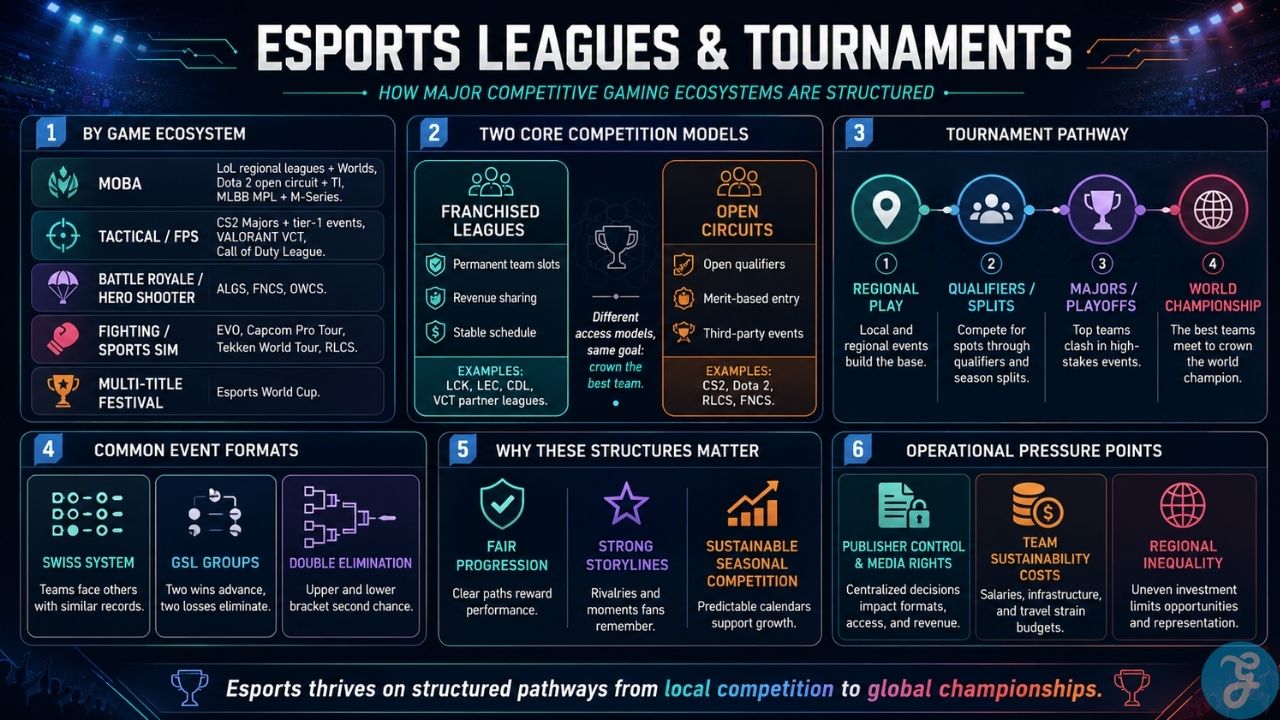
Franchised Regional Leagues vs. Open Circuits
Franchised leagues (like the CDL or LCK) sell permanent slots to team organizations, guaranteeing media rights revenue and revenue sharing. In contrast, open circuits (like CS2 or RLCS) allow any team to climb through open qualifiers, prioritizing meritocratic access over financial buy-in.
Stage Formats: Swiss System, GSL, and Double Elimination
Modern esports tournaments utilize distinct competitive formats:
-
Swiss System: Used in CS2 Majors and Swiss-stage events, pairing teams with identical win-loss records until teams reach a set threshold of wins (advance) or losses (eliminated).
-
GSL Groups: Four-team dual-tournament groups where two wins grant advancement and two losses result in elimination.
-
Double Elimination: A bracket split into an Upper and Lower bracket, giving teams a second chance after dropping a single series.
Ecosystem Challenges and Operational Limitations
While competitive circuits continue to expand, operators and teams navigate several structural hurdles.
Publisher Control and Media Rights Monetization
Because game publishers own the intellectual property of their games, independent tournament organizers must secure commercial licenses to host events. This centralization limits third-party innovation if a publisher decides to force all competitive play into an internal, closed ecosystem.
Team Sustainability and Regional Inequality
Maintaining permanent rosters across global flight schedules and bootcamp facilities presents high overhead costs. Smaller regions often struggle with lower media rights valuations, making it difficult for local teams to compete financially with North American, European, or Asian organizations.
The Verdict
Navigating the full list of esports leagues and tournaments highlights a diverse industry balanced between structured franchised leagues and dynamic open circuits. Whether following regional splits in League of Legends, high-stakes tactical shooter Majors in CS2, or community brackets at EVO, every competitive game relies on structured tournament pipelines to crown true champions.
Frequently Asked Questions about Esports Leagues and Tournaments
What is the difference between S-Tier and A-Tier esports tournaments?
S-Tier tournaments represent the highest level of competition, featuring world-class team fields, multi-million dollar prize pools, and global broadcast coverage. A-Tier tournaments act as major regional championships or secondary international events that feed seeding or points into S-Tier championships.
How do open qualifiers work in major esports circuits?
Open qualifiers allow any registered team to enter an early bracket stage, usually played online. Winning an open qualifier grants advancement to closed qualifiers or regional main events, enabling unknown teams to reach professional tiers.
Which esports title has the most active regional leagues?
League of Legends and Mobile Legends: Bang Bang maintain the most extensive structured regional league networks, running official domestic splits across dozens of countries worldwide.