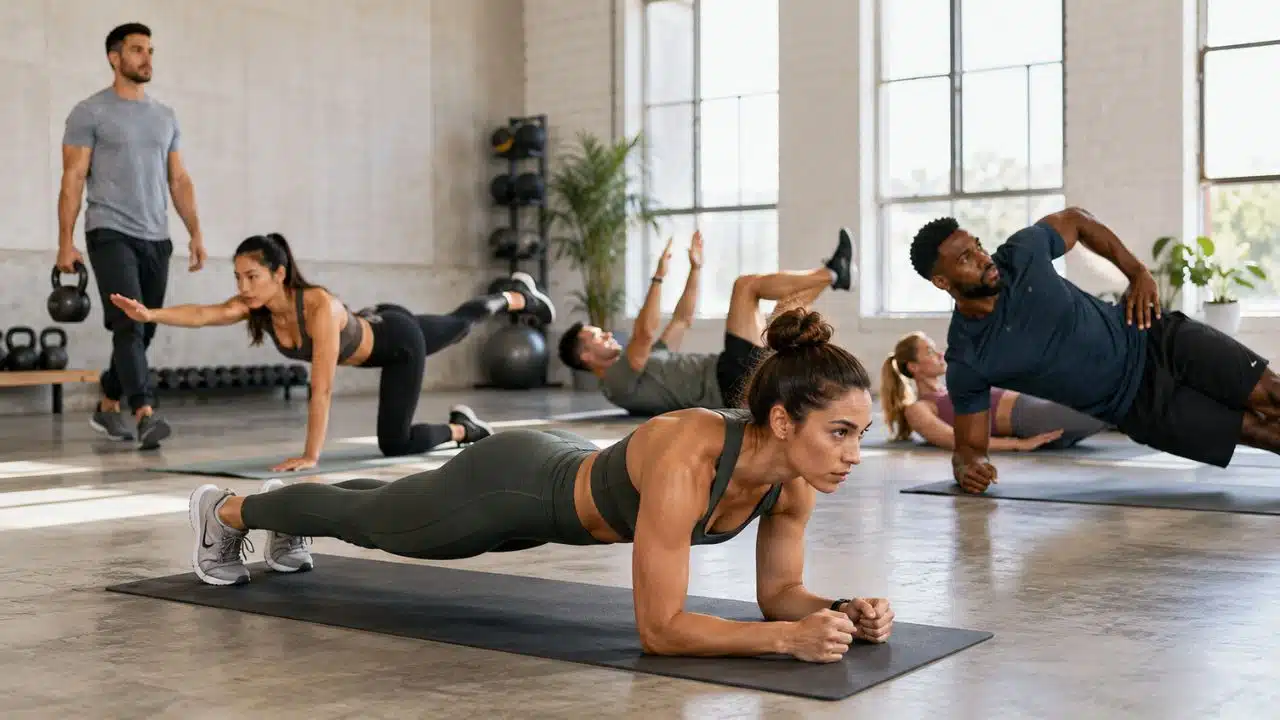
Crunches are not the only way to train your abs. For many people, they are the exercise that makes core training feel worse than it needs to.
The neck starts pulling. The lower back feels annoyed. The reps get faster because the movement is uncomfortable. After a few sets, the person has done “ab work,” but not necessarily useful core training.
That is where core workouts no crunches can be a better option. A strong core is not just about curling the shoulders off the floor. It is about keeping the trunk steady while the arms and legs move, resisting unwanted twisting, controlling the pelvis, and supporting everyday movement.
That matters when you carry groceries, stand for a long time, climb stairs, lift something from the floor, walk with a bag on one side, or brace during a workout. Real life rarely asks the body to perform 50 floor crunches. It asks the core to stay organized under pressure.
One caution before starting: if you have active back or neck pain, numbness, pain traveling down the leg, recent surgery, pregnancy-related concerns, osteoporosis, or any condition that affects exercise tolerance, get professional guidance before changing your routine. Core training can be helpful, but the right exercise still needs the right dose.
Why Crunches Are Not Required
Crunches mainly train trunk flexion, which is the motion of bringing the ribs toward the pelvis. That is a real abdominal function, so crunches are not useless.
The problem is that many people do them poorly or choose them before their body is ready. They pull on the head. They jam the chin forward. They flatten or arch the lower back without control. They chase a burning feeling and mistake that for progress.
Crunches also train only one slice of what the core does.
A more complete core routine should help you:
- Resist the lower back sagging during movement
- Stop the torso from twisting when one side is loaded
- Control side bending
- Coordinate breathing, ribs, pelvis, and hips
- Stay stable while the arms and legs move
That is why no-crunch training is not a soft alternative. Done well, it is often more useful than a high-rep crunch routine.
What to Watch Before Any Core Exercise
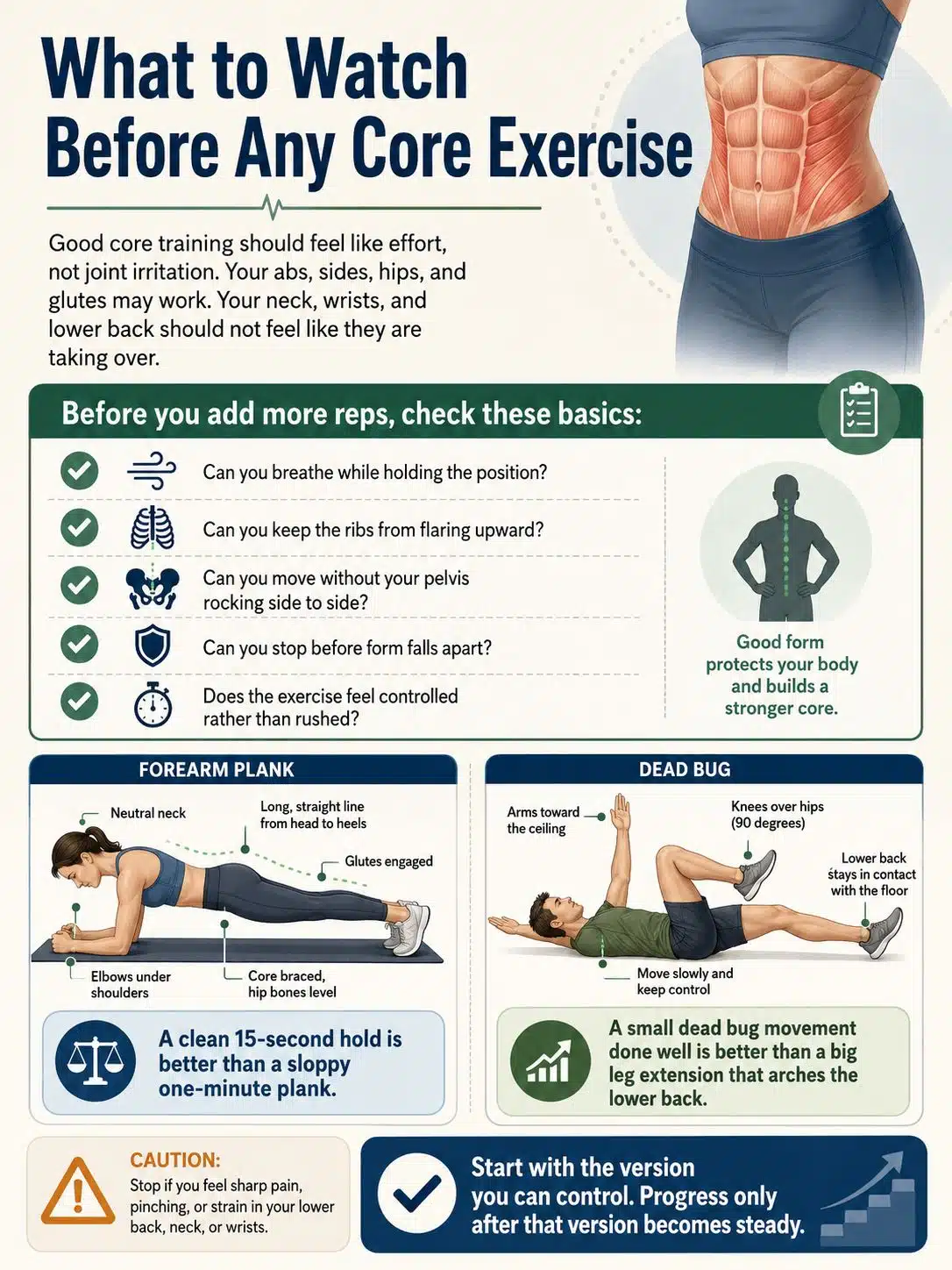
Good core training should feel like effort, not joint irritation. Your abs, sides, hips, and glutes may work. Your neck, wrists, and lower back should not feel like they are taking over.
Before you add more reps, check these basics:
- Can you breathe while holding the position?
- Can you keep the ribs from flaring upward?
- Can you move without your pelvis rocking side to side?
- Can you stop before form falls apart?
- Does the exercise feel controlled rather than rushed?
A clean 15-second hold is better than a sloppy one-minute plank. A small dead bug movement done well is better than a big leg extension that arches the lower back.
Start with the version you can control. Progress only after that version becomes steady.
1. Dead Bug
The dead bug is one of the best starting points for no-crunch core training because it teaches the trunk to stay still while the limbs move.
Lie on your back with your knees bent. You can keep your feet on the floor at first or lift your legs into a tabletop position if you can control your back. Reach your arms above your chest. Slowly lower one heel or extend one leg while the opposite arm moves overhead. Return to the starting position and switch sides.
The useful part is not how far the arm or leg moves. The useful part is keeping the ribs and pelvis steady.
If your lower back arches, shorten the movement. If your neck tightens, rest the head fully on the floor and slow down. People often make dead bugs too large too soon, then wonder why the lower back feels involved.
A good starting point: 2 sets of 6 to 8 controlled reps per side.
2. Bird Dog
Bird dog is simple enough to look unimpressive and useful enough to stay in a long-term routine.
Start on hands and knees. Place your hands under your shoulders and knees under your hips. Extend one arm forward and the opposite leg back. Pause, then return with control. Switch sides.
Do not lift the back leg as high as possible. That usually turns the exercise into a lower-back arch. The better cue is to reach long, not high. Imagine your hips staying level while the arm and leg move away from each other.
If the full version feels unstable, begin with legs only. Once that is steady, add the opposite arm.
Bird dog is especially helpful because it links the core with the glutes, shoulders, and back. It trains coordination, not just muscle burn.
Try: 2 to 3 sets of 5 slow reps per side.
3. Forearm Plank
The forearm plank is often treated like a test of toughness. That is the wrong way to use it.
Set your elbows under your shoulders and place your forearms on the floor. Step the feet back. Keep the body in a long line from head to heels. Lightly tighten the thighs and glutes, then breathe.
The plank should not become a lower-back sag or a high-hip tent shape. It also should not become a breath-holding contest.
For many readers, the best plank is shorter than expected. Ten to twenty seconds of clean tension may be enough at first. If the floor version bothers the back, use a knee plank. If the wrists are the issue, forearms usually work better than straight arms.
Try: 3 holds of 10 to 25 seconds. Stop each hold before the shape breaks.
4. Side Plank
Side planks deserve more attention than they get. They train the side of the trunk, especially the obliques and lateral stabilizers. That helps with walking, carrying, climbing stairs, and resisting side-to-side collapse.
Start on your side with your elbow under your shoulder. Bend your knees for the easier version. Lift your hips and keep your ribs stacked over your pelvis.
If your shoulder feels jammed, press the floor away and reduce the hold time. If your hips roll backward, use the knee-bent version and rebuild control before straightening the legs.
This is one of the most useful core workouts no crunches options because it trains a job crunches barely address: resisting side bending.
Try: 2 sets of 10 to 20 seconds per side.
5. Glute Bridge March
Some core routines ignore the hips, which is a mistake. The glutes and core work together during walking, lifting, standing, and many strength exercises.
Lie on your back with your knees bent and feet flat. Lift your hips until your body forms a line from shoulders to knees. From there, lift one foot a few inches, put it down, then lift the other.
The march should be quiet. If the hips drop or twist, the exercise is too hard for now. Go back to a regular bridge hold and build control there first.
This exercise is useful for people who sit a lot because it reminds the glutes to contribute. When the glutes do not help, the lower back often tries to do more than it should.
Try: 2 sets of 6 to 10 marches per side.
6. Bear Hold
The bear hold looks small but can feel demanding very quickly.
Start on hands and knees. Tuck your toes. Brace gently and lift your knees one or two inches off the floor. Keep your back flat and your hips close to knee height.
The knees do not need to rise high. In fact, lifting them too much often makes the exercise worse. Keep the position compact and controlled.
This move is not ideal for everyone. If your wrists hurt, use handles, a folded mat, or skip it. If your lower back rounds or sags immediately, start with bird dog and dead bug first.
Try: 4 holds of 8 to 15 seconds.
7. Pallof Press
The Pallof press is one of the cleanest ways to train anti-rotation strength. You need a resistance band or a cable machine.
Anchor the band at chest height. Stand sideways to the anchor and hold the band at your chest. Step away until there is light tension. Press your hands straight forward, pause, then bring them back.
The band will try to rotate your torso. Your job is to stay square.
Use less resistance than you think you need. A band that is too heavy turns the movement into a shoulder and hip struggle. The best version looks almost boring because the body stays still.
This is a strong choice for people who want core training that carries over to lifting, sports, or daily movement. It also avoids floor crunching completely.
Try: 2 to 3 sets of 8 to 12 presses per side.
8. Suitcase Carry
A suitcase carry is practical core training. Pick up weight on one side and walk without leaning.
You can use a dumbbell, kettlebell, loaded backpack, water jug, or heavy grocery bag. Stand tall, keep your shoulders relaxed, and walk slowly. The loaded side should not drag you down, and the unloaded side should not overcorrect.
This exercise trains the core to resist side bending. That is useful because daily life often loads the body unevenly: one suitcase, one shopping bag, one child on one hip, one work bag over one shoulder.
The mistake is going too heavy too soon. If your posture changes immediately, the load is too much. The carry should challenge your trunk without turning your walk into a limp.
Try: 3 walks of 20 to 40 seconds per side.
9. Wall Plank Shoulder Tap
Floor shoulder taps are popular, but many people are not ready for them. The hips swing, the shoulders collapse, and the movement becomes more about survival than control.
The wall version is a better entry point.
Stand facing a wall. Put both hands on the wall at shoulder height and step back into a leaning plank. Keep your body long. Slowly lift one hand and tap the opposite shoulder. Put it back, then switch sides.
If your body sways, step closer to the wall. If it feels too easy, step farther back or use a sturdy countertop. The floor version can come later.
This is a good option for people who want a standing core exercise, have trouble getting down to the floor, or need a lighter version before high planks.
Try: 2 sets of 8 to 12 taps per side.
A Simple No-Crunch Core Routine
You do not need all nine exercises in one workout. More variety does not automatically mean better training.
Pick four movements:
- One control drill: dead bug or bird dog
- One hold: forearm plank, side plank, or bear hold
- One hip-and-core move: glute bridge march
- One standing or loaded move: Pallof press, suitcase carry, or wall shoulder tap
A beginner session could look like this:
| Exercise | Amount |
|---|---|
| Dead bug | 2 sets of 6 reps per side |
| Bird dog | 2 sets of 5 slow reps per side |
| Side plank from knees | 2 holds of 10–15 seconds per side |
| Suitcase carry | 3 walks of 20 seconds per side |
Do this two or three times per week. If you already lift weights, place core work near the end of the session rather than before heavy squats, deadlifts, rows, or overhead pressing. Fatiguing the trunk too early can make the rest of the workout messier.
What These Exercises Will Not Do
No-crunch core workouts can improve strength, endurance, balance, and control. They will not directly burn fat from the belly.
That point is worth saying clearly because many ab routines are sold with unrealistic expectations. Stronger abdominal muscles do not automatically create a flatter stomach. Body fat is affected by overall activity, nutrition, sleep, genetics, health conditions, hormones, and long-term consistency.
This does not make core training less valuable. It just means the benefit should be judged properly. A stronger core may help you move better, lift more safely, feel steadier, and train with better control. Those are useful outcomes even when the mirror changes slowly.
Mistakes That Make No-Crunch Core Training Less Effective
The first mistake is rushing. Dead bugs, bird dogs, Pallof presses, and shoulder taps all become less useful when done fast. Slow reps expose whether the trunk is actually steady.
The second mistake is choosing the hardest version first. A straight-leg side plank is not better than a knee side plank if the hips are twisting and the shoulder is irritated.
The third mistake is holding the breath. Bracing should create support, not panic. If you cannot breathe during a plank or carry, reduce the difficulty.
Another common mistake is treating pain as proof that the exercise is working. Muscle effort is normal. Sharp pain, radiating pain, numbness, tingling, dizziness, or joint pain is not something to push through.
And finally, do not train the core hard every single day just because the exercises look small. Two or three focused sessions per week usually beat daily tired reps with poor control.
How to Progress Without Adding Crunches
Progress can be simple. You do not need to jump from beginner dead bugs to advanced hanging leg raises.
Choose one change at a time:
- Add a longer pause
- Slow the movement
- Increase the range slightly
- Move from knees to toes
- Use a lighter base of support
- Add a little resistance
- Carry a slightly heavier load
- Add one extra set
The boring progression is usually the safer progression. If you make an exercise heavier, longer, and less stable all at once, form will likely break.
A useful rule: progress only when the current version feels controlled for every rep, not just the first few.
Final Thoughts
The best core workouts no crunches plan is not a punishment routine for the abs. It is a small, steady set of exercises that teaches the trunk to support movement.
Start with dead bugs, bird dogs, glute bridges, planks, side planks, and carries. Add Pallof presses if you have a band or cable. Use wall variations when floor work is not practical. Keep the exercises clean before making them harder.
Crunches can still have a place for people who tolerate them well and want direct abdominal flexion work. They are not required for a strong core.
If crunches bother your neck, irritate your back, or make core training feel like something to avoid, stop forcing the same exercise. Build control first. Strength will have a better base to grow from.