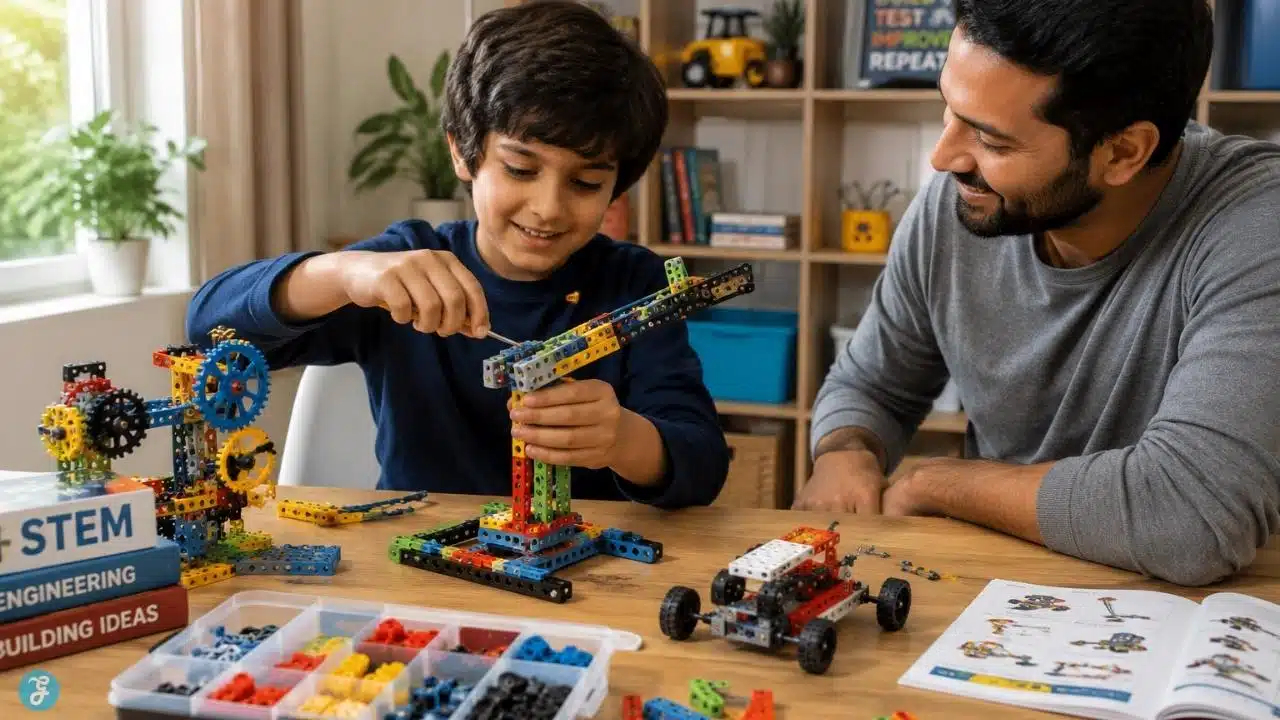
Engineering toys kids actually use are not always the flashiest ones on the shelf. I have seen many parents buy expensive STEM kits that look impressive for one afternoon, then disappear into a corner because the child cannot rebuild, remix, or understand what to do next. That is not a good investment.
The best engineering toys give children something to build, test, break, fix, and improve. They do not just entertain. They teach patience, problem-solving, spatial thinking, cause and effect, creativity, and the confidence to try again after something falls apart.
From my experience working around kids’ learning, e-learning, and STEM-focused content, I would not judge a toy only by price, brand name, or “STEM” printed on the box. I would judge it by one simple question: Can the child use it in more than one meaningful way? That is where real learning begins.
Why Engineering Toys Matter for Kids
Engineering is not only about bridges, machines, robots, or future careers. For children, engineering begins when they ask, “How can I make this work better?”
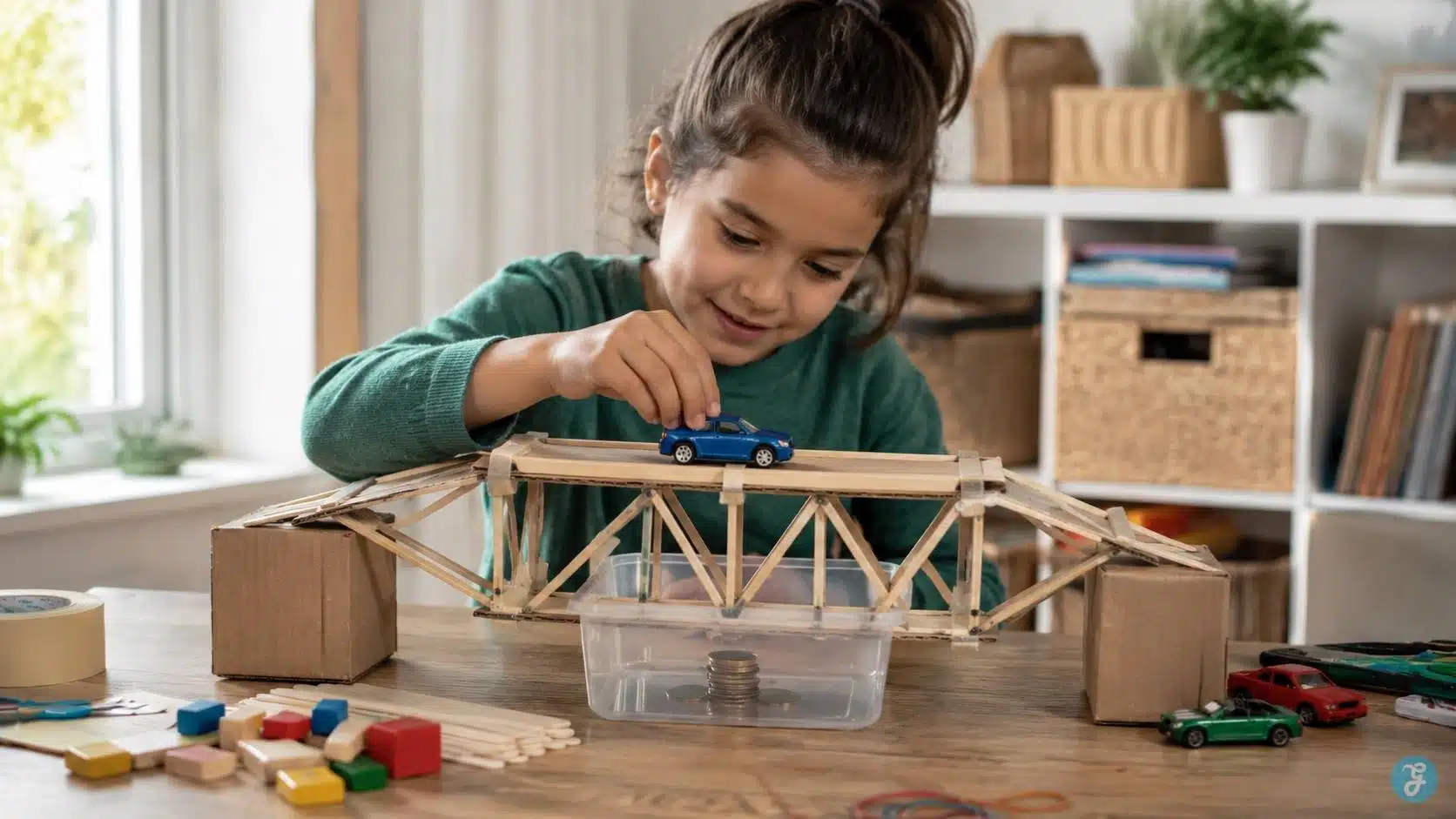
A block tower that keeps falling is an engineering problem. A paper bridge that cannot hold coins is an engineering problem. A marble run that gets stuck is an engineering problem. A gear set that will not move properly is also an engineering problem.
The National Academies says young children are capable of learning sophisticated science and engineering concepts and naturally show curiosity about the world around them. That matters because kids do not need to wait until high school to think like young engineers. They need age-appropriate chances to build and improve things.
Engineering toys help children practice:
- planning before building;
- testing ideas;
- improving weak designs;
- understanding motion and balance;
- using math in simple ways;
- working through frustration;
- explaining how something works.
This is also why engineering toys fit so well into a broader STEM learning for kids roadmap. They turn abstract STEM ideas into something children can actually touch.
What Makes the Best Engineering Toys Worth Buying?
The best engineering toys are not always the most expensive. They are the ones that stay useful after the first build.
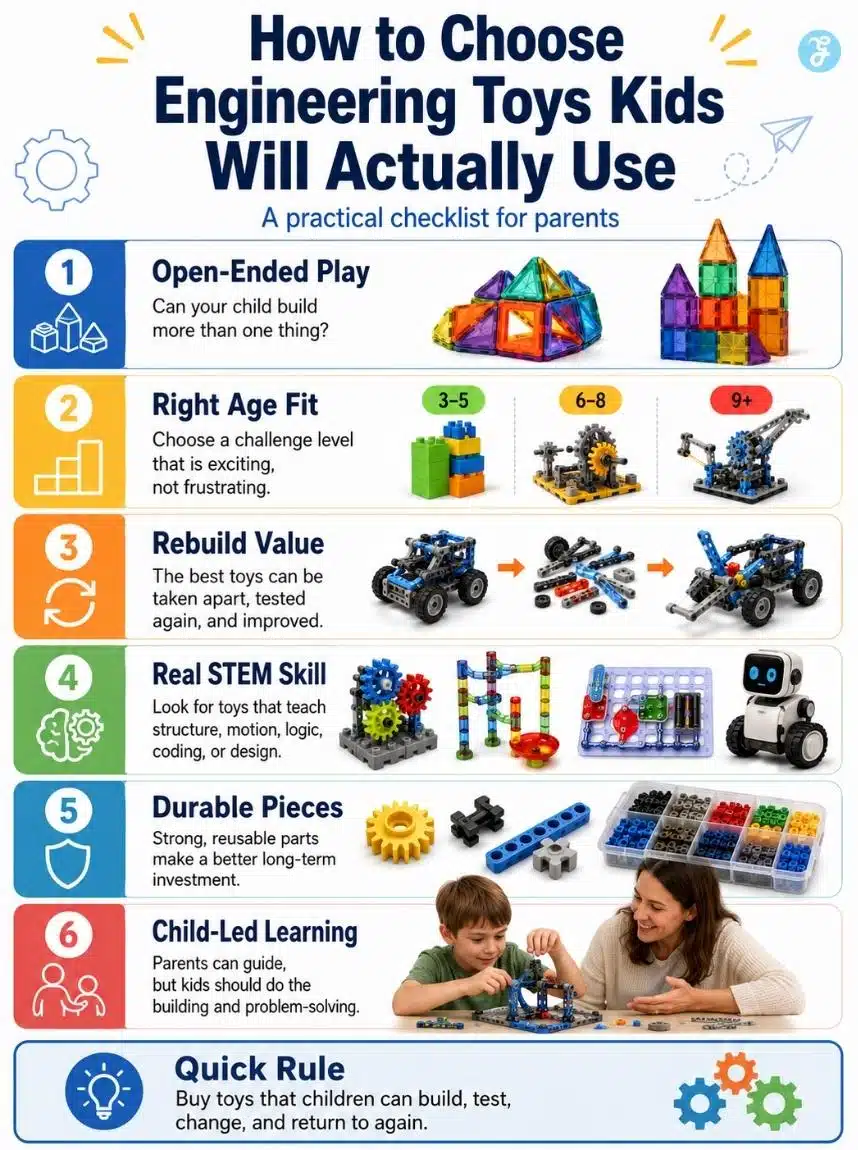
Before buying any kids’ engineering kits, I look for these things:
| Buying Factor | Why It Matters |
| Open-ended play | Children can build many designs, not just one model. |
| Age fit | The toy challenges the child without overwhelming them. |
| Rebuild value | The child can take it apart and try again. |
| Clear instructions | Good guides help beginners start confidently. |
| Durability | Pieces should survive repeated use. |
| Learning depth | The toy should teach structure, motion, logic, or design. |
| Expansion potential | Add-ons or compatible sets can extend learning. |
The real test is not whether the toy looks educational. The real test is whether the child returns to it without being forced.
The Engineering Design Process Kids Should Learn Through Play
Good engineering toys quietly teach the engineering design process. Science Buddies explains the engineering design process as a problem-solving cycle that starts with defining a problem, researching, setting requirements, building a prototype, testing it, and improving based on results.
For younger kids, I simplify it like this:
- Ask: What problem are we solving?
- Imagine: What could work?
- Build: Let’s try one idea.
- Test: Did it work?
- Improve: What should we change?
A child does not need to memorize these steps. They need to experience them. That is why STEM building toys work better when parents ask good questions:
- Why did this part fall?
- What would make it stronger?
- What happens if we make the base wider?
- Can you make it taller without making it weaker?
- What would you change if you built it again?
These small questions turn play into learning.
Best Engineering Toys by Age Group
Children need different types of engineering toys at different ages. A toy that is perfect for a 4-year-old may bore a 10-year-old. A robotics kit that excites a 12-year-old may frustrate a 6-year-old.
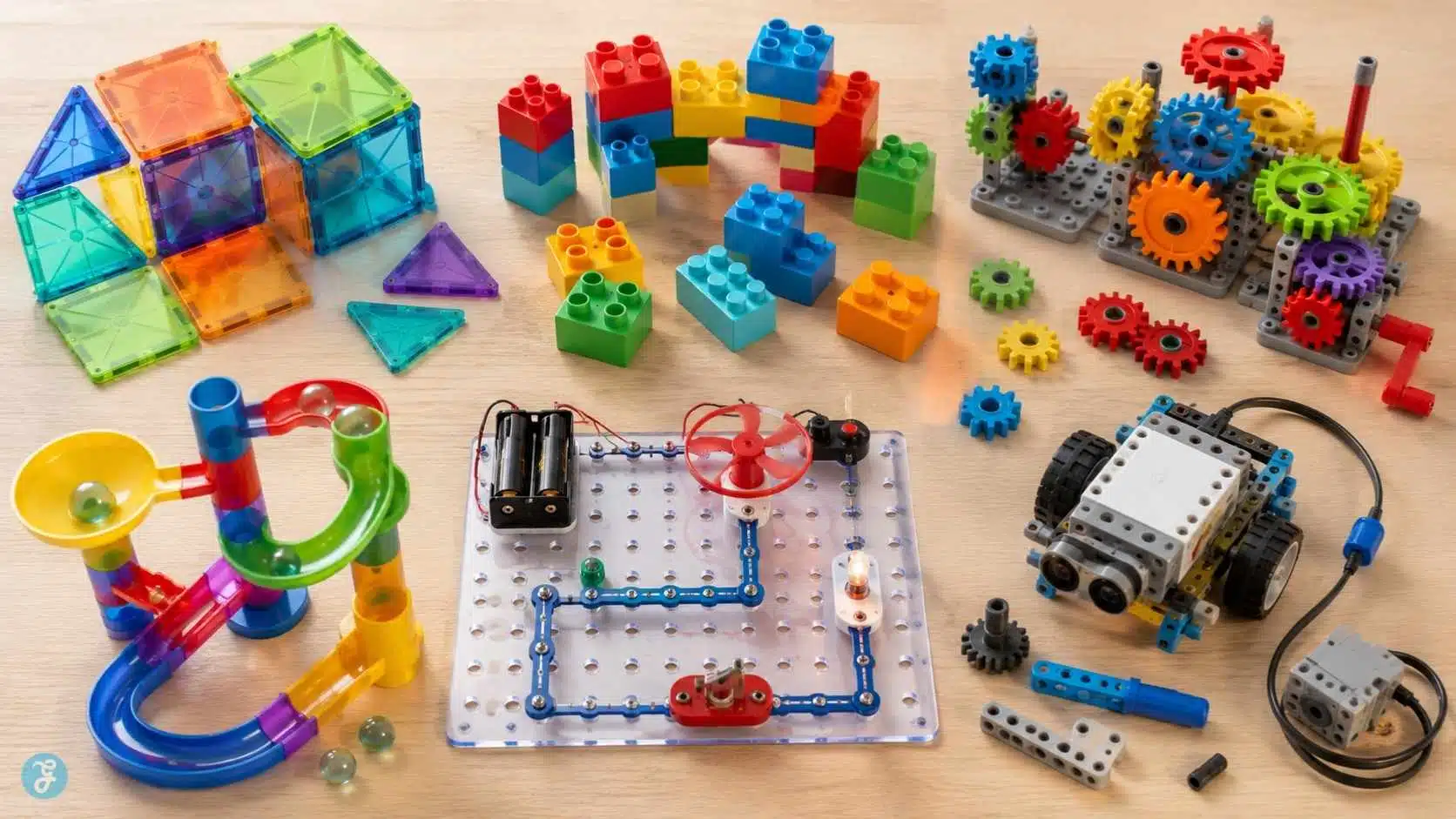
Here is a simple age-wise guide:
| Age Range | Best Toy Type | What It Builds |
| 3–5 | Magnetic tiles, large blocks, gears | Shape, balance, motion, and early spatial thinking |
| 6–8 | Marble runs, basic construction sets, and simple machines | Cause and effect, planning, problem-solving |
| 8–10 | LEGO Technic-style builds, circuit kits, bridge kits | Mechanical thinking, sequencing, and design improvement |
| 10–12 | Robotics kits, advanced construction sets, electronics kits | Logic, coding, systems thinking |
| 13+ | Programmable robotics, mechanical models, maker kits | Engineering design, troubleshooting, and real-world problem-solving |
I would always choose slightly challenging over too easy. But if a toy needs constant adult rescue, it is too advanced for independent learning.
1. Magnetic Building Tiles for Early Engineering
Magnetic tiles are one of the best engineering toys kids can start with because they are simple, visual, and open-ended.
Children can build houses, towers, roads, animals, vehicles, castles, and patterns without needing tiny connectors or complicated instructions. MAGNA-TILES describes its sets as magnetic building tiles that click together on every side, allowing children to build both flat designs and 3D structures.
Best for: ages 3–7
Why they are worth investing in:
- They support open-ended building.
- They help children understand shapes and structures.
- They are easy for younger children to use.
- They work well for solo or group play.
- They usually stay useful for years.
Things to consider: Check magnet safety, build quality, and piece size. For younger children, avoid small parts and always follow the manufacturer’s age guidance.
2. Gear Building Sets for Motion and Cause-Effect Learning
Gear toys are excellent for helping children see motion. When one gear turns and another moves with it, children can physically see cause and effect. That is powerful for early engineering thinking.
Learning Resources describes its Gears! Gears! Gears! Deluxe Building Set is a 100-piece STEM construction toy with interlocking gears, pillars, axles, bases, and a crank handle for motion-based building.
Best for: ages 3–8
Why they are worth investing in:
- They teach motion in a visible way.
- They encourage trial and error.
- Children can redesign layouts quickly.
- They are useful before advanced mechanical kits.
Things to consider: Some younger children may need adult help at first. Start with flat gear layouts before building taller structures.
3. Marble Runs for Testing, Gravity, and Design
Marble runs are among the best STEM building toys because children can see immediately whether the design works. If the marble stops, falls, or flies off the track, the child gets instant feedback. That creates natural testing and improvement.
A good marble run teaches:
- gravity;
- slope;
- speed;
- stability;
- sequencing;
- cause and effect;
- structural support.
Best for: ages 5–10
Why they are worth investing in:
- They make engineering visible and exciting.
- Children naturally want to test again.
- They support creative layouts.
- They encourage problem-solving without feeling like schoolwork.
Things to consider: Avoid sets that are too fragile or difficult to assemble. If every small bump breaks the build, children may lose patience quickly.
4. LEGO Technic-Style Sets for Mechanical Thinking
For older children, LEGO Technic-style sets can introduce gears, axles, levers, wheels, and more advanced building systems.
LEGO’s STEM category presents its STEM sets as toys that help children learn science, technology, engineering, and math through LEGO bricks. Its Technic line also includes more detailed vehicle and engineering-themed builds, with some sets listed for children aged 9 and up.
Best for: ages 8–13+
Why they are worth investing in:
- They introduce mechanical parts.
- They build patience and precision.
- Instructions teach sequencing.
- Many builds can be modified after completion.
- They work well for children who like vehicles, machines, or moving parts.
Things to consider: Some sets are more model-focused than open-ended. If your goal is engineering thinking, choose sets with moving mechanisms, gears, steering, or rebuild options.
5. Circuit Kits for Electricity and Systems Thinking
Circuit kits are great for children who are ready to move beyond structures into systems. Snap Circuits, for example, describes its product line as kits with different sizes and complexity, designed for future engineers ages 8+, with a beginner set designed for younger learners. Its classroom-ready STEM kit is also listed for ages 8+.
Best for: ages 8–12+
Why they are worth investing in:
- They make electricity safer and more understandable.
- Children can build working circuits.
- They teach cause and effect clearly.
- They prepare kids for robotics and electronics.
- They encourage careful step-by-step thinking.
Things to consider: Always follow safety instructions. Circuit kits are better when adults explain what is happening, not just whether the light turns on.
6. Robotics Kits for Older Kids
Robotics kits are usually a bigger investment, so I would not start here too early. Children should first have some comfort with building, following instructions, testing, and problem-solving. Once they are ready, robotics can combine engineering, coding, logic, electronics, and design.
VEX Robotics describes its education system as covering Pre-K through 12+, including coding, construction, robotics curriculum, and hands-on STEM learning across grade bands.
Best for: ages 9–14+
Why they are worth investing in:
- They combine multiple STEM skills.
- Children can code real actions.
- They teach debugging and iteration.
- They support teamwork and competitions.
- They feel closer to real engineering.
Things to consider: Robotics kits can become adult projects if the child is not ready. Let the child make decisions, test ideas, and fix mistakes instead of building everything for them.
7. Story-Based Engineering Kits for Younger Kids
Some children need a story before they care about the build. Story-based kids’ engineering kits can be useful because they give the child a reason to build. Instead of “make this structure,” the challenge becomes “help this character solve a problem.”
Thames & Kosmos offers construction and engineering kits for children, including early engineering sets with illustrated storybook formats for young learners.
Best for: ages 3–7
Why they are worth investing in:
- They make engineering feel less abstract.
- They support parent-child learning.
- They combine storytelling with building.
- They work well for children who need context before tasks.
Things to consider: Look for kits that allow rebuilding after the story ends. A good story should introduce the problem, not limit the child to one fixed answer.
How to Choose Engineering Toys Kids Will Actually Use
A toy can be popular and still wrong for your child. Before buying, ask these questions.
Does It Match the Child’s Current Skill Level?
If the toy is too easy, the child gets bored. If it is too hard, the child gets frustrated.
The best engineering toy sits in the middle: challenging but possible.
Can the Child Build More Than One Thing?
One-and-done toys rarely offer strong long-term value.
Open-ended sets usually last longer because children can rebuild in different ways.
Does It Teach a Real Engineering Idea?
Look for toys that teach structure, motion, balance, electricity, coding, force, stability, or problem-solving.
A toy does not need to teach everything. It just needs to teach something clearly.
Will the Child Want to Return to It?
Repeat use matters. Engineering learning improves through testing and redesign.
If a child only uses the toy once, the learning value is limited.
Can Parents Join Without Taking Over?
The best parent role is not “chief engineer.” It is guide, question-asker, and gentle helper.
Let the child lead whenever possible.
Where Digital Learning Fits Beside Engineering Toys
Engineering toys are hands-on, but digital learning can support the same thinking habits when used carefully.
At Editorialge Media LLC, we look at kids’ learning through a wider lens: hands-on play, digital practice, storytelling, creativity, and skill-building can work together. A child who builds with blocks can also strengthen number recognition, logic, sequencing, and early problem-solving through interactive kids’ learning games.
For younger learners, 123 Magic Number Fun: Math Kid can support early math practice before and alongside engineering play. Its Google Play listing describes number tracing, counting, matching, sequencing, missing numbers, arithmetic, and puzzle-style activities for young children. These skills matter because engineering play often depends on counting pieces, noticing patterns, comparing sizes, and following sequences.
The point is balance. Let children build with their hands, then use digital learning for short, focused practice. That mix is much stronger than screen time without purpose or toys without reflection.
Common Mistakes Parents Make When Buying Engineering Toys
Buying the Hardest Kit Too Early
Advanced does not always mean better. If a child cannot use the kit without constant adult help, the learning value drops.
Choosing Looks Over Rebuild Value
A beautiful model may look good on a shelf, but it may not teach much after the first build.
Ignoring the Child’s Interests
A child who loves vehicles may enjoy mechanical sets. A child who loves stories may enjoy story-based kits. A child who loves puzzles may enjoy circuits or robotics.
Expecting Instant STEM Skills
Engineering toys do not magically create engineering thinking. The learning comes from repeated building, testing, and improving.
Taking Over the Project
Adults often jump in too quickly. Let the child struggle a little. That struggle is part of the learning.
Quick Buying Guide for Parents
Here is my practical recommendation.
| Child’s Interest | Best Toy Type |
| Loves building houses or towers | Magnetic tiles or blocks |
| Loves moving parts | Gear sets or marble runs |
| Loves vehicles | LEGO Technic-style sets |
| Loves puzzles | Circuit kits |
| Loves screens and coding | Robotics kits |
| Loves stories | Story-based engineering kits |
| Loves experimenting | Open-ended STEM building toys |
If you are buying only one toy, choose something open-ended. If the child can build 20 different things with it, the value is usually better.
Final Thoughts: Buy Toys That Teach Children to Try Again
The engineering toys kids benefit from most are not the ones that promise genius-level results. They are the ones that make children curious enough to try again.
A good engineering toy lets a child build something, watch it fail, think for a moment, change one part, and test it again. That small loop is powerful. It teaches patience, logic, creativity, and resilience.
Do not buy only for the first reaction. Buy for the fifth build, the tenth redesign, and the moment your child says, “Wait, I think I know how to fix it.” That is when a toy becomes more than a toy. That is when engineering learning starts to feel real.
Frequently Asked Questions About Engineering Toys Kids Can Use
1. What Are the Best Engineering Toys for Kids?
The best engineering toys are open-ended, age-appropriate, durable, and reusable. Magnetic tiles, gear sets, marble runs, LEGO Technic-style builds, circuit kits, and robotics kits are strong options depending on the child’s age and interest.
2. At What Age Should Kids Start Using Engineering Toys?
Children can start with simple engineering toys around age 3, such as blocks, magnetic tiles, and large gear sets. Older children can move into marble runs, circuit kits, mechanical builds, and robotics as their patience and problem-solving skills grow.
3. Are Expensive Kids Engineering Kits Worth It?
They can be worth it if the kit offers repeat use, open-ended building, strong instructions, durable parts, and real problem-solving value. If the kit only creates one fixed model and has little replay value, it may not be the best investment.
4. What Skills Do STEM Building Toys Develop?
STEM building toys can develop spatial reasoning, fine motor skills, planning, patience, creativity, logic, measurement, cause and effect thinking, and design improvement. They also help children learn that failure is part of problem-solving.
5. Are Robotics Kits Good for Young Kids?
Robotics kits are useful when matched to the child’s age and ability. Younger children should start with simple coding or button-based robots, while older children can handle programmable robots, sensors, motors, and more advanced builds.
6. How Can Parents Make Engineering Toys More Educational?
Ask questions during play. Try prompts like “Why did it fall?”, “How can we make it stronger?”, “What changed this time?”, and “What would you improve?” These questions turn an ordinary building into engineering thinking.