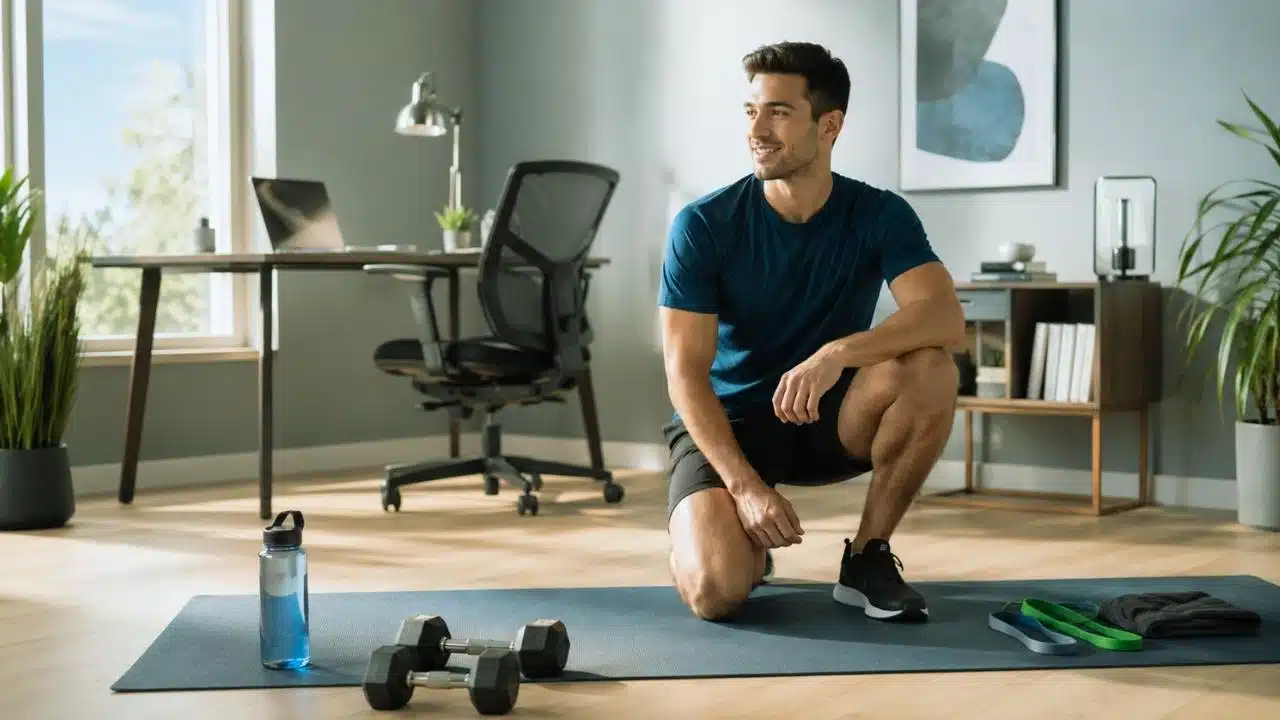
A beginners workout routine should make fitness feel possible, not intimidating. That may sound simple, but many beginners are given workout plans that feel like they were designed for someone already fit. The plan has too many exercises, too many gym terms, too much intensity, and almost no explanation of what to do when soreness, work stress, low energy, or confusion shows up.
I have seen this problem again and again with beginners. They do not fail because they are lazy. They fail because their first routine is not built for a beginner’s body or a beginner’s life. A real starter workout plan should help you learn basic movement, build confidence, recover properly, and show up again next week.
The first month is not about becoming a completely different person. It is about learning how your body responds to training. You should understand how hard to push, how much rest you need, which exercises feel safe, and how to progress without hurting yourself. That learning stage is not optional. It is the foundation. This article is part of the larger Beginner’s Complete Fitness Guide and connects naturally with the earlier topics on setting realistic fitness goals and cardio vs strength beginners. Those articles help you understand your goal and workout type. This one gives you the actual routine.
For desk workers, creators, founders, and busy professionals, the routine needs to be even more realistic. Long sitting, stiff hips, weak glutes, rounded shoulders, and screen fatigue all affect how your body feels during exercise. That is why this guide follows the Corporate Athlete idea: train smarter, move better, recover better, and build a body that supports your work and life. HappinessFit.com can also support this practical health-first approach for readers who want fitness habits that fit real life.
Why Beginners Need a Simple Workout Routine First?
Beginners need a simple workout routine because complexity creates hesitation. When a plan has too many exercises, too many decisions, and too many technical details, beginners often spend more time wondering what to do than actually doing it. A simple routine removes that problem. You know what day to train, what exercises to do, how many sets to complete, and when to rest.
In my experience, beginners make better progress when they repeat the same basic movements for a few weeks. That repetition is not boring; it is useful. Your body learns the movement. Your form improves. You feel less awkward. You also start noticing small progress, such as doing more reps, walking longer, or feeling less sore after workouts.
A complicated plan may look impressive, but it can create early burnout. If you go from no exercise to six hard workouts per week, your muscles, joints, tendons, and nervous system may not recover well. A beginner’s body needs gradual exposure. You are teaching your body to handle training, not forcing it to survive punishment.
A simple workout routine also helps you build confidence. Confidence matters more than most people admit. When beginners feel confused or embarrassed, they often stop. When they feel capable, they keep going. That is why the first month should focus on consistency, clean movement, and manageable effort.
The first routine should include basic patterns: squat, hinge, push, pull, carry, brace, and walk. These movements are practical because they show up in daily life. You sit, stand, lift, carry, push doors, pull objects, and walk every day. Training these patterns makes your body more useful, not just more active.
| Why Simplicity Matters | What Happens With Complicated Plans | Better Beginner Approach |
| Easier consistency | Beginners skip because the plan feels confusing | Use 5–6 basic exercises per workout |
| Better form | Too many movements reduce learning | Repeat the same patterns for 4 weeks |
| Less soreness | Overloaded plans create painful recovery | Start with moderate sets and reps |
| Easier tracking | Random workouts hide progress | Record sets, reps, and walking time |
| More confidence | Beginners feel less intimidated | Choose exercises you can perform safely |
| Better recovery | Too many hard days drain energy | Use rest days and light cardio |
| Less decision fatigue | Every workout feels like a new puzzle | Follow a fixed weekly structure |
| Stronger habit formation | The routine becomes easier to remember | Keep the first month predictable |
A beginner does not need a perfect routine. A beginner needs a routine that can be repeated.
What a Beginners Workout Routine Should Include?

A good beginners workout routine should include strength training, cardio, warm-ups, mobility, recovery, and simple progression. These pieces work together. If you only do cardio, you may improve stamina but miss strength, posture, and muscle support. If you only lift weights, you may build strength but still feel tired during daily movement. A balanced plan gives the body a better foundation.
Strength training is important because it builds muscle and supports joints. It also helps with daily tasks like climbing stairs, carrying groceries, lifting bags, and sitting with better posture. Beginners should not think strength training is only for bodybuilders. In real life, it is one of the most useful forms of exercise.
Cardio is equally important. Walking, cycling, swimming, or light jogging improves stamina and heart-lung fitness. For beginners, walking is often the best starting point because it is simple, low-impact, and easy to recover from. It also works well for desk workers who need more daily movement.
Warm-ups and mobility work prepare your body before training. This is especially useful if you sit for long hours. Tight hips, stiff shoulders, and a sleepy lower back can make exercises feel awkward. A short warm-up makes the first set feel smoother and safer.
Recovery is the part beginners usually underestimate. Your body does not become stronger during the workout alone. It adapts after the workout, when you sleep, eat, hydrate, and rest. Without recovery, even a good routine can start feeling too heavy.
| Routine Component | Why It Matters | Beginner Example |
| Strength training | Builds muscle, posture, and joint support | 2 full-body sessions per week |
| Cardio | Improves stamina and heart health | Walking 20–30 minutes |
| Warm-up | Prepares muscles and joints | 5–8 minutes before workouts |
| Mobility | Reduces stiffness and improves movement | Hip circles, shoulder rotations |
| Core training | Supports posture and control | Dead bugs, planks, carries |
| Recovery | Allows adaptation | Rest days and good sleep |
| Progression | Keeps improvement moving | Add reps, time, or resistance gradually |
| Tracking | Shows real progress | Notes app, calendar, or notebook |
The best beginner plan covers the whole body without making the week feel crowded.
Before You Start: Check Your Current Fitness Level
Before starting your first month fitness plan, check your current fitness level honestly. This step is not about judging yourself. It is about choosing the right starting point. A person who can already walk 30 minutes comfortably does not need the same starting plan as someone who gets tired after 8 minutes.
Your current fitness level affects everything: exercise choice, workout duration, cardio intensity, strength level, and recovery time. If you ignore your starting point, you may choose a routine that is too hard. That can lead to soreness, frustration, or quitting early.
I usually tell beginners to check five things first: walking ability, basic strength, mobility, pain, and schedule. These five areas reveal a lot. If walking feels difficult, cardio should start gently. If chair squats feel hard, lower-body strength needs patience. If shoulders feel tight, warm-ups need more attention.
Desk workers should pay extra attention to stiffness. Long sitting can make your hips tight, glutes inactive, shoulders rounded, and lower back sensitive. If you move straight from a chair into lunges or squats without preparation, your body may feel uncomfortable. That is not always because the exercise is bad. Sometimes your body simply needs a better warm-up.
Your schedule also matters. A routine that requires five gym days will not work if your real life only allows three short sessions. Fitness improves when the plan fits your life, not when your life is forced to fit an unrealistic plan.
| Fitness Check | Beginner Question | How It Shapes Your Routine |
| Walking capacity | Can I walk 20 minutes comfortably? | Sets your cardio starting point |
| Lower-body strength | Can I stand from a chair without using my hands? | Helps choose squat variation |
| Upper-body strength | Can I do wall or incline push-ups? | Helps choose push movement |
| Mobility | Do my hips, shoulders, or ankles feel stiff? | Shows warm-up priorities |
| Pain | Do I have knee, back, or shoulder pain? | Helps modify exercises |
| Sleep | Do I sleep enough to recover? | Affects intensity and frequency |
| Schedule | Which days can I realistically train? | Builds a plan you can follow |
| Confidence | Do I feel nervous in gyms? | May suggest home workouts first |
Your baseline is not a weakness. It is the information that helps you train smarter.
The Best Weekly Structure for a Starter Workout Plan
A starter workout plan should be balanced but not overloaded. For most beginners, three structured workout days per week is a strong starting point. It gives enough training to build progress but leaves enough space for recovery, work, family, and normal life.
A good weekly structure usually includes two full-body strength days and two or three walking or cardio days. If that sounds like too much, start with two strength days and two walks. You can build from there. The goal is to start with a routine you can complete, not one that looks impressive but collapses after one week.
Full-body strength workouts are better for beginners than complicated body-part splits. A body-part split may train chest one day, legs another day, back another day, and shoulders another day. That can work for advanced lifters, but beginners need repeated practice with basic movements. Full-body training gives that practice.
Cardio days should be simple. Walking is enough for many beginners. You can also cycle, swim, use an elliptical, or do another low-impact activity you enjoy. The cardio should improve stamina without making strength workouts harder to recover from.
Rest days should stay in the plan. Beginners sometimes feel guilty resting, but rest is part of the training process. If you train hard every day before your body is ready, progress usually slows down. A repeatable weekly rhythm is better than an aggressive routine that burns you out.
| Day | Beginner Plan | Purpose |
| Monday | Full-Body Strength A | Build basic movement and strength |
| Tuesday | 20–30 Minute Walk | Improve cardio and recovery |
| Wednesday | Rest or Mobility | Reduce stiffness and support recovery |
| Thursday | Full-Body Strength B | Practice full-body strength again |
| Friday | 20–30 Minute Walk | Build aerobic habit |
| Saturday | Optional Easy Cardio or Mobility | Add movement without heavy stress |
| Sunday | Rest | Let the body recover |
This structure gives beginners a clear rhythm: train, move, recover, repeat.
Your First Month Fitness Plan: Week-by-Week Breakdown
The first month fitness plan should teach you how to train, not just make you tired. Many beginners think the first month should be intense because they want quick results. In reality, the first month should be controlled, educational, and repeatable.
Week one is about learning the routine. You should not test your limits immediately. Use lighter effort, focus on form, and see how your body responds. If you finish week one feeling like you can continue, that is a good sign.
Week two is about repeating the same structure. This may feel less exciting, but repetition is where confidence grows. You start remembering the exercises. You move with better control. You understand which movements feel natural and which need adjustment.
Week three is where you add small progress. That may mean one or two more reps, a slightly longer walk, or a little more control in each movement. Do not add too much at once. Progress should feel manageable.
Week four is your review week. You still train, but you also reflect. Did the routine fit your schedule? Did soreness feel manageable? Did your walking improve? Did any exercise cause discomfort? This review helps you prepare for the next month without restarting from zero.
| Week | Main Focus | What to Do | What to Avoid |
| Week 1 | Learn the routine | Use light effort and clean form | Going all-out |
| Week 2 | Repeat and stabilize | Keep the same exercises | Changing the plan too soon |
| Week 3 | Add small progress | Add reps, time, or slight resistance | Adding too many changes |
| Week 4 | Review and refine | Track wins and adjust | Judging only by weight |
| End of Month | Plan next phase | Keep what worked | Restarting from scratch |
A first month plan should leave you feeling more capable, not broken.
Workout A: Beginner Full-Body Strength Routine

Workout A is designed to train the full body with beginner-friendly movements. It includes a squat, push, bridge, pull, core exercise, and carry. These patterns matter because they build strength you can use in daily life.
Start with a warm-up before this workout. If you have been sitting for hours, do not jump straight into squats or push-ups. Your joints and muscles need a few minutes to prepare. A short warm-up can make the exercises feel much smoother.
The chair squat teaches lower-body control. The incline push-up builds upper-body pushing strength without forcing you to the floor too soon. The glute bridge wakes up the hips and glutes, which is especially helpful for desk workers. The band row strengthens the upper back and helps balance sitting posture.
The dead bug teaches core control without stressing the lower back. The farmer carry builds grip, posture, and full-body stability. These are simple exercises, but together they create a strong foundation.
Do not rush through the workout. Move with control. Stop each set before form breaks. A good beginner workout should feel challenging but manageable. You should finish feeling like you trained, not like you survived something terrible.
| Exercise | Sets | Reps | Beginner Coaching Note |
| Chair Squat | 2–3 | 8–12 | Sit back, keep chest tall, stand with control |
| Incline Push-Up | 2–3 | 6–10 | Use wall, desk, bench, or counter |
| Glute Bridge | 2–3 | 10–15 | Squeeze glutes at the top, avoid arching lower back |
| Resistance Band Row | 2–3 | 8–12 | Pull elbows back, keep shoulders down |
| Dead Bug | 2 | 6–8 per side | Move slowly and keep core controlled |
| Farmer Carry | 2 | 30 seconds | Walk tall while holding light weights or bags |
This workout is simple, practical, and complete enough for a beginner’s first month.
Workout B: Beginner Full-Body Strength Routine
Workout B uses different exercises while still training the same major movement patterns. This is useful because beginners need repetition, but they also benefit from small variety. The goal is not to confuse the body with random exercises. The goal is to build strength from slightly different angles.
Step-ups help with lower-body strength and balance. They are useful because climbing stairs is a real-life movement. Start with a low step and move slowly. If your knee feels uncomfortable, reduce the height or hold support.
The hip hinge drill teaches you how to bend from the hips instead of rounding the back. This is one of the most important beginner movements because it affects how you lift things in daily life. A clean hinge can help protect the lower back.
The dumbbell floor press builds pushing strength in a stable position. Assisted split squats train single-leg control, but beginners should use support and stay within a comfortable range. Side planks build core stability, while calf raises strengthen the lower legs and ankles.
This workout should feel controlled. Do not turn it into a speed challenge. Strength training works best when each rep has purpose.
| Exercise | Sets | Reps | Beginner Coaching Note |
| Low Step-Up | 2–3 | 8 per leg | Use a low step and control the descent |
| Hip Hinge Drill | 2–3 | 8–12 | Push hips back, keep spine neutral |
| Dumbbell Floor Press | 2–3 | 8–12 | Lower slowly, press smoothly |
| Assisted Split Squat | 2 | 6–8 per leg | Hold support and use a comfortable range |
| Side Plank | 2 | 15–25 seconds per side | Keep hips lifted and body aligned |
| Calf Raise | 2–3 | 10–15 | Pause briefly at the top |
Workout B adds variety without making the routine complicated.
Simple Cardio Plan for Beginners
A simple cardio plan should build stamina gradually. Beginners often make cardio too hard too quickly. They try to run before walking feels comfortable, or they push every session until they feel exhausted. That is not necessary.
Walking is one of the best beginner cardio choices because it is accessible, low-impact, and easy to repeat. You can walk outside, on a treadmill, around your office, or after meals. It does not require skill, expensive equipment, or gym confidence.
The goal of beginner cardio is to improve your aerobic base. You should breathe faster, but you should still feel in control. If you cannot speak in short sentences, slow down. Beginner cardio should not feel like panic.
Start with 20 minutes if you are unsure. If that feels too much, start with 10 or 15 minutes and build gradually. If it feels easy, increase to 25 or 30 minutes over the first month.
For desk workers, walking can do more than improve cardio. It breaks long sitting, improves circulation, reduces stiffness, and gives your mind a reset. This makes it one of the most practical habits for busy professionals.
| Week | Cardio Goal | Effort Level | Practical Note |
| Week 1 | Walk 20 minutes, 3 days | Easy to moderate | Focus on showing up |
| Week 2 | Walk 25 minutes, 3 days | Moderate | Keep a steady pace |
| Week 3 | Walk 30 minutes, 3 days | Moderate | Add light brisk sections |
| Week 4 | Walk 30 minutes, 4 days | Moderate | Build consistency |
| Optional | Easy cycling or swimming | Easy to moderate | Use if walking is uncomfortable |
Cardio should help you feel more energetic, not make you dread movement.
Warm-Up Routine for Beginners
A warm-up is one of the easiest ways to make a beginner workout feel better. It prepares your body for movement, raises body temperature, improves joint comfort, and helps you mentally shift into training mode.
Beginners often skip warm-ups because they want to save time. But skipping five minutes of preparation can make the workout feel harder than it needs to be. This is especially true if you have been sitting at a desk for hours.
A good warm-up does not need to be complicated. It should include easy movement, joint circles, light bodyweight patterns, and a few practice reps. The goal is not to get tired. The goal is to feel ready.
Dynamic movement usually works better before training than long static stretching. You want to move through comfortable ranges and wake up the muscles you are about to use. Longer relaxed stretching can come after the workout or on separate mobility days.
The warm-up is also a body check. If something feels painful during the warm-up, do not ignore it. Modify the workout before adding load or intensity.
| Warm-Up Movement | Time or Reps | Purpose |
| Easy March or Walk | 1–2 minutes | Raises body temperature |
| Shoulder Circles | 30–45 seconds | Prepares shoulders |
| Hip Circles | 30–45 seconds | Loosens hips |
| Bodyweight Good Morning | 8–10 reps | Prepares hip hinge |
| Chair Squat Practice | 8 reps | Prepares legs |
| Wall Push-Up | 8 reps | Prepares upper body |
| Light Band Pull-Apart | 8–10 reps | Wakes upper back |
| Deep Breathing | 3–5 breaths | Helps focus and control |
A good warm-up should make the first real exercise feel smoother and more natural.
Cool-Down and Recovery Routine After Workouts

A cool-down helps your body shift from effort back to normal. Beginners sometimes finish the last set and immediately sit down, check their phone, or return to work. That can leave the body feeling stiff, especially after strength training.
A simple cool-down can include slow walking, breathing, and gentle stretching. You do not need a long routine. Five to eight minutes is enough for most beginners. The goal is to lower intensity gradually and notice how your body feels.
Recovery after the workout matters just as much. Drink water, eat a balanced meal, and sleep enough. If you train but recover poorly, progress will slow down. You may feel tired, sore, unmotivated, or mentally drained.
Mild soreness is normal when you start new movements. Severe soreness is a sign that the workout may have been too much. Sharp pain, swelling, or joint pain should not be ignored. Beginners should learn the difference between normal muscle effort and warning signs.
For desk workers, recovery also includes movement during the workday. Long sitting after a workout can make stiffness worse. Short walks, standing breaks, and posture resets help the body feel better.
| Recovery Step | What to Do | Why It Helps |
| Slow Walking | 2–3 minutes | Gradually lowers intensity |
| Breathing | 1–2 minutes | Calms nervous system |
| Gentle Stretching | 3–5 minutes | Reduces tightness |
| Hydration | Drink water after training | Supports normal function |
| Balanced Meal | Include protein and carbs | Supports muscle recovery |
| Sleep | Aim for consistent rest | Supports adaptation |
| Light Movement | Walk on rest days | Reduces stiffness |
| Body Check | Notice pain or fatigue | Helps adjust future workouts |
Recovery is not a bonus. It is part of the routine.
How to Progress Your Simple Workout Routine?
Progression is what turns a simple workout routine into a long-term fitness plan. If you do the same thing forever, progress eventually slows. But beginners should progress slowly and carefully.
There are many ways to progress. You can add reps, add sets, increase weight, use a stronger resistance band, slow down the movement, improve range of motion, reduce rest slightly, or add walking time. The mistake is trying to increase everything at once.
For example, if you did 2 sets of 8 chair squats in week one, you might do 2 sets of 10 in week two. Later, you might do 3 sets. After that, you might hold a light dumbbell. This is simple, controlled progression.
The same idea applies to cardio. Add time before speed. If you walk 20 minutes comfortably, move to 25 minutes. Then 30 minutes. After that, you can add short brisk sections. This is easier on the joints and more sustainable.
Progress should never destroy form. If adding weight makes your movement sloppy, reduce the weight. Clean movement matters more than ego.
| Progression Method | How to Use It | Beginner Example |
| Add reps | Increase repetitions gradually | 8 squats to 10 squats |
| Add sets | Add volume carefully | 2 sets to 3 sets |
| Add resistance | Use more weight or band tension | Light dumbbell goblet squat |
| Slow tempo | Move with more control | 3 seconds lowering phase |
| Add time | Increase cardio duration | 20-minute walk to 25-minute walk |
| Improve range | Move through better control | Lower chair height for squats |
| Reduce rest | Slightly shorten breaks | 90 seconds to 75 seconds |
| Improve form | Make movement cleaner | Better knee and hip control |
Progress should feel like a small step forward, not a leap into burnout.
How Hard Should a Beginner Workout Feel?
A beginner workout should feel challenging but controlled. It should not feel like punishment. If every workout leaves you exhausted, sore for days, or scared of the next session, the routine is too hard.
A useful effort scale is 1 to 10. A 1 feels like doing almost nothing. A 10 feels like maximum effort. Most beginner strength sets should feel like a 6 or 7. That means you are working, but you still have a few good reps left.
For cardio, most sessions should feel moderate. You should breathe faster but stay in control. If you can talk in short sentences, you are probably in a good beginner zone. If you are gasping or dizzy, reduce the intensity.
Beginners often think harder means better. That is not always true. Repeatable training beats extreme training. Fitness is built through many reasonable sessions, not one dramatic workout.
Your goal is to finish feeling proud and capable. You should feel like you did something useful, but you should also feel able to continue your week.
| Effort Level | How It Feels | Beginner Use |
| 1–2 | Very easy | Rest, gentle movement |
| 3–4 | Light | Warm-up, mobility, recovery walks |
| 5–6 | Moderate | Beginner cardio and easy strength sets |
| 7 | Challenging but controlled | Good strength training effort |
| 8 | Hard | Use occasionally after experience grows |
| 9–10 | Very hard or maximum | Not needed for most beginners |
The right beginner effort should build consistency, not fear.
Beginner Workout Routine at Home vs Gym
A beginner workout routine can work at home or in the gym. The best option depends on your comfort, schedule, budget, equipment, and confidence. Neither is automatically better.
Home workouts are great for beginners who feel nervous in gyms or have limited time. You can train with a yoga mat, resistance bands, dumbbells, a chair, and your bodyweight. Home workouts remove travel time and make consistency easier.
The gym offers more equipment and progression options. Machines, dumbbells, cables, and cardio machines can be useful. However, gyms can also feel overwhelming if you do not know what to do. That is why beginners should enter the gym with a written plan.
A hybrid routine can also work well. You might do strength training at home and cardio outside. Or you might use the gym twice per week and walk at home on other days. The routine matters more than the location.
The best training environment is the one where you show up consistently. An expensive gym membership does not help if you never go. A simple home routine can work very well if you follow it.
| Option | Best For | Possible Challenge | Beginner Tip |
| Home workouts | Convenience and privacy | Limited equipment | Use bands, dumbbells, and bodyweight |
| Gym workouts | Equipment variety | Can feel intimidating | Follow a written plan |
| Outdoor workouts | Walking and fresh air | Weather issues | Use flexible timing |
| Hybrid routine | Busy professionals | Requires planning | Strength at home, cardio outside |
| Office-friendly movement | Desk workers | Limited space | Add short walking and mobility breaks |
The best place to train is the place where fitness becomes easiest to repeat.
Starter Workout Plan for Busy Professionals
Busy professionals need a starter workout plan that respects time. If a plan requires 90 minutes a day, six days per week, it will not work for most desk workers, founders, creators, or office employees. The better option is short, focused training.
A 25–35 minute workout can be enough for beginners. You can warm up for 5 minutes, train for 20–25 minutes, and cool down briefly. That is realistic during a busy week.
The key is scheduling. Do not wait for free time to appear. Put workouts on the calendar like meetings. Morning, lunch, or after work can all work. The best time is the time you can repeat.
Busy professionals should also use micro-movement. These are small movement breaks during the day. A two-minute walk, shoulder circles, bodyweight squats, or light stretching between work blocks can reduce stiffness.
This is where the Corporate Athlete mindset becomes practical. Fitness is not only the workout. It is the way you manage your body during the entire workday.
| Busy Professional Strategy | How to Use It | Why It Works |
| Short workouts | 25–35 minutes | Easier to fit into schedule |
| Fixed training days | Monday and Thursday strength | Reduces decision fatigue |
| Walking meetings | Walk during calls when possible | Adds low-stress movement |
| Desk mobility | 2–5 minutes between work blocks | Reduces stiffness |
| Visible equipment | Keep bands or mat nearby | Lowers friction |
| Calendar reminders | Schedule workouts | Treats fitness like a priority |
| Simple meal support | Protein-rich meals | Helps recovery |
| Sleep protection | Avoid late intense workouts if needed | Supports energy |
A busy life does not need a perfect fitness plan. It needs a realistic one.
Common Mistakes in a Beginners Workout Routine

Beginner workout mistakes are usually predictable. The most common one is doing too much too soon. Motivation is high at the beginning, so beginners often train too hard, too often, and with too many exercises. Then soreness and fatigue arrive, and the routine disappears.
Another common mistake is changing exercises constantly. Beginners think variety creates progress, but too much variety prevents learning. If you never repeat movements, you never clearly improve them.
Skipping warm-ups is also a major mistake. This is especially true for desk workers. Going straight from sitting to exercising can make the body feel stiff and unprepared. A short warm-up can fix a lot of that.
Some beginners only do cardio and avoid strength training. Others only lift weights and ignore cardio. Both approaches are incomplete. A good beginners workout routine should include both strength and cardio.
The final mistake is judging progress only by body weight. In the first month, progress may show up as better energy, improved form, more reps, easier walking, and better consistency.
| Mistake | Why It Hurts Progress | Better Approach |
| Training every day immediately | Causes fatigue and soreness | Start with 3 structured days |
| Skipping warm-ups | Body feels stiff and unprepared | Warm up 5–8 minutes |
| Random workouts | Progress is hard to measure | Follow one plan for 4 weeks |
| Lifting too heavy | Form breaks down | Use controlled resistance |
| Avoiding strength | Limits muscle and posture gains | Strength train twice weekly |
| Avoiding cardio | Limits stamina | Walk 2–4 days weekly |
| No rest days | Recovery suffers | Keep 1–2 easier days |
| Only tracking weight | Misses early progress | Track workouts, reps, and energy |
Avoiding these mistakes makes the first month smoother and more successful.
How to Know Your Beginner Workout Routine Is Working?
A beginner workout routine is working when you can repeat it, recover from it, and notice small improvements. You do not need a dramatic transformation in the first month to prove that fitness is working. The earliest signs are often simple. You feel less stiff. You walk more comfortably. You complete workouts with less hesitation. You remember the exercises. You feel more confident in your body. These signs matter.
Strength progress can show up quickly because beginners learn movement patterns. You may go from 8 chair squats to 12. You may move from wall push-ups to incline push-ups. You may hold a plank longer. These are real improvements.
Cardio progress may show up as better breathing. A 20-minute walk that felt hard in week one may feel comfortable by week four. That is your body adapting. Consistency is also progress. If you complete 10 or 12 workouts in a month after doing none before, that is a major win. Do not dismiss it because your body does not look completely different yet.
| Progress Sign | What It Means |
| You complete most planned workouts | Routine fits your life |
| Exercises feel smoother | Coordination is improving |
| You can do more reps | Strength is increasing |
| Walks feel easier | Cardio fitness is improving |
| You feel less stiff | Movement quality is improving |
| You recover faster | Body is adapting |
| You sleep better | Recovery habits may be improving |
| You feel more confident | Fitness identity is forming |
| You miss fewer sessions | Habit is becoming stable |
The first month is about building proof. Proof builds confidence.
When to Change Your Beginner Workout Routine?
You do not need to change your beginner workout routine every week. In fact, changing too often can slow progress because your body never gets enough time to learn the exercises. Most beginners should follow the same basic routine for at least four weeks. You should change the routine if it becomes too easy, too painful, too boring, or unrealistic for your schedule. But change it carefully. Most of the time, you do not need a completely new plan. You only need a small adjustment.
If an exercise feels too easy, add reps or resistance. If cardio feels too easy, add time. If soreness is too high, reduce sets. If pain appears, modify the movement. If your schedule changes, move the workout to a better time. Avoid changing everything at once. If you replace all exercises, add more cardio, increase intensity, and change nutrition at the same time, you will not know what helped or hurt.
A workout routine should evolve. It should not restart from zero every time you face a small problem.
| Situation | What to Change | Example |
| Exercises feel too easy | Add reps or resistance | 10 squats to 12 squats |
| Cardio feels too easy | Add time or pace | 25-minute walk to 30-minute walk |
| Soreness is too high | Reduce sets | 3 sets to 2 sets |
| Pain appears | Modify exercise | Lunges to step-ups |
| Schedule is failing | Change timing | Evening workout to morning workout |
| Motivation is low | Add small variety | Change one exercise |
| Progress has stalled | Add progression | Increase weight slightly |
| Recovery feels poor | Add rest | Replace one workout with mobility |
Smart adjustments keep the routine alive.
A Complete 4-Week Beginners Workout Routine
Here is a simple first month fitness plan you can follow. It includes strength training, walking, mobility, and rest. It is designed to be realistic for beginners, especially those who are busy, desk-based, or returning after a long break.
Use this as a template. If it feels too hard, reduce volume. If it feels too easy after two weeks, add small progress. The plan should serve your body, not punish it.
Week one is about learning. Week two is about repeating. Week three is about adding small progress. Week four is about building confidence and reviewing what worked.
The best thing about this plan is that it is not complicated. You can see the whole week clearly. That makes it easier to follow, track, and adjust.
Week 1: Learn and Start
| Day | Plan |
| Monday | Workout A |
| Tuesday | 20-minute walk |
| Wednesday | Rest or 5-minute mobility |
| Thursday | Workout B |
| Friday | 20-minute walk |
| Saturday | Optional easy walk |
| Sunday | Rest |
Week 2: Repeat and Stabilize
| Day | Plan |
| Monday | Workout A |
| Tuesday | 25-minute walk |
| Wednesday | Mobility or rest |
| Thursday | Workout B |
| Friday | 25-minute walk |
| Saturday | Optional easy cardio |
| Sunday | Rest |
Week 3: Add Small Progress
| Day | Plan |
| Monday | Workout A, add 1–2 reps where possible |
| Tuesday | 30-minute walk |
| Wednesday | Rest or mobility |
| Thursday | Workout B, add 1–2 reps where possible |
| Friday | 30-minute walk |
| Saturday | Optional easy cardio or longer walk |
| Sunday | Rest |
Week 4: Build Confidence and Review
| Day | Plan |
| Monday | Workout A |
| Tuesday | 30-minute walk |
| Wednesday | Mobility and recovery |
| Thursday | Workout B |
| Friday | 30-minute walk |
| Saturday | Optional walk, cycling, or stretching |
| Sunday | Review progress and rest |
By the end of the month, you should know your body better. That is a big win.
Final Thoughts
A beginners workout routine should make fitness feel possible. It should not overwhelm you, punish you, or make you feel behind. The first month is about building a base: basic strength, better stamina, cleaner movement, and the confidence to continue. Start with a simple workout routine. Train your full body twice per week. Walk regularly. Warm up. Recover. Track your progress. Add difficulty slowly. Do not chase soreness. Do not compare yourself to advanced people. Do not restart every time life gets messy.
For beginners, consistency is the real transformation. The body changes after the habit becomes repeatable. That is why your first routine should be practical, not dramatic. A good starter workout plan should fit your real life, especially if you are a desk worker or busy professional trying to build a healthier Corporate Athlete lifestyle. Fitness should help you work better, move better, recover better, and feel more capable in your own body.
Start simple. Repeat the basics. Let the first month teach you. Then build from there.
Frequently Asked Question (FAQs) About Beginners Workout Routine
How Many Days a Week Should a Beginner Work Out?
Most beginners do well with three structured workout days per week and light walking on other days. A practical starting point is two full-body strength workouts and two or three walking sessions weekly. This gives enough movement to improve while leaving room for recovery. If three days feels too much, start with two and build gradually.
What Is the Best Starter Workout Plan?
The best starter workout plan includes full-body strength training, walking or low-impact cardio, warm-ups, and rest days. It should be simple enough to repeat for four weeks. Beginners should focus on consistency, form, and recovery before intensity. A plan that you can complete is better than a perfect plan you avoid.
Can I Build a Beginners Workout Routine at Home?
Yes, you can build a strong beginner routine at home. Chair squats, incline push-ups, glute bridges, resistance band rows, dead bugs, and walking are enough to start. Dumbbells and resistance bands can help you progress later. Home workouts are especially useful if you feel nervous in gyms or have a busy schedule.
How Long Should a Beginner Workout Last?
A beginner workout can last 25–40 minutes. You do not need long sessions at the start. A short workout with good exercises and clean form is better than a long workout that leaves you exhausted. The goal is to train well and recover well.
Should Beginners Do Cardio or Strength First?
If strength is the main goal, do strength training first after a warm-up. If cardio is the main goal, do cardio first. Many beginners do best by separating strength and cardio days when possible. If you combine them, keep one as the priority.
When Should I Increase Weight or Difficulty?
Increase difficulty when the exercise feels controlled and you can complete all reps with good form. Start by adding reps before adding weight. Progress should be gradual and comfortable enough to repeat. If your form gets worse, the progression is too aggressive.
Is Soreness Normal After a Beginner Workout?
Mild soreness is normal when you start new exercises. Severe soreness, sharp pain, swelling, or joint pain is not something to ignore. If soreness is too high, reduce sets, reps, or intensity next time. A workout does not need to make you sore to be effective.
What Should I Do If I Miss a Workout?
Continue with the next planned workout. Do not punish yourself by doubling the next session. Missing one workout is normal. The key is returning quickly instead of quitting for the week.