Fed meetings used to sound like something only bond traders, economists, and people with suspiciously complicated spreadsheets cared about. Not anymore. Today, every Fed Rate Decision can move technology stocks, banks, real estate, utilities, consumer companies, energy names, and the broader S&P 500 because interest rates now sit at the center of valuation, borrowing costs, earnings expectations, and investor risk appetite.
The key point is simple: rates do not hit every sector the same way. A higher-for-longer Fed can support some financial stocks, pressure rate-sensitive real estate, challenge long-duration growth stocks, and shift investor attention toward cash flows, balance sheets, and pricing power. As of the Fed’s April 30, 2026 meeting, the target range for the federal funds rate remained at 3.50% to 3.75%, and Reuters reported that investors generally expected the rate to stay in that range in the near term amid inflation uncertainty.
Our Selection Criteria
To keep this guide practical, the focus is not on abstract monetary theory. The goal is to explain how rate decisions flow into sector winners and losers in the US stock market.
Here is the selection logic used for this guide.
| Selection Factor | Why It Matters |
|---|---|
| Rate Sensitivity | Some sectors react more sharply to borrowing costs |
| Valuation Impact | Higher discount rates can pressure expensive growth stocks |
| Earnings Exposure | Rates affect margins, loans, demand, and capital spending |
| Balance Sheet Strength | Highly leveraged sectors suffer more when financing costs rise |
| Dividend Competition | High bond yields can make defensive dividend stocks less attractive |
| Consumer Behavior | Rate decisions influence mortgages, credit cards, cars, and spending |
| Inflation Link | Inflation changes the Fed path and sector pricing power |
| Market Expectations | Stocks often react to what investors expected, not just the decision |
| Yield Curve Effects | Banks, insurers, and lenders watch curve shape closely |
| Sector Rotation | Investors move between growth, defensives, cyclicals, and value as the rate outlook changes |
This article is useful for investors, finance writers, market researchers, students, and business readers who want to understand why Fed policy can change the stock market’s internal leadership.
Whom This Is For
This guide is for readers who want a practical explanation of rate-driven sector rotation without drowning in central-bank jargon.
It is especially useful for:
- long-term investors;
- stock market beginners;
- finance and investing writers;
- portfolio watchers;
- business students;
- sector ETF investors;
- readers trying to understand why one part of the market rises while another falls.
Now let’s break down the 10 facts that explain how Fed policy reshapes sector winners and losers.
10 Critical Facts About Fed Rate Decisions And Which US Stock Sectors Win Or Lose
Rate decisions do not act like a light switch. They work through expectations, bond yields, credit conditions, earnings forecasts, and investor psychology. That is why sector impact can look obvious in theory but messy in real markets.
1. The Fed’s “Hold” Can Still Move Markets
A Fed hold is not always neutral. When the Fed keeps rates unchanged, investors immediately ask why: is inflation too sticky, growth too strong, the labor market too resilient, or policymakers worried about cutting too soon? That answer matters for sectors.
In 2026, the Fed has kept the target range at 3.50% to 3.75%, while minutes from the March meeting said futures-implied rate expectations had shifted higher, with a rate cut not fully priced until December and options pricing consistent with no rate change this year.
Best For:
- Understanding why “no change” can still affect stocks
- Investors tracking sector rotation after Fed meetings
Why We Chose It:
- Market reaction depends on the message, not only the rate number
- A hawkish hold can pressure growth and rate-sensitive sectors
- A dovish hold can support risk assets
- Fed language often matters as much as the decision itself
Things To Consider:
- Stocks may rally or fall even when the Fed does exactly what markets expected
- Sector moves depend on guidance, inflation data, and Treasury yields after the meeting
2. Technology Stocks Are Sensitive Because Valuations Depend On Future Earnings
Technology stocks often behave like long-duration assets. A large part of their value comes from future earnings expectations, and higher interest rates reduce the present value investors place on those future profits. That does not mean tech always loses when rates rise, but expensive tech tends to face more valuation pressure when yields climb.
In 2026, Reuters reported that optimism about future productivity growth, including AI, helped support the stock market even as interest-rate uncertainty remained high. That matters because AI-related optimism can offset some rate pressure, at least for the strongest companies.
Best For:
- Growth-stock investors
- Readers tracking AI, software, semiconductors, and mega-cap tech
Why We Chose It:
- Tech valuations are highly sensitive to discount rates
- Higher yields can make expensive future earnings less attractive
- AI optimism can keep investor demand strong despite rate pressure
- Strong balance sheets help large tech firms withstand higher rates better than smaller growth names
Things To Consider:
- Not all tech stocks react the same way
- Profitable mega-cap tech can hold up better than speculative software or unprofitable growth stocks
3. Financial Stocks Can Benefit From Higher Rates, But Only Up To A Point
Banks, insurers, brokers, and asset managers often react strongly to Fed policy. Higher rates can help banks earn more on loans and assets, but the benefit depends on deposit costs, credit losses, loan demand, and the shape of the yield curve.
MarketWatch reported in mid-2026 that S&P 500 financial stocks had become more attractive on valuation, with the sector’s forward P/E ratio falling to 14.3 while earnings expectations rose. The same report noted that the financial sector’s valuation stood at about 60% of the broader index’s P/E, below its 15-year average of 75%.
Best For:
- Bank, insurance, and value-sector investors
- Readers watching whether higher rates help or hurt lenders
Why We Chose It:
- Higher rates can improve lending spreads
- Banks can benefit when the economy stays resilient
- Insurers may earn more on investment portfolios
- Lower valuations can attract long-term investors
Things To Consider:
- If high rates cause credit stress, banks can suffer
- A flat or inverted yield curve can reduce the benefit of higher short-term rates
4. Real Estate Is Usually One Of The Biggest Losers When Rates Stay High
Real estate investment trusts, homebuilders, commercial property companies, and housing-related stocks often struggle when rates stay elevated. Higher rates raise mortgage costs, increase financing expenses, reduce property affordability, and can lower the value investors assign to income-producing real estate.
This does not mean every real estate stock falls automatically. Data centers, logistics facilities, and specialized REITs can behave differently from office or retail property names. But as a sector, real estate is one of the clearest examples of rate sensitivity.
Best For:
- REIT investors
- Readers tracking housing, commercial property, and mortgage-sensitive stocks
Why We Chose It:
- Real estate relies heavily on financing costs
- Higher bond yields compete with REIT dividend yields
- Mortgage rates affect housing affordability
- Commercial property refinancing becomes harder when rates stay elevated
Things To Consider:
- Real estate subsectors differ sharply
- Companies with low debt, strong tenants, and inflation-linked rents may hold up better
5. Utilities And Dividend Stocks Face Competition From Bonds
Utilities are often treated as defensive stocks because they provide essential services and steady dividends. But when Treasury yields rise, income investors may prefer bonds over utility stocks because bonds can offer attractive yields with less equity risk.
Reuters reported on May 14, 2026, that the 10-year Treasury yield had recently hit 4.484%, its highest level in 11 months, as investors prepared for prolonged high yields amid inflation concerns. Higher Treasury yields can make dividend-heavy sectors less compelling unless earnings growth or dividend growth offsets the comparison.
Best For:
- Income investors
- Readers comparing dividend stocks with bonds
Why We Chose It:
- Utilities compete directly with bonds for income-focused capital
- Higher rates can raise utility financing costs
- Regulated utilities often carry significant debt
- Defensive sectors may underperform when yields become attractive
Things To Consider:
- Utilities can still work during market stress
- Rate cuts can make utility dividends more attractive again
6. Consumer Discretionary Stocks Depend On Credit Conditions And Household Confidence
Consumer discretionary companies sell things people can delay: cars, furniture, travel, apparel, restaurants, electronics, home improvement, and entertainment. When rates are high, credit cards, auto loans, and mortgages become more expensive, which can pressure spending.
Fed Rate Decisions also shape household psychology. If people expect borrowing costs to stay high, they may delay big-ticket purchases. That can hurt retailers, automakers, home-improvement chains, and leisure companies.
Best For:
- Investors watching retail, autos, travel, restaurants, and housing-linked spending
- Readers studying consumer-demand cycles
Why We Chose It:
- Higher rates reduce affordability for financed purchases
- Consumer confidence affects discretionary spending
- Credit-sensitive households feel rate pressure faster
- Big-ticket categories are often hit before everyday essentials
Things To Consider:
- Wealthier consumers may stay resilient longer
- Premium brands can outperform mass-market brands if high-income households keep spending
7. Consumer Staples Can Hold Up Better, But They Are Not Immune
Consumer staples include food, beverages, household products, and basic personal-care companies. These businesses are usually less cyclical because people still buy essentials when rates rise or the economy slows.
However, staples can still be affected by Fed policy. Higher rates can pressure valuations, and sticky inflation can hurt margins if companies cannot pass costs to consumers. Staples may protect portfolios in downturns, but they do not automatically win every rate cycle.
Best For:
- Defensive investors
- Readers comparing staples with discretionary stocks
Why We Chose It:
- Staples are less dependent on credit-driven purchases
- Demand tends to be steadier than discretionary categories
- Strong brands may have pricing power during inflation
- The sector can attract investors during economic uncertainty
Things To Consider:
- Staples can look expensive when growth is slow
- Higher bond yields may reduce the appeal of defensive dividend stocks
8. Energy Stocks Can Behave Differently Because Inflation And Oil Prices Matter More
Energy is not a simple rate-sensitive sector. Oil and gas stocks often move more with commodity prices, geopolitical risk, supply-demand dynamics, and inflation expectations than with the Fed’s rate decision alone.
In 2026, Reuters reported that war-driven oil and gasoline price spikes were contributing to inflation concerns, complicating the Fed outlook and delaying rate-cut expectations. That kind of energy shock can support energy-sector revenues while hurting other sectors through higher input costs and weaker consumer confidence.
Best For:
- Investors tracking oil, gas, inflation, and geopolitics
- Readers trying to understand why energy can rise when other sectors struggle
Why We Chose It:
- Energy can benefit from inflationary commodity shocks
- Higher oil prices can lift producer profits
- Energy can act differently from growth or dividend sectors
- Fed policy may react to inflation caused partly by energy prices
Things To Consider:
- Energy stocks can fall if rate hikes weaken demand
- Commodity prices can reverse quickly and sharply
9. Industrials And Materials Depend On Whether Rates Slow The Real Economy
Industrials and materials sit closer to the real economy. They depend on capital spending, manufacturing demand, infrastructure, construction, transportation, and global trade. When Fed policy tightens financial conditions, these sectors can face slower orders and weaker margins.
However, they can also perform well when the economy remains resilient and inflation supports pricing power. The key question is whether rates slow demand enough to hurt earnings.
Best For:
- Cyclical-stock investors
- Readers watching manufacturing, infrastructure, transport, and construction trends
Why We Chose It:
- Industrials and materials are tied to business cycles
- Higher borrowing costs can reduce capital spending
- Infrastructure demand can offset some rate pressure
- Pricing power matters during inflationary periods
Things To Consider:
- These sectors may rally if investors expect rate cuts without recession
- Global demand and currency movements can matter as much as Fed policy
10. The Biggest Sector Winners Are Often The Ones With Strong Balance Sheets And Pricing Power
Fed Rate Decisions matter, but they are not the only thing that determines winners and losers. Within every sector, companies with strong balance sheets, low refinancing needs, durable margins, and pricing power usually handle rate volatility better.
That is especially important in a higher-for-longer environment. If rates stay elevated, companies that must constantly refinance debt at higher costs may struggle. Companies with cash, strong free cash flow, and low leverage have more flexibility.
Best For:
- Long-term investors
- Readers trying to separate sector trends from company quality
Why We Chose It:
- Sector labels can hide major differences between companies
- Strong balance sheets matter more when money is expensive
- Pricing power helps companies defend margins
- Free cash flow becomes more valuable when rates are high
Things To Consider:
- A weak company in a winning sector can still underperform
- A strong company in a pressured sector can still outperform competitors
An Overview Of 10 Facts About Fed Rate Decisions And Stock Sector Winners
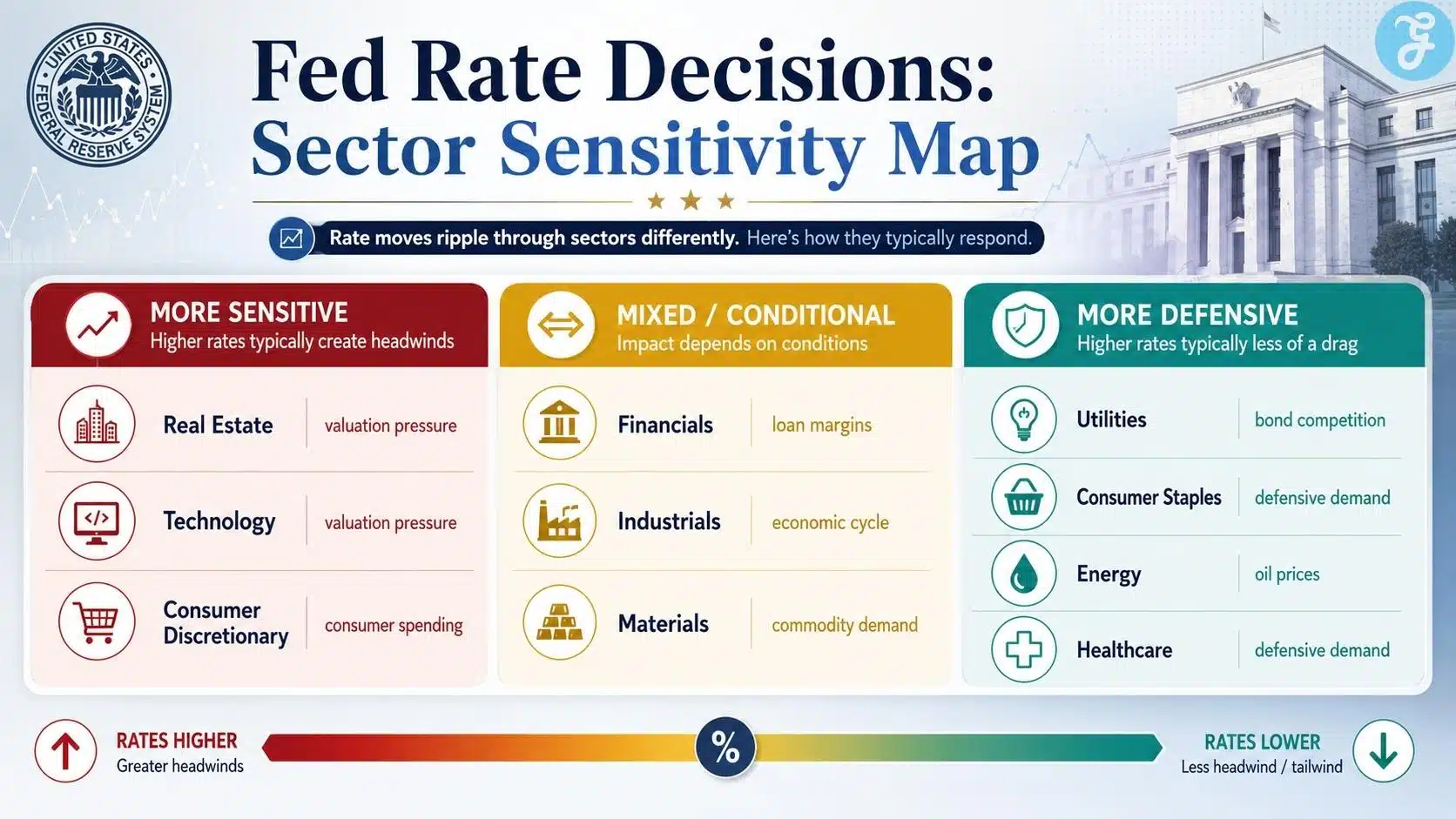
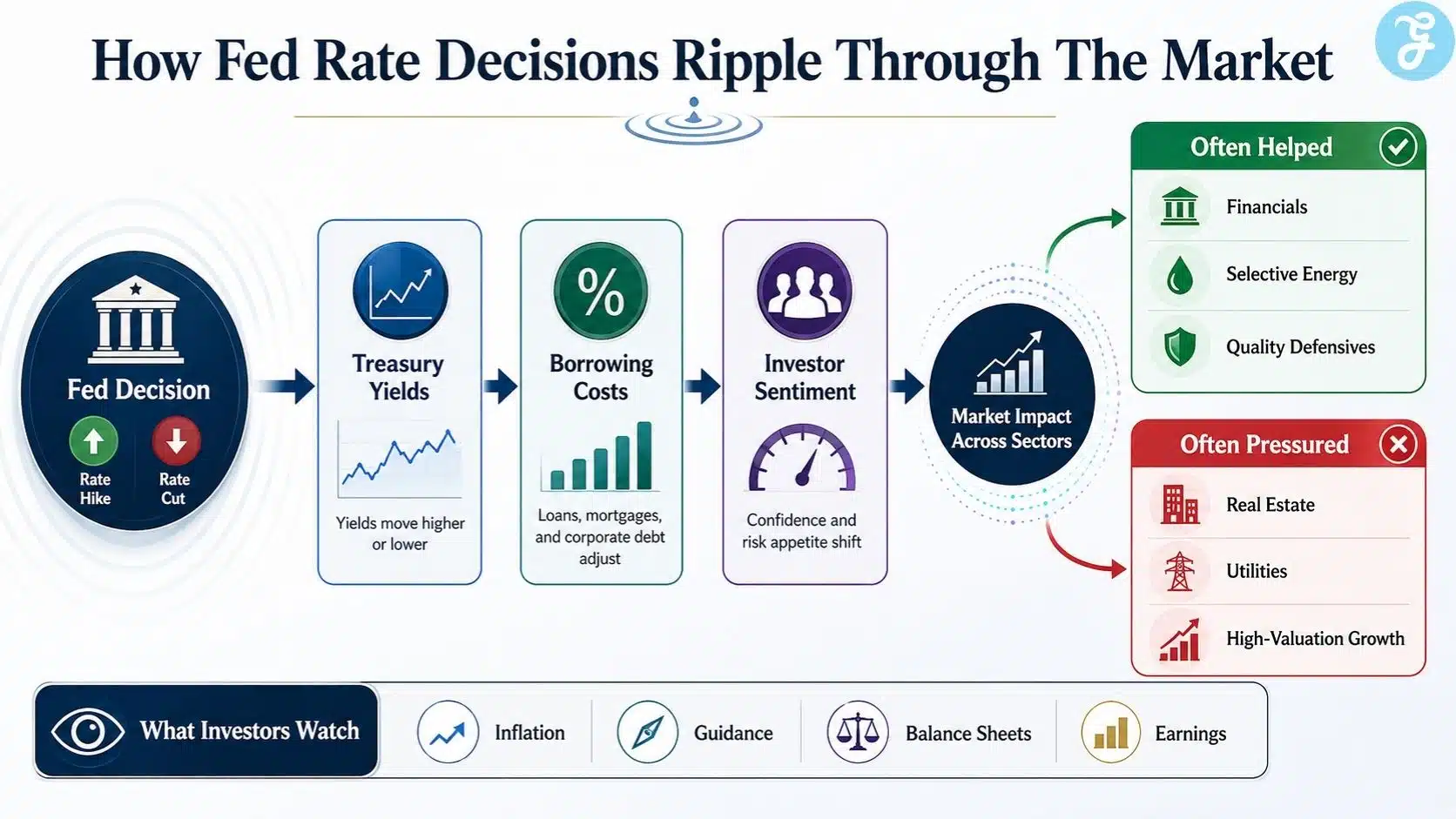
Fed policy reshapes the stock market through multiple channels: yields, valuation, credit costs, consumer demand, inflation, lending margins, and investor sentiment. The result is not one simple winner-and-loser list. It is a changing map of sector sensitivity.
Overview Comparison
Here is a quick way to understand how each sector usually reacts when rates stay high or rate cuts get delayed.
| Sector | Typical Rate Sensitivity | What Helps | What Hurts |
|---|---|---|---|
| Technology | High | AI growth, strong cash flow, durable earnings | Rising yields, high valuations |
| Financials | Medium To High | Wider lending spreads, resilient economy | Credit losses, weak loan demand |
| Real Estate | Very High | Falling yields, strong property demand | Refinancing costs, high mortgage rates |
| Utilities | Medium To High | Defensive demand, stable dividends | Bond-yield competition, debt costs |
| Consumer Discretionary | High | Strong wages, wealthy consumers | Costly credit, weak confidence |
| Consumer Staples | Lower | Essential demand, pricing power | Margin pressure, expensive valuations |
| Energy | Mixed | Oil shocks, inflation, supply constraints | Demand slowdown, commodity reversals |
| Industrials | Medium | Infrastructure demand, business spending | Slower capex, tighter credit |
| Materials | Medium | Inflation support, global demand | Construction slowdown, weaker manufacturing |
| Healthcare | Lower To Medium | Defensive demand, innovation | Valuation pressure, policy risk |
How To Understand Fed Rate Decisions?
Investors should avoid treating every Fed meeting as a simple “rates up, stocks down” event. Markets usually move based on expectations, guidance, inflation data, and whether the decision changes the path investors had already priced in.
The Selection Framework:
- Watch The Rate Path, Not Just The Decision: A hold can be hawkish or dovish depending on what the Fed signals next.
- Track Treasury Yields: Sectors often respond more directly to bond yields than to the Fed statement itself.
- Separate Growth From Valuation: A sector can have strong earnings and still fall if valuations compress.
- Check Balance Sheets: High-debt sectors and companies are more exposed when rates stay high.
The Final Checklist
Before reacting to a Fed decision, use this five-point checklist.
- Did the Fed decision match market expectations?
- Did Treasury yields rise or fall afterward?
- Did the Fed signal cuts, hikes, or a longer pause?
- Which sectors have the highest debt and valuation sensitivity?
- Are earnings expectations improving or weakening by sector?
The Bigger Market Lesson Behind Fed-Driven Sector Rotation
The most important lesson is that Fed policy does not create one stock market. It creates several stock markets inside the stock market. Growth stocks, banks, REITs, utilities, energy producers, retailers, and industrial companies all respond to rates through different channels.
That is why Fed Rate Decisions are reshaping which US stock sectors win and lose. Higher-for-longer rates reward cash flow discipline, punish weak balance sheets, challenge expensive valuations, and force investors to ask whether a sector’s earnings can justify its price. Rate cuts, when they become more likely, can reverse some of those pressures, especially for real estate, utilities, small caps, and growth names.
The uncomfortable truth is that investors often want a simple answer: “Which sector wins if the Fed cuts?” or “Which sector loses if rates stay high?” Real markets are less polite. A sector can win for six weeks and then lose after one inflation print. A company can beat its sector because it has better margins. A rate cut can be bullish if inflation is cooling, but bearish if it arrives because the economy is cracking.
So the smartest approach is not to worship the Fed or ignore it. It is to understand the transmission channels. Rates change the cost of money. The cost of money changes valuations, demand, lending, margins, and risk appetite. That is where sector winners and losers are made.
Frequently Asked Questions (FAQs) About Fed Rate Decisions
How Do Fed Rate Decisions Affect Stocks?
Fed Rate Decisions affect stocks by changing interest-rate expectations, Treasury yields, borrowing costs, valuation models, and investor risk appetite. Sectors with high debt, expensive valuations, or strong credit sensitivity usually react more sharply.
Which Stock Sectors Usually Benefit From Higher Rates?
Financials can benefit from higher rates if lending spreads improve and credit quality remains strong. Energy can also benefit when inflation is driven by higher oil prices, though its performance depends more on commodities than the Fed alone.
Which Sectors Usually Struggle When Rates Stay High?
Real estate, utilities, consumer discretionary, and expensive growth stocks often face more pressure when rates stay high. The reasons include refinancing costs, weaker affordability, bond-yield competition, and valuation compression.
Are Rate Cuts Always Good For Stocks?
No. Rate cuts can help stocks when inflation is falling and growth remains stable. But if the Fed cuts because the economy is weakening fast, cyclical sectors and earnings-sensitive stocks may still struggle.
Why Do Stocks Move Even When The Fed Does Not Change Rates?
Stocks move because investors react to the Fed’s tone, inflation outlook, future rate path, and Treasury yields. A hold can be bullish if markets hear future cuts, or bearish if the Fed signals rates may stay high longer.