If you are looking into the health risks of sitting all day and how to counter them, you have probably noticed how drained you feel after doing absolutely nothing but sitting at a desk. It sounds strange, but it happens to all of us. You sit at your desk for eight hours. Then you sit in your car for the commute home. Finally, you sit on your couch to watch a show.
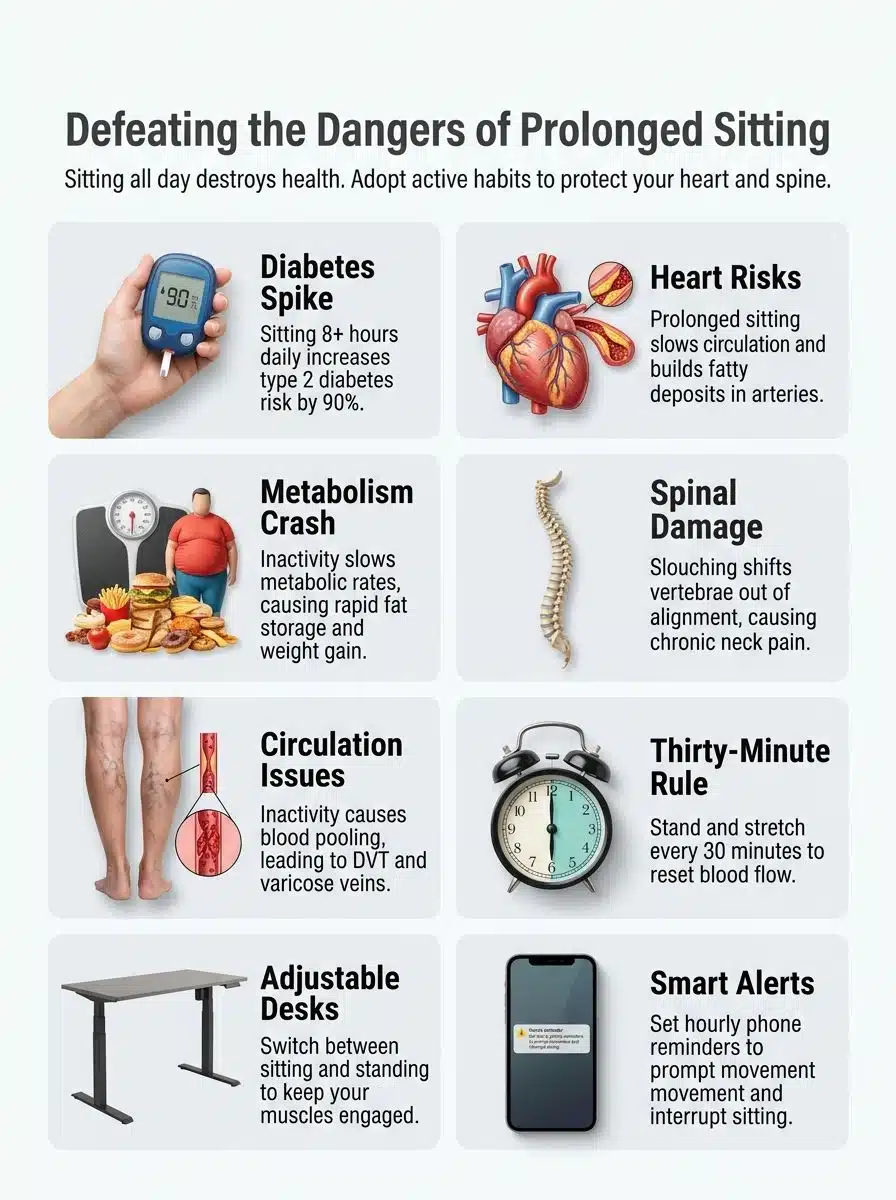
Many people spend most of their day in a chair, completely unaware of the damage this does to their bodies. Your body wants to move, stretch, and stay active. Here is a fact that might surprise you. People who sit for more than eight hours a day have a 90 percent higher risk of developing type 2 diabetes. That is a massive number.
You might feel perfectly fine today, but your heart, your muscles, and your metabolism are all suffering quietly. I am going to walk you through exactly what happens to your body when you sit too much. Then, we will look at some simple, practical steps you can take right now to protect your health.
Why Is Sitting All Day Harmful?
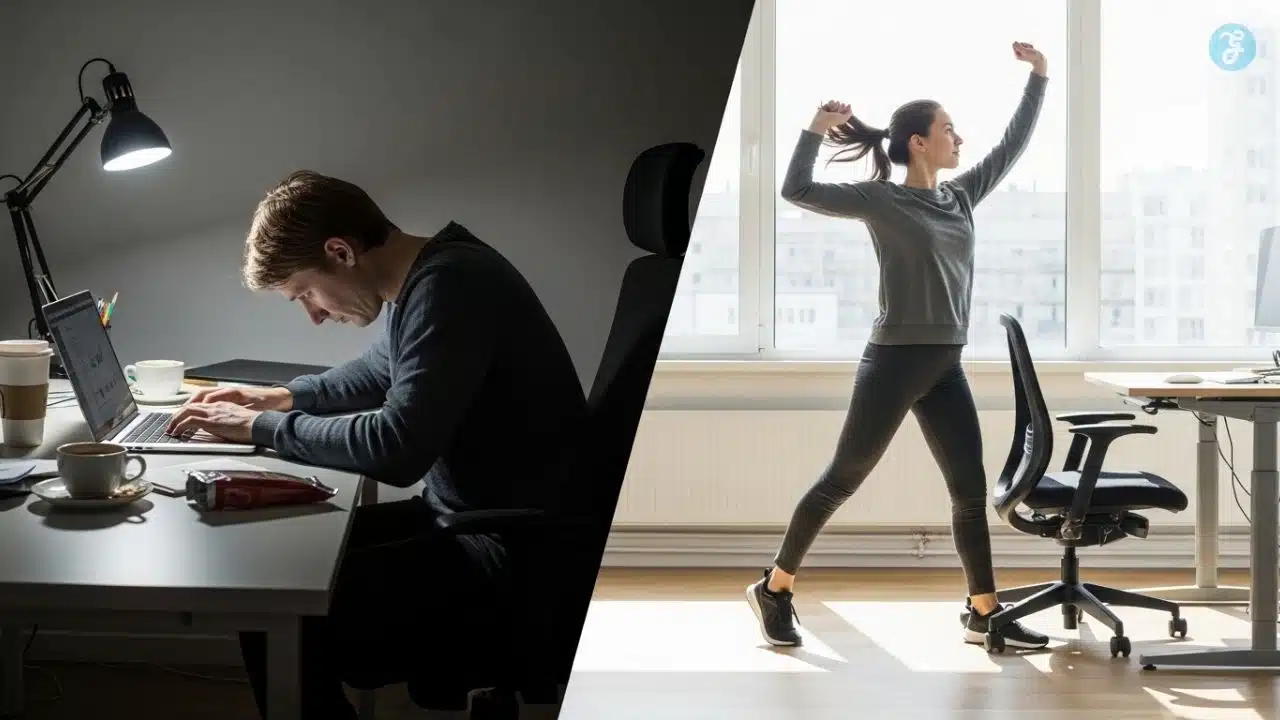
Your body is built for movement. It was not designed to park in a chair for eight straight hours. When you sit all day, you trigger a chain reaction that slows down your entire system.
Your metabolism drags, meaning your body burns fewer calories and stores more fat. Your blood circulation weakens, so oxygen and essential nutrients travel much more slowly through your veins. Without movement, your muscles begin to lose their strength. This is especially true for your gluteals, the large muscles that support your spine and help you walk.
The statistics on this are eye-opening. According to the American Heart Association’s 2025 Heart and Stroke Statistical Update, less than half of adults in the United States get the recommended 150 minutes of weekly physical activity. As a result, we are seeing more spinal issues, higher rates of heart disease, and increased diabetes risk.
Sitting is the new smoking, and the science backs this claim up completely.
This inactive routine hurts your cardiovascular health because your heart simply works less efficiently when you stay still. It also opens the door for blood clots, a serious condition called deep vein thrombosis. Breaking this cycle requires action. The good news is that very small changes will make an enormous difference in how you feel.
Drawbacks of Sitting All Day
Your body pays a steep price when you spend hours glued to your screen. From your heart to your mood, the effects of a sedentary lifestyle touch almost every part of your well-being. Let us look at the specific drawbacks.
Slowed metabolism and weight gain
Sitting for hours on end puts your metabolism into a slow-motion state. Your body burns far fewer calories when you stay put. Because you are not burning off the food you eat, that excess energy gets stored as fat.
Muscles need movement to stay active and burn fuel efficiently. Without regular physical activity, your metabolic rate drops. Extra pounds pile up much faster than you might expect, making weight gain almost inevitable.
This creates a frustrating cycle. Less movement leads to a slower metabolism, which then leads to more weight gain. Breaking this pattern requires you to get up and get your blood flowing again.
Increased risk of heart disease
Your heart suffers greatly when you stay seated for long stretches. Prolonged sitting slows your blood circulation, which allows fatty deposits to build up in your arteries. Without regular movement, your cardiovascular system weakens, forcing your heart to work much harder to pump blood.
A recent 2025 study published in the American Heart Association journal Circulation found a very clear solution. Researchers discovered that replacing just 30 minutes of sedentary time with 30 minutes of light-intensity physical activity lowers the risk of having a cardiovascular event by 50 percent.
Even short walks or standing breaks interrupt the harmful effects of prolonged sitting. When you move, your circulation improves, oxygen flows better to your organs, and your heart stays strong.
Higher likelihood of diabetes
Sitting for long hours seriously messes with how your body handles blood sugar. When you sit all day, your muscles do not burn glucose as they should, causing sugar to build up in your bloodstream.
A landmark study led by Dr. Keith Diaz at Columbia University found an incredible hack for this. The researchers tested different movement routines to see which countered the effects of sitting best.
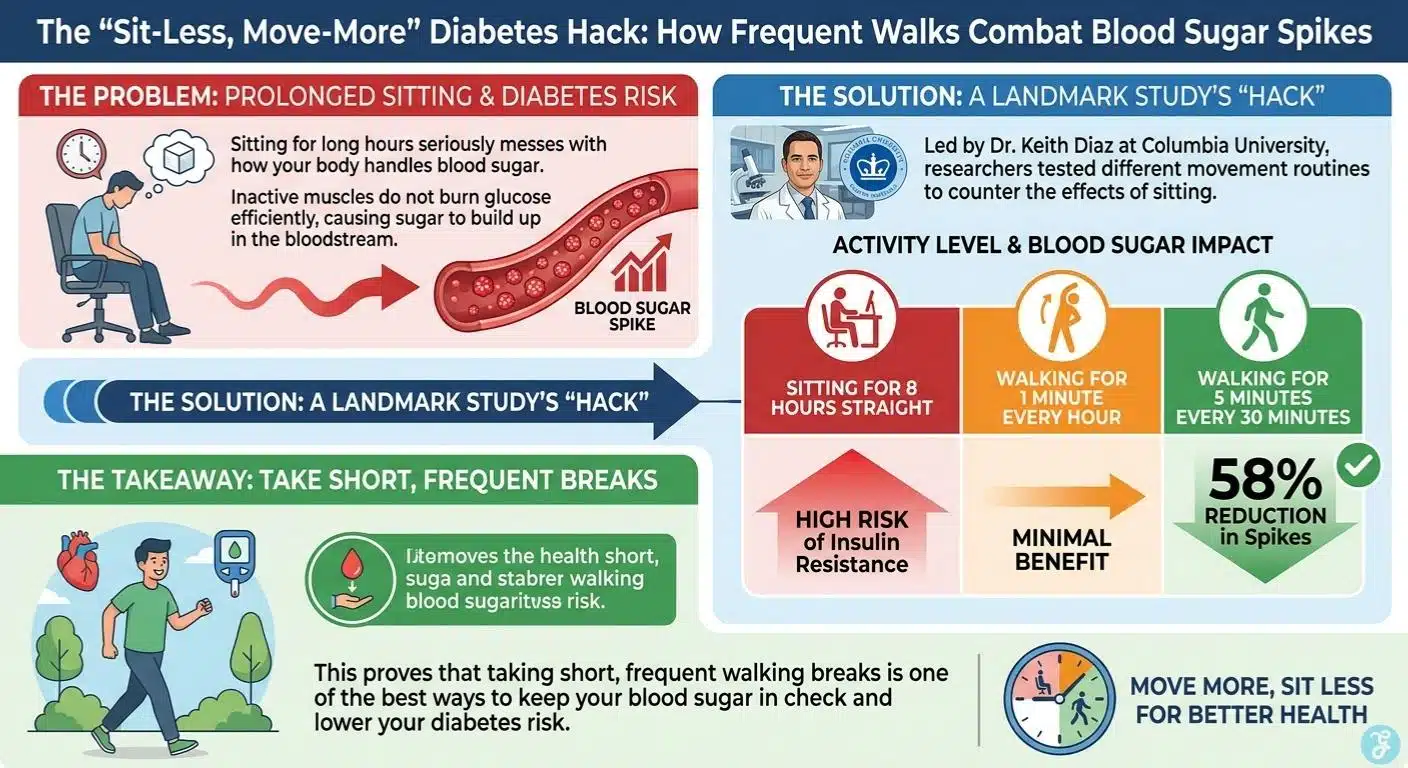
| Activity Level During Workday | Impact on Blood Sugar Spikes |
|---|---|
| Sitting for 8 hours straight | High risk of insulin resistance |
| Walking for 1 minute every hour | Minimal benefit |
| Walking for 5 minutes every 30 minutes | 58% reduction in spikes |
This proves that taking short, frequent walking breaks is one of the best ways to keep your blood sugar in check and lower your diabetes risk.
Poor posture and spinal issues
In my years helping people set up ergonomic home offices across the United States, the most common mistake I see is the slow, steady slouch. This poor posture creates several painful issues:
- It rounds your shoulders forward.
- It pushes your head out of alignment.
- It heavily strains your neck muscles.
This forward head position forces your spine to work harder. Over time, your vertebrae shift out of alignment, causing chronic pain and stiffness. Standing up straight, adjusting your workstation, and taking regular breaks will help reverse this damage and balance your muscles.
Mental health challenges like anxiety and depression
Beyond the physical toll, sitting all day takes a serious hit on your mental health. Your brain needs movement to stay sharp and happy. An inactive lifestyle starves your brain of that vital fuel.
Anxiety often creeps in when your body stays locked in one position for hours. Studies show that people who sit for long stretches face higher rates of mental health problems compared to those who move regularly.
Exercise releases endorphins, which act as natural mood boosters. The American Heart Association recently highlighted research showing that adults who walk at least 5,000 steps a day report fewer symptoms of depression. Getting outside for a quick walk gives your mind the fresh air and activity it craves.
Physical Health Risks of Prolonged Sitting
Sitting for hours on end damages your blood vessels and nerves in ways you might not notice right away. Your body starts to rebel when you stay still too long, creating serious physical problems.
Deep vein thrombosis (DVT)
Deep vein thrombosis happens when blood clots form in your legs after you sit for too long. Your blood circulation slows down significantly when you stay in one position for hours.
These clots can become very dangerous if they travel to your lungs. Office workers and frequent travelers face the highest risk because their lifestyle keeps them immobile for extended periods.
You can fight this by moving your legs every hour. Stand up, walk around, and flex your calf muscles. Compression socks also help squeeze your legs and keep circulation moving, which is a very smart move if you work at a desk all day.
Varicose veins
Sitting for long hours squeezes your leg veins and slows blood circulation. Instead of flowing smoothly back to your heart, blood pools in your legs. This pooling stretches your veins and damages the tiny valves inside them.
Varicose veins develop when these weakened valves fail to push blood upward. You will notice twisted, bulging veins that appear purple or dark blue on your legs.
This is not just a cosmetic issue. It signals real problems with your cardiovascular health. Walking, stretching, or taking the stairs activates the leg muscles that support healthy veins.
Stiff neck and shoulders
Your neck and shoulders take a real beating when you sit for hours without moving. Because your upper body stays locked in the same position all day, those muscles never get a chance to relax.
This creates a painful cycle:
- Blood circulation slows down in your upper body.
- Muscles tighten up around your cervical spine.
- Tension builds like a pressure cooker.
Breaking this cycle requires movement. Roll your shoulders backward and forward, holding each stretch for a few seconds, and tilt your head gently from side to side to loosen those tight muscles.
Weakening of muscles, especially the gluteals
Sitting literally crushes your largest muscle group into a state of constant inactivity. Over time, this causes your gluteal muscles to weaken and deteriorate.

When your glutes get weak, your entire body struggles to function properly, forcing your lower back to take on weight it was never meant to carry.
This muscular breakdown also compromises your metabolism. You lose the ability to stand tall and walk with confidence. Reactivating these dormant muscles requires intentional effort throughout your day.
The Health Risks of Sitting All Day and How To Counter Them
You can absolutely fight back against the damage that sitting causes. Small changes to your daily routine make a real difference in how you feel and function. Here are the best ways to get started.
Take regular breaks to stand and move
Your body turns into a couch potato when you sit for hours without moving. Your metabolism slows down, your blood circulation weakens, and your muscles start to forget how to work.
Taking regular breaks to stand and move is like hitting the reset button on your health. Think back to that Columbia University study. The researchers proved that just five minutes of light walking every 30 minutes is the optimal routine.
This simple habit gets your blood flowing again. Short walks to the water cooler or a quick trip up the stairs will interrupt the harmful cycle of prolonged sitting.
Upper Body Stretching Routines
Stretching unlocks flexibility and improves blood circulation. Let us start with a few simple moves for your upper half.
- Neck stretches: Release tension from hunching over your desk. Gently tilt your head toward each shoulder and hold for fifteen seconds on both sides.
- Shoulder rolls: Combat upper body tightness by rotating your shoulders backward in slow circles for thirty seconds. Then, reverse the direction.
- Wrist and forearm stretches: Extend one arm straight out. Gently press your fingers backward with your other hand, holding for fifteen seconds to prevent carpal tunnel stiffness.
Core and Back Stretching Routines
Your spine takes the brunt of the pressure when you sit. These stretches help relieve that load.
- Seated spinal twists: Sit upright and gently rotate your torso to each side. Hold each twist for twenty seconds to engage your core and loosen your back.
- Full body stretches: Stand up and reach both arms overhead as high as you can. Then, bend gently forward to touch your toes, holding for thirty seconds.
Lower Body Stretching Routines
Your legs and hips get incredibly tight from sitting. Keep them loose with these quick moves.
- Hamstring stretches: While seated, reach forward toward your toes. Hold this position for thirty seconds to stretch the back of your thighs.
- Hip flexor stretches: Step one leg forward into a lunge position. Hold for twenty seconds on each side to counteract the shortening that happens when you sit.
- Quad stretches: Stand up and pull one foot gently behind you toward your glutes. Hold for fifteen seconds per leg.
- Calf stretches: Place your hands on a wall and step one leg back. Keep your back heel firmly grounded for twenty seconds.
Use a standing desk or adjustable workstation
An adjustable workstation transforms how your body works throughout the day. These desks let you switch between sitting and standing, which keeps your circulation flowing.
They are also amazing for your work performance. A 2024 study from the Texas A&M University School of Public Health measured office workers over a 10-day period. They found that 80 percent of workers using a traditional desk experienced lower back discomfort. For those using a stand-biased desk, that number dropped to just 52 percent.
An earlier study from the same university even found that call center employees using stand-capable workstations were 46 percent more productive than those sitting down. Making the switch does not mean you have to stand all day. The real power comes from mixing it up. Sit for a bit, then stand for a stretch.
Walk or exercise during breaks
Movement matters far more than just staying upright in one spot. Walking or exercising during breaks transforms your workday from a sitting marathon into a healthy routine.
Short walks pack serious power for your metabolism. Even a ten-minute stroll after lunch can spark your energy levels and improve focus. Exercise during breaks strengthens your gluteals and boosts cardiovascular health. You do not need a gym or fancy equipment. A quick walk around the office, some deep knee bends, or climbing the stairs works wonders.
Good Posture Habits for the Upper Body
Poor alignment can undo all your hard work. Keep your upper body in check with these tips.
- Position your back firmly against the chair to maintain the natural curve of your spine.
- Align your shoulders directly over your hips, keeping them relaxed and pushed down.
- Rest your arms on the desk or armrests so your elbows form a 90-degree angle.
- Tuck your chin slightly inward, keeping your head balanced instead of jutting forward like a turtle.
Workstation Ergonomics and Lower Body Alignment
Your equipment and lower body placement are just as important as your back.
- Keep your feet flat on the floor or on a footrest, with your knees at a 90-degree angle.
- Place your monitor exactly at eye level, about an arm’s length away, to stop you from tilting your head down.
- Invest in an ergonomic chair that offers firm lumbar support.
- Adjust your entire workstation height so your desk, chair, and monitor work together as a cohesive team.
Building a More Active Lifestyle
You can flip your daily habits on their head by moving your body more often. Small changes add up fast and completely transform how you feel.
Set reminders to move throughout the day
Your phone can become your best friend in the fight against sedentary habits. Set phone alarms or calendar notifications every 30 minutes to prompt yourself to stand up.
Try setting different reminders for different activities:
- Top of the hour: Stretch your neck and shoulders.
- Half-past the hour: Walk to the kitchen for a glass of water.
- Mid-afternoon: Do two minutes of light desk exercises.
Your body responds much better to frequent, small movements than to one long exercise session at the end of the day.
Engage in regular physical activity or exercise
Physical activity works like medicine for your body. Exercise boosts your metabolism, burns calories, and strengthens the exact muscles that sitting weakens.
Even thirty minutes of walking, jogging, or dancing makes a very real difference. Pick activities you actually enjoy so you stick with them. Swimming, cycling, and playing team sports all count toward your goals.
Building exercise into your routine does not mean you need a pricey gym membership. Take the stairs instead of the elevator. Park your car farther away from the store entrance. Play with your kids or pets outside in the yard.
Reduce sedentary activities like excessive TV time
Exercise builds your foundation for better health, but cutting back on screen time matters just as much. Binge-watching shows for hours keeps your blood circulation sluggish.
You sit there motionless while your muscles weaken. Breaking this pattern requires real action. Set limits on how much television you watch each evening.
Turn off the TV after one show instead of three. If you do watch, stand up during the commercial breaks and do some quick stretches. Every minute you spend away from the screen is a minute your body spends healing itself.
Wrapping Up
Your body sends very clear signals when you sit too long. Stiffness creeps in, your energy drops, and your focus fades fast. Movement matters more than you think. Your cardiovascular health, your metabolism, and your mental state all improve when you stand up and get the blood flowing. Start today with one simple action. Set a phone alarm every half hour at work. Stand up, stretch your arms overhead, and take a five-minute walk.
These tiny shifts in your physical activity add up to major improvements. Understanding The Health Risks Of Sitting All Day And How To Counter Them is the first step, but your future self will be incredibly grateful that you actually took action today.
Frequently Asked Questions on The Health Risks of Sitting All Day
1. Why is sitting all day bad for your health?
Sitting for long periods slows your metabolism by up to 90% compared to standing or walking. Your muscles get lazy, blood flow drops, and calories burn more slowly, which can lead to weight gain, sore backs, stiff necks, and even heart trouble.
2. What are the main health risks of sitting all day?
Research shows that sitting too much raises your risk of heart disease by 147%. You might face back pain that nags throughout the day, tight hips that creak when you stand up, and higher blood sugar after meals. Over time, this can increase your chances of developing diabetes or serious cardiovascular problems.
3. How can I counter the effects of sitting too much?
Stand up every 30 minutes and take short walks during breaks, like a quick lap around your office. Try using a standing desk converter like Varidesk to alternate between sitting and standing, and take the stairs instead of elevators whenever possible.
4. Can small changes really make a difference against these risks?
Absolutely! Studies show that just 5 minutes of walking for every 30 minutes of sitting can significantly lower blood sugar and blood pressure. Each small move adds up and helps keep both your mind and body sharp throughout the day.