
Do you want to know how to set boundaries without feeling guilty? You are not alone in this struggle. Many people worry about hurting others or being seen as mean. This fear keeps them trapped in situations that drain their energy. The guilt creeps in fast. Suddenly, you are stuck doing things that do not serve you. Here is a helpful secret I have learned over the years. Setting personal boundaries is the highest form of self-care.
A 2025 study from the Journal of Health and Social Behavior found that people with clear boundaries saw a 43% lower rate of anxiety disorders.
I am going to walk you through the exact steps of setting boundaries that protect your peace. Grab a cup of coffee, and let’s go through it together.
Understanding Boundaries and Their Significance
Boundaries act like guardrails that protect your mental health and shape how others treat you. They give you the structure you need to control your time and energy.
Defining Boundaries
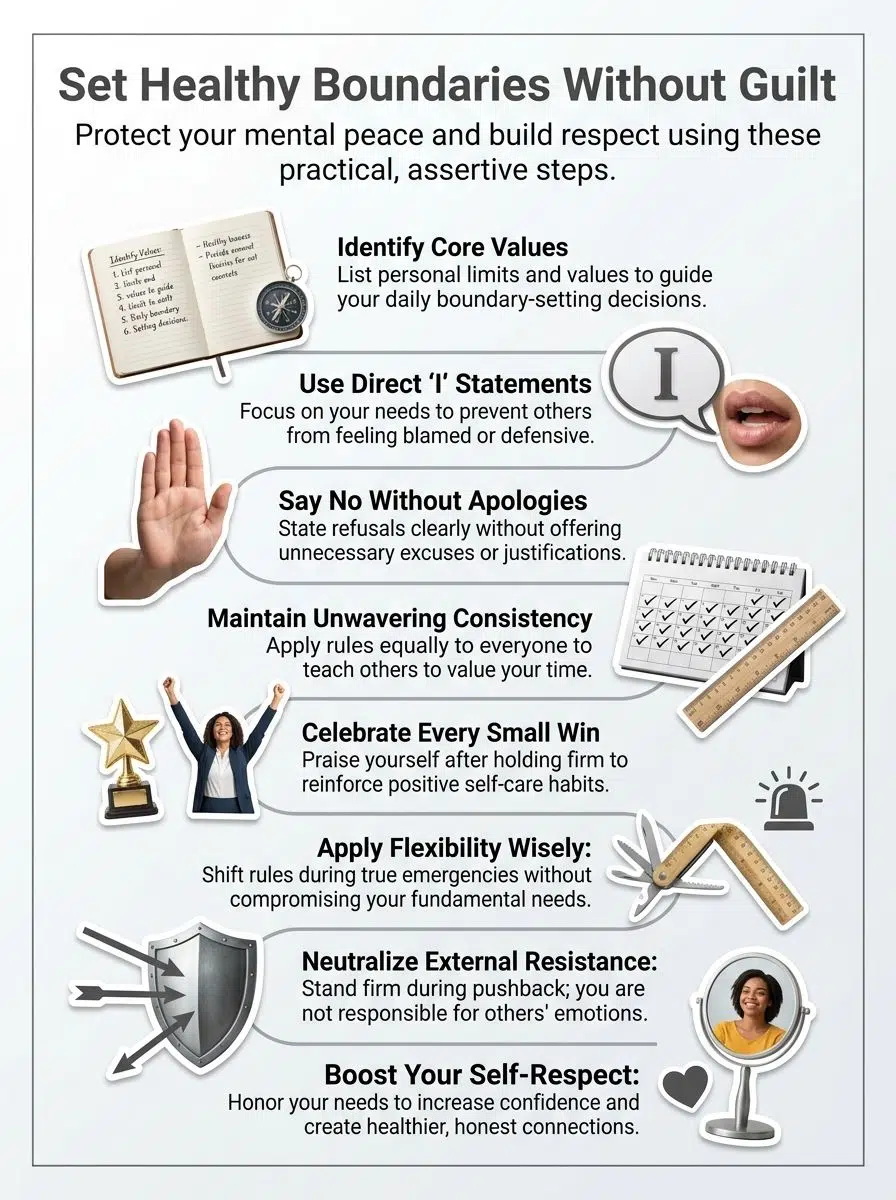
Boundaries are the limits you set for yourself and others. They clearly show what you will accept and what you will not. Nedra Glover Tawwab is a popular US therapist and author. In her 2021 book Set Boundaries, Find Peace, she calls boundaries the true blueprint for how to love ourselves.
Think of them like a fence around your home. They protect your space and your feelings. Your boundaries might involve saying no to extra work or protecting your personal time.
Clear boundaries help you feel safer. Your values shape the limits you create, so if family time matters to you, set rules around work hours.
The Impact of Boundaries on Mental Health and Relationships
Healthy boundaries act like a shield for your mental health. They protect you from anxiety and emotional exhaustion. In 2024, Mental Health America reported that over 60 million US adults experienced mental illness. Setting daily limits is a frontline defense against this emotional burnout.
Dr. Henry Cloud co-authored the famous book Boundaries. He often compares these limits to a property line that helps you take responsibility for your own life.
Daring to set boundaries is about having the courage to love ourselves, even when we risk disappointing others. Brené Brown
Your confidence grows when you stand up for what matters to you. Relationships improve because friends and coworkers appreciate clarity.
The Challenge of Establishing Boundaries
Setting rules feels scary because you worry about disappointing people you care about. Guilt creeps in fast, making you question your choices.
The Fear of Upsetting Others
Many people struggle to speak up because they fear making someone angry. You worry that saying no might damage your relationships. According to a 2026 report in Psychology Today, 62% of initial boundary attempts fail due to guilt. Expecting pushback is just part of the process.
Dialectical Behavior Therapy teaches a helpful concept called Radical Acceptance. You accept that others might be upset, but you hold your ground anyway to protect your inner peace.
Here is how you can reframe that fear:
- Old Thought: Saying no makes me a bad friend.
- New Thought: Saying no keeps me from building resentment.
- Old Thought: They will be angry with me.
- New Thought: Their reaction is not my responsibility.
The Influence of Guilt and Social Expectations
Guilt acts like an invisible weight holding you back. Society teaches us to put others first and avoid conflict at all costs. A 2020 study in the journal Self and Identity found a great solution. Practicing self-compassion actually reduces boundary-related guilt by 53%.
Social pressure often hits women the hardest. A 2025 workplace study showed women experience burnout at a 46% rate compared to 37% for men, mostly due to these uneven expectations.
Your emotional wellness suffers when you ignore your values. Setting boundaries is an act of love, not a selfish choice.
The Struggle with Confidence in Boundary-Setting
Confidence plays a massive role in your success. You might know what you need to say, yet doubt creeps in and freezes you. To build confidence, you can use journaling apps like Stoic to track your daily mood. This helps you understand exactly where your limits are being crossed.
Research shows it takes an average of 66 days to form a new habit. Don’t beat yourself up if saying “no” feels shaky the first few times.
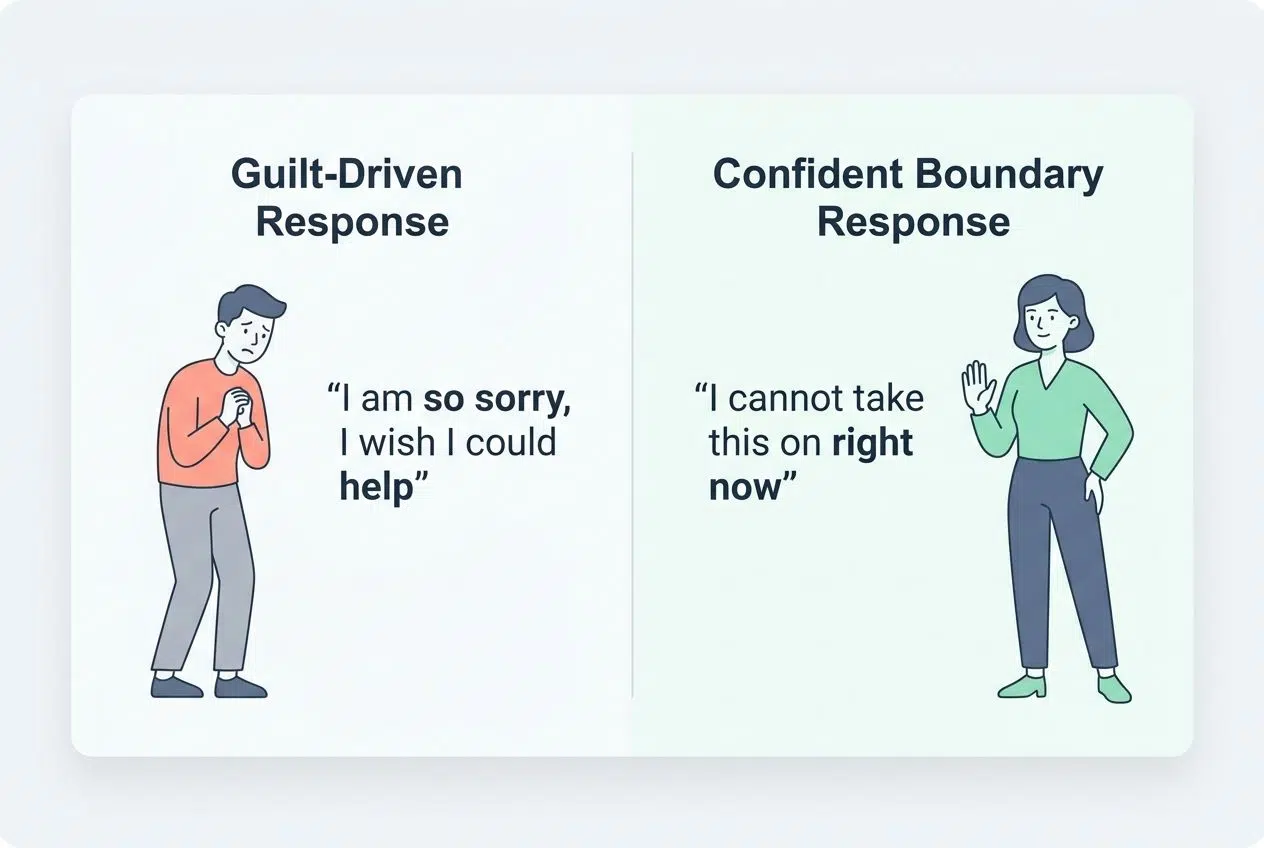
| Guilt-Driven Response | Confident Boundary Response |
|---|---|
| “I am so sorry, I wish I could help, but I am just so busy right now.” | “I cannot take this on right now, but thank you for thinking of me.” |
| “Maybe I can squeeze it in if I stay up late.” | “My schedule is full, so I will have to pass.” |
Practical Steps on How To Set Boundaries Without Feeling Guilty
You already know what you want. Now you need to say it out loud, clearly and without apology.
Recognize Your Personal Values and Limits
Your values shape who you are and guide your choices. Take time for some honest self-reflection to write out what matters most to you. If you are not sure where to start, use the Daylio app. It is a great tool to track what activities drain you and what gives you energy.
Melissa Urban wrote The Book of Boundaries. She suggests looking for green, yellow, and red flags in your daily energy levels to pinpoint your exact limits. Your values act as your personal compass. Once you identify them, setting rules becomes much easier.
Clearly and Calmly Communicate Your Boundaries
Clear communication forms the backbone of healthy relationships. Speaking your needs with calm confidence helps others understand what you expect.
Try the DEAR MAN technique from Dialectical Behavior Therapy. It stands for Describe, Express, Assert, and Reinforce. Roots Relational Therapy noted a 50% improvement in relationship stability after one year for people who practiced these specific scripts.
- Use simple language when you talk about your limits. Say exactly what you mean without hiding behind hints.
- Pick the right time and place for this conversation. Choose a quiet moment when both people feel calm.
- Start with “I” statements that focus on your feelings. Say “I need quiet time after work” instead of “You always bother me.”
- Speak in a steady tone throughout the talk. Raised voices make others defensive, which blocks real communication.
- Explain why this boundary matters to your emotional health. Help the other person see how this protects your well-being.
- Listen to what the other person says in return. Good communication skills flow both ways.
Practice Assertive Refusal
Saying no without guilt takes practice. Assertive refusal is your most powerful tool. The broken record technique is a favorite among psychologists. You just repeat your boundary in a calm tone, like “I cannot take this on right now,” without changing your story.
- Limit your refusal to under ten words if possible. Over-explaining invites unnecessary negotiation.
- Offer a brief reason for your refusal, but avoid making excuses. People often talk too much when they feel anxious.
- Practice saying no out loud before the actual conversation happens. Rehearsing your response builds assertiveness.
- Maintain eye contact and use an open body posture. Standing tall shows you believe in what you are saying.
- Avoid apologizing for having limits. Your needs are legitimate, and you do not need permission to protect them.
- Use phrases like “That does not work for me” or “I am unable to do that.” These responses are firm without being harsh.
Strategies for Sustaining Healthy Boundaries
Keep your boundaries strong by staying consistent and rewarding yourself. Life throws curveballs, so a little flexibility helps too.
Maintain Consistency in Your Boundaries
Consistency forms the backbone of healthy limits. Your rules only work when you stick to them every single time. According to the Journal of Applied Psychology, boundary violations actually increase temporarily when you first set them. Consistency is your only defense against this initial pushback.
- App trackers like Streaks or Habitify can help you log every time you successfully say no. This builds great visual momentum.
- Apply your rules equally to everyone in your life. People respect fairness and notice when you play favorites.
- Enforce consequences without hesitation when someone crosses your line. Inconsistent enforcement sends the message that your rules are fake.
- Track your boundary decisions in a notebook to spot patterns. Writing things down helps you recall what you have committed to doing.
- Resist the urge to justify your decisions to others. The more you talk, the more people think they can debate you.
Employ Positive Reinforcement Techniques
Positive reinforcement transforms your boundary-setting journey into a rewarding experience. You celebrate your wins and build momentum.
- Use a gamified self-care app like Finch to reward yourself with digital treats when you stick to your guns.
- Treat yourself to a fancy coffee from Starbucks or a quiet walk after a tough conversation. This signals to your brain that setting limits brings positive results.
- Praise yourself immediately after you set a boundary. Your brain responds to instant recognition and stores these moments as victories.
- Share your boundary victories with trusted friends who cheer you on. External validation reduces guilt.
- Notice how people respond positively when you stand firm. Let that feedback anchor your commitment to self-respect.
Integrate Flexibility into Your Boundaries
Healthy boundaries do not have to be rigid walls. Life changes fast, and your rules should move with you like a tree swaying in the wind. A 42% capacity rule is popular in modern workload management. You leave room for the unexpected so your boundaries can flex without breaking.
A 2023 Leesman survey of global workers highlighted something huge. Flexibility within boundaries cuts healthcare costs for companies by 50% because it drastically lowers stress.
Assertiveness means knowing what matters most to you and protecting it. Your relationships thrive when others understand you are being thoughtful, not difficult.
Illustrations of Effective Boundaries
Boundaries work differently across your life, from your home to your office. Real examples show you exactly how to draw lines that stick.
Setting Boundaries in Personal Relationships
Your personal relationships shape who you are, so protecting them matters. You set limits in romantic partnerships by stating what you need.
Saying “I need 30 minutes alone after work before we talk” is a perfect example of a clear, time-based boundary. A 2026 Zencare report found a 50% rise in searches for couples counseling. Many people are actively seeking professional help to establish these very communication rules.
Friends deserve the same honesty you give your romantic partner. You can say no to plans without explaining yourself endlessly.
Establishing Boundaries in the Workplace
Your workplace demands the same skills you use at home, but the stakes feel different. Work environments test your limits in unique ways. In 2025, a massive 82% of employees were at risk of burnout. Protecting your lunch hour is no longer a luxury.
Here are a few ways to protect your energy at work:
- Use tools like Reclaim.ai to automatically block your calendar for deep work. Let the software do the heavy lifting.
- Set an auto-responder for emails received after 6 PM.
- Decline meetings that do not have a clear agenda attached.
- Take your full lunch break away from your desk.
Managing Boundaries with Family and Friends
Family members often test our limits because they feel closest to us. Setting rules with loved ones requires honest reflection about what you can actually give. During the holidays, saying “We will only be staying for two hours” is a clear limit. It prevents family gatherings from becoming draining.
Acknowledging the relationship first softens the boundary. Say something like, “I value our friendship, but I need to sleep by 10 PM.” Practice saying no without making excuses. Extra words often signal that you do not truly believe in your own limits.
Tackling Obstacles in Boundary Setting
People will push back when you change the rules. You need solid strategies to handle their resistance without caving in.
Address Resistance from Others
Resistance from others shows up in many forms, and it can shake your confidence. Some people might get angry or try to guilt-trip you. When someone pushes back, use the “GIVE” skill from DBT. Be Gentle, act Interested, validate their feelings, but keep an Easy manner while holding your line.
A seven-year longitudinal study showed a 29% increase in relationship satisfaction for those who held firm through initial resistance.

You cannot control how others react to your boundaries, but you can control whether you set them.
Your emotional intelligence shines when you stay firm. You can handle conflict resolution kindly and strongly at the exact same time.
Manage Feelings of Guilt When Enforcing Boundaries
Once others push back, guilt often sneaks in right behind them. That guilt is normal, but you do not have to let it control your choices. Remind yourself that self-care is a clinical necessity. The American Psychological Association notes that 77% of Americans regularly experience physical symptoms caused by stress.
If the guilt spikes right after saying no, try the 5-4-3-2-1 grounding technique. It helps calm your nervous system instantly.
Here are ways to stop the guilt spiral:
- Talk to yourself the way you would talk to a good friend.
- Remember that boundaries keep everyone safe, like guardrails on a bridge.
- Focus on the positive results of your choice, not the temporary discomfort of others.
- Recognize that saying no to them means saying yes to your own health.
Advantages of Healthy Boundary Setting
Setting rules transforms your self-respect in powerful ways. You will find that your relationships deepen when you honor what matters most.
Boost Self-Esteem and Confidence Through Boundaries
Healthy boundaries act like a mirror for your self-respect. You start to see yourself differently when you stop letting others cross your lines. Research shows a 58% improved sense of personal autonomy for people who enforce clear boundaries in their daily lives.
It is exactly like a muscle. As Dr. John Townsend explains, the more you exercise your “no” muscle, the stronger your identity becomes. This personal growth feeds your confidence in every area of your life. You discover that protecting your peace is honest and brave.
Cultivate Stronger, Healthier Relationships with Boundaries
Clear limits create the foundation for genuine connection. People respect you more when you know what you want and stick to it. Setting limits directly correlates with higher engagement. Gallup found that employees with clear boundaries are 26% more likely to be fully engaged at work.
It also removes the toxic “scorekeeping” dynamic that destroys friendships. This clarity leads to what psychologists call a secure attachment style.
Here are the benefits you will see:
- Less anger and resentment are building up inside you.
- More energy to spend on the people who truly matter.
- Mutual respect makes conflict resolution much easier.
- A deep sense of empowerment in your daily life.
Final Words
You have finally learned how to set boundaries without feeling guilty, and it all starts with knowing your values. Start today by picking one area where you struggle. Practice saying no to something small, and watch your self-respect grow. Take action right now. You deserve to live a life where your needs matter just as much as everyone else’s.
Frequently Asked Questions (FAQs) on Setting Boundaries
1. Why do I feel guilty when I set boundaries with people close to me?
Research from the Journal of Personality and Social Psychology found that people-pleasers experience guilt when setting boundaries because they fear social rejection. You might worry about hurting feelings or being seen as selfish, but saying no protects your own peace and mental health.
2. How can I say no without sounding rude or cold?
Communication experts recommend using “I” statements that focus on your needs rather than blaming others. Try saying, “I appreciate you thinking of me, but I need to take care of myself right now.” People respect honest, direct communication.
3. What if someone gets upset when I set limits?
Their reaction belongs to them, not you. A 2023 study in the Journal of Social and Personal Relationships found that people who consistently maintain boundaries report stronger, more authentic connections over time.
4. Can setting boundaries actually improve my relationships?
Yes, research from the University of California shows that relationships with clear boundaries have 30% higher satisfaction rates. When people know where you stand, they stop guessing and start respecting what matters to you.