
Does your app move a little slower these days? Maybe your team waits weeks just to fix a few small bugs. Adding new features might feel like pushing a giant boulder up a steep hill. If your company runs on a single massive system, these headaches probably sound very familiar. One big codebase handles everything. This setup means even a tiny change requires testing the whole application. This structure worked great years ago. Today, fast-moving businesses in the US need a better way to operate.
A 2025 survey from O’Reilly showed that over 70% of US enterprise teams have adopted new, separated software structures. Companies like Netflix, Amazon, and Uber left their massive, single-code systems behind a long time ago. They figured out a secret. Breaking their applications into smaller, separate pieces changed everything about how they build software.
I am going to walk you through Monoliths Vs Microservices Architecture. We will look at the real benefits and the actual hurdles.
Grab a cup of coffee, and let us go through it together. I will show you everything you need to know to make the right choice for your team.
What is Monolithic Architecture?
A monolithic architecture bundles all your application parts into one single codebase. Your database, user interfaces, and business logic all live together in one place.
This all-in-one approach made total sense for decades. Many companies still run their daily operations on monolithic systems today using classic frameworks like Ruby on Rails or Django.
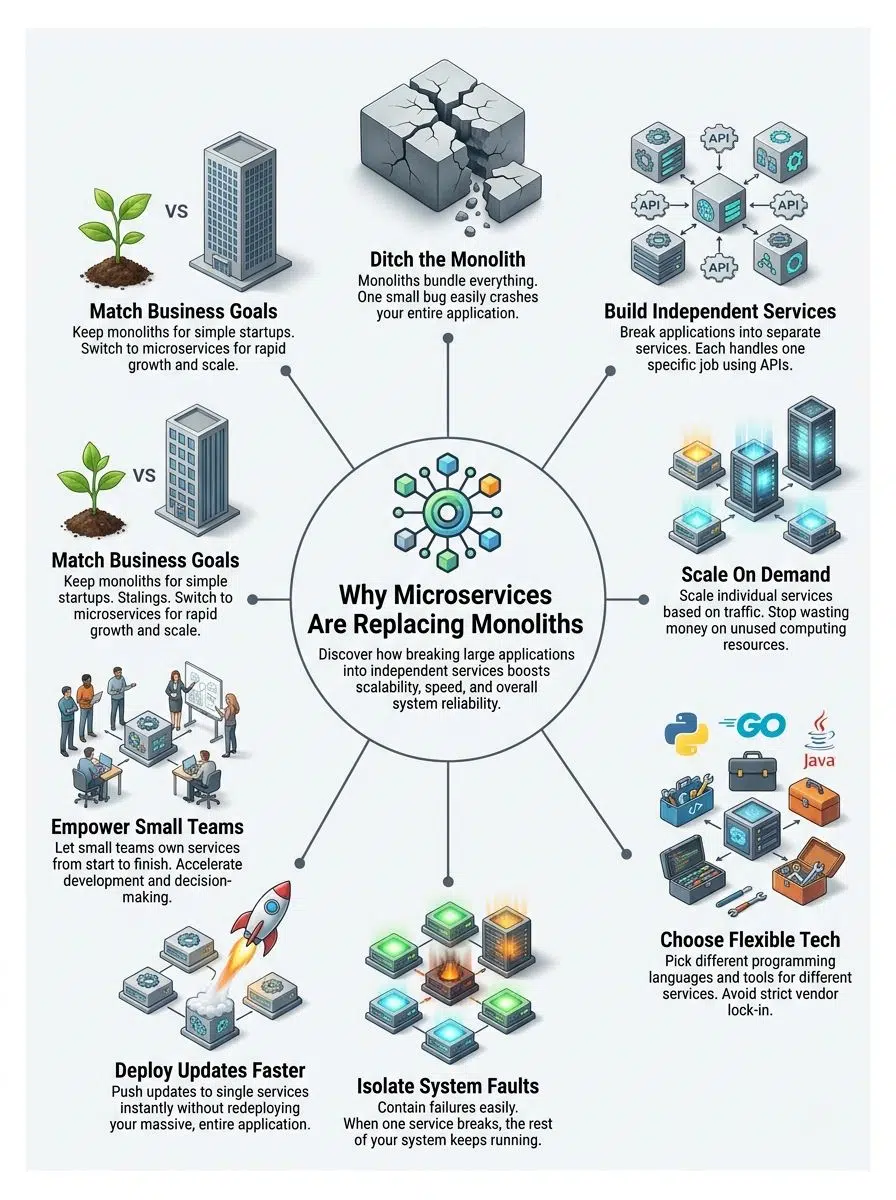
Characteristics of monolithic systems
These systems bundle all software components into one large package. These applications run as a single process. This makes them easier to build initially but harder to scale over time.
- Single codebase: One repository houses all features and functions. Developers work within the same project structure regardless of their specific role.
- Tightly coupled components: Dependencies run throughout the application. Changing one part requires testing multiple other sections to prevent errors.
- One deployment process: The entire application restarts whenever you release updates. This causes downtime for all users, even if you only changed one small feature.
- Shared database architecture: All data lives in a single database system. Components must follow identical access patterns.
Advantages of monolithic architecture
Simplicity breeds success, and a monolithic approach delivers exactly that from day one.
These setups shine when you need speed and simplification right out of the gate. A single, unified codebase makes development straightforward for small teams.
Developers work in one place, share the same database, and deploy everything together. You skip the headache of managing multiple network services.
Testing stays simple because you test the entire application as one single unit. Performance stays solid since all components live in the same server process.
There are no network calls slowing things down between different parts of your software. A 2024 Stack Overflow developer survey highlighted that teams of under ten people launch products up to 30% faster using a monolith. You run one application instead of many, which keeps infrastructure costs very lean.
Drawbacks of monolithic architecture
That initial simplicity comes with a steep price later on. Monolithic systems create tight coupling throughout the entire codebase. Changes in one part ripple through the whole application like dominoes falling.
Scaling becomes a nightmare because you must duplicate the entire application. You cannot just scale the parts that need more power. This wastes server resources and money. A single bug can crash the whole system, leaving your reliability in question.
Teams step on each other’s toes constantly since everyone works in the same massive codebase. You cannot push a small update without redeploying everything.
A recent 2025 DORA report shows that monolithic deployments experience a three times higher change failure rate compared to decoupled systems. Adding new features requires touching code written by multiple teams, creating massive integration headaches.
What is Microservices Architecture?
Microservices architecture breaks your application into small, independent services that work together. Each service handles one specific job and talks to others through APIs.
Tech giants paved the way here. Amazon Web Services uses this exact model to handle billions of API requests across the US every single day.
Key features of microservices
These setups separate large applications into isolated parts. Each service operates independently.
- Independent deployment: Teams release new features without touching other services. This speeds up the entire software development cycle.
- Loose coupling: Services stay separate from each other. Problems in one service do not crash the whole system.
- Technology flexibility: Different teams pick different programming languages. They choose the databases and tools that work best for their specific service.
- Targeted scalability: You grow the specific parts that need more power. You do not have to scale your entire application.
- Fault isolation: Failures stay contained. When one service breaks down, the others keep running smoothly without interruption.
Advantages of microservices architecture
These features create real advantages that companies can leverage right away. Teams scale individual services based on actual demand. You do not waste money running unnecessary code. Your developers can deploy updates to one service without touching the entire system.
This flexibility means your business responds faster to market changes. Teams work independently on different services, so they move more quickly.
The architecture improves reliability across the board. If a payment service fails, your users can still browse the product catalog.
Cost efficiency jumps up because you only pay for the computing power you actually use. A 2025 Gartner study found that US companies using microservices ship new features 45% faster than their competitors.
Challenges of microservices architecture
This approach brings real headaches to the table if you are not prepared. The fragmentation of your codebase means you have more repositories to maintain.
- Network latency: Experienced engineers on the r/devops forum warn that latency will ruin your application performance if you do not use a dedicated service mesh like Istio.
- Tracking problems: Distributed systems create more moving parts. Tracking down a bug across ten different servers becomes a massive detective game.
- Complex testing: Testing becomes a multi-stage process. You test individual services, then test them together, and then test the whole system.
- Cloud costs: The cost efficiency you gain in scalability can disappear fast if you fail to monitor your cloud infrastructure closely.
Why Are Microservices Replacing Monoliths?
Companies make the switch because they gain better scalability, faster deployment cycles, and stronger fault isolation. Monolithic systems simply cannot match these benefits.

Scalability and flexibility
Upgrading a massive standard AWS EC2 instance to handle a traffic spike often costs triple what it takes to spin up a few small AWS ECS containers for a single microservice.
Monolithic systems struggle heavily when traffic spikes hit. One massive codebase handles everything, so adding more servers provides very little help.
Microservices flip this entirely on its head. You scale individual services based on actual demand from your users. Do you need more power for your payment processing? You simply scale that specific service. If your user dashboard runs fine, you leave it alone.
This targeted scaling cuts costs and boosts performance at the very same time. Teams deploy updates faster because they work on separate pieces of the puzzle.
Developers get to choose different tools and languages for different services. One team picks Java, another uses Python, and a third selects Node.js. This freedom sparks genuine innovation across your organization.
Enhanced development and deployment processes
Teams discover that development and deployment processes transform dramatically. Developers work on smaller, independent services rather than wrestling with massive codebases.
- Decentralized ownership: Each team fully owns its service. They make decisions faster and ship updates without waiting for approval from other departments.
- Simple deployment: You push one small service live instead of redeploying an entire application.
- Automated testing: Engineers use continuous integration tools like GitHub Actions to automate testing. This automation reduces human error and speeds up your time to market.
Improved fault isolation
In a monolithic system, one broken part can crash the entire application like a house of cards. Microservices fix this problem by breaking your software into separate, independent services.
Each service runs on its own isolated server or container. If one fails, the others keep working normally. Your customers experience less downtime. Your team spends less time fighting late-night fires.
Developers can pinpoint exactly which service caused an issue and deploy a fix without touching the rest of your codebase. The architecture makes testing much easier and highly focused.
Teams test individual services in isolation, catching bugs before they spread to other parts of the system. This decentralization of services transforms how companies handle errors. It gives teams better control over their software stability.
Transitioning from Monolith to Microservices
Moving away from a monolith demands careful planning and clear goals. Your organization must build new skills and prepare for major operational changes.
The most successful US tech companies use a method called the “Strangler Fig Pattern.” This strategy involves slowly replacing parts of the old system piece by piece until the monolith is gone completely.
Planning a migration strategy
Planning your migration requires careful thought and solid groundwork. Your team must map out each step before touching a single line of code.
- Audit your current system: Identify which parts can be broken apart into separate services easily. This helps you understand your current data flows.
- Define clear business goals: Know exactly why you are migrating. Focus on goals like improving scalability or reducing deployment times.
- Assess team readiness: Evaluate whether your team has the cloud computing knowledge to manage distributed systems.
- Create a phased approach: Break the migration into smaller chunks. Never attempt one massive overhaul overnight.
- Establish monitoring tools: Set up observability platforms like Datadog before you launch anything. You need to track performance in real time.
Adopting DevOps practices
Once you have a solid migration strategy, adopting new operational practices is your next critical move. These habits transform how your teams build and test software.
- Establish collaborative cultures: Break down the traditional walls between development and operations teams.
- Implement automated pipelines: Use automated testing and release processes. This allows teams to push code changes daily.
- Use containerization: Package your services using technologies like Docker. This ensures each service runs the same way everywhere.
- Create self-service tools: Let developers provision cloud resources themselves. This stops them from waiting weeks for IT approvals.
Building and managing microservices
Building microservices means separating your software into small, dedicated jobs. Each service handles one specific task, like processing customer payments or managing user profiles.
Your teams deploy these services separately. One team can update its service without breaking another team’s work. This speeds up your deployment cycles immensely. You need solid API management to connect these services, since they talk to each other constantly.
Cloud platforms make hosting these services much easier than traditional hardware setups. Managing this architecture requires clear communication between every department.
You will monitor each service separately to catch problems fast. Cost efficiency improves dramatically when you only scale the services that need more server power.
Use Cases for Microservices vs. Monoliths
Different projects demand different architectural approaches. Picking the right one can make or break your software success. Your team needs to understand which situations call for monolithic systems and which ones thrive with a distributed setup.
Best scenarios for monolithic applications
Monolithic applications still thrive in specific situations. Their simplicity and tight integration deliver real value to smaller organizations.
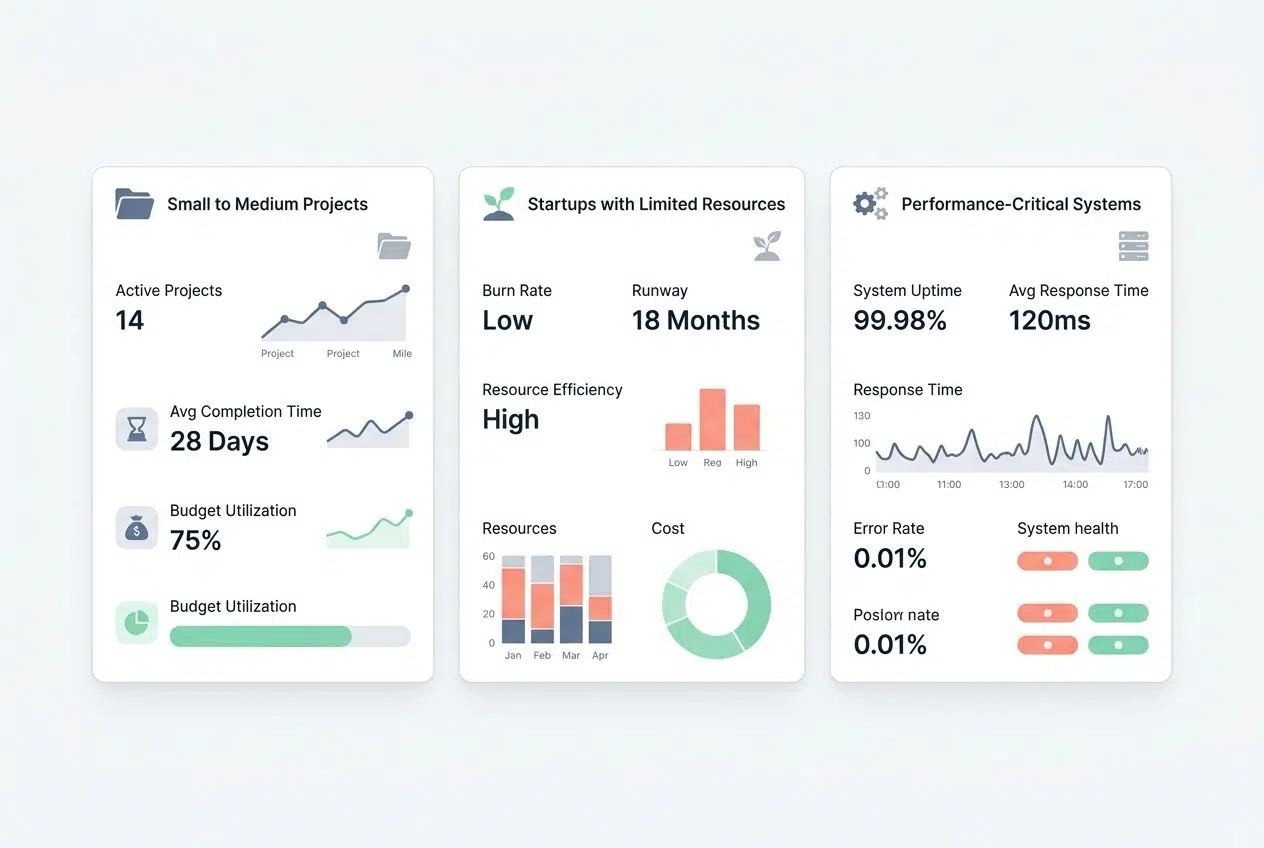
| Scenario | Why It Works Best | Key Benefits |
|---|---|---|
| Small to Medium Projects | Your team stays lean. You avoid the overhead that comes with distributed systems. One codebase keeps everyone on the same page. | Lower operational costs, simpler debugging, and faster time to market. |
| Startups with Limited Resources | Building microservices demands expertise you might lack. A monolith lets you focus purely on product development instead of architecture battles. | Reduced infrastructure complexity and lower hiring requirements. |
| Performance-Critical Systems | In-process server calls beat network API calls every single time. Latency stays low when milliseconds affect user experience. | Minimal latency, predictable performance, and efficient resource usage. |
Ideal scenarios for microservices architecture
This architecture shines when your application faces rapid growth. It handles complex feature demands beautifully.
| Scenario | Why It Works Best | Key Benefit |
|---|---|---|
| Large-Scale Applications | Your app handles millions of users. Breaking it into services lets each part scale independently without wasting money. | Saves costs and boosts performance exactly where needed. |
| Multiple Development Teams | Your organization has fifty or more engineers. Teams work in parallel without stepping on each other’s toes. | Teams move faster and own their services end-to-end. |
| Diverse Technology Stacks | Your analytics service works best in Python, while your API runs on Node.js. You are not locked into one single language. | Teams use the best technologies that match their specific needs. |
The Bottom Line
Organizations face a critical choice between monolithic and microservices architecture. Monoliths still work incredibly well for small teams building simple applications.
They offer easier deployment and lower operational costs at the start. Microservices shine when companies need flexibility and rapid innovation. The shift toward microservices reflects real US business demands. It is not just a passing technical trend.
Teams that adopt modern cloud computing gain significant competitive advantages. Your decision should match your actual business goals and technical capacity.
A startup might thrive with a simple setup initially, then transition as it grows. The architecture you select shapes how your team develops software. Companies that align their software structure with their growth strategy always achieve better outcomes.
Frequently Asked Questions (FAQs) on Monoliths Vs Microservices Architecture
1. What is microservices architecture, and how does it differ from monolithic systems?
Microservices architecture breaks an application into small, independent services that each handle a specific job. Monolithic systems bundle everything together in one big block of code, which means updating one feature requires redeploying the entire application.
2. Why are companies moving away from monoliths to microservices?
Companies want flexibility and speed, and platforms like Netflix run their entire system on hundreds of microservices. Microservices let teams work on different features at the same time. If one service fails, the rest of your system keeps running.
3. How do microservices help with scaling software applications?
With microservices, you can scale just the busy parts instead of making everything bigger at once. This keeps things running smoothly when traffic spikes and helps you save money on cloud infrastructure.
4. Are there any challenges when switching from a monolithic setup to microservices?
Yes, breaking up old programs takes planning and patience. Teams must learn container orchestration tools like Kubernetes to manage all those services and keep them communicating properly.