When people think of Scandinavian countries, they usually picture stunning fjords, high taxes, and a perfect society where the government provides absolutely everything without any hassle. Norway frequently tops global charts for happiness, life expectancy, and overall quality of life. Naturally, much of this praise connects directly to the Norway healthcare system. Many outsiders assume that getting sick in Norway means walking into a pristine hospital, receiving world-class treatment, and leaving without ever opening a wallet.
While the country offers one of the strongest safety nets on the planet, the day-to-day reality of medical care is much more nuanced and fascinating. The medical infrastructure relies on equity, heavy prevention strategies, and decentralised local management. It ensures that whether you live in bustling Oslo or a remote Arctic fishing village, you have reliable access to excellent medical care.
If you plan to relocate for work, study global public health policies, or just feel curious about how other nations look after their people, the Norwegian model will likely challenge your assumptions. You will find that the system requires a collective effort, relying heavily on taxpayer contributions while still demanding minor financial responsibility from the patient. This delicate balance prevents the system from becoming overwhelmed while ensuring nobody faces total financial ruin due to illness. The nation continuously adapts its medical guidelines to meet the needs of an aging population, introducing digital health portals and community-driven initiatives that make accessing care smoother than ever. Let us explore the extensive details and uncover the facts behind this highly praised medical setup.
| Metric | Detail |
| System Type | Universal public coverage with cost-sharing elements |
| Primary Funding | General taxation and mandatory payroll contributions |
| National Scheme | Folketrygden (National Insurance Scheme) |
| Exemption Limit | 3,278 Norwegian Krone per year (as of recent data) |
| Global Ranking | Consistently ranks among the top in patient safety and clinical outcomes |
How Does the Norway Healthcare System Work?
To truly grasp how patients move through clinics and hospitals, you must understand the underlying structure of the Norway healthcare system. It does not operate as a single massive federal entity dictating every bandage and blood test from the capital city. Instead, it functions as a carefully balanced partnership between the national government, regional authorities, and local community councils. This layered approach ensures funding remains strong while care remains incredibly personal and relevant to the local area. At the absolute centre of the medical infrastructure sits Folketrygden, which translates to the National Insurance Scheme. This is the financial engine that powers the entire operation. Every single person who legally resides or works in the country automatically enrols in this scheme. General taxation and mandatory payroll contributions fund the system directly.
When you receive your monthly paycheck, the government automatically diverts a specific percentage to fund public health, state pensions, and unemployment benefits. This massive collective funding pool allows the state to subsidise expensive hospital machinery, pay competitive doctor salaries, and secure complex pharmaceutical imports. The system relies heavily on a strict referral pathway to keep administrative costs down and prevent unnecessary overcrowding in specialist hospital wards. Your entry point into the medical system is always your general practitioner. You cannot simply walk into a hospital and demand an appointment with a cardiologist or a neurologist. Norway operates as a highly digitised society, and the medical sector clearly reflects this technological push through a centralised digital portal called Helsenorge. As a resident, you simply log into this secure website using your electronic banking identification to manage your entire medical life.
| Level of Care | Responsible Authority | Primary Duties |
| Primary Care | Local Municipalities | General practitioners, nursing homes, and home care services |
| Specialist Care | Regional Health Authorities | Large hospitals, psychiatric wards, and major surgical centres |
| Financial Oversight | National Government | Setting budgets and managing the National Insurance Scheme |
| Patient Portal | Helsenorge | Booking appointments, checking records, and monitoring exemption limits |
10 Surprising Facts About Healthcare in Norway
1. It Is Universal, But It Is Not Completely Free
In many parts of the world, people hear the word universal and immediately assume everything is entirely free of charge right at the point of service. In the Norwegian setup, this is definitely not the case. The government uses a cost-sharing model to fund its services and deter people from booking appointments for incredibly minor issues like a common cold. Every time you visit your general practitioner, known locally as a fastlege, you must pay a small consultation fee. This fee is known as an egenandel or user fee, and a standard visit usually costs between 160 and 200 Norwegian Krone. You will also pay minor fees for blood tests, x-rays, and specialist consultations.
It might seem strange to pay for medical care in a country famous for its high taxes, but these small out-of-pocket costs ensure that doctor schedules remain open for people who truly need medical attention. The system guarantees that everyone pays a little bit, but nobody pays an overwhelming amount. Medical clinics usually have automated payment machines in the waiting room where you tap your card after seeing the doctor, making the administrative process entirely seamless and incredibly fast.
| Medical Service | Average User Fee (NOK) | Counts Towards Exemption Limit? |
| General Practitioner Visit | 160 – 200 | Yes |
| Specialist Consultation | 350 – 400 | Yes |
| Routine Blood Tests | 50 – 100 | Yes |
| Hospital Admission (Overnight) | 0 (Fully Covered) | N/A |
2. The Famous Frikort Protects Patients from Medical Bankruptcy
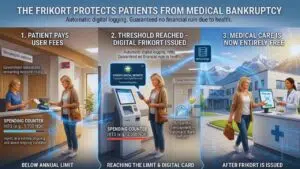
If you develop a serious illness or require ongoing medical treatment, paying for every single doctor visit could quickly become a massive financial burden that ruins your savings. To prevent this terrifying scenario, the government established the frikort, which translates directly to exemption card in English. Each year, the national parliament sets a strict maximum out-of-pocket limit for public health services. Every time you pay a user fee at the doctor, hospital, or pharmacy, the central digital system logs it automatically without you needing to keep paper receipts.
Once your total spending hits that specific threshold within a single calendar year, you receive a digital frikort on your Helsenorge profile. From that exact moment until the year ends, almost all of your public medical care becomes entirely free. The digital system tracks everything effortlessly, and if you accidentally overpay at a clinic before the system updates, the health authority automatically refunds the difference directly into your registered bank account a few days later. This brilliant safety net guarantees that nobody faces financial ruin due to bad health.
| Spending Phase | Patient Financial Responsibility | Government Financial Contribution |
| Below Annual Limit | Patient pays standard user fees | Government subsidises the remaining massive costs |
| Reaching the Limit | Patient pays user fee until exact cap is met | Government covers all costs beyond the cap amount |
| After Frikort is Issued | Patient pays absolutely nothing | Government covers 100% of approved public medical care |
| Accidental Overpayment | Patient receives automatic bank refund | Government tracks receipts and issues automatic refunds |
3. Expectant Mothers and Children Receive 100 Percent Free Care
While most adults deal with standard user fees and the exemption card system, the government completely shields children and pregnant women from these costs entirely. The nation places massive cultural and political importance on early childhood development and maternal wellbeing. If you are under sixteen years of age, you never pay a single krone for public medical care, allowing parents to seek help for their children without any financial hesitation. This rule covers regular paediatric checkups at the local health station, emergency room visits, and complex orthopaedic or cardiac surgeries.
Expectant mothers receive the exact same level of ultimate financial protection. Every single aspect of pregnancy is covered by the state without question. This includes all prenatal appointments with your midwife or doctor, necessary ultrasound scans, the hospital delivery, and any postnatal care you might need. Even if unexpected complications arise that require a caesarean section, an extended hospital stay, or neonatal intensive care for the baby, the family receives no bill whatsoever.
| Patient Category | Core Services Covered | Out-of-Pocket Cost |
| Children Under 16 | GP visits, surgeries, emergency care, vaccinations | 0 NOK |
| Expectant Mothers | Midwife checkups, ultrasounds, hospital birth, postnatal care | 0 NOK |
| Nursing Mothers | Lactation consultations, maternal recovery checkups | 0 NOK |
| Teenagers (16 to 18) | Standard medical care, heavily subsidised dental care | Minimal user fees |
4. Blue and White Prescriptions Dictate Medication Costs
When your doctor writes you a prescription, the final cost depends entirely on a unique colour-coded classification system managed by the national health economics administration. The system categorises medications into blue prescriptions and white prescriptions to manage the national pharmaceutical budget effectively. Blue prescriptions are specifically reserved for chronic illnesses and long-term conditions that require medication for at least three months of the year, such as diabetes, asthma, or heart disease. If you receive a blue prescription, the government heavily subsidises the cost of the drug, meaning you only pay a small fraction of the total retail price at the pharmacy counter.
This minor payment counts directly towards your annual exemption card limit. White prescriptions cover short-term medical issues, such as a temporary respiratory infection that requires a brief course of antibiotics or strong painkillers for a minor injury. For white prescription medications, you must pay the full retail price out of your own pocket. These specific costs do not count towards your annual limit unless they exceed a completely separate, much higher financial threshold designed for exceptionally expensive temporary treatments.
| Prescription Type | Medical Condition Condition | Financial Subsidy Level |
| Blue Prescription | Chronic diseases (lasting 3+ months annually) | Heavily subsidised; counts towards Frikort |
| White Prescription | Short-term illnesses (infections, minor pain) | Patient pays full retail price; does not count to Frikort |
| H-Recept (Hospital) | Highly specialised hospital treatments (e.g. cancer drugs) | 100% covered by the regional health authority |
| Over-the-Counter | Minor ailments (allergies, mild headaches) | Full price paid by patient at pharmacies or supermarkets |
5. Adult Dental Care Is Mostly Paid Out of Pocket
You might reasonably expect a country with such a generous medical safety net to include your teeth, but dental care operates under a completely different set of political and financial rules. The public system treats dental health as a separate entity, and for the vast majority of adults, it remains entirely privatised and strictly market-driven. Once you reach adulthood, you must pay the full market price for routine checkups, daily cleanings, cavity fillings, and major dental surgeries like root canals or implants. Dentists set their own competitive prices, meaning costs can vary wildly from clinic to clinic depending on the city you live in.
Because of these high costs, dental tourism is quite common, with many Norwegians travelling to eastern Europe to get major dental work done at a fraction of the local price. However, there are some vital legal exceptions to this rule. Children and teenagers receive completely free dental care from the Public Dental Health Service until they turn eighteen. Young adults between the ages of nineteen and twenty receive a generous seventy-five percent discount on their dental bills to help them transition into financial independence.
| Age Group | Dental Care Subsidy Level | Patient Financial Responsibility |
| Children (0 – 18) | 100% completely free via public clinics | 0 NOK |
| Young Adults (19 – 20) | 75% subsidised by the government | Patient pays remaining 25% of the total bill |
| Young Adults (21 – 24) | 50% subsidised (introduced in recent reforms) | Patient pays remaining 50% of the total bill |
| Adults (25 and older) | 0% subsidised (unless suffering rare medical conditions) | Patient pays full private market price |
6. Private Health Insurance Exists but Is Barely Used
In many developed nations, holding private medical insurance is an absolute necessity if you want to receive decent care in a timely manner without suffering in crowded waiting rooms. In Norway, the general public views private insurance as an optional, almost unnecessary luxury item rather than a fundamental survival tool. National statistics show that only a very small fraction of the population holds any sort of private medical cover. Furthermore, individuals rarely buy these expensive policies themselves out of pocket. Instead, private insurance is usually provided by large corporate employers as an attractive workplace perk to retain top talent and ensure their workforce remains healthy.
The public hospital network provides world-class treatment, and the actual clinical outcomes and survival rates are exactly the same in both the public and private sectors. The only real tangible benefit of having private insurance is the ability to skip the waiting lists for non-urgent care. The public sector strictly prioritises patients based on immediate medical need, meaning elective surgeries can come with long wait times. Private insurance allows you to bypass these annoying queues for minor procedures like a knee arthroscopy, but for acute emergencies like a heart attack, absolutely everyone relies on the incredible public hospitals.
| Insurance Sector | Primary Function and Usage | Typical Wait Times |
| Public Health System | Handles all emergencies, major surgeries, and chronic care | Zero wait for emergencies; long waits for elective surgeries |
| Private Employer Insurance | Used to skip queues for minor orthopaedic or specialist care | Very short wait times; appointments often within days |
| Private Self-Funded | Extremely rare; used by high-net-worth individuals for convenience | Immediate access to private clinics like Volvat or Aleris |
| Travel Health Insurance | Crucial for residents travelling abroad outside the European Union | Varies depending on international provider |
7. Healthcare Is Highly Decentralised to the Municipalities
Physical geography heavily influences how the country manages its vast medical infrastructure. Because the nation features rugged mountains, deep isolated fjords, and incredibly remote northern communities facing harsh winters, managing every single clinic from a central office in Oslo would create an impossible logistical nightmare. To solve this problem, the government intentionally decentralised the entire system into local blocks. Primary care remains the strict legal responsibility of the local municipalities. Each local government must ensure its residents have immediate access to general practitioners, local emergency out-of-hours clinics, nursing homes, and home care visiting services.
This hyper-local approach guarantees that medical services are directly tailored to the specific cultural and demographic needs of the community. The local authorities understand exactly how many elderly residents need home visits and can deploy nurses effectively. However, the municipalities do not manage the massive, expensive specialist hospitals. The central government oversees the four Regional Health Authorities, which handle complex neurosurgeries, secure psychiatric wards, and advanced cancer treatments. This clever split structure ensures local control over everyday care while maintaining incredibly high national standards for specialised medicine.
| Administrative Level | Governance Entity | Managed Facilities and Services |
| Local Level | Municipalities (Kommune) | General practitioners, health stations, nursing homes, home nursing |
| Regional Level | Regional Health Authorities (RHF) | Public specialist hospitals, psychiatric institutions, ambulance services |
| National Level | Ministry of Health and Care Services | National legislation, budget allocation, public health policies |
| Digital Level | Norwegian Health Network | Secure data transfer, Helsenorge portal, electronic prescriptions |
8. Norway Boasts One of the Highest Doctor to Patient Ratios in Europe
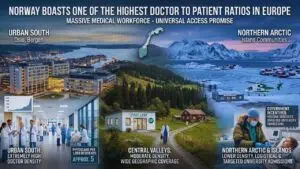
If you constantly worry about finding a qualified medical professional, the national employment statistics should easily put your mind at ease. The country employs a massive medical workforce and features one of the highest physician-to-patient ratios anywhere on the planet. Recent data indicates there are roughly five practising doctors for every one thousand residents. This incredibly high density of professionals ensures that patients have steady, reliable access to both primary and highly specialised care without facing severe doctor shortages seen in other western nations. Despite these excellent overall numbers, the country still faces severe logistical challenges when it comes to rural recruitment.
Many newly graduated doctors understandably prefer to live and work in the busy urban centres of the south, such as Oslo, Stavanger, or Bergen, where cultural amenities and large research hospitals are plentiful. To counter this frustrating trend, the government offers significant financial incentives, housing subsidies, and targeted university admission policies to actively encourage medical professionals to move to the remote northern regions. This ongoing political effort helps maintain the promise of universal access across every single isolated corner of the country.
| Geographic Region | Doctor Density | Primary Recruitment Challenges |
| Urban South (Oslo, Bergen) | Extremely high density | High competition for specialist roles; heavy patient volume |
| Central Valleys | Moderate density | Balancing coverage across large, sparsely populated inland areas |
| Northern Arctic Region | Lower density | Extreme weather and isolation deter long-term physician settlement |
| Island Communities | Variable density | Reliance on locum doctors and air ambulance transport |
9. Mental Health Is Treated with Equal Priority to Physical Health
Historically, many global medical systems treated psychological issues as a secondary concern, focusing all their primary resources on physical ailments and visible injuries. Norway has spent decades actively changing this damaging narrative and systematically breaking down the societal stigma surrounding psychological wellbeing. Today, mental health care is deeply and permanently integrated into the core medical system, treated with the exact same severity as a cardiac issue. The government recently launched a massive decade-long escalation plan heavily designed to improve community-based psychological care and provide much easier access to local therapists and crisis centres.
If you need mental health support, the referral process works exactly the same as it does for a physical injury. You visit your general practitioner, discuss your symptoms openly, and receive a formal referral to a specialist at a District Psychiatric Centre. Once you successfully enter the public psychological care system, your therapy sessions are highly subsidised by the state. The user fees you pay for weekly therapy count directly towards your annual exemption card limit, ensuring that long-term mental health treatment never becomes an impossible financial burden for struggling individuals.
| Care Level | Treatment Facility | Primary Focus Area |
| Primary Care | General Practitioner | Initial assessment, mild depression/anxiety, medication prescription |
| Secondary Care | District Psychiatric Centre (DPS) | Specialised outpatient therapy, moderate to severe psychological disorders |
| Acute Care | Psychiatric Hospital Wards | Crisis intervention, severe trauma, immediate suicide prevention |
| Community Support | Municipal Crisis Teams | At-home support, addiction recovery groups, occupational therapy |
10. Generous Parental Benefits Extend Beyond Just Medical Care
The government rightly views family health as a complete, holistic concept that extends far beyond the sterile walls of the delivery room. To ensure parents and children truly thrive during those crucial early months of life, the country offers some of the most generous parental leave policies in the entire world. After a mother gives birth entirely for free, the family faces absolutely no pressure to rush back to the corporate workplace. Parents can choose to take forty-two weeks of fully paid leave, receiving one hundred percent of their normal working salary. Alternatively, they can stretch the leave further and take fifty-two weeks at an eighty percent pay rate.
The system even includes a legally dedicated paternity quota, locally known as pappaperm, to guarantee fathers spend significant, uninterrupted time bonding with the newborn and supporting the mother’s physical recovery. If a parent does not qualify for paid leave due to a lack of recent employment history, the state provides a massive one-time, tax-free lump sum payment. This guarantees that every single new family has the baseline financial stability needed to recover, bond, and grow in absolute peace without worrying about keeping the lights on.
| Leave Option | Salary Compensation | Total Leave Duration |
| Standard Option | 100% of normal working salary | 49 weeks (divided between mother, father, and shared period) |
| Extended Option | 80% of normal working salary | 59 weeks (divided between mother, father, and shared period) |
| Non-Employed Parent | One-time tax-free lump sum | Minimum safety net payment provided immediately upon birth |
| Sick Child Leave | 100% of normal working salary | Up to 10-15 days annually to stay home with a sick toddler |
The Pros and Cons of Norway Healthcare
The Norwegian medical model is frequently praised on the global stage, especially by researchers examining patient safety and longevity, but it is deeply important to view it through a strictly objective lens. Every system has its brilliant successes and its frustrating daily shortcomings. Understanding both sides of the equation provides a much clearer picture of what it is truly like to live, work, and seek treatment under this specific system.
Advantages of the System
The absolute biggest advantage of the system is the profound financial peace of mind it provides to every single resident. Thanks to the strict exemption card limit, you never have to worry about losing your family home or draining your retirement savings account because of an unexpected medical emergency. The strong national focus on preventive medicine, strict food safety standards, and robust public health campaigns naturally create a healthier baseline population.
High life expectancy rates and incredibly low infant mortality statistics prove that the system delivers on its core promises. Furthermore, the system gives you the legal freedom to choose your own general practitioner from a public registry. If you feel unheard or uncomfortable with your current doctor, you have the absolute right to switch to a new physician up to twice a year without facing any complex administrative hurdles or awkward conversations.
Challenges the System Faces Today
Despite the massive amounts of tax revenue poured into the medical infrastructure every year, the system still struggles constantly with resource allocation and daily efficiency. Because the public sector strictly prioritises patients based entirely on medical urgency, people waiting for elective or non-life-threatening procedures often face incredibly long waiting lists. You might wait several frustrating months just to get a routine knee surgery or a non-urgent diagnostic scan, which pushes some people to use private clinics out of sheer frustration.
Another major complaint among native residents is the severe lack of public adult dental coverage, which forces many working people to pay high private fees that strain their monthly budgets. Finally, like many European nations, the country faces a rapidly aging population. This unavoidable demographic shift places a heavy, increasing strain on municipal nursing homes and home care services, creating constant workforce shortages in the remote rural districts.
Final Thoughts
Understanding the daily intricacies of global health models helps us clearly see what is practically possible when a society fully pools its financial resources for the common good. The Norway healthcare system definitively proves that a modern government can provide excellent, life-saving medical safety nets without entirely removing individual financial responsibility from the equation.
It absolutely requires high taxation and a massive daily administrative effort, but the positive results speak clearly through the remarkable health, happiness, and extreme longevity of the general population. While local residents still occasionally grumble about frustrating waiting times for elective surgeries and the undeniably high cost of private dental work, the absolute guarantee that a terrifying cancer diagnosis will not lead to personal financial ruin is a profound daily comfort.
Frequently Asked Questions (FAQs) About Norway Healthcare System
Navigating a foreign medical infrastructure can easily feel overwhelming, especially when you are dealing with brand new terminology, foreign websites, and different administrative rules. Many newly arrived expats and visiting tourists have highly specific questions about how their legal status affects their access to local clinics and emergency rooms. We have gathered some of the most common and uncommon questions people ask about the system.
1. Is healthcare free for tourists in Norway?
Tourists absolutely do not receive free medical treatment when visiting the country. If you hold citizenship outside the European Union, you must pay the full private cost for any medical consultations, ambulance rides, or hospital stays. It is highly recommended that you purchase comprehensive travel insurance before you cross the border to protect yourself from massive bills. However, there is a major legal exception for European tourists. If you carry a valid European Health Insurance Card, the system treats you exactly like a local resident. You will only pay the standard user fees for emergency treatments, and the Norwegian government covers the rest of the massive bill.
2. How much does a doctor visit cost in Norway?
When you book a standard daytime appointment with your registered general practitioner, you will pay a small user fee known as an egenandel. This specific fee usually sits between 160 and 200 Norwegian Krone. If the doctor needs to draw blood for laboratory tests, perform an ultrasound, or issue medical equipment, you might pay a slightly higher fee at the front desk. The crucial thing to remember is that these costs are strictly capped by the government. Every time you pay this fee, it counts towards your annual exemption card limit. Once you spend around 3,278 Norwegian Krone in a single calendar year, all your subsequent doctor visits become entirely free until the new calendar year begins.
3. Do expats get free healthcare in Norway?
Expatriates do not get entirely free care immediately upon landing, but they do get access to the exact same highly subsidised system as native-born citizens once legally registered. Once you move to the country, secure an employment contract, and register your physical address with the tax office, you receive a national identity number. This unique number automatically enrols you in the National Insurance Scheme. From that point forward, a portion of your monthly income tax goes towards funding the medical infrastructure. You can then log online, choose a local doctor from the public registry, and begin paying the exact same low user fees as everyone else while working towards your exemption card limit.
4. What happens if I miss my doctor appointment?
If you fail to show up for a scheduled medical appointment without giving the clinic at least twenty-four hours of advance notice, the hospital or clinic will immediately send you a financial fine in the mail. For specialist appointments at busy outpatient clinics or psychiatric centres, this penalty can be extremely high, sometimes reaching nearly 2,000 Norwegian Krone. This harsh penalty fee absolutely does not count towards your annual exemption card limit. The government strictly enforces this rule to ensure that incredibly valuable medical time is not wasted and that waiting lists keep moving forward rapidly for other patients who desperately need care.
5. Can I choose which hospital treats me?
Yes, the system operates strongly on a principle of free patient choice. If your general practitioner formally refers you to a specialist or recommends a specific surgical procedure, you have the absolute legal right to choose which public hospital performs the operation. You can check the central online portal, Helsenorge, to directly compare waiting times across different regional hospitals. If a hospital in a different city or region has a much shorter waiting list for your specific operation, you can request to be sent there instead. The government even covers a large portion of your travel and accommodation expenses if you must travel long distances for approved public medical treatment.