
As we navigate the landscape of 2026, the mental health of younger generations has moved to the forefront of Canadian provincial policy. With a shift away from reactive, hospital-based care toward proactive, community-integrated support, provinces are leveraging new funding and innovative structures to reach youth in their own environments. By dismantling traditional barriers and prioritizing social connection, these initiatives represent a significant leap in how the country protects its most vulnerable citizens.
How We Selected Our 7 Best Canada Youth Mental Health Initiatives 2026
To determine which programs are making the most significant impact this year, we evaluated provincial budgets, clinical outcome reports, and youth engagement data from the 2025-2026 cycle. Our selection process was guided by four specific criteria to ensure these initiatives offer more than just a temporary fix.
-
Accessibility: The ease with which a young person can access services without a formal referral or long waitlist.
-
Integration: How well the program blends mental health support into schools, recreation centers, or digital platforms.
-
Sustainability: The presence of multi-year provincial funding and permanent infrastructure.
-
Youth Involvement: The degree to which young people are involved in the design and delivery of the service.
The following summary provides a quick look at the primary focus of each selected initiative.
| Evaluation Metric | High Impact | Emerging Impact |
| Early Intervention | ICY Teams, SchoolsPlus | AI Peer Support |
| Intensive Care | CASA Classrooms | Secure Youth Detox |
| Community Connection | Youth Wellness Hubs | CMHA Mandate |
The 7 Most Impactful Canada Youth Mental Health Initiatives 2026
Understanding the specific mechanics of these programs helps families and educators identify the right support system for their local context.
1. Integrated Child and Youth (ICY) Teams (BC)
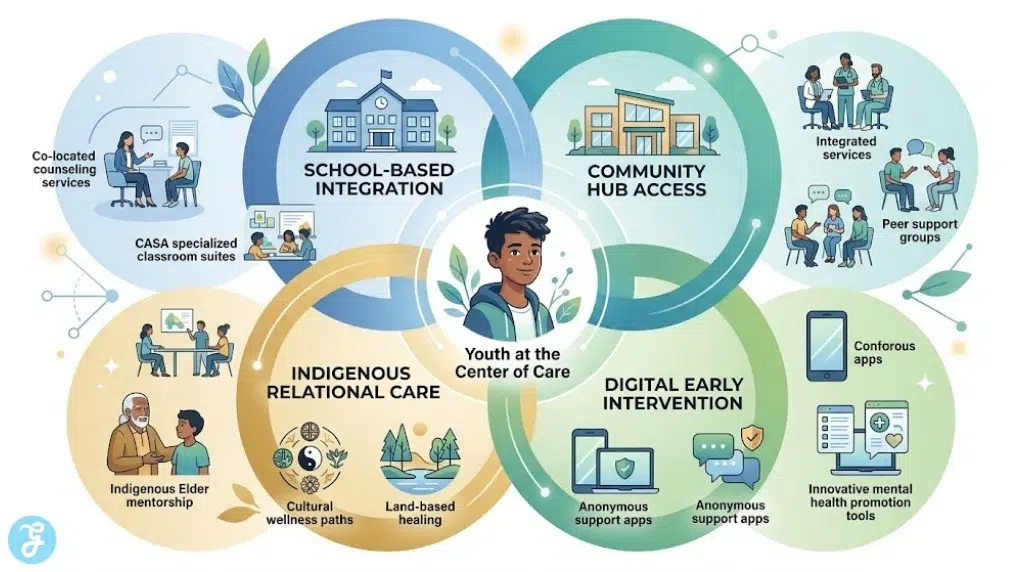
British Columbia has significantly expanded its Integrated Child and Youth (ICY) teams in 2026 as part of a multi-billion dollar commitment to adolescent well-being. These teams are multidisciplinary, consisting of clinical counselors, youth peer supports, and Indigenous elders who deliver wrap-around care directly in schools and homes.
Best for: Families seeking seamless, coordinated care that bridges the gap between school environments and therapeutic support.
Why We Chose It:
-
It minimizes referral fatigue by providing a single point of access for complex mental health and substance use needs.
-
It prioritizes cultural safety through the inclusion of Indigenous positions and traditional relational structures.
-
It delivers outreach and outbound services that reach youth who may be unable or unwilling to attend office-based appointments.
Things to consider: Implementation success depends on full staffing levels across various school districts, particularly in remote and northern regions.
2. CASA Mental Health Classrooms (Alberta)
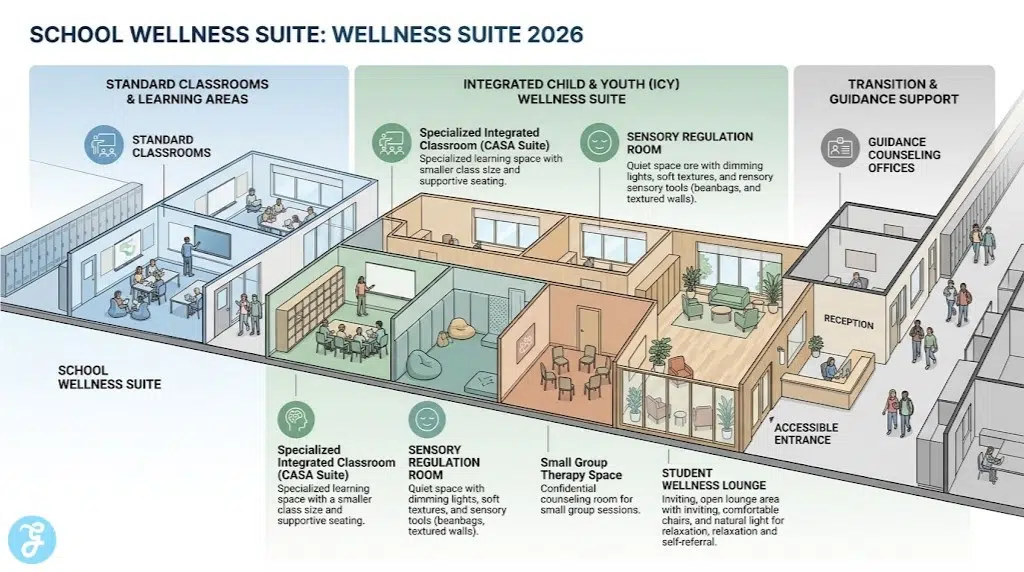
Alberta has made a major leap in early 2026 by expanding its CASA Mental Health Classrooms to 28 sites across 21 communities. This model provides specialized therapeutic suites for students in grades 4–12 who have not responded to traditional outpatient therapy but do not require full-time hospitalization.
Best for: Students with moderate-to-severe mental health challenges who require more support than a standard guidance counselor can provide.
Why We Chose It:
-
It allows students to stay connected to their learning environment while receiving individualized and group therapy.
-
It eliminates the need for caregivers to take time off work or schedule external medical appointments during school hours.
-
It reports high efficacy rates, with a significant majority of students noting improved mental health and a reduction in self-harming behaviors.
Things to consider: The program involves an intensive phase of support followed by a structured transition period back into a regular school setting.
3. The CMHA “Come Together” Connection Mandate
For Mental Health Week in May 2026, the Canadian Mental Health Association (CMHA) has launched a national initiative focusing on the critical role of social connection. This mandate moves away from purely digital interventions to combat the epidemic of youth loneliness by funding physical “third spaces” in every province.
Best for: Addressing the systemic social isolation that often triggers or exacerbates more severe clinical mental health issues.
Why We Chose It:
-
It is backed by 2026 research showing that meaningful social connection is as essential to health as nutrition and sleep.
-
It provides a low-barrier solution that can be implemented at the community level without massive clinical overhead.
-
It calls for small, everyday actions of connection to strengthen mental health and build healthier neighborhoods.
Things to consider: While social connection is a vital preventative tool, it must be used alongside professional clinical services for youth in acute crisis.
4. Healthy Youth Initiative Team Grants (CIHR)
The Canadian Institutes of Health Research (CIHR) has rolled out the Healthy Youth 2026 team grants to support youth-engaged research across the country. These grants are specifically aimed at strengthening Canada’s capacity to respond to childhood health challenges through inter-disciplinary and community-engaged research.
Best for: Academic institutions and community organizations looking to develop evidence-based interventions for diverse youth populations.
Why We Chose It:
-
It empowers youth to serve as program advisors and key stakeholders in the research that directly affects them.
-
It bridges the gap between high-level academic theory and practical, community-level application.
-
It focuses on generating evidence for the six priorities of Canada’s Youth Policy, including Truth and Reconciliation and Climate Action.
Things to consider: The application process is highly competitive and requires significant partnership development between researchers and community knowledge users.
5. The “Being Initiative” Shift (Quebec/National)
Led by Grand Challenges Canada, the “Being Initiative” has reached its transition-to-scale phase in 2026. This initiative represents a fundamental shift away from purely clinical models toward mental health promotion and prevention by addressing root causes like stigma and socio-economic stress.
Best for: Innovative community programs that use non-traditional methods like the arts and sports to reach marginalized youth.
Why We Chose It:
-
It prioritizes youth-led solutions, ensuring that the programs are relevant to the actual lived experiences of today’s teens.
-
It focuses on social and structural drivers of mental health rather than just individual biological symptoms.
-
It utilizes 2026 technology to provide immediate, anonymous intervention for youth wary of traditional clinics.
Things to consider: This initiative often requires organizations to demonstrate a high degree of digital or social innovation to qualify for funding.
6. Youth Wellness Hubs Ontario (YWHO) Expansion
Ontario has continued the aggressive expansion of its Youth Wellness Hubs (YWHO) in 2026, now reaching over 32 operational sites. These hubs provide one-stop-shop integrated services—including mental health, substance use support, and primary care—for youth aged 12 to 25.
Best for: Young people who need rapid, walk-in access to a variety of health and social services without navigating multiple ministries.
Why We Chose It:
-
It eliminates mandated service transitions at age 18, allowing youth to stay with the same providers until age 25.
-
It offers stepped care models that can scale up or down based on the individual’s needs at any given time.
-
It improves communication and coordination between the different sectors responsible for youth well-being.
Things to consider: Wait times for highly specialized psychiatric care within the hubs can still fluctuate depending on the specific community’s resource levels.
7. Digital-First Access & AI Peer Support
To reach youth in remote and northern regions, several provinces have launched 24/7 digital-first access points in 2026. These platforms combine human peer support with AI-driven early intervention tools to ensure that distance is no longer a barrier to receiving high-quality mental health advice.
Best for: Youth in remote or isolated communities who cannot easily access physical wellness hubs or school-based clinics.
Why We Chose It:
-
It provides an immediate, 24/7 safety net for youth who may experience crisis outside of regular school or clinic hours.
-
It leverages AI to provide personalized coping strategies and mental fitness plans.
-
It acts as a low-barrier gateway, referring youth to more intensive in-person services when required.
Things to consider: Digital tools are most effective when they are treated as a supplement to, rather than a replacement for, face-to-face human interaction.
An Overview Of Canada Youth Mental Health Initiatives 2026
As these programs roll out, it becomes clear that each province is tailoring its approach to suit its specific geography and demographic needs.
Overview Comparison Table
The following comparison illustrates how different regions are structuring their primary access points to ensure maximum coverage.
| Initiative Type | Primary Focus | Primary Access Point | Availability |
| ICY Teams | Wrap-around Care | Schools & Homes | BC Wide (Phased) |
| CASA Classrooms | Intensive Education | Specialized Schools | 28 Sites in Alberta |
| Wellness Hubs | Integrated Health | Community Hubs | 32 Sites in Ontario |
| SchoolsPlus | Co-located Support | Every Public School | Nova Scotia Wide |
Our Top 3 Picks and Why?
While all seven initiatives are valuable, the CASA Classrooms (Alberta), ICY Teams (BC), and Youth Wellness Hubs (Ontario) represent the most scalable and effective models. Alberta’s classrooms provide the highest level of academic and clinical integration seen in decades. BC’s teams are the most flexible, reaching youth in their homes, while Ontario’s hubs provide the longest continuity of care by supporting youth through the difficult transition from age 18 to 25.
How to Choose the Right Canada Youth Mental Health Initiatives 2026 by Yourself?
Finding the right support for a young person requires looking beyond the program name and examining the depth of service provided.
The Selection Framework:
-
Check the Age Range: Ensure the program supports the specific age of the youth, as some cut off at 18 while others extend to 25.
-
Evaluate Transport Needs: Determine if the service is co-located in a school or if it requires travel to a community hub.
-
Verify the Service Mix: Look for programs that offer more than just counseling, such as primary care, peer support, or employment help.
-
Assess the “Low-Barrier” Status: Prioritize walk-in services that do not require a doctor’s referral for the first visit.
Decision Matrix:
The following matrix helps you decide which type of provincial support fits your specific situation.
| Choose this model if… | Then look for… |
| The youth is struggling to stay in school. | CASA Classrooms or SchoolsPlus. |
| The youth is 18-25 and needs multiple services. | Youth Wellness Hubs or Aire ouverte. |
| You live in a remote or northern community. | Digital-First Access or ICY Outreach. |
The Final Checklist
-
Is the service formally linked to the provincial health or education ministry?
-
Does the program offer a clear pathway for “stepping up” to specialized psychiatric care if needed?
-
Are there Indigenous-led or culturally specific options within the team?
-
Is the service accessible during evenings, weekends, or school holidays?
-
Has the youth been involved in choosing the type of support they prefer?
Securing a Resilient Future for Canadian Youth
The progress made in 2026 suggests that the silos between health, education, and social services are finally beginning to crumble. By moving mental health professionals into schools and community spaces, provinces are creating a system that is as accessible as a local library or recreation center. While challenges remain in staffing and rural reach, the commitment to integrated, youth-led care is a promising sign for the long-term well-being of the next generation. As these models continue to mature, they will serve as the essential foundation for a healthier, more resilient Canada.