
You check the forex market one day, and boom, your favorite currency pair drops like a rock. Frustrating, right? Many traders feel lost when big swings hit without warning, especially if you’re new to buying and selling currencies. You might wonder why these changes happen so fast, messing with your plans to trade or even travel abroad. It’s like trying to ride a wave that keeps shifting under you, and it can leave you scratching your head.
Did you know that central banks control about 80 percent of the world’s money supply, directly swaying exchange rates? This ties right into the Central Bank Impact on Forex Trading.
In this post, we’ll break it down step by step, showing you how their choices ripple through markets and what you can do about it. You’ll get tips to spot these moves early and trade smarter.
Stick around; you won’t want to miss this.
What Is a Central Bank and Its Role in Forex Markets?
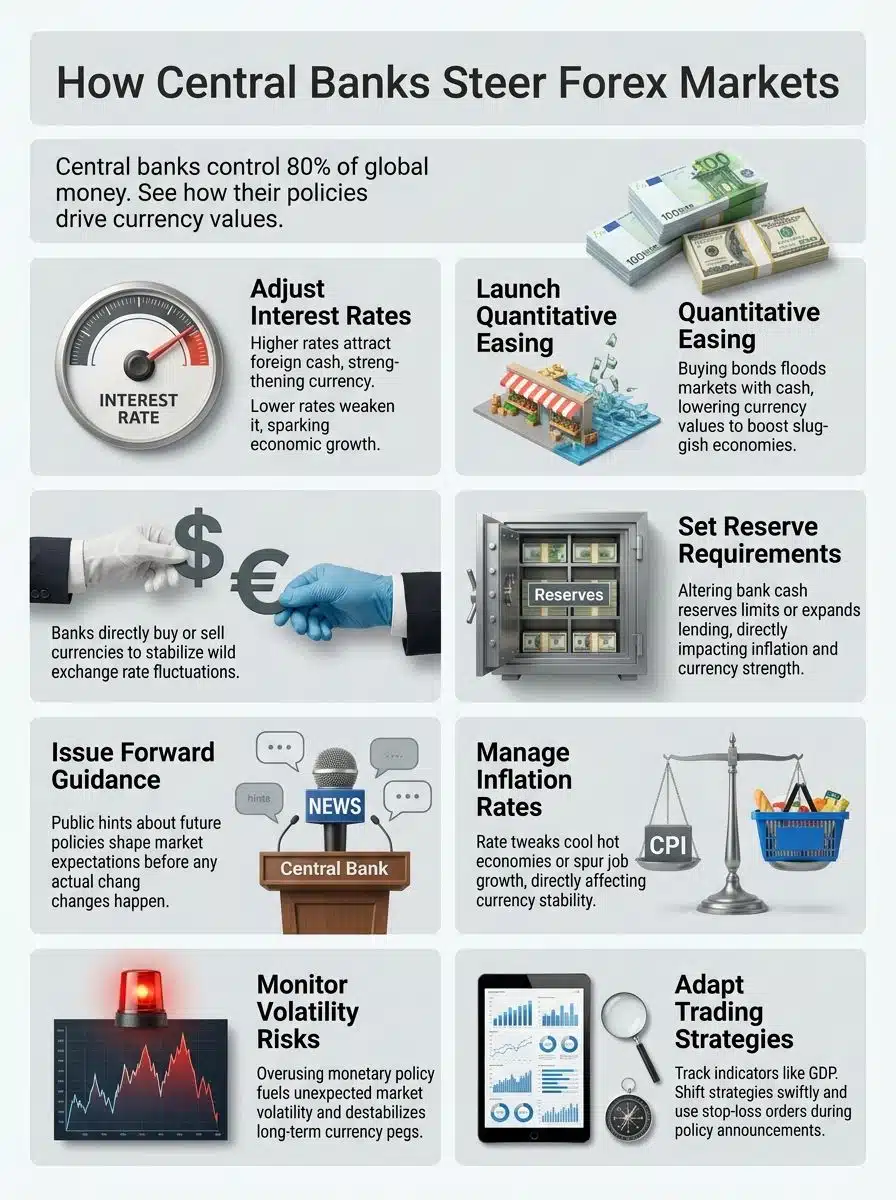
Central banks act as the big bosses of a country’s money system. They manage the flow of cash, keep prices stable, and aim for full employment. Think of them like referees in a soccer game, making sure no one plays too roughly.
In forex markets, these banks shape how currencies trade against each other. They set rules that sway exchange rates and currency values. For instance, if a central bank hikes interest rates, folks rush to buy that currency, boosting its strength.
This impacts foreign exchange big time, as traders watch every move. Central banks also step in during crises, like stabilizing a falling currency peg. Their monetary policy decisions ripple through financial markets, affecting inflation rates and economic indicators. It’s like a chess game, where one smart play changes the whole board.
Central banks are the guardians of economic stability, influencing forex through careful policy maneuvers. – Anonymous Economist
Central bank actions keep markets humming, but they use specific tools to make it happen. That leads us right into the key tools they wield to influence forex markets.
Key Tools Used by Central Banks to Influence Forex Markets
Central banks wield powerful tools that can shake up currency values, like a captain steering a ship through stormy seas. Ever wonder how they pull those strings to keep economies afloat, or sometimes send markets into a spin?
Interest Rate Decisions
Interest rates act as a main tool for central banks in shaping forex markets. Banks raise these rates to attract foreign cash, which boosts currency values. Picture a magnet pulling in investments; higher rates make a nation’s money more appealing.
Traders watch these moves closely, as they tie into monetary policy and exchange rates. A hike can curb inflation but slow growth, affecting currency pegs and market expectations. In 2022, the Federal Reserve lifted rates multiple times, strengthening the USD against the euro.
Lower interest rates push money out, weakening currencies in the foreign exchange market. Banks cut rates to spark spending and growth, like adding fuel to an economy’s engine. This impacts inflation rates and economic indicators, leading to exchange rate fluctuations.
For instance, the Bank of Japan kept rates low for years, influencing yen stability and forex trading. Such decisions create chances for savvy traders, who adapt strategies amid central bank actions and financial market shifts.
Quantitative Easing and Tightening
Central banks launch quantitative easing to spark economic growth. They purchase bonds and securities from the market. This floods the system with cash, easing monetary policy. Currency values often weaken in foreign exchange markets as a result.
Picture it like adding fuel to a sluggish engine; the economy revs up, but exchange rates can dip. Traders adapt strategies to these shifts in market expectations. Quantitative tightening reverses the process.
Banks sell off those assets. They drain excess money from circulation. This tightens control over inflation rates and boosts currency strength. Forex trading feels the impact through wild exchange rate fluctuations. Central bank actions like these keep financial markets on their toes, don’t they?

Quantitative easing isn’t magic; it’s a tool to manage economic indicators and stabilize currency pegs during tough times. – Ben Bernanke, former Federal Reserve Chair
Foreign Exchange Interventions
Beyond tweaking the money supply with quantitative easing and tightening, central banks jump right into the action through foreign exchange interventions. They buy or sell currencies in the foreign exchange market to steady exchange rates.
Imagine a bank spots its currency dropping too fast, so it sells reserves to prop it up. This market intervention helps manage currency values and curb wild exchange rate fluctuations. Traders watch these moves closely, as they signal shifts in monetary policy.
Such interventions often aim at inflation rates or economic indicators like trade balances. For instance, a central bank might intervene to weaken its currency, making exports cheaper and boosting growth.
You feel the impact in forex trading, where sudden actions spark quick market expectations. Keep an eye on these, folks, they shake up financial markets in a flash. Empathy kicks in here; it is tough predicting them, but staying informed eases the ride.
Reserve Requirements
Central banks set reserve requirements to control how much cash banks must keep on hand. This tool shapes monetary policy by limiting or expanding lending. Banks hold back a portion of deposits, say 10 percent, instead of loaning it all out.
Lower requirements free up money for loans, boosting economic growth and potentially weakening currency values through inflation. Traders watch these changes closely, as they signal shifts in exchange rates and forex trading opportunities.
Imagine a bank like a baker reserving flour for tomorrow’s bread. Central banks tweak these rules to manage inflation rates and financial markets. They might raise requirements to cool an overheated economy, strengthening the local currency against others.
Such moves create market intervention ripples, affecting currency pegs and exchange rate fluctuations. You, as a reader, can spot these in economic indicators to refine your forex strategies.
How Central Bank Policies Impact Currency Values
Central banks tweak policies, and currencies dance to their tune, rising or falling like a seesaw in the playground of global trade. Imagine your dollar flexing its muscles after a rate hike, or wilting like a flower in drought when easing kicks in, sparking wild rides for traders everywhere.
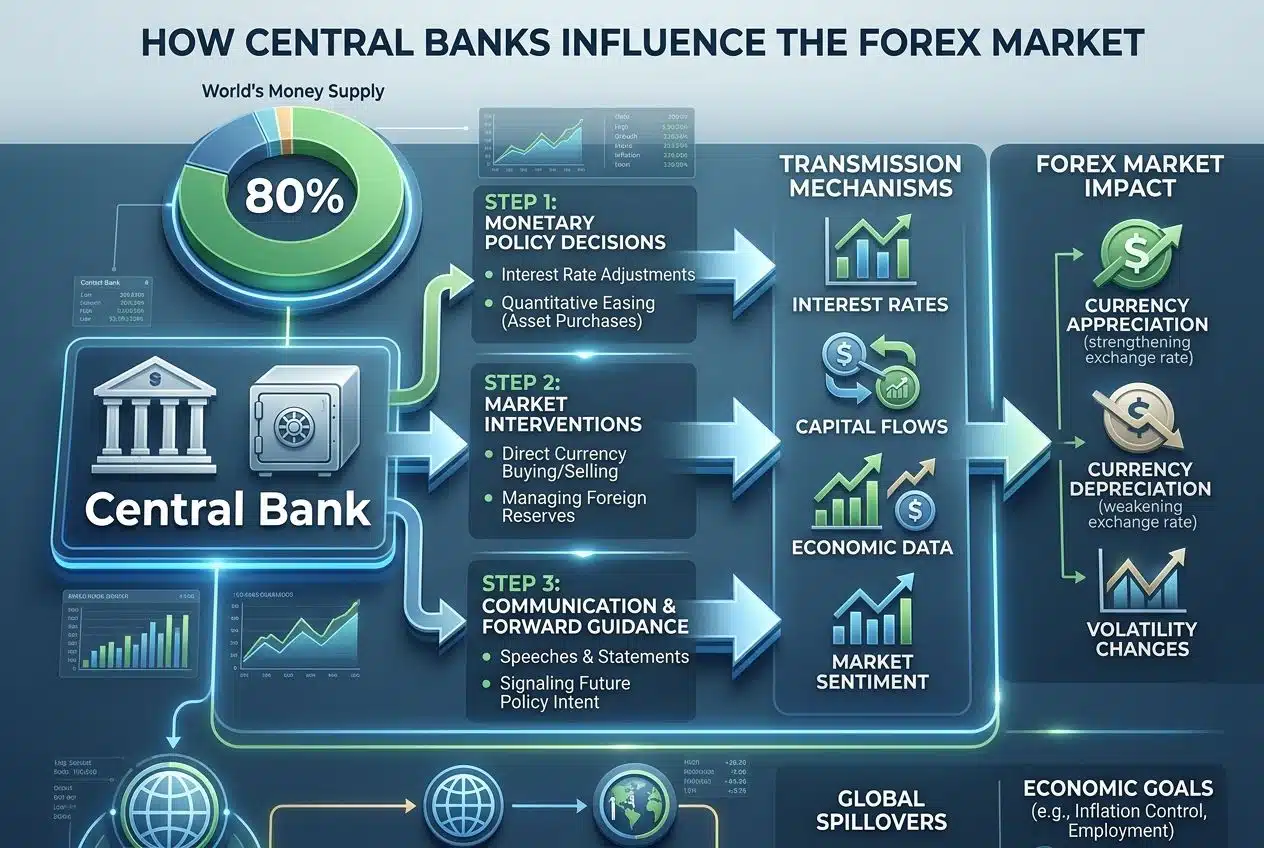
Strengthening or Weakening Currencies
Central banks tweak interest rates to boost or cut currency values, folks. They raise rates, and money flows in from investors chasing higher returns. This demand strengthens the currency, like a magnet pulling in cash.
Picture the US dollar surging when the Federal Reserve hikes rates amid rising inflation. Traders watch these moves closely in the foreign exchange market. Such actions help manage economic growth, too.
Banks sometimes slash rates to weaken currencies on purpose. Lower rates make borrowing cheap, sparking spending and exports. A weaker currency means goods sell better abroad, right? Think of the Bank of Japan stepping in to curb a too-strong yen.
These monetary policy shifts create exchange rate fluctuations, keeping forex trading lively. You adapt by tracking economic indicators for clues.
Managing Inflation and Economic Growth
Central banks tackle inflation by adjusting interest rates, aiming to keep prices stable. They raise rates to cool off a hot economy, which slows spending and curbs rising costs. Lower rates spark growth, encouraging loans and investments that boost jobs.
This balancing act affects currency values directly; high inflation weakens a currency, while steady growth strengthens it. Picture a tightrope walker, carefully stepping to avoid a fall – that’s how banks manage these forces.
Traders watch economic indicators like inflation rates to predict shifts in monetary policy. A sudden spike in prices might prompt a rate hike, shaking up exchange rates. Banks use tools like quantitative easing to pump money into the system, fostering growth without overheating.
These moves create ripples in the foreign exchange market, where smart players adapt quickly. Stay alert, folks, because one policy tweak can flip currency pegs and spark market intervention.
Examples of Central Bank Interventions
Central banks jump into action with bold moves that ripple through forex markets, like a captain steering a ship through stormy seas. Picture the Federal Reserve tweaking rates to steady the dollar, or the European Central Bank juggling policies to keep the euro afloat. Stick around to see how these plays unfold in real scenarios.
The Federal Reserve (USA) and USD Movements
The Federal Reserve shapes USD movements with its monetary policy tools. It adjusts interest rates to control inflation and growth. Higher interest rates draw investors, boosting currency values.
Lower rates often weaken the dollar against others. Traders watch these shifts in the foreign exchange market. Picture the Fed as a captain steering a ship through stormy economic waters, making quick calls that ripple across exchange rates.
In 2022, the Fed hiked rates sharply to fight high inflation rates, strengthening the USD. This move hurt emerging markets but stabilized U.S. financial markets. Back in 2008, during the crisis, the Fed slashed rates and launched quantitative easing.
That action weakened the dollar but spurred recovery. Such central bank actions highlight how policy changes drive exchange rate fluctuations. Forex trading pros adapt by monitoring these economic indicators closely.
The European Central Bank (ECB) and Euro Stability
The European Central Bank steers the euro’s course across 19 countries. It focuses on keeping prices stable, aiming for about 2 percent inflation. ECB leaders set monetary policy that shapes currency values and exchange rates.
They adjust interest rates to fight high prices or boost growth. Picture the 2012 debt crisis; ECB chief Mario Draghi pledged to do “whatever it takes” to save the euro. That bold move calmed markets and steadied the currency. Traders watch these central bank actions closely, as they spark big shifts in forex trading.
ECB interventions often involve buying bonds through quantitative easing. This floods the economy with cash, weakening the euro to spur exports. In 2015, they launched a massive program worth over 2 trillion euros.
Such steps manage economic indicators like inflation rates and prevent wild exchange rate fluctuations. Investors adapt by tracking ECB announcements, turning policy hints into trading gold.
Yet, these moves can surprise, like when rate hikes strengthen the euro against the dollar. Stay alert, folks; the ECB’s plays keep the foreign exchange market buzzing.
The Bank of Japan (BOJ) and Yen Interventions
Shifting from Europe’s euro stability efforts, Asia offers its own twists in currency management. Japan steps in with bold moves to steer the yen.
Bank of Japan officials watch exchange rates like hawks. They jump into the forex markets when the yen swings too wildly. For instance, in 2022, the yen hit a low of 150 against the dollar.
BOJ sold dollars and bought yen to prop it up. This central bank intervention aims to curb sharp drops. It protects exporters from a too-weak currency. Monetary policy here often pairs with interest rates near zero.
That keeps currency values in check amid global shifts. Traders eye these actions for clues on yen trends. Economic indicators, like inflation rates, guide BOJ’s next play. Such market interventions can spark quick exchange rate fluctuations. Japan shows how central banks juggle growth and stability in the foreign exchange market.
The Role of Forward Guidance in Forex Markets
Central banks drop hints about their future moves, as a coach signaling plays from the sidelines, and traders hang on every word to predict currency shifts. This chatter shapes market bets, turning vague statements into wild rides for exchange rates, so keep your ears open for those policy whispers.
Communication and Market Expectations
Banks share future plans through forward guidance. They shape market expectations this way. Traders watch these signals closely in the foreign exchange market. Imagine a weather forecast warning of a storm; markets react before it hits.
Officials use speeches and statements to hint at monetary policy shifts. This influences currency values without immediate action. Forex trading pros adjust strategies based on these clues. Clear talk builds trust and steadies exchange rates.
Poor communication sparks confusion in financial markets. Traders misread signals and cause wild exchange rate fluctuations. Banks aim for transparency to manage economic indicators like inflation rates.
Think of it as a captain steering a ship through fog with a clear voice. Market intervention often follows strong words. Expectations drive buying or selling in the forex market. Now, let’s explore the impact of monetary policy announcements.
The Impact of Monetary Policy Announcements
Central banks drop hints about future moves through announcements, and traders hang on every word. These statements shape market expectations, sparking quick shifts in currency values.
Picture a Fed chair hinting at rate hikes, folks, that sends the USD soaring as investors rush in. Monetary policy reveals that it drives exchange rate fluctuations, often before any real changes hit. You feel the buzz in forex trading circles, where a single phrase can flip the script on economic indicators.
Such announcements pack a punch in the foreign exchange market, influencing inflation rates and financial markets alike. Traders adapt fast, eyeing central bank actions for clues on currency valuation.
Imagine the ECB signaling easing, and suddenly the euro dips against rivals. This forward guidance builds hype or calm, keeping everyone on their toes with potential market intervention vibes.
Risks and Challenges of Central Bank Actions in Forex
Central banks aim to steady the ship, but their moves can spark wild waves in forex markets, leaving traders scrambling like sailors in a storm. Imagine, overdoing policies might inflate bubbles that pop loudly, turning smart bets into quick regrets and pushing folks to dig deeper for savvy strategies.
Overreliance on Monetary Policy
Banks lean too hard on monetary policy sometimes, and that spells trouble for forex markets. Imagine this, folks, it’s like putting all your eggs in one basket during a bumpy ride.
Traders see wild swings in currency values when policies fail to fix deeper economic woes. Inflation rates climb unchecked, or growth stalls despite rate tweaks. The Federal Reserve’s long QE run after 2008 showed this pitfall, sparking market doubts and uneven exchange rates. Over time, such dependence erodes trust in central bank actions.
You know the saying, too much of a good thing can backfire. Economies suffer when monetary policy overshadows fiscal fixes, leading to forex trading chaos. Market expectations twist, and currency pegs wobble under pressure.
The ECB’s euro struggles in the 2010s highlighted how overreliance fueled volatility in foreign exchange markets. Investors face risks as economic indicators lag, pushing for smarter, balanced approaches in financial markets.
Unintended Market Volatility
Central bank actions sometimes spark wild swings in the foreign exchange market. Imagine a sudden interest rate hike aims to curb inflation rates, but traders panic and dump currencies.
Exchange rate fluctuations spike as a result. Central bank intervention, meant to steady currency values, can backfire and fuel more chaos in financial markets. Investors feel the heat, scrambling to adjust their forex trading strategies amid the turmoil. Monetary policy announcements often trigger these unexpected jolts, like a ripple turning into a wave.
You know how a well-intended fix can stir up a hornet’s nest? Market expectations clash with reality, leading to sharp drops in exchange rates. Economic indicators, such as rising unemployment, amplify the volatility when policies miss the mark.
Traders watch closely, but the foreign exchange market turns unpredictable. Central banks try to manage it, yet unintended ripples affect currency pegs and general stability. Stay alert, folks, these twists keep everyone on their toes.
How Traders Can Respond to Central Bank Decisions
Traders, picture yourself as a surfer spotting a big wave. Central bank moves can crash or carry you, so stay alert and ride them smart. Keep your eyes on key signals, adjust your sails fast, and you’ll turn policy shifts into profit waves. Want to learn the exact plays?
Monitoring Economic Indicators
You know, keeping an eye on economic indicators helps you spot central bank moves before they shake up forex markets. These signals act like a weather vane, pointing to shifts in interest rates, monetary policy, and currency values.

- Gross Domestic Product reports show economic growth, and strong GDP often leads central banks to hike interest rates, boosting currency values in the foreign exchange market. Watch quarterly releases from sources like the Bureau of Economic Analysis for the US, as a surprise jump can spike exchange rates overnight.
- Inflation rates, tracked through Consumer Price Index data, influence central bank intervention; if inflation climbs too high, banks might tighten monetary policy to stabilize prices, weakening currencies temporarily. For example, the European Central Bank monitors eurozone CPI monthly, and traders use this to predict euro stability against other currencies.
- Unemployment figures reveal labor market health, prompting banks to adjust policies for economic indicators like job growth. Low unemployment might signal rate hikes from the Federal Reserve, impacting USD movements in forex trading, so check non-farm payrolls on the first Friday of each month.
- Retail sales data highlights consumer spending, a key driver for central bank actions on exchange rates. Rising sales could mean tighter policy to curb inflation, affecting market expectations; in Japan, the Bank of Japan watches this closely for yen interventions.
- Trade balance numbers expose export-import gaps, swaying currency peg decisions and market intervention. A surplus strengthens a currency, as seen with the Swiss National Bank’s franc policies, so monitor monthly reports to adapt your forex strategies.
- Purchasing Managers’ Index surveys gauge manufacturing and services activity, signaling potential shifts in monetary policy. High PMI scores often precede rate changes, creating exchange rate fluctuations; traders eye flash PMIs from Markit for early clues on financial markets.
Adapting Strategies to Policy Changes
Central banks often shake up forex markets with their decisions, catching traders off guard. Smart traders adapt their strategies to these shifts, staying ahead in the game.
- Stay glued to economic indicators like inflation rates and employment data, because they signal upcoming monetary policy changes from central banks, helping you predict exchange rate fluctuations before they hit.
- Adjust your positions based on interest rate decisions, for instance, if the Federal Reserve hikes rates, buy USD pairs since that often strengthens the currency against others in the foreign exchange market.
- Use stop-loss orders liberally to manage risks during market intervention announcements, as sudden central bank actions can spike volatility and wipe out gains if you’re not careful.
- Diversify your portfolio across multiple currency pairs to buffer against a single central bank intervention, like when the Bank of Japan steps in to weaken the yen, affecting Asian exchange rates broadly.
- Follow forward guidance from banks like the European Central Bank, since their hints on future monetary policy shape market expectations and guide your long-term forex trading plans.
- Incorporate technical analysis tools to spot trends after policy shifts, such as monitoring moving averages that reveal how currency values react to quantitative easing programs.
- Test strategies in a demo account first, especially when adapting to new reserve requirements that alter liquidity in the financial markets, giving you a safe space to practice without real losses.
- Network with other traders through forums or chats, sharing insights on how central bank actions influence currency pegs, like the Swiss National Bank’s past moves to maintain the franc’s value.
- Keep a trading journal to track how you’ve responded to past events, noting specifics like the 2015 ECB quantitative easing that boosted the euro, so you refine your approach over time.
- Scale your trade sizes according to the scale of the policy change, dialing back during uncertain times to avoid big hits from unexpected exchange rate swings.
The Bottom Line
You know, central bank decisions really pack a punch in forex markets. They tweak interest rates, and that shifts currency values fast. Monetary policy announcements spark exchange rate fluctuations, keeping traders on their toes.
Picture a captain steering a ship through stormy seas; that’s how these banks guide economic indicators like inflation rates. Foreign exchange markets react swiftly to such moves. Market expectations build around central bank intervention, often leading to big swings in currency pegs.
Stay sharp with these insights, folks. Adapt your forex trading strategies to track central bank actions. Watch for hints in financial markets, like upcoming policy changes. Currency exchange thrives on this dance between banks and traders.
Economic indicators offer clues, so use them wisely. Market intervention can surprise everyone, but smart responses turn risks into opportunities.
FAQs on Central Bank Impact on Forex Trading
1. Hey, what exactly are central bank decisions, and how do they shake up forex markets?
Central banks make big calls on things like interest rates and money supply, you know, to keep the economy humming. These moves can send currency values soaring or crashing, like a roller coaster ride for traders. Picture this: a hiker adjusting his pack, that’s how a bank tweaks policy to steady the financial trail.
2. Okay, so how do interest rate hikes from central banks impact currency trading?
When a central bank jacks up rates, it often boosts that country’s currency value in forex markets. Investors flock to higher returns, like bees to honey.
3. Why should forex traders care about central bank talks on inflation?
Inflation data guides central bank actions, which can flip currency strengths overnight. If inflation runs hot, banks might tighten policy, making their money more appealing abroad. It’s like a game of chess, where one smart move changes the whole board for traders watching the action.
4. Do central bank surprises really cause wild swings in forex?
You bet, unexpected decisions can spark massive volatility, turning calm markets into a stormy sea.