For the better part of three generations, the most heavily fortified social contract in the modern industrialized world was remarkably simple: put your head down, take on the necessary federally backed debt, acquire a university degree, and the macroeconomic system will mathematically reward you with a secure, middle-class life. This was not pitched as a variable-risk gamble; it was sold as an economic certainty backed by decades of data. The university was positioned as the great equalizer, the ultimate, failsafe engine of upward mobility.
But as we navigate the economic realities of 2026, it is abundantly clear that this social contract has quietly, completely collapsed, triggering a systemic Graduate Underemployment Crisis that is actively hollowing out the middle class.
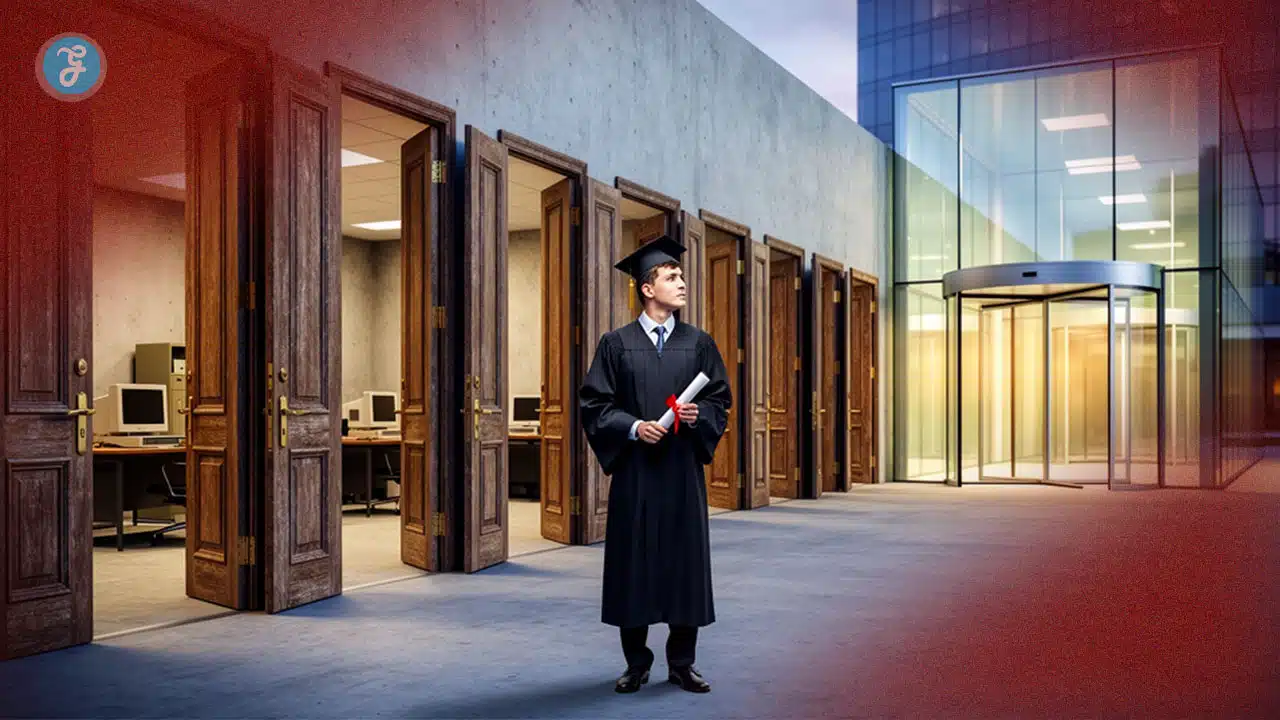
Millions of young adults faithfully followed the exact map handed to them by their parents, their high school guidance counselors, and their governments, only to arrive at the destination and realize the coordinates were entirely obsolete. The degrees still physically exist, the non-dischargeable debt is more real than ever, but the doors those degrees were supposed to open have been bricked over, automated, or moved entirely out of reach.
We are currently witnessing the greatest generational bait-and-switch in modern economic history. An entire cohort has been aggressively funneled into a massive, heavily subsidized higher-education industrial complex, sold a 20th-century dream at an exponentially inflated 21st-century premium. They were told repeatedly that higher education was an investment that would yield guaranteed compounding returns.

Instead, they find themselves holding a rapidly depreciating credential, shackled by inescapable federal debt, and competing in a hyper-optimized labor market that no longer values the generic academic signals they spent four years acquiring. It is time to stop pretending that this is a temporary macroeconomic blip, a symptom of “quiet quitting,” or a failure of individual work ethic. The system is functioning exactly as it is currently designed: to extract liquid wealth from the young to sustain the bloated, administrative infrastructure of the institutions.
To understand the sheer scale of this betrayal, we must analyze the structural realities of the current economy, highlighting the stark contrast between the promises made to students and the factual reality of the labor market they inherit.
The Higher-Ed Industrial Complex and the Graduate Underemployment Crisis
To truly comprehend the depth of the Graduate Underemployment Crisis, we must first look objectively at the perpetrators of the crisis: the universities themselves. Over the last three decades, both elite and mid-tier universities ceased functioning primarily as educational institutions and transformed into highly lucrative, tax-exempt real estate portfolios and hedge funds. Shielded by the limitless availability of federally backed student loans, universities realized they had absolutely no financial incentive to control costs, optimize efficiency, or improve the actual return on investment of their product. If an 18-year-old can instantly access tens of thousands of dollars in non-dischargeable loans with a mere signature, the university will invariably find a way to raise tuition to absorb that exact amount of capital.
This infinite money glitch fueled an unprecedented explosion in administrative bloat. According to data tracked by the National Center for Education Statistics, the hiring of university administrators and non-teaching staff has vastly outpaced the hiring of full-time, tenured faculty over the last twenty-five years. While the ranks of actual professors stagnated or were actively replaced by poorly paid, temporary adjuncts, universities hired armies of highly paid administrators: Vice Presidents of Student Experience, Directors of Campus Life, and dense layers of bureaucratic management that add zero tangible value to the academic rigor or the post-graduation employability of the students. The universities effectively built luxury country clubs, complete with lazy rivers, state-of-the-art recreation centers, and gourmet dining halls, purely to attract consumer “customers.” They masked this gross capital misallocation behind the noble, unassailable veneer of “expanding access to higher education.”

The macroeconomic data outlining this financial extraction is staggering. By early 2026, the total outstanding student loan debt in the United States will continue to hover near a crippling $1.8 trillion. The average student is walking across the graduation stage carrying close to $40,000 in federal and private debt, stepping straight into an economy where they are fundamentally overqualified for the jobs that are actually hiring.
The breakdown below illustrates the imbalanced financial mechanics of how universities extract wealth while transferring all the systemic risk to the student.
The Mathematical Impossibility of the Graduate Underemployment Crisis
The tragedy of the Graduate Underemployment Crisis is not just a lack of total jobs in the economy; it is the specific type of jobs graduates are forced to take just to survive the crushing weight of their monthly loan payments. According to long-term tracking by the Federal Reserve Bank of New York, the underemployment rate for recent college graduates has consistently hovered near or above 40% over the last decade. This means that roughly four out of every ten individuals who played by the rules and acquired a traditional four-year degree are currently working in positions, like retail, hospitality, basic logistics, or low-level administration, that simply do not require a degree at all.
When you combine a 40% underemployment rate with an average debt load of nearly $40,000 at interest rates frequently exceeding 5% to 7%, the math of the middle-class dream physically and undeniably breaks. A recent graduate pouring coffee, driving for a ride-share service, or working a chaotic retail schedule cannot mathematically out-earn the compounding interest of their federal and private loans while also paying for rent, food, and healthcare. They are trapped in a state of modern financial indentured servitude, where their disposable income is siphoned off by loan servicers before it can ever be saved for a down payment on a home, invested in the stock market, or used as seed capital to start a small business. We have successfully financialized the ambition of our youth, turning their desire for a better life into a highly profitable, securitized debt product for institutional investors and the federal government.
The matrix below highlights the devastating long-term macroeconomic consequences of this debt-fueled underemployment on the broader economy.
Agentic AI and the Evaporation of the Entry-Level in the Graduate Underemployment Crisis
If the universities painstakingly built the debt trap, the rapid evolution of technology definitively sprung it. The most severe accelerant of the Graduate Underemployment Crisis in 2026 is the widespread commercial deployment of Agentic Artificial Intelligence in the white-collar workplace. Historically, the implicit, foundational promise of a college degree was that it granted you access to the “entry-level”: the corporate mailroom, the junior copywriting desk, the paralegal pool, the basic coding farm, or the accounting bullpen. These roles were often tedious and unglamorous, but they were the necessary apprenticeships of the corporate world. They allowed young graduates to learn the cadence of the industry, build a professional network, and eventually climb the corporate ladder into middle management.

Those entry-level roles are rapidly ceasing to exist. They have been aggressively optimized out of existence by AI agents that do not require health insurance, do not take sick days, do not complain to HR, and can generate legal briefs, marketing copy, and backend code in seconds rather than days. Major corporations, desperate to cut overhead and maximize shareholder value in a tightening macroeconomic environment, have realized that they no longer need to hire five junior associates straight out of college; they can simply hire one senior director armed with a sophisticated suite of enterprise AI tools.
The doors haven’t just closed for recent graduates; the entire first floor of the corporate building has been demolished. We are mass-producing millions of generalist graduates who are specifically trained to perform exactly the kind of routine, patterned cognitive labor that machine learning algorithms have already mastered.
This comparative overview demonstrates how automation and AI have fundamentally altered the corporate hiring pipeline, removing the bottom rungs of the ladder.
The Gaslighting of the Graduate Underemployment Crisis
Perhaps the most infuriating and psychologically damaging aspect of the Graduate Underemployment Crisis is the relentless gaslighting perpetrated by older generations, established politicians, and the university presidents themselves. When a recent graduate inevitably struggles to find professional work in 2026, the institutional response is almost entirely focused on blaming the victim. The graduate is sternly told they “chose the wrong major,” that they “lack resilience and grit,” or that they simply aren’t “hustling hard enough” in the modern gig economy.
This narrative is a deliberate, highly coordinated smokescreen designed to protect the profitable status quo. It is incredibly convenient for a university president earning a seven-figure salary to blame a 22-year-old’s unemployment on their decision to study liberal arts, rather than admitting that the university’s career services department is entirely disconnected from the reality of a skills-based, AI-driven hiring market.
Furthermore, even the vaunted STEM (Science, Technology, Engineering, and Mathematics) degrees are no longer a guaranteed sanctuary. As the tech sector underwent brutal, sustained layoffs throughout 2023, 2024, and 2025, flooded with oversupply and aggressively automated by their own AI creations, recent computer science graduates found themselves competing fiercely for a rapidly shrinking pool of junior roles.
The system demands that teenagers make a $100,000 financial decision at the age of eighteen, based on labor market projections that will be entirely obsolete by the time they graduate four years later. When the gamble inevitably fails due to macro-structural shifts, the system washes its hands of them.
The breakdown below exposes the false narratives frequently peddled to students versus the harsh, verifiable structural realities of the current job market.

The Rise of Credential Inflation and the Graduate Underemployment Crisis
As the labor market tightened and the Graduate Underemployment Crisis deepened over the last decade, the corporate world responded with a devastating defensive mechanism: credential inflation. Because universities flooded the market with millions of generic Bachelor’s degrees, HR departments could no longer use a standard four-year degree as a reliable filter for competence, intelligence, or work ethic. When everyone has a degree, the degree itself loses almost all of its signaling value.
Consequently, corporations began requiring Bachelor’s degrees for basic administrative, coordination, and sales roles that historically required only a high school diploma. According to labor analytics firms like Lightcast, this “upcredentialing” trend affected millions of jobs. Simultaneously, they began demanding Master’s degrees for standard entry-level management positions.
This arms race of credentials forces students to stay in the higher-education pipeline even longer, accumulating even more unpayable debt, simply to tread water in the labor market. It is a vicious, highly inflationary cycle that heavily enriches the universities while aggressively impoverishing the workforce.
This artificial inflation of requirements disproportionately harms lower-income and marginalized students. A wealthy student can afford to take on the debt for a Master’s degree and accept an unpaid or low-paying internship in an expensive major city to build their resume. A working-class student, saddled with undergraduate debt, must immediately take whatever paying job they can find: often falling instantly into the underemployment trap, effectively locking them out of the professional class regardless of their actual intellect or capability.
This structural overview highlights how credential inflation physically blocks upward mobility and distorts the labor market.
Breaking the Cartel: Surviving the Graduate Underemployment Crisis
We cannot fix the Graduate Underemployment Crisis by simply forgiving the debt, though that may be a necessary, temporary economic triage for a bleeding generation. If we wipe the slate clean without fundamentally altering the pipeline, we will simply recreate the exact same $1.8 trillion debt bubble within a decade. Solving this requires a ruthless, structural dismantling of the university cartel and a total, uncompromising paradigm shift in how we evaluate human capital in the corporate world.
First, we must absolutely sever the infinite federal money supply. Federal student loans must be strictly capped, and universities must be forced by law to co-sign the loans of their students. If a university claims in its marketing materials that a specific degree program is a guaranteed pathway to success, it must have actual financial skin in the game. If a cohort of graduates defaults on their loans because the degree was useless in the open market, the university’s tax-exempt endowment should be on the hook for the balance. Instantly, you would see universities aggressively slash administrative bloat, permanently close obsolete degree programs, and hyper-focus on the actual, verifiable employability of their graduates.
Second, the corporate world must completely abandon the lazy, outdated metric of the four-year degree. We must transition fully to a verified Skills-Based Economy. Employers should not care where, or if, a candidate spent four years sitting in a lecture hall; they should only care if the candidate possesses the specific, demonstrable skills required to execute the job on day one.
The final strategic matrix outlines the necessary shifts from a broken credential-based economy to a functional skills-based economy to alleviate the crisis.
Reclaiming the Future and Ending the Graduate Underemployment Crisis
The mid-20th-century social contract is dead, and mourning its passing will not pay the rent. The millions of young adults currently navigating the Graduate Underemployment Crisis were not foolish for believing the promises made to them by the adults in the room, the government, and the institutions. They were systematically misled by a deeply entrenched industrial complex that prioritized its own limitless financial growth over the economic survival of its students.
But recognizing the reality of the scam is the absolute first step to escaping it. The future economy belongs entirely to those who stop waiting for the traditional, established doors to open. The degrees have lost their institutional magic, but human adaptability and ingenuity have not. We must collectively stop asking universities for permission to participate in the economy. By embracing highly specialized micro-credentials, actively leveraging the very AI tools that displaced the entry-level to multiply our own output, and aggressively demanding skills-based evaluations from employers, this generation can bypass the cartel entirely.
The map we were handed was deliberately drawn to lead us into an inescapable debt trap. It is time to burn the map, stop knocking on the doors that have already moved, and start building entirely new, structurally sound entrances to the global economy.