Backtest a Forex Strategy to avoid costly mistakes and improve trading performance. Many traders face losses because they skip testing strategies on historical data, leading to unreliable results and increased risk.
Using past market data allows traders to evaluate how a strategy performs before risking real capital. Professional traders typically rely on at least 100–200 trades during testing to ensure meaningful and consistent results.
This guide covers essential steps, including collecting historical data, analyzing key metrics like win rate and maximum drawdown, and using tools such as MetaTrader 4. With proper risk management and structured rules, backtesting helps build more reliable and effective forex trading strategies.
What is Forex Backtesting?
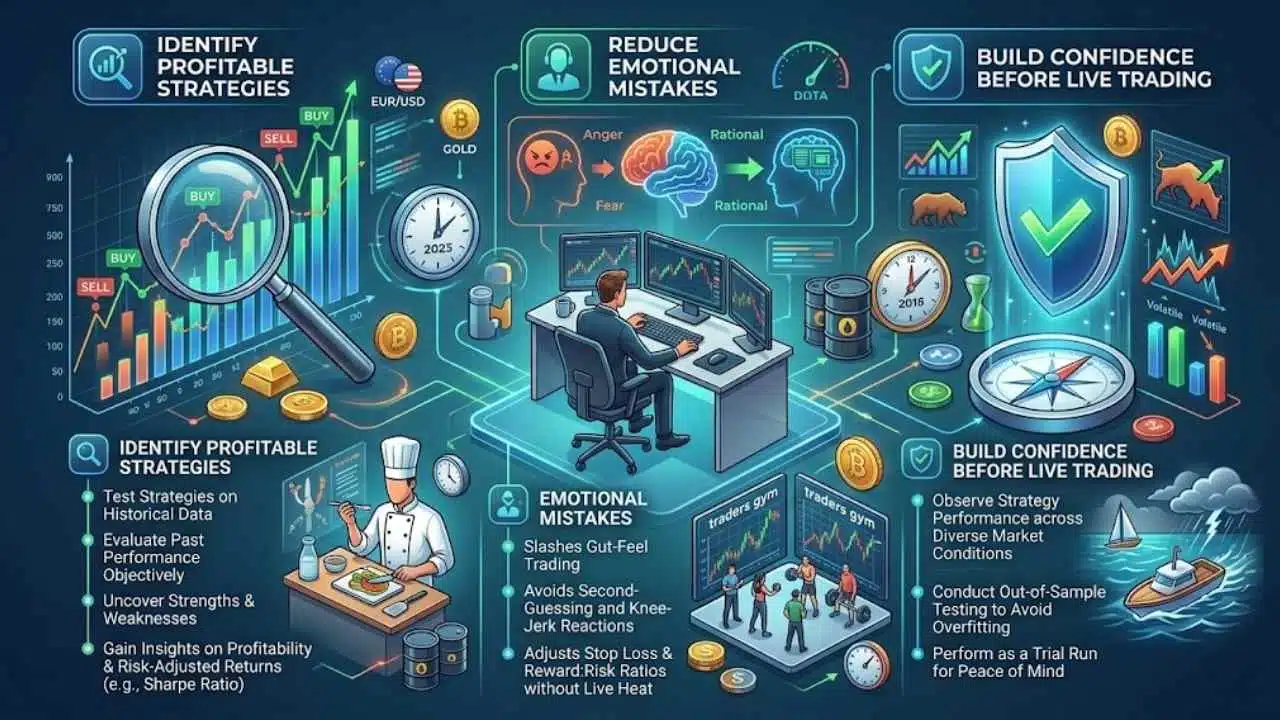
Forex backtesting lets you test your trading strategies on historical data. Traders run these strategies to check performance over a chosen time. This happens before they start live trading with real money.
The process simulates trades in real time. You follow set rules for entry and exit. Picture it like a time machine for your trades, showing what might have happened in past market conditions.
Forex backtesting uses data from the last few months, or it stretches back 10 to 20 years for deeper looks. Tools like Forex Tester help with this. That software works across markets, such as commodities, oil, gas, major FX crosses, cryptocurrency, and futures.
Backtesting boosts your trading precision. It helps you grasp market forces and grow your financial literacy. Imagine dodging costly errors by learning from history first, like a dress rehearsal for the big show.
Backtesting provides traders with the ability to assess how a strategy would have performed under historical market conditions.
Why Is Backtesting Important in Forex Trading?
Imagine spotting a winning edge in currency markets before risking your cash, that’s the magic of backtesting with tools like MetaTrader 5. It sharpens your edge by testing trading signals on past data, cutting down on gut-feel errors that plague many traders.
Identifying profitable strategies
You spot profitable strategies in forex trading with backtesting. Traders use historical data to check past performance. This step reveals if a strategy might work in the future. Strategy evaluation gives objective insights on profitability and risk-adjusted returns.
These insights help you make smart choices. Backtesting boosts your success odds by pushing diversified investments across asset classes and sectors. Picture it as a trial run, like testing a recipe before serving guests at a big dinner.
A trading platform offers access to historical data. Pair it with a spreadsheet for solid backtesting. The aim stays clear: find strengths and weaknesses in your approaches before real trades hit.
Track performance metrics like winrate and profit factor during tests. Tools such as MetaTrader or TradingView make manual backtesting easy. Automated backtesting speeds things up with expert advisors.
Sharpe ratio measures risk-adjusted returns well. Currency markets demand this prep to avoid nasty surprises.
Reducing emotional mistakes
Backtesting cuts down on emotional slip-ups in the financial markets, folks. It empowers you to make smart calls by digging into market data, which slashes your dependence on gut feelings.
Imagine trading like a pro, with 100% trust in your setup, no more second-guessing. Aspiring traders, get this: grasping what your strategy dishes out builds real confidence, especially when you see it hold up in wild market swings.
Tools like MetaTrader’s strategy tester or Python scripts for algorithmic testing help here, letting you tweak stop loss levels and reward-to-risk ratios without the heat of live action. Backtesting builds confidence by observing a strategy’s performance across different market conditions.
Picture yourself in a traders gym, practicing moves on historical charts from sources like forex.com or ThinkMarkets. You spot how moving averages and price action play out in in-sample data, then test on out-of-sample data to dodge curve-fitting.
This way, you avoid knee-jerk reactions, like dumping a trade too soon in quantitative trading setups. Machine learning can amp this up, analyzing big data from journals, but keep it simple at first with paper trading or a demo account through Quantra courses.
Building confidence before live trading
You build confidence in your Forex strategy by watching it perform in various market conditions. Patience plays a key role here, so take your time and put in the effort for solid results.
Imagine testing a boat in calm waters and storms alike, you see what holds up. This approach, like algorithmic automated testing, helps you spot strengths before risking real money.
Out-of-Sample Testing checks your plan on fresh data, making sure it fits without overfitting to old charts.
Traders often refine strategies as markets change and new info comes in. You observe the reward:risk ratio during these tests, building trust step by step. Think of it as a trial run that eases your nerves, much like practicing lines before a big show.
Studies in the Journal of Big Data highlight how this boosts decisions in the global backtesting software market. Keep reviewing to stay sharp and confident.
Steps to Backtest a Forex Strategy
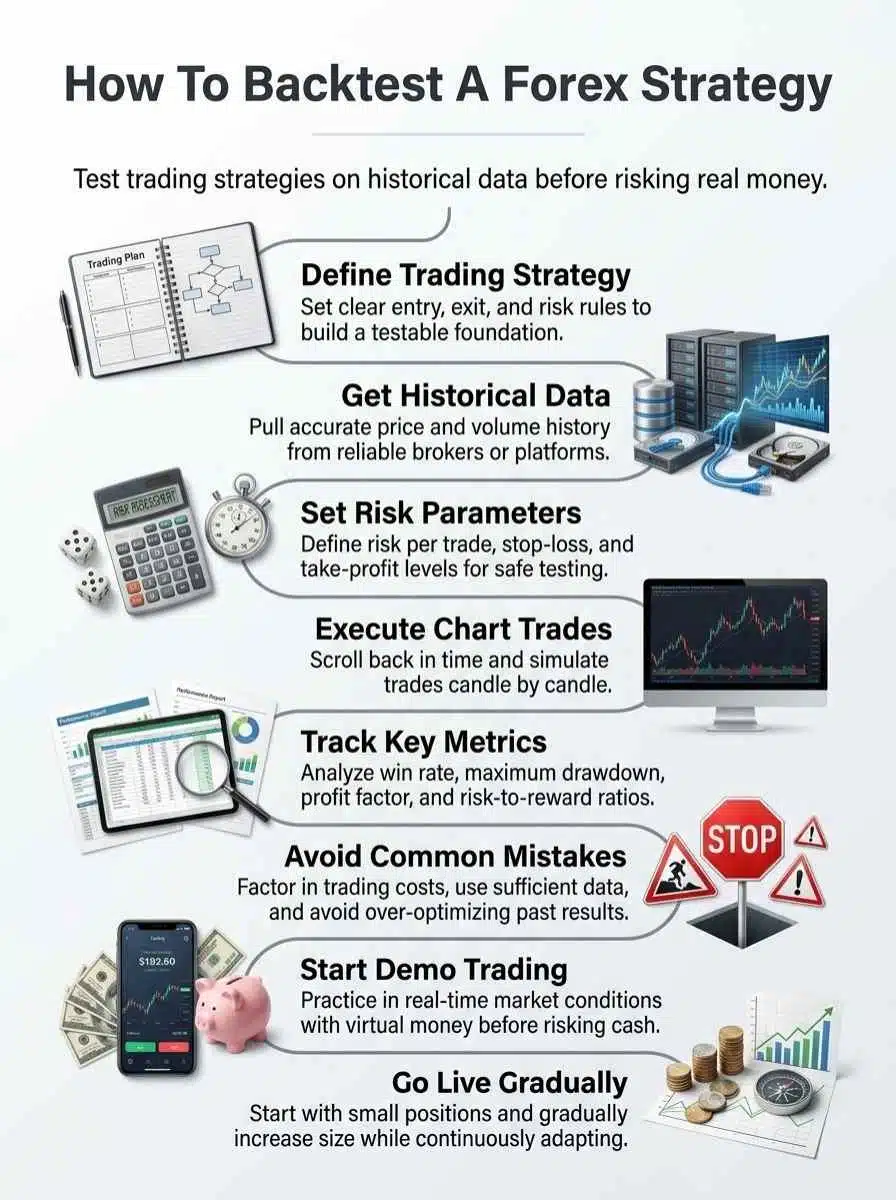
4. Steps to Backtest a Forex Strategy: Hey, imagine testing your forex ideas on past market moves without losing a dime, like practicing a sport before the big game – you start by outlining your entry and exit rules, pull in reliable price history from platforms like MetaTrader, dial in your stop-loss and take-profit levels, simulate trades across those old candlestick patterns, and crunch the numbers on wins versus losses, all to spot what really pays off, so hang tight and read on for the full breakdown that could save your trading account.
Define your trading strategy
Define your trading strategy first, folks. You specify rules for entry and exit conditions. Add position sizing and risk management parameters too. This builds a solid base, like laying bricks for a sturdy house.
Picture a clear trading logic or hypothesis. Use a moving average crossover approach for buy and sell signals, for example. That keeps things straightforward and testable.
Decide on fixed reward-to-risk ratios, say 2:1, or go with discretionary targets for flexibility. Consider trailing stops to lock in profits as the market moves your way. Scaling in and out helps manage risk, it gradually adjusts position sizes to boost returns.
All this sets up algorithmic automated testing down the line, making sure your plan holds water before the real action starts.
Obtain historical data
You need solid historical data to backtest your Forex strategy right. Grab it from reliable sources like your CFD brokerage or platforms such as MetaTrader 4. This step keeps things accurate, and hey, it avoids those pesky errors that could throw off your results, like a bad map leading you astray.
Focus on data that includes price and volume info for the currency pairs you trade. For example, pull Forex records from January 1, 2018, to January 1, 2023, that’s a solid six-year stretch for algorithmic testing.
Think of equities too; folks use Microsoft stock prices from Yahoo! Finance for similar backtests, mirroring real market vibes.
Set up trade and risk parameters
Set your trade parameters by outlining clear entry and exit rules. Use objective indicators to spot those moments. For instance, buy when a 30-minute candle closes above resistance, and aim for a 2:1 risk-reward ratio.
Pick a timeframe that fits, like daily, 4-hour, or 15-minute charts. This keeps things specific and testable.
Now, tackle risk parameters with solid risk management. Define the risk per trade to protect your capital. Place stop-loss orders based on timing analysis for safety. Size positions to match your account.
Figure out take-profit levels through that same analysis. These steps let you run algorithmic automated testing smoothly, spotting issues early.
Execute trades on historical charts
Open your trading platform, like MetaTrader 4 or TradingView. Set up your charts with key indicators from your strategy. Scroll back in time to start at a chosen historical point. Progress through the data candle by candle, oh yeah, that keeps things fair and stops any sneaky bias from creeping in.
Press the new order button to kick off trade simulation. Head to the open positions section for a quick check. Make an intentional losing trade now and then; it adds that real-world grit to your results.
Close all orders with one click, or pick them off one by one. This hands-on approach mimics live action, blending in elements of algorithmic testing for sharper insights.
Record and analyze results
Log your results in detail during manual backtesting. Use a spreadsheet or tool for this task. Track every trade, entry point, exit point, and outcome. This habit keeps things organized, like a roadmap for your strategy’s journey.
Annotate charts as you go. Highlight key situations that pop up. Take screenshots to capture those moments. These steps help you spot patterns, you know, the ones that make or break your plan.
Switch to automated backtesting for faster insights. Input your strategy rules into software like MetaTrader, TradingView, or NinjaTrader. These platforms support algorithmic testing.
Execute the backtest to simulate trades automatically. The software generates a report with key performance metrics. Analyze that data to see what works. Spot weaknesses early, before real money hits the line.
Key Metrics to Monitor During Backtesting
Hey, picture yourself as a detective hunting clues in your Forex trades, where spotting patterns in win rates and peak losses can save you from big pitfalls, so keep going to uncover how these gems boost your edge.
Win/Loss rate
You calculate the win rate as the percentage of winning trades from total executed trades. This simple metric reveals how often your forex strategy succeeds. Picture a trader with a 40% win rate; they can still profit big time if average wins outpace losses by a wide margin.
Keep that in mind, folks, it flips the script on what “winning” means.
For reliable insights in algorithmic testing, gather data from 100 to 200 trades. Fewer than that? You risk basing decisions on flukes, not solid patterns. Tools like MetaTrader help track this stat accurately, letting you spot strengths in your setup.
A lower win rate works fine with higher average win sizes, so focus on the full picture during backtests.
Maximum drawdown
Maximum drawdown tracks the biggest drop in your portfolio value from its highest point to its lowest during a test period. Traders examine this metric as the largest peak-to-trough decline, and it shows risk exposure in clear terms.
Picture starting with a $10,000 investment that climbs to $12,000, then dips to $7,000. That gives a maximum drawdown of -41.6%, expressed as a percentage. This number reveals potential losses in your strategy, so keep an eye on it during backtesting.
In algorithmic testing, maximum drawdown helps you grasp how much your account might suffer in tough times. It measures the maximum loss from peak to trough, and that’s key for building solid plans.
Use tools like MetaTrader to spot these drops on historical charts. Stay alert to this, folks, it keeps your trading dreams from turning into nightmares.
Profit factor
Profit factor measures your strategy’s edge in forex trading. It shows the ratio of total profits to total losses. A value over 1 signals general profitability, like a thumbs-up for your plan.
Imagine, you earn more than you lose, and that keeps you in the game. Traders love this metric because it cuts through the noise. In algorithmic testing, it helps spot winners fast.
Say your profit factor hits 2. That means you pocket $2 for every $1 lost. Smart folks evaluate this to check long-term profitability. Use tools like MetaTrader to calculate it during backtests.
Keep an eye on it, and tweak your approach if it dips low. This way, you build a solid foundation before live trades.
Risk-to-reward ratio
Traders assess the risk-to-reward ratio as average reward relative to average risk. This metric compares potential risk against potential reward, and it guides decisions on taking a trade.
Picture a setup where you risk $100 to gain $200; that’s a 2:1 ratio, meaning the potential reward doubles the risk. You calculate it by dividing total profits from winners by total losses from losers over many trades.
The ratio works hand in hand with win rate to manage expectations on winning and losing streaks. A high ratio lets you profit even with fewer wins, like breaking even on a 40% win rate with a 3:1 setup.
In algorithmic testing, you spot these patterns fast, tweaking your approach before real money hits the line. Imagine dodging a bad streak because backtesting revealed the truth early, saving you headaches down the road.
Common Mistakes to Avoid When Backtesting
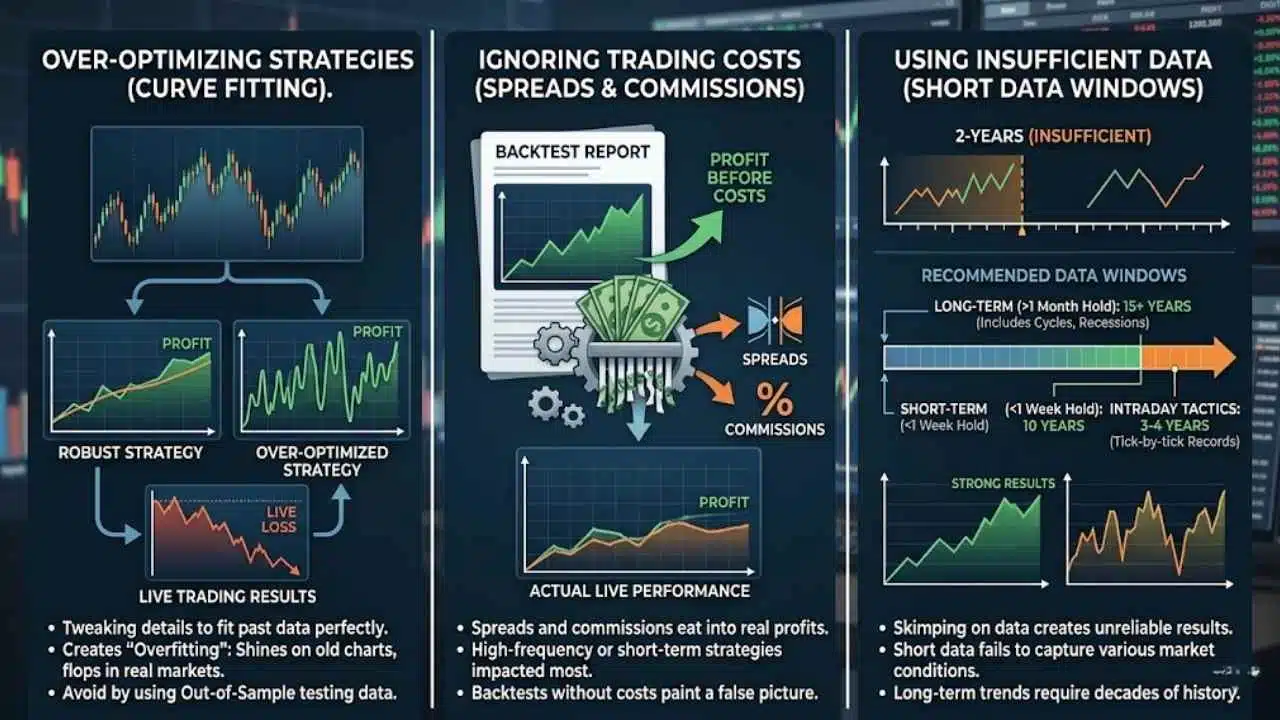
Hey, fellow traders, you’ve got this great Forex strategy, but one wrong move in backtesting can wreck your results, like chasing perfect fits that ignore real market slips. Dive deeper with me, and let’s sidestep those curveballs together, using tools like MetaTrader to spot slippage and keep your tests on track.
Over-optimizing strategies
Over-optimizing your forex strategy sounds smart at first, but it often backfires big time. You tweak every tiny detail to fit past data perfectly, like forcing a puzzle piece that doesn’t belong.
This creates overfitting, where the setup shines on old charts but flops in real markets. Traders fall into this trap during algorithmic testing, chasing perfect results without seeing the risks.
Split your historical data wisely to dodge this mess. Use in-sample data for building and fine-tuning your automated testing approach, yet watch for that overfitting danger. Then test on out-of-sample data, a fresh batch, to check how it holds up in new scenarios.
This step keeps your strategy realistic and ready for live action, saving you from nasty surprises.
Ignoring trading costs
Traders often skip trading costs in backtesting, and that leads to big problems. Imagine this, you run your strategy through historical data, and it looks like a gold mine. But hold on, spreads and commissions eat into profits in real trades.
Factor them in right away to dodge overestimating how well your plan works. High-frequency strategies suffer the most from this slip-up, as those tiny fees add up fast. Even in algorithmic testing, automated runs without costs paint a false picture of success.
Short-term strategies face misleading backtest results when you ignore those expenses. Spreads widen during volatile times, and commissions stack up with each trade. I get it, excitement builds when numbers shine bright, but reality hits hard in live markets.
Use tools like MetaTrader to simulate real fees during your tests. This step keeps your confidence grounded and your wallet safer.
Using insufficient data
Skimping on data during backtesting fools you into thinking a strategy shines, when it really flops in real markets. Imagine you’re testing a long-term approach where you hold positions for over a month.
Grab at least 15 years of historical charts to spot true patterns, or else unreliable results creep in and puff up your expectations. Short-term plays, those lasting under a week, demand 10 years of data for a fair shake.
Yeah, it feels like a drag, but dodging this pitfall saves you from nasty surprises down the road.
Intraday tactics, wrapping up in less than a day, need 3-4 years of tick-by-tick records to mimic wild market swings. Tools like MetaTrader 5 or Forex Tester make algorithmic automated testing a breeze with vast data sets, so load them up properly.
Overstate effectiveness by using skimpy info, and boom, your confidence crashes when live trades bite back. Stay smart, folks, and pile on that data to keep things real.
Tools for Backtesting Forex Strategies
You know, picking the right gear can make or break your trading game, like choosing a trusty map for a treasure hunt. Traders often grab platforms such as chart replay features or full simulation software to test ideas without real cash on the line.
These tools let you rewind time, spot patterns, and tweak plans with ease. Imagine practicing your shots before the big match, that’s the vibe. Dive deeper into which ones suit you best, and keep reading for tips on making the switch to live action.
TradingView Bar Replay
TradingView Bar Replay lets you manually backtest your forex strategies. You progress through historical price bars step by step. This tool keeps things real, like rewinding a movie to spot the plot twists.
Traders love it for spotting patterns without peeking ahead. Go candle by candle, and you dodge that sneaky bias that creeps in otherwise. It feels like a practice run in slow motion, building your skills bit by bit.
During sessions, annotate your charts to mark key spots. Highlight those big moments that change the game, like a sudden price swing. Take screenshots to capture wins and slips for later review.
This approach turns manual testing into a smart habit, even if you’re eyeing algorithmic testing down the line. Picture a friend sharing trading war stories; that’s the vibe as you build confidence.
Manual backtesting here sharpens your edge before live trades hit.
MetaTrader 4/5
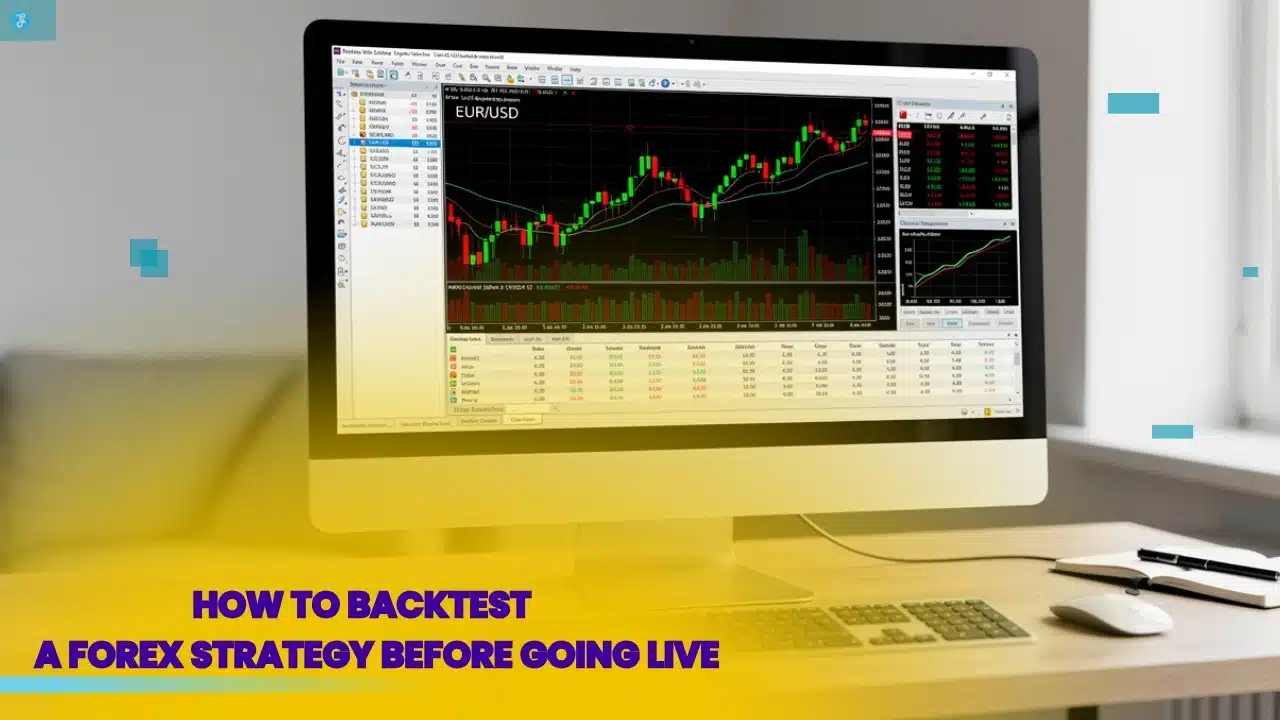
MetaTrader 4 and 5 stand out as popular platforms for Forex backtesting. Traders love them because they support both manual and automated methods. You can get started right away, input your strategy rules, and run algorithmic testing with ease.
These tools execute automated backtests on historical data, just like a reliable co-pilot guiding your trades. Imagine: you set up your plan, hit play, and watch how it performs over past market moves.
The platforms deliver detailed reports packed with key performance metrics. Think win rates, drawdowns, and profit factors, all at your fingertips. Users often share stories of spotting weak spots in strategies before risking real cash.
MetaTrader makes the process straightforward, helping you build solid confidence. Jump in and experiment; it feels like practicing in a safe sandbox.
Forex Tester
Forex Tester stands out as a powerful tool for backtesting your forex strategies. This software lets you test ideas across many markets, like commodities, oil, gas, major FX crosses, cryptocurrency, and futures.
Imagine practicing trades on the AUD/JPY pair without risking real money; it feels like a safe sandbox for your plans. You set up indicators just like in live trading, so everything matches what you’d do for real.
Best of all, Forex Tester skips the hassle of flipping between time frames during tests. It boosts your automated testing by simulating trades step by step. Traders love how it builds skills fast, almost like chatting with a wise mentor who points out flaws early.
Give it a try, and watch your confidence grow before you enter live action.
Moving from Backtesting to Live Trading
You’ve nailed your strategy in backtests, now picture easing into real markets like dipping a toe in the pool before jumping in. Jump to a demo account first, where you trade with fake cash on platforms like MetaTrader, and watch how live conditions test your plan without burning your wallet.
Start with demo trading
Jump into demo trading right after backtesting. You use a demo account for paper trading, which simulates real-time trades without risking your actual money. This step lets you validate your strategies in live market conditions, spotting any weak spots before they hit your wallet.
Imagine it like a dress rehearsal for a big show; you practice every move to build that rock-solid confidence. Traders often start here to avoid those gut-wrenching losses from jumping straight to live action.
Demo trading also opens doors to algorithmic automated testing on platforms like MetaTrader 4 or 5. Register for access, and you can take exams that track your progress and results, helping refine your skills.
Feel the market’s pulse without financial risk, tweaking your approach as you go. It’s like having a safety net while you learn the ropes, making the shift to real trades smoother and smarter.
Gradually increase trading size
You nailed the backtesting phase, and demo trading feels solid. Now, ease into real trades by slowly ramping up your position size. Think of it like dipping your toes in the pool before a full swim, you avoid shocks that way.
After successful demo runs, boost your trade sizes bit by bit to manage risk smartly. Keep things steady, no big leaps that could wipe out gains.
Track the position size and percentage risk from your backtesting records. Carry those over to live adjustments for consistency. This approach builds on algorithmic testing methods, like automated checks in tools such as MetaTrader.
It feels like a safety net, right? Adjust as you go, and watch your confidence grow without the drama.
Monitor and adapt strategies
Markets change fast, like a river shifting its course, so review your forex strategies often. Refine them as new data rolls in and conditions evolve to keep them effective. Imagine this: you spot a glitch in your plan during live trades, so you tweak it right away.
Then, run further tests on fresh data sets or different time frames to check reliability and consistency. Tools like MetaTrader help with this algorithmic testing, letting you automate checks and spot issues early.
Adapt your strategy continuously based on fresh insights and shifting market vibes. Stay alert, folks, because what worked yesterday might flop tomorrow. Use platforms such as Forex Tester for quick simulations after changes.
This keeps your trading sharp, avoiding big slip-ups. Imagine chatting with a buddy over coffee: “Hey, my setup tanked last week, but I fixed it with some automated testing tweaks.” That kind of flexibility builds real staying power in forex.
Final Thoughts
You learned how to define your strategy, grab historical data, and track metrics like win rate and profit factor. These steps make backtesting simple and quick to apply in your daily routine.
Solid backtesting cuts risks and boosts your trading success over time. Check out tools like TradingView or MetaTrader for more practice. I once skipped proper testing and lost big, so take my word, do it right. Jump in now and turn those strategies into real wins.