
The United Kingdom’s immigration landscape has entered a period of intense restriction and recalibration. As we move through the 2025 and 2026 fiscal years, the UK Skilled Worker Visa 2025 framework has transitioned from a flexible post-Brexit tool into a highly selective instrument designed to attract only the highest-earning and most qualified global talent. With the general salary threshold now settled at a significantly higher baseline and the skill level requirement returning to graduate-heavy standards, both employers and applicants must navigate a set of rules that are far more rigorous than those of the previous decade.
How We Selected Our 15 Best UK Skilled Worker Visa 2025 Facts
To provide a comprehensive overview of the current environment, we analyzed the 2025 Immigration Rules Impact Assessment and the specific technical updates issued by the Home Office for the 2026 “earned settlement” rollout. Our selection criteria focused on the “hidden” hurdles that often lead to application refusals, such as the interaction between hourly pay floors and annual salary totals. We prioritized facts that differentiate the new rules from the transitional arrangements, ensuring that new applicants from overseas understand the starkly different requirements they face compared to those already in the UK. This list captures the shift from a quantity-based system to one that demands high economic contribution and integration.
15 Critical Facts Defining the UK Skilled Worker Visa 2025 Landscape
The following guide breaks down the essential technical requirements and strategic shifts that define the route to working and eventually settling in Britain today.
1. The £41,700 Universal Salary Baseline
For the vast majority of new applicants from overseas, the general annual salary threshold has been set at £41,700. This is a dramatic increase from the previous decade’s standards and serves as a hard floor. Even if a job’s specific going rate is lower, the employer must still meet this £41,700 minimum to secure a visa for a new hire who does not qualify for specific discounts.
Best for: overseas professionals in corporate, finance, and technical sectors.
Why We Chose It:
-
It is the single most important figure for the 2025/2026 application cycle.
-
It sets a clear expectations barrier for entry-level roles in high-cost regions.
Things to consider:
-
This threshold applies to a 37.5-hour week; longer hours require a proportionally higher salary.
2. The Return to RQF Level 6 Requirements
A pivotal change in July 2025 was the decision to raise the minimum skill level back to RQF Level 6 (graduate level) for most new applicants. This effectively removed approximately 180 medium-skilled roles that were previously eligible, meaning that jobs requiring only A-levels or equivalent experience no longer qualify for sponsorship under the general route.
Best for: university-educated professionals and specialized technical leads.
Why We Chose It:
-
It significantly narrows the pool of eligible jobs compared to the 2020-2024 era.
-
It underscores the government’s focus on “high-value” migration.
Things to consider:
-
Only roles on the Temporary Shortage List maintain access at lower RQF levels.
3. The £12.82 Mandatory Hourly Wage Floor
While the annual salary is the headline figure, the Home Office also enforces a strict hourly wage floor of £12.82 as of April 2025. This ensures that employers cannot meet the annual threshold by simply demanding 60-hour work weeks. Every hour worked must be compensated at or above this rate, regardless of the total annual package.
Best for: HR departments and finance teams managing sponsorship budgets.
Why We Chose It:
-
It prevents the exploitation of migrant workers through excessive unpaid overtime.
-
It provides a secondary compliance check during Home Office audits.
Things to consider:
-
This floor is indexed to the UK’s wider wage data and may rise again in late 2026.
4. The 4-Year “New Entrant” Absolute Limit
The “New Entrant” discount, which allows for lower starting salaries, is strictly capped at a total of four years. Crucially, this four-year limit includes any time you have already spent in the UK on a Graduate visa or a Tier 2 route. Once this period expires, you must immediately jump to the full £41,700 or the 100% going rate.
Best for: international students transitioning from UK universities to the workforce.
Why We Chose It:
-
It is a common “trap” where workers find themselves unable to extend their visa because their salary hasn’t grown enough.
-
It forces a clear career progression timeline on young professionals.
Things to consider:
-
You cannot “reset” this four-year clock by switching employers.
5. The £33,400 New Entrant Salary Floor
Even with the 30% discount applied to the going rate, “New Entrants” cannot be paid less than £33,400 per year. This floor ensures that even junior roles provide a significant economic contribution. You must earn whichever is higher: £33,400 or 70% of your job’s specific going rate.
Best for: junior analysts, developers, and researchers under age 26.
Why We Chose It:
-
It prevents the “New Entrant” route from being used for low-wage labor.
-
It provides a manageable entry point for high-potential talent.
Things to consider:
-
This rate only applies for the first few years of your career in the UK.
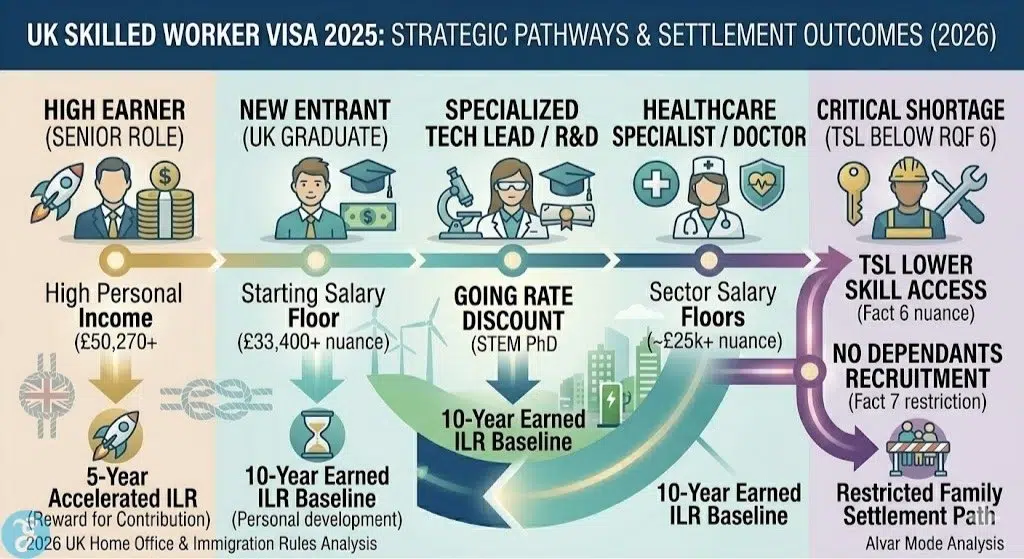
6. Introduction of the Temporary Shortage List (TSL)
The old Immigration Salary List has been superseded by a more restrictive “Temporary Shortage List.” Roles on this list are those identified by the Migration Advisory Committee as critically undersupplied but strategically important. While they offer lower salary thresholds, they are intended to be time-limited interventions rather than permanent fixtures.
Best for: workers in specialized construction, engineering, or health sectors.
Why We Chose It:
-
It is the only remaining gateway for roles that sit below the RQF Level 6 skill threshold.
-
It reflects the 2026 “Modern Industrial Strategy” of the UK government.
Things to consider:
-
Most roles on this list are scheduled to be reviewed or removed by December 2026.
7. No Dependants for TSL Below-Degree Roles
A major policy shift for 2026 is that workers recruited for roles below RQF Level 6 via the Temporary Shortage List are generally prohibited from bringing family members (dependants). The government’s view is that shorter-term, lower-skilled migration should not lead to long-term family settlement.
Best for: solo professionals willing to work in the UK temporarily without family.
Why We Chose It:
-
It is a critical differentiator for those deciding between different visa options.
-
It significantly impacts the “settlement potential” for many families.
Things to consider:
-
This restriction does not apply to Health and Care workers, who fall under separate rules.
8. The 10-Year “Earned Settlement” Baseline
Starting in April 2026, the pathway to Indefinite Leave to Remain (ILR) has moved to a baseline of 10 years of continuous residence. The traditional 5-year automatic route has been replaced by this “earned” model, where time is just one of several factors. Most skilled workers will now need a decade in the UK before they can apply for permanent residency.
Best for: long-term planners looking to build a life in the United Kingdom.
Why We Chose It:
-
It is the most significant change to settlement rules in decades.
-
It shifts the focus from “time served” to “contribution and integration.”
Things to consider:
-
Time spent on a Student or Graduate visa usually does not count toward this 10-year baseline.
9. Accelerated ILR for High Earners (£50,270+)
While the baseline for settlement is 10 years, the 2026 system offers a “Contribution-Based Reduction.” If you earn a taxable income of at least £50,270 for three consecutive years prior to your application, you can reduce your qualifying period by 5 years, effectively allowing you to settle in 5 years total.
Best for: senior management, software architects, and specialized consultants.
Why We Chose It:
-
It provides a clear incentive for high-earning individuals to stay and contribute.
-
It preserves the “fast track” for the UK’s most economically productive migrants.
Things to consider:
-
This income must be personal taxable income, not combined household income.
10. The New B2 English Requirement for Settlement
For those reaching the settlement stage in 2026, the English language requirement has been raised from B1 to B2 level. This means that merely being “conversational” is no longer enough; you must demonstrate a higher level of fluency and integration into UK society to be granted permanent status.
Best for: applicants from non-English speaking countries nearing the end of their visa.
Why We Chose It:
-
It reflects the “Integration Pillar” of the new earned settlement system.
-
It ensures that those who settle can participate fully in UK civic life.
Things to consider:
-
Achieving a C1 level can even provide a 1-year reduction in your ILR qualifying period.
11. The STEM PhD 80% Going Rate Discount
If you have a science, technology, engineering, or mathematics (STEM) PhD that is relevant to your job, you only need to be paid 80% of the standard going rate. This is a powerful tool for academic and research-heavy industries to recruit top-tier intellectual talent without meeting the full corporate pay scales.
Best for: research scientists, academic fellows, and high-tech innovation leads.
Why We Chose It:
-
It highlights the UK’s desire to remain a “science superpower.”
-
It provides a significant cost saving for universities and R&D firms.
Things to consider:
-
You must still earn at least £33,400 per year, regardless of the PhD discount.
12. Health and Care Worker Salary Floors
Health and Care workers remain on a separate, lower salary track to ensure the NHS remains staffed. For new entrants in this sector, the floor is approximately £25,000, significantly lower than the general £41,700 threshold. However, they are now subject to much stricter rules regarding where they can work and who they can sponsor.
Best for: nurses, medical doctors, and specialized allied health professionals.
Why We Chose It:
-
It is the most high-volume visa sub-category in the UK today.
-
It represents the “public service” exception to the high-salary rules.
Things to consider:
-
Social care workers (SOC 6135/6136) can no longer bring dependants if applying from overseas.
13. Phasing Out of the Social Care Route for New Hirees
In an effort to reduce net migration, the government has begun phasing out the ability for overseas applicants to enter as “Care Workers” or “Senior Care Workers” unless they are already in the UK. This forces the sector to rely more on the domestic workforce or those already within the UK immigration system.
Best for: HR directors in the adult social care and residential home sectors.
Why We Chose It:
-
It signals a major shift in how the UK intends to solve labor shortages in low-wage sectors.
-
It makes in-country switching a vital strategy for care providers.
Things to consider:
-
In-country switching for existing care workers remains available until July 2028.
14. Transitional Arrangements for Existing Workers
If you were already on a Skilled Worker visa before the April 2024 or July 2025 rule changes, you are generally protected by “transitional arrangements.” When you renew, your general salary threshold may be as low as £31,300, and you may still be able to sponsor dependants in roles that are now restricted for new arrivals.
Best for: current visa holders looking to extend their stay or change employers.
Why We Chose It:
-
It prevents the “sudden deportation” of workers who were compliant under old rules.
-
It creates a “two-tier” system that heavily favors those already in the country.
Things to consider:
-
These protections are not indefinite and are expected to be reviewed in 2027.
15. The “100% Going Rate” Default (Option A)
For most standard applications, you must meet 100% of the “going rate” listed for your specific occupation code. In 2025/2026, these going rates were updated using the most recent wage data, meaning many roles now require salaries far in excess of the £41,700 general minimum.
Best for: all skilled worker applicants as the primary method of qualifying.
Why We Chose It:
-
It is the “default” path that most applicants will travel.
-
It ensures that migrant wages are aligned with local market rates.
Things to consider:
-
If your job’s going rate is £60,000, then £60,000 is your minimum, not £41,700.
A Summary of the Shifting UK Immigration Framework
The evolution of the Skilled Worker route in 2025 and 2026 reflects a UK government that is increasingly selective about who is allowed to build a long-term future in the country. By raising salary floors and moving toward an “earned” model for residency, the system now clearly favors high earners and those in key strategic sectors. While the door remains open, the cost of entry, both in terms of salary and the time required to achieve permanent status, has never been higher.
Strategic Analysis of UK Skilled Worker Visa 2025 Pathways
Choosing the right path depends on your career stage, your field of study, and your long-term residency goals. The following breakdown illustrates how different applicant profiles interact with the current salary and settlement rules.
Pathway Suitability Summary
The data provided reflects the current requirements for various routes under the 2025 and 2026 immigration rules.
| Applicant Profile | General Salary Floor | ILR Baseline | Dependant Rights |
| New Overseas Hire (Standard) | £41,700 | 10 Years | Yes |
| New Entrant (Graduate/Under 26) | £33,400 | 10 Years | Yes |
| STEM PhD Professional | £33,400 | 10 Years | Yes |
| Temporary Shortage (Below RQF 6) | £33,400 | 15 Years | No |
| High Earner (£50,270+) | £50,270 | 5 Years | Yes |
| Health and Care Worker | ~£25,000 | 10 Years | Role-Specific |
Our Top 3 Picks and Why?
-
The High Earner Accelerated ILR: This is our top pick because it preserves the 5-year path to settlement for the UK’s most economically productive migrants. It turns a potential 10-year wait into a 5-year journey for those who hit the £50,270 threshold.
-
The New Entrant Discount: We chose this as a vital pick because it remains the most accessible bridge for international students to start their careers in the UK despite the otherwise high salary floors.
-
The STEM PhD Provisions: This pick is essential for the innovation sector. It allows high-level researchers to enter the UK at a salary that is competitive with academia while still providing a clear path to long-term residency.
Successfully securing a UK visa today requires more than just a job offer; it requires a deep understanding of how your role fits into the Home Office’s complex coding and salary matrix.
The Selection Framework
-
Identify Your Correct SOC Code: Your job title is less important than your Standard Occupational Classification (SOC) code. Ensure your employer matches your duties to an RQF Level 6 code unless you are using the Shortage List.
-
Calculate Your Hourly Rate: Do not just look at the £41,700. If you work 48 hours a week, you must be paid at least £31,998 plus whatever is required to hit the £12.82 hourly floor, which would total nearly £32,000.
-
Verify Your “New Entrant” Clock: If you spent two years on a Graduate visa, you only have two years of “New Entrant” discount left. Ensure your employer is prepared to raise your salary to the full rate after those two years.
-
Factor in the ILR Surcharge: Settlement fees and the Immigration Health Surcharge are rising. Budget for at least £5,000 to £7,000 per person for the final settlement stage in 2026.
The following guide will help you decide which route aligns best with your specific professional background and financial expectations.
Decision Matrix
Use this matrix to determine the most logical visa strategy for your profile in the current year.
| If your priority is… | Choose X if… | Choose Y if… |
| Fastest Route to ILR | Choose Option A and aim for a £50,270+ salary. | Choose Global Talent if you are a leader in your field. |
| Lower Initial Salary | Choose New Entrant if you are under 26 or a graduate. | Choose STEM PhD if your doctorate is relevant to the role. |
| Bringing Your Family | Choose Standard RQF 6 or Health/Care roles. | Avoid TSL roles that are below degree level. |
| Long-Term Cost Savings | Choose ISL/TSL roles for lower application fees. | Avoid High-Surcharge routes if you are on a tight budget. |
The Final Checklist: 5-Point UK Readiness Plan
-
Confirm your job’s SOC code is at RQF Level 6 or on the Temporary Shortage List.
-
Ensure your offered salary meets both the annual threshold and the £12.82 hourly floor.
-
Calculate your “New Entrant” eligibility period, accounting for any previous UK visas.
-
Check if your role qualifies for a PhD discount and ensure your certificate is verified by Ecctis.
-
Set a 5-year or 10-year savings goal for your eventual settlement fees and English B2 tests.
Adapting to the High-Skill Era of UK Immigration
The UK Skilled Worker Visa 2025 represents a fundamental shift toward merit-based and contribution-heavy immigration. By setting high salary floors and extending the path to residency, the UK has made it clear that only those who can significantly boost the economy will be granted long-term stability. For the right candidate, the rewards remain high, access to one of the world’s most dynamic labor markets and an accelerated path to settlement for top earners. However, the complexity of the current rules means that precision in your application and a proactive approach to your salary negotiations are more critical than they have ever been.