The shift from voluntary disclosure to automated surveillance in the South African digital economy has reached a definitive turning point. As of March 1, 2026, the South African Revenue Service (SARS) has officially activated its most aggressive oversight regime to date, integrating local crypto activity into the global financial transparency network. This transition effectively ends the era of “invisible” digital wealth, replacing it with a structured data architecture that allows the tax office to reconcile individual lifestyle spending with blockchain-based gains in real-time.
How We Selected Our 11 Best SARS Crypto Oversight 2026 Methods
To identify the most critical shifts for the current tax year, we analyzed the final Business Requirement Specifications (BRS) released by SARS in February 2026 and the 2026 Budget Speech FAQs. Our selection criteria prioritized the new mandatory reporting frameworks that move the burden of data collection from the taxpayer to the service provider. We focused on mechanisms that provide SARS with high-definition visibility, such as the automated exchange of offshore data and the tracking of high-value retail transactions. These 11 methods were chosen because they represent the “hard” technical barriers that now make non-compliance a high-risk strategy in the South African market.
11 Critical Strategies Defining SARS Crypto Oversight 2026
The following points detail the technical and legislative tools SARS is using to ensure every crypto-to-crypto swap, fiat disposal, and wallet transfer is accurately captured for tax purposes.
1. Implementation of the Crypto-Asset Reporting Framework (CARF)
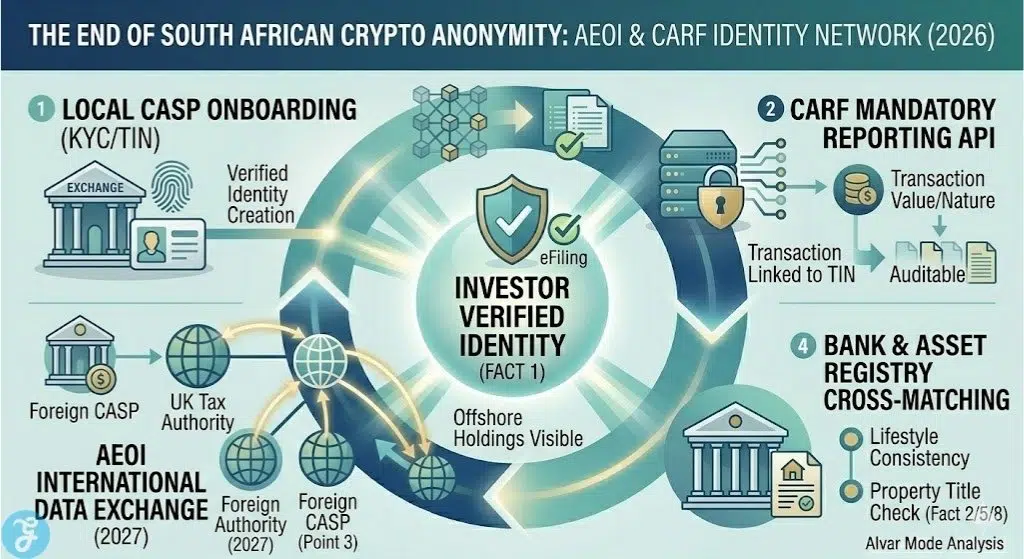
As of March 1, 2026, South Africa has officially implemented the OECD’s CARF into domestic law. This framework requires all Reporting Crypto-Asset Service Providers (RCASPs) to perform rigorous due diligence and collect detailed identification data, including tax residency and tax identification numbers (TINs), for every user. This ensures that every transaction is linked to a verified identity from the moment of onboarding.
Best for: establishing a permanent, verified link between digital wallets and taxpayer IDs.
Why We Chose It:
-
It is the foundational regulation that enables all other forms of automated oversight.
-
It aligns South Africa with the global standard used by over 40 other jurisdictions.
-
It removes the anonymity previously associated with local exchange accounts.
Things to consider:
-
Local platforms have been updating their KYC requirements throughout late 2025 to meet this 2026 deadline.
2. Automated Cross-Matching of Structured Data
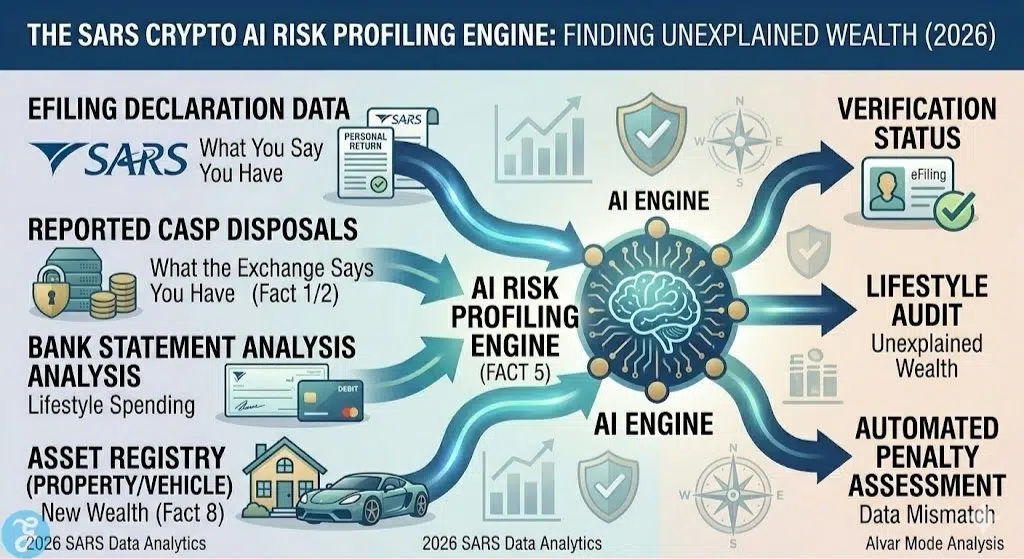
SARS has upgraded its internal systems to process the “structured data” received from third-party providers. Unlike previous years where data was fragmented, the new 2026 system reconciles reported disposals against your personal income tax return automatically. If a discrepancy is found between what an exchange reported and what you declared, the system generates an immediate verification flag.
Best for: identifying taxpayers who omit crypto gains from their annual returns.
Why We Chose It:
-
It replaces manual “guesswork” audits with precise, data-driven risk profiling.
-
The system can process millions of transactions per second to find non-compliant patterns.
Things to consider:
-
A “Verification” status on your eFiling profile is now frequently triggered by these automated matches.
3. International Automatic Exchange of Information (AEOI)
Through the Multilateral Competent Authority Agreement (MCAA), SARS is now part of a global network that will begin exchanging crypto data internationally. While domestic reporting starts now, the first international data swaps are scheduled for September 2027, covering the 2026 tax year. This means that assets held on foreign exchanges are no longer hidden from local authorities.
Best for: capturing offshore crypto holdings and international arbitrage profits.
Why We Chose It:
-
It effectively closes the “offshore loophole” for South African tax residents.
-
It creates a unified global front, making it difficult to find “tax-neutral” zones for crypto.
Things to consider:
-
Historical data from offshore accounts may be visible once the first exchange cycle completes.
4. Mandatory Reporting of Transfers to Unhosted Wallets
Under the new 2026 BRS, service providers must specifically report when a user transfers crypto to an “unhosted” or private cold wallet. While the private wallet’s full contents remain hidden, SARS receives a record of the capital “exit” and the value at the time of transfer, which can be used to track unexplained wealth later.
Best for: tracking the flow of capital from regulated exchanges into private storage.
Why We Chose It:
-
It prevents users from “disappearing” their assets without leaving a paper trail.
-
It helps SARS identify potential points of capital flight or future undeclared disposals.
Things to consider:
-
Transfers to your own private wallet are not usually taxable events, but they must be documented as “self-transfers.”
5. Enhanced Risk Profiling via Machine Learning
SARS is now deploying sophisticated AI models that analyze a taxpayer’s broader financial footprint—including bank inflows, luxury car purchases, and property acquisitions—against their declared crypto income. These models are designed to find “unexplained wealth” that may have been funded by undeclared digital asset gains.
Best for: identifying high-net-worth individuals with large, “invisible” portfolios.
Why We Chose It:
-
It allows SARS to target the most significant cases of evasion with surgical precision.
-
It can identify complex “layering” techniques used to hide the source of funds.
Things to consider:
-
Your lifestyle and spending habits are now a primary data point for crypto tax audits.
6. Integration with FSCA Licensing Data
The Financial Sector Conduct Authority (FSCA) now shares its comprehensive list of licensed CASPs directly with SARS. This ensures that every entity operating legally in South Africa is also fully integrated into the tax reporting ecosystem, leaving no room for “unregulated” local platforms to avoid their data-sharing duties.
Best for: ensuring a 100% compliance rate among local financial service providers.
Why We Chose It:
-
It creates a “closed loop” where business licensing is tied to tax transparency.
-
It protects consumers by ensuring their chosen platforms are operating within the law.
Things to consider:
-
Using a licensed provider is now a guarantee that your data is being shared with the tax office.
7. Retrospective Audits and the VDP Window
With the 2026 implementation of CARF, SARS has signaled that it will use new data to look back at previous tax years. They are strongly encouraging taxpayers to use the Voluntary Disclosure Programme (VDP) to regularize past non-compliance before the automated data begins flowing in full by May 2027.
Best for: investors with significant undeclared gains from the 2021 or 2024 bull runs.
Why We Chose It:
-
It offers a “last chance” for taxpayers to avoid criminal prosecution and heavy penalties.
-
It allows SARS to clear the backlog of historical non-compliance efficiently.
Things to consider:
-
Once an audit has been initiated by SARS, you are no longer eligible for the VDP.
8. Oversight of High-Value Retail Payments
A specific 2026 provision requires providers facilitating crypto payments for goods and services to report any “reportable retail payment transaction” exceeding $50,000 (approximately R930,000). This is designed to capture the use of crypto for high-end luxury purchases, such as real estate or vehicles, which were previously harder to track.
Best for: regulating the use of crypto as a medium of exchange for large assets.
Why We Chose It:
-
It ensures that “spending” crypto is treated with the same tax rigor as “selling” it.
-
It prevents the use of digital assets for large-scale, untracked capital transfers.
Things to consider:
-
For smaller retail purchases, the merchant is still required to treat the transaction as a “barter” for tax purposes.
9. Standardized Definition of “Crypto Assets”
Legislative updates for the 2026 tax year have finalized the move away from the term “cryptocurrency” in favor of “crypto asset.” This broader definition explicitly includes NFTs, stablecoins, and certain utility tokens, ensuring that no digital asset class can claim to be “outside” the current oversight framework.
Best for: providing legal certainty across all types of digital holdings.
Why We Chose It:
-
It removes the ability for taxpayers to argue that a specific token is not “money” and therefore not taxable.
-
It future-proofs the tax code against emerging types of blockchain assets.
Things to consider:
-
If it is a digital representation of value that uses cryptography, it is likely a reportable crypto asset.
10. Third-Party Data Retention Mandates
All RCASPs in South Africa are now legally required to maintain detailed transaction and due diligence records for a minimum of five years. SARS has been granted the authority to request these historical logs at any time, even if a user has closed their account or moved their assets elsewhere.
Best for: ensuring a verifiable audit trail for historical tax assessments.
Why We Chose It:
-
It prevents the “erasure” of transaction history as a method of evasion.
-
It provides a reliable “source of truth” that SARS can use to challenge a taxpayer’s claims.
Things to consider:
-
You should keep your own independent records (CSV exports) to cross-check against exchange data.
11. Future Pre-Population of Crypto Returns
SARS has announced a pilot program for the 2026/2027 tax year to begin pre-populating certain crypto disposal data directly into the personal income tax returns of selected users. Much like bank interest, your reported gains may soon appear automatically on your eFiling screen, requiring only your verification.
Best for: simplifying the compliance process for the average retail investor.
Why We Chose It:
-
It makes it practically impossible to “forget” to declare your crypto activity.
-
It aligns crypto reporting with the user-friendly experience of traditional financial assets.
Things to consider:
-
You remain legally responsible for the accuracy of any pre-populated data on your return.
An Overview Of 11 SARS Crypto Oversight 2026 Outcomes
The arrival of CARF on March 1, 2026, marks the end of the “informal” era of crypto in South Africa. By integrating blockchain activity into the same transparency architecture as traditional banking, SARS has ensured that the digital economy is both visible and taxable. This shift provides the state with much-needed revenue while offering the compliant investor a more stable and predictable regulatory environment in which to grow their wealth.
Overview Of 11 SARS Crypto Oversight 2026: A Comparative Summary
The following comparison illustrates how different types of digital activity are handled under the new 2026 reporting protocols. This high-level view helps identify which activities carry the highest immediate risk of an automated audit.
Activity Tracking and Reporting Summary
The data presented below highlights the varying levels of visibility SARS maintains over different crypto-related behaviors this year.
| Activity Type | Visibility to SARS | Reporting Requirement | Primary Risk Factor |
| Local Exchange Trade | Maximum | Direct CARF API | Automated Discrepancy |
| Offshore Exchange | Moderate | Int. AEOI (2027) | Cross-Border Data Swap |
| Unhosted Transfer | Moderate | RCASP Exit Report | Unexplained Wealth |
| Retail Payment (>$50k) | High | Payment Provider | Transactional Audit |
| Local Barter Sale | Moderate | Merchant Reporting | Lifestyle Matching |
| Self-Custody Hold | Low | N/A (Until Sale) | Historical Tracking |
Our Top 3 Picks and Why?
-
CARF Implementation: This is our top pick because it is the “master key” that unlocks all other forms of oversight. Without mandatory reporting from the exchanges, the rest of the system would still rely on voluntary honesty.
-
AI Risk Profiling: We chose this because it is the most effective tool for finding hidden wealth. By looking at what a person spends rather than just what they declare, SARS can identify high-value evasion with almost 100% accuracy.
-
The VDP Window: This is a vital pick because it represents the only “safe” way out for those who have been non-compliant in the past. It offers a strategic path to legal safety before the automated systems go fully live in 2027.
How to Choose the Right SARS Crypto Oversight 2026 Strategy by Yourself?
Navigating this high-oversight era requires a shift in mindset from “hiding” to “optimizing.” The goal in 2026 is to ensure that your records are so clean that an automated SARS flag can be resolved in minutes.
The Selection Framework
-
Audit Your History: Use 2026 to reconcile every trade you have ever made. If there are major gaps, consider the VDP now.
-
Select Compliant Platforms: Use local, licensed providers for your primary trading. While they report more data, they also provide the high-quality tax certificates needed to defend your return.
-
Document “Self-Transfers”: If you move assets to cold storage, keep a timestamped record or a screenshot of the transaction. You must be able to prove that the “exit” from the exchange was not a sale.
-
Monitor Your “Intent”: SARS taxes you based on why you bought the asset. If you trade frequently, you are a “trader” (income tax). If you hold for years, you are an “investor” (CGT). Ensure your behavior matches your tax declaration.
Use the decision matrix below to find the best compliance path for your specific situation in 2026.
Decision Matrix
This matrix compares different types of crypto users with the most logical compliance action for the current tax year.
| If your profile is… | Choose X if… | Choose Y if… |
| The Long-Term HODLer | Keep original buy records to minimize future CGT. | Declare as Capital only after holding for 3+ years. |
| The Active Trader | Use automated tax software to track every swap. | Declare as Gross Income to avoid audit penalties. |
| The Offshore Investor | Prepare for 2027 swaps by regularizing in 2026. | Use the VDP if previous gains were never declared. |
| The Crypto Spender | Keep all retail receipts for large purchases. | Factor in the $50k trigger for high-value items. |
The Final Checklist: 5-Point SARS Readiness Plan
-
Download and verify your 2025/2026 tax certificates (IT3s) from your local exchange.
-
Consolidate all historical CSV transaction logs from every platform you have used.
-
Check your eFiling “Verification” status regularly for any automated flags.
-
Consult with a specialized crypto tax practitioner if your portfolio exceeds R1 million.
-
Ensure your declared income is sufficient to justify your current lifestyle and luxury assets.
Securing Your Digital Legacy Through Compliance
The new SARS Crypto Oversight 2026 protocols represent the coming of age for digital assets in South Africa. While the increased surveillance may feel like a burden, it provides a clear, legal framework that allows you to build and spend your wealth without the constant threat of a surprise audit. In this new era of transparency, the most successful investors will be those who treat their crypto portfolios with the same professional rigor as a traditional share portfolio. By staying ahead of the automated reporting curve, you ensure that your digital legacy remains secure, compliant, and growing for years to come.