What Is Forex Trading?
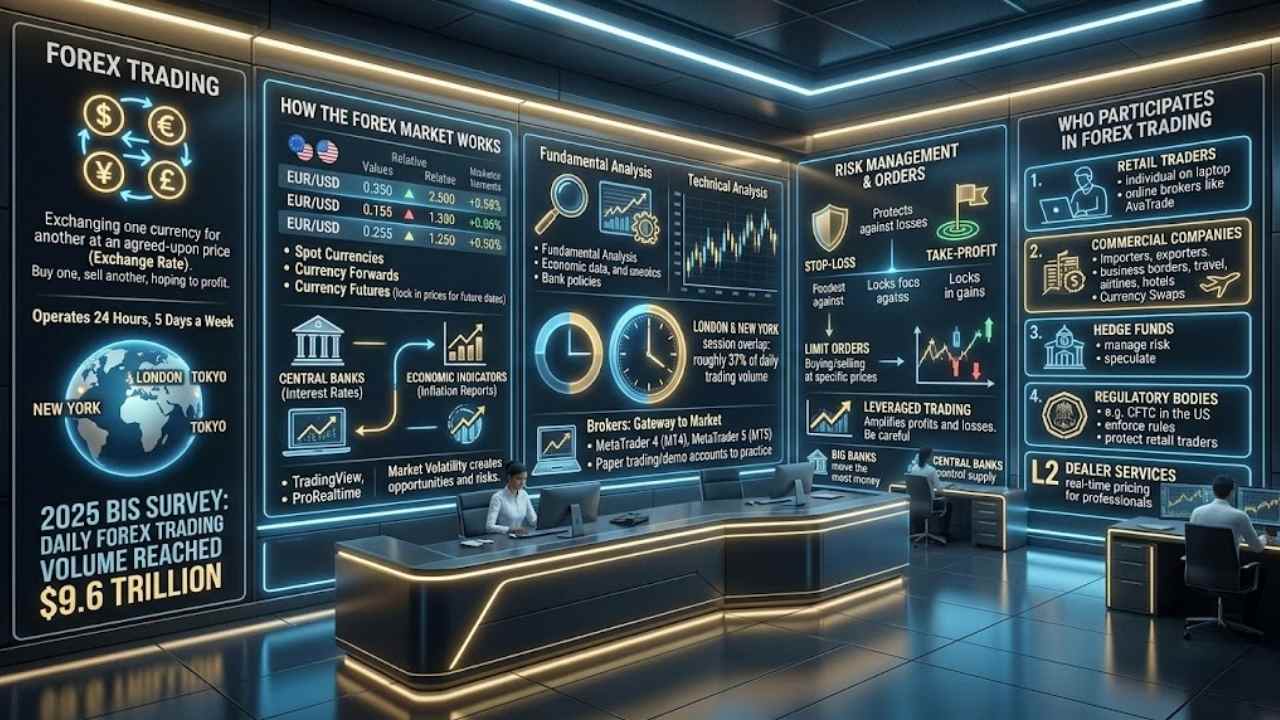
Forex trading is the process of exchanging one currency for another at an agreed-upon price. Traders call this the exchange rate. You buy one currency while selling another, hoping to profit from price changes.
The foreign exchange market operates 24 hours a day, five days a week. It moves across major financial hubs like New York, London, and Tokyo. Banks, companies, and individual traders all participate to make money or protect their investments.
The sheer size of this market might surprise you. A 2025 survey from the Bank for International Settlements revealed that daily forex trading volume reached a massive $9.6 trillion.
In forex trading, you are trading the economic health of entire nations.
The market moves fast. Prices shift constantly based on economic news and global events. Data analytics show that roughly 37% of daily trading volume happens during the London and New York session overlap.
This is the perfect window to spot market opportunities. A broker serves as your gateway to the foreign exchange market. They provide platforms like MetaTrader 4 or MetaTrader 5 where you execute trades.
Paper trading, or demo accounts, allows you to practice without risking real cash before moving to live trading. The key difference between forex and other financial markets is its incredible size, speed, and accessibility for beginners.
Understanding the Forex Market
The forex market runs twenty-four hours a day across the globe. It lets traders buy and sell currencies whenever they want.
How the Forex Market Works
Forex trading requires exchanging one currency for another at a specific exchange rate. Central banks, large financial institutions, corporations, and individual traders all participate in this massive market.
Spot currencies trade at current rates. Currency forwards and currency futures allow traders to lock in prices for future dates.
Interest rates set by central banks influence currency values heavily. Economic indicators like inflation reports shape market movements constantly. Traders use platforms like TradingView and ProRealtime to monitor price changes and execute trades.
Each currency pair, such as EUR/USD, represents the value of one currency against another. Market volatility creates both opportunities and risks for those who trade.
Successful traders analyze the market using two main approaches. Fundamental analysis examines economic indicators and central bank policies to predict currency movements. Technical analysis studies price charts to identify trading patterns.
Stop-loss orders automatically close trades at predetermined prices if the market moves against you. Take-profit orders lock in gains when prices reach your target levels.
Limit orders let traders buy or sell at specific prices they choose. Leveraged trading amplifies both profits and losses, so beginners must approach it carefully.
Who Participates in Forex Trading
Big banks move the most money in forex trading. These giant financial institutions move trillions of dollars across the globe daily. Central banks jump in too, controlling their country’s money supply and exchange rates.
Here are the main participants moving the market:
- Retail Traders: Individual traders use platforms provided by brokers like AvaTrade and other online forex brokers.
- Commercial Companies: Importers and exporters need forex to conduct business across borders. Travel companies, airlines, and hotels use currency swaps daily.
- Hedge Funds: These firms participate to manage risk and speculate on currency movements.
- Regulatory Bodies: In the US, the Commodity Futures Trading Commission (CFTC) oversees the market and enforces rules to protect retail traders.
Your broker connects you to this whole ecosystem. L2 dealer services provide real-time pricing data to professional traders. Small traders can compete in this arena by learning the right strategies and staying disciplined.
Benefits and Risks of Forex Trading
Forex trading gives you access to a massive market where you can make money around the clock. This same opportunity comes with real dangers that can drain your account fast. Smart traders learn to balance the rewards against the threats before they risk their cash.
Advantages of Forex Trading
Trading currencies opens doors that many other markets keep locked. You can start your journey with a beginner’s step-by-step guide and learn at your own pace.
- You access the market twenty-four hours a day, five days a week, so you trade whenever it suits your schedule.
- Trading costs stay low compared to stock markets because brokers make money through spreads rather than commissions.
- Leverage lets you control large amounts of currency with a small deposit. In the US, the CFTC limits retail forex leverage to 50:1 for major currency pairs. This multiplies your potential gains.
- The US pattern day trader rule restricts stock traders with small accounts, but this rule does not apply to forex trading. You can trade as often as you like.
- Currency pairs move constantly, creating fresh opportunities every single day. You can profit whether prices climb up or fall down.
- Liquidity runs deep in this market, meaning you buy and sell instantly without struggling to find a partner.
- Starting small works perfectly fine here, unlike real estate or stock trading. Many platforms let you begin with just a few hundred dollars.
- You learn through demo accounts that use pretend money, so mistakes cost you nothing. Practice your strategies risk-free.
Common Risks to Consider
Forex trading demands respect. Understanding the risks will keep you from losing your shirt.
- Currency prices swing wildly. Sudden market moves can wipe out your account fast. Exchange rates shift based on global events and economic data.
- Leverage acts like a double-edged sword. While US regulations cap major pair leverage at 50:1, minor pairs are capped at a stricter 20:1 to protect traders from wild swings. Losses still multiply quickly.
- Volatility creates unpredictable price swings that catch traders off guard. Market conditions change rapidly during major economic announcements.
- Your stop-loss order might not execute at the price you expected during fast-moving markets. Gaps in pricing can leave you stuck with losses larger than planned.
- Counterparty risk means your broker could fail or go bankrupt. Choose a broker regulated by major authorities like the National Futures Association (NFA) to reduce this danger.
- Emotional trading destroys accounts more than any market condition. Fear and greed push traders to make poor decisions. Successful traders stick to their plans.
- Lack of knowledge leads many beginners straight into losses. You need to master fundamental analysis and technical analysis. Educational resources from IG Academy and similar platforms help you build this foundation.
Getting Started with Forex Trading
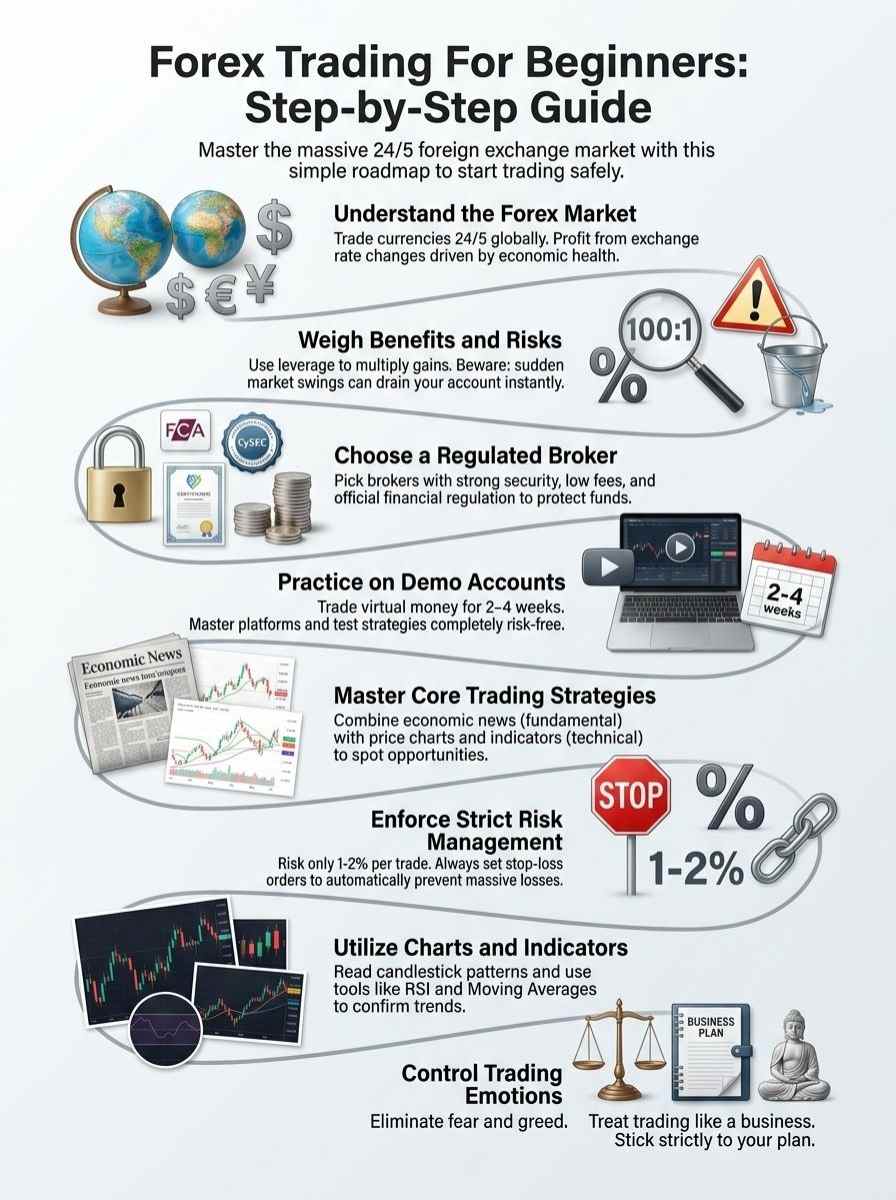
You need to pick a solid broker and open a real trading account to start your forex journey. First, practice on a demo account so you can learn the ropes safely.
Choosing a Reliable Broker
Your broker is the gatekeeper to forex trading. Picking the right one matters more than you might think. A solid broker offers strong security, low fees, and fast customer support.
If you live in the United States, you must choose a broker regulated by the CFTC and registered as a member of the NFA. This protects your money and ensures fair trading practices. Checking the NFA’s online database is the easiest way to verify a broker’s credentials.
Read reviews from other traders, compare their spreads, and test their trading platform. The best brokers give you access to educational materials, trading tools, and a demo account. Some brokers work great for day traders, while others suit long-term investors better.
Ask yourself what tools matter most to you. You might want advanced charts, mobile apps, or low minimum deposits. Many brokers offer a downloadable pdf with their fees and features listed out clearly.
Opening a Trading Account
Opening a trading account marks your entry into the forex market. This step requires focus and careful attention to detail.
- Fill out the broker’s application form with accurate personal information.
- Provide proof of identity by submitting a government-issued ID or passport.
- Submit proof of address using a recent utility bill or bank statement.
- Complete the financial questionnaire that asks about your income and investment experience.
- Choose your account type based on your trading capital.
- Set your base currency, which determines the denomination of your account balance.
- Agree to the broker’s terms and conditions after reading them thoroughly.
- Fund your account by transferring money through a bank wire or electronic payment method.
- Activate your live trading account once the broker confirms your documentation.
- Download the trading platform software or access the web-based version.
Practicing on a Demo Account
A demo account lets you trade without risking real money. You can learn forex trading essentials and test strategies in a safe space.
- Sign up for a demo account with your broker right away.
- Access the same trading tools and charts that real traders use.
- Practice identifying major currency pairs.
- Test your fundamental analysis skills by researching economic news.
- Apply technical analysis methods using indicators and price charts.
- Start with small virtual trades to build your confidence.
- Experiment with different risk management strategies, such as setting stop losses.
- Track your trades in a journal, writing down why you entered each position.
- Spend at least two to four weeks on your demo account before moving to real money.
- Simulate real market conditions by trading during actual forex market hours.
Essential Forex Trading Strategies
You need smart strategies to make money in forex. I will show you three powerful approaches that separate winners from losers.
Fundamental Analysis
Fundamental analysis looks at the big picture of why currencies move. This approach studies economic data, interest rates, inflation, and government policies. Traders who use this method read news reports, check employment numbers, and track GDP growth.
A strong economy usually makes its currency go up in value. Weak economic data often pushes a currency down. Central banks, like the Federal Reserve, control the money supply and interest rates. When a bank raises rates, investors want more of that currency.
One of the most powerful reports in the US is the Non-Farm Payrolls (NFP) report. The Bureau of Labor Statistics releases this data on the first Friday of every month. It shows the total number of paid US workers, excluding farm employees.
Forex traders watch the NFP report closely because strong job growth usually boosts the US Dollar. If the report misses expectations, the Dollar often drops fast. Traders who master fundamental analysis spot these opportunities before other people do.
Technical Analysis
Technical analysis means studying past price movements and market patterns. You look at charts and graphs to spot trends. Candlestick patterns, moving averages, and oscillators help you read the market.
These tools show where prices went before, so you can guess where they might go next. Traders use this method to find the right market opportunities. Price action tells a story, and technical tools translate that story into trading signals.
The forex trading platforms include these analysis tools as standard features. Indicators act like a trader’s compass on the forex trading setup. The Relative Strength Index measures momentum. Bollinger Bands show volatility levels.
Support and resistance lines mark price zones where currency pairs often bounce back. Learning to read these tools takes practice, but demo accounts let you test them safely. Charts display price data in different timeframes. Five-minute charts show quick moves, while daily charts reveal bigger trends.
Risk Management Strategies
Risk management keeps your money safe in forex trading. You protect your account by following smart rules and limits.
- Set a stop-loss order on every trade you make. This automatically closes your position when prices drop to a certain level.
- Calculate your position size before you enter any trade. Never risk more than one to two percent of your total account on a single trade. For example, if you have a $1,000 account, limit your risk to $10 per trade.
- Use take-profit orders to lock in gains when prices reach your target level. Walk away with money instead of hoping for bigger profits.
- Diversify across multiple currency pairs rather than putting all your eggs in one basket. Spreading your trades across different markets reduces the damage from one bad trade.
- Establish a daily loss limit that tells you when to stop trading for the day. This protects your account from emotional decisions during losing streaks.
- Apply the risk-to-reward ratio method. Only take trades where you can make at least twice what you risk.
- Keep a trading journal that documents every trade you make. Track your entry points, exit points, and reasons for each decision.
- Monitor economic calendars for major news events that shake currency markets. Reduce your position sizes before big announcements hit the wires.
Key Forex Trading Tools and Terminology
You need to learn the language of forex to trade like a pro. Charts, indicators, and currency pairs form the foundation of every trade you make.
Charts and Indicators
Charts reveal market movements. They show you exactly what currencies are doing right now. Indicators add another layer, helping you spot patterns before they become obvious.
| Chart Type | What It Shows | Best For |
|---|---|---|
| Candlestick Charts | Opening, closing, high, and low prices. Green candles show price increases. Red candles show price drops. | Spotting reversals and momentum shifts quickly. Most traders prefer these over other chart types. |
| Line Charts | Simple dots connected by lines showing closing prices only. | Getting a clear view of overall trends without getting lost in details. |
| Moving Averages | A line that smooths out price data by averaging prices over a set number of days. | Identifying trends and confirming whether an uptrend or downtrend is real. |
| Relative Strength Index (RSI) | Measures how fast prices are changing. Ranges from 0 to 100. | Finding potential entry and exit points. Readings above 70 suggest overbought conditions. |
| Bollinger Bands | Three lines that form a channel around price. The outer bands show volatility. | Spotting overbought and oversold conditions. Prices that touch the bands often bounce back. |
| MACD | Two lines that show momentum. Crossovers signal potential trades. | Confirming trend direction and spotting momentum shifts early. |
Your trading platform displays charts in multiple timeframes, from one-minute charts to monthly charts. Short timeframes show quick price movements. Long timeframes reveal bigger trends.
Indicators work best when you combine several together. One indicator alone can fool you. Two or three indicators supporting each other give you confidence.
Understanding Currency Pairs
Currency pairs form the backbone of forex trading. You trade one currency against another, like EUR/USD or GBP/JPY. The first currency in the pair is the base currency. The second currency is the quote currency.
The base currency always equals one unit. The quote currency shows how much you need to spend to buy that one unit. For example, if EUR/USD trades at 1.10, you need 1.10 US dollars to buy one euro.
Major pairs involve the US dollar paired with other strong currencies. A 2025 Bank for International Settlements report showed that the EUR/USD pair takes the top spot, accounting for 21.2% of all daily forex trades.
Minor pairs exclude the US dollar entirely. They pair two major currencies together, like EUR/GBP or AUD/NZD. Exotic pairs combine a major currency with a currency from an emerging market. These pairs move unpredictably and carry higher costs.
Bid prices show what buyers will pay for a currency pair. Ask prices show what sellers demand for that same pair. The difference between bid and ask is the spread. Spreads represent your trading cost. Tighter spreads mean lower costs for you. Pips measure price movements in currency pairs. One pip equals 0.0001 for most pairs.
Lots determine your position size. A standard lot equals 100,000 units of the base currency. Micro lots equal 1,000 units. Smaller lots help beginners control risk better. Learning these terms takes practice, but it becomes second nature quickly.
Tips for Successful Forex Trading
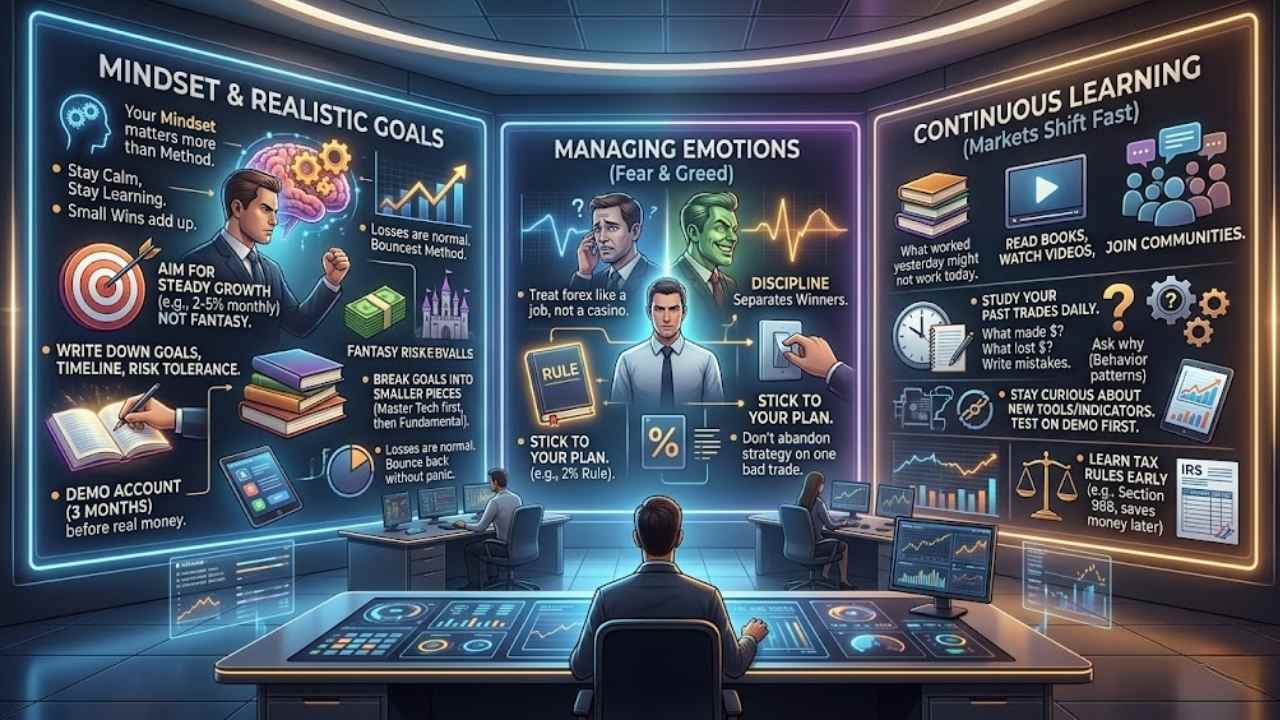
Your mindset matters more than your method in forex trading. Small wins add up fast when you stay calm, keep learning, and stick to your plan.
Setting Realistic Goals
Most traders fail because they chase big profits too fast. Set goals you can actually hit, not dreams that belong in a fantasy novel. Aim to make 2 to 5 percent profit each month instead of doubling your money overnight.
Small, steady wins add up over time, and they keep you in the game. Your broker’s trading platform gives you all the tools to track your progress. Write down what you want to achieve, the timeline you need, and how much risk you can handle. This simple act keeps you honest and focused.
Goals need teeth, so break them into smaller pieces. You might want to master technical analysis first, then move to fundamental analysis later. Start with a demo account for three months before risking real money.
Trading for real cash demands a structured approach. That is where realistic targets shine. Traders who know exactly what they are aiming for make better choices when the market gets wild. You will face losses, and that is normal. Having clear goals helps you bounce back without panic.
Managing Emotions
Forex trading will test your nerves like nothing else. Your account grows one day, then shrinks the next. Fear and greed become your worst enemies in the trading game.
A trader who panics at small losses often makes terrible decisions. The best traders treat forex trading like a job, not a casino.
Successful traders control their feelings instead of letting feelings control their trades. Your emotions can destroy a solid trading plan faster than any market crash. They stick to their rules, even when their gut screams otherwise.
Charts and indicators show what the market does, but only you control how you react. Discipline separates winners from losers in forex trading. Set your goals before you start trading, then follow them no matter what happens.
If you planned to risk only 2% of your account on one trade, stick to that rule. Do not change your mind because you feel lucky today. Do not abandon your strategy because one trade went bad. Your emotions will always show up during live trading. The question is whether you will manage them or let them manage you.
Continuous Learning
Trading currency pairs demands that you keep learning. Markets shift fast. What worked last month might not work this month.
Read books about technical analysis and fundamental analysis. Watch videos from successful traders. Join online communities where traders share ideas. The Internal Revenue Service (IRS) taxes forex trades differently depending on how you classify them, often falling under Section 988 in the US. Learning these tax rules early saves you money later.
Study your past trades every single day. Look at what made money and what lost money. Write down your mistakes. Ask yourself why you made each choice. This habit builds your trading skills over time.
You will spot patterns in your own behavior. You will understand your emotions better. Many beginners skip this step, but it is the fastest way to improve. Stay curious about new tools and indicators. Test them on a demo account first. Your growth as a trader never stops.
Final Thoughts
You have learned what forex trading is and how currency markets work. You know why brokers matter for your success. You now understand the real advantages and risks that come with trading currencies. You discovered practical strategies like fundamental analysis and technical analysis to guide your decisions.
Risk management tools, charts, and indicators give you the power to spot opportunities and protect your money. Start small with a demo account. Set realistic goals, and keep learning.
The market rewards those who stay curious and disciplined. Your journey into forex trading starts today. Every successful trader you admire started exactly where you are right now.