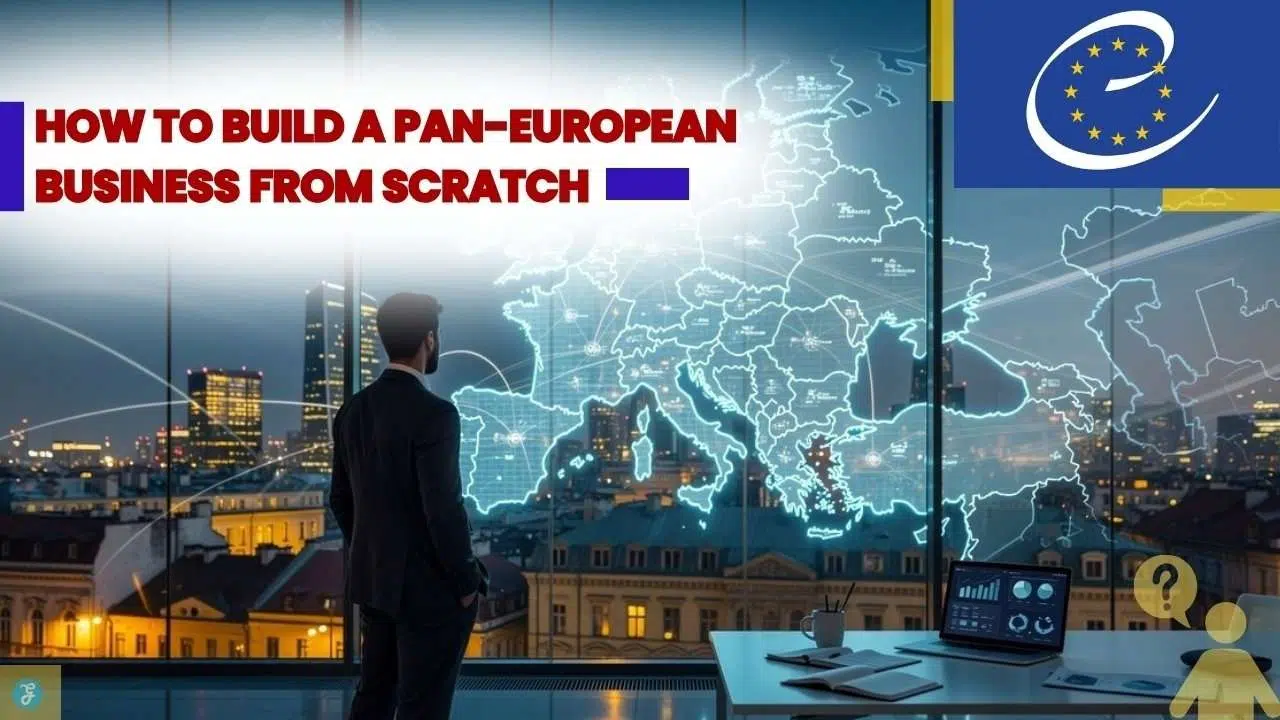
Have you ever wondered how to build a Pan-European business from scratch? You might have hit a wall trying to expand beyond your borders. Shipping costs drain your profits, and rules change from country to country. Finding the right partners can feel impossible. Many entrepreneurs face this exact problem, and it stops them from growing. Here is the good news: the European market holds a massive opportunity. Over 450 million people live across the European Union alone.
They spend money on products and services every single day. A Pan-European business lets you tap into this huge customer base without starting from zero in each country. You can build one strong operation that serves multiple nations at once.
I will walk you through the exact steps I use, and I think you will be surprised at how simple it can be. So grab a cup of coffee, and let’s go through it together. I will show you everything you need to know.
Understanding How To Build A Pan-European Business From Scratch
Operating across multiple European countries opens doors to massive markets and diverse customer bases. You gain access to millions of potential customers and build a business that thrives on a continental scale.
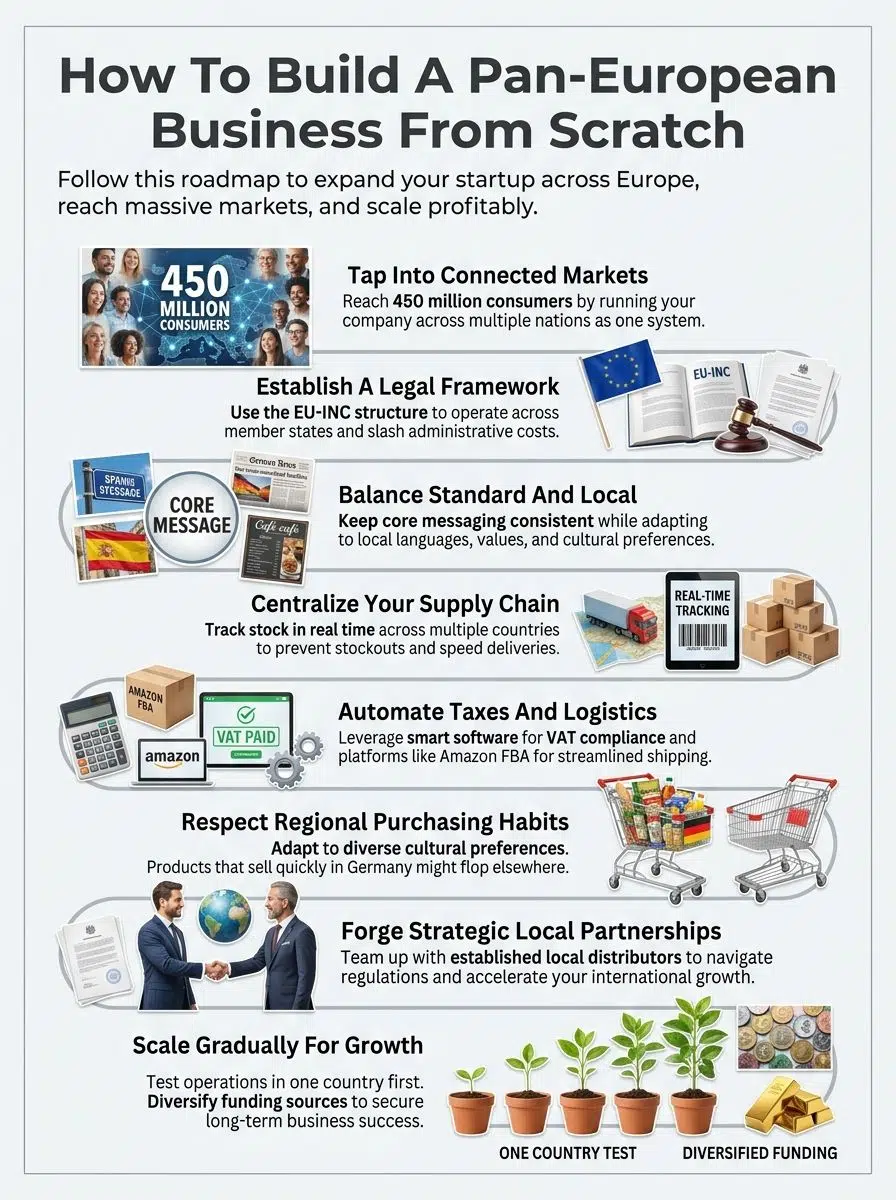
What does it mean to operate Pan-European?
Operating a pan-European business means you run your company across multiple European countries as one connected operation. You sell your products or services in France, Germany, Spain, Italy, Poland, and beyond, all from a single business structure.
Your customers live in different nations and speak different languages. Yet you manage them all through one coordinated system. This approach lets you reach far more people than staying in just one country.
Recent data from Euromonitor International shows that European e-commerce penetration is projected to hit 20% of all retail sales by 2026. This means more people are buying online than ever before.
A pan-European business treats the entire European market as its playground. You standardize supply chains and technology systems to save money and time. You then adapt your marketing messages to fit what local customers actually want.
Key advantages of a Pan-European approach
A Pan-European approach opens doors to a massive market reach that single-country businesses can only dream about. You tap into over 450 million consumers across the European Union, making your revenue potential skyrocket.
A 2024 European E-commerce Report showed that cross-border online sales within Europe reached a staggering €326 billion. That represents a 39% increase from the previous year, showing massive consumer demand.
Entrepreneurs who spread their operations across multiple European nations reduce their dependence on any single market. If one country faces an economic slowdown, your other markets keep the cash flowing. This diversification acts like a safety net.
Cost efficiency becomes your secret weapon in a Pan-European business model. You consolidate your operations across borders, which cuts expenses dramatically.
- Centralized Warehousing: You store goods in one location to serve five countries.
- Bulk Purchasing: Larger-scale operations attract better deals from suppliers.
- Unified Tech Stack: You pay for one software system instead of five different regional tools.
- Broader Funding: Investors see growth potential across an entire continent rather than one country.
Setting Up the Legal Framework
You need to set up the right legal structure to operate across Europe without running into trouble. Getting this part right from the start saves you money and keeps your business on solid ground as you grow.
Overview of EU-INC and its potential
The EU-INC concept gives entrepreneurs a single legal structure to operate across all European Union member states. This structure cuts through red tape and lets business owners skip the hassle of registering separate companies in each country.
Estonia’s e-Residency program serves as a perfect real-world example of this digital-first approach. It provides a secure digital identity that allows US founders and global entrepreneurs to set up and run an EU company completely online.
As of 2025, the costs are incredibly startup-friendly. You pay a state fee of €265 plus a €150 application fee to get started. In total, you spend about €415 to access the entire European market legally.
Estonia also offers a highly efficient tax system. The country taxes corporate profits only when you distribute them, using a 22/78 rate for distributed profits starting in 2025. Retained and reinvested profits remain untaxed, allowing you to fuel your company’s growth faster.
Working through rules and legal requirements
Operating across Europe requires you to master multiple legal frameworks. Each country maintains its own tax rules, labor laws, and business registration requirements.
You must register your company in the appropriate jurisdiction, obtain necessary licenses, and comply with local regulations. VAT compliance alone demands careful attention.
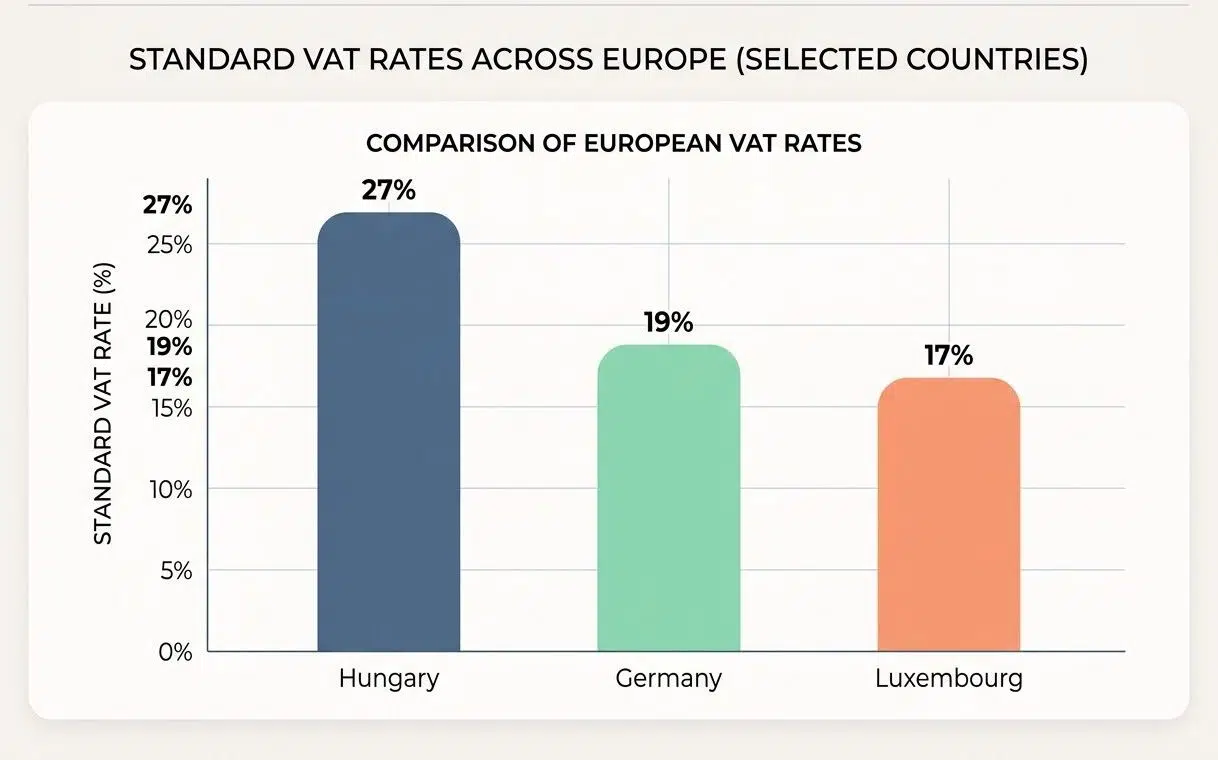
Rates vary significantly across member states:
| Country | Standard VAT Rate |
|---|---|
| Hungary | 27% |
| Germany | 19% |
| Luxembourg | 17% |
These differences affect your pricing strategy and profit margins. Hiring local compliance officers saves you from costly mistakes.
Data protection laws present another major hurdle. The General Data Protection Regulation (GDPR) imposes strict rules on how you collect and store customer information. Serious violations can result in fines reaching €20 million or 4% of global revenue.
Designing a Pan-European Business Strategy
You need a solid game plan that speaks to customers across different countries while keeping your core message intact. Your strategy must balance what works everywhere with what works in each specific market.
Identifying target markets and customer segments
Finding the right customers makes or breaks your pan-European business. Your market research shapes every decision you make moving forward.
A 2024 study by the International Trade Administration highlights massive differences in e-commerce adoption across the continent. You must prioritize your rollout based on these numbers rather than guessing.
- High Adoption: The United Kingdom boasts a massive 97% e-commerce penetration rate, making it a highly receptive but competitive market.
- Moderate Adoption: Germany sits around 70%, offering a large population with strong purchasing power.
- Growing Markets: Italy trails at around 45%, presenting an opportunity for early entry before the market fully matures.
Examine cultural preferences and consumer behaviors in your target areas. What sells in Germany might flop in Italy. Segment your audience by lifestyle and values rather than just basic demographics. Connect with local business networks to gain insider knowledge about customer expectations.
Developing a unified marketing approach
Now that you know who your customers are across Europe, you need to craft marketing messages that speak to all of them. A unified marketing approach means you create one core brand message, but you adapt how you deliver it in each country.
A 2024 Mollie report surveying 10,000 European consumers found that 48% prefer shopping online over physical stores. However, these shoppers are increasingly price-conscious and demand clear, local messaging.
Your core values stay the same everywhere. The way you talk about your product changes based on local culture and language. This strategy saves you money because you do not build separate campaigns from scratch in each market.
A company selling fitness equipment might emphasize health benefits in Germany but focus on lifestyle and community in Spain. Both campaigns use the same brand colors and logo. Both tell the same core story about quality.
Balancing standardization and local adaptation
Your pan-European business needs to walk a tightrope between doing things the same way everywhere and changing things for local markets. Standardization cuts your costs down and makes your operations run like a well-oiled machine.
Local adaptation respects what customers actually want in each market. Language is the most critical factor here. A 2024 study by CSA Research showed that 76% of online shoppers prefer to buy products with information in their native language.
Use high-quality localization tools like DeepL Pro to translate your product descriptions and marketing copy. DeepL captures local nuances and idioms far better than standard automated translation plugins.
Start by identifying which parts of your business model stay the same everywhere and which parts need to bend. Your core product might stay identical, but your marketing message should speak to local values. Small tweaks to packaging or messaging show customers that you respect their culture.
Building an Efficient Pan-European Supply Chain
Getting your products from warehouses to customers across multiple countries requires smart planning and real coordination. You will face shipping delays and inventory headaches, but solving these problems opens up massive growth opportunities.
Logistics and distribution across multiple countries
Moving products across Europe requires smart planning and real execution. Your supply chain can determine the success of your international expansion. You need warehouses in key locations, reliable shipping partners, and clear tracking systems.
Using a Third-Party Logistics (3PL) provider is the smartest move for an expanding company. Modern European 3PL providers like ShipBob and Byrd manage the continent’s network of countries, languages, and customs requirements for you.
ShipBob operates an AI Decision Engine that analyzes your historical sales data. It then automatically recommends exactly how much inventory you should place in their UK, Netherlands, or Polish fulfillment centers. This prevents stockouts and reduces split shipments.
Managing inventory with centralized tools
Inventory management can make or break your pan-European business. Centralized tools give you real-time visibility across all your European warehouses, letting you control stock levels easily.
A major insider tip from Reddit’s r/FulfillmentByAmazon community is to always hold an extra 20% of buffer stock in your central European hub during the Q4 holiday season. Regional carrier delays in November and December are notoriously unpredictable.
- Real-time tracking systems show you exactly where your products sit at any given moment.
- Automated reordering features kick in when inventory drops below set thresholds.
- Centralized dashboards display inventory levels from all your locations on a single screen.
- Compliance tracking built into centralized tools helps you manage VAT requirements across different countries.
Cost allocation systems break down storage fees, shipping expenses, and handling costs by location. This gives you clear numbers for your business calculations.
Leveraging Technology for Growth
Technology transforms how you handle taxes and money across borders. Smart software and sales platforms let you reach millions of European customers without breaking a sweat.
Tools for VAT compliance and tax management
Managing taxes across multiple European countries can feel like juggling flaming torches. Smart business owners use software tools to handle VAT compliance and tax obligations without feeling overwhelmed.
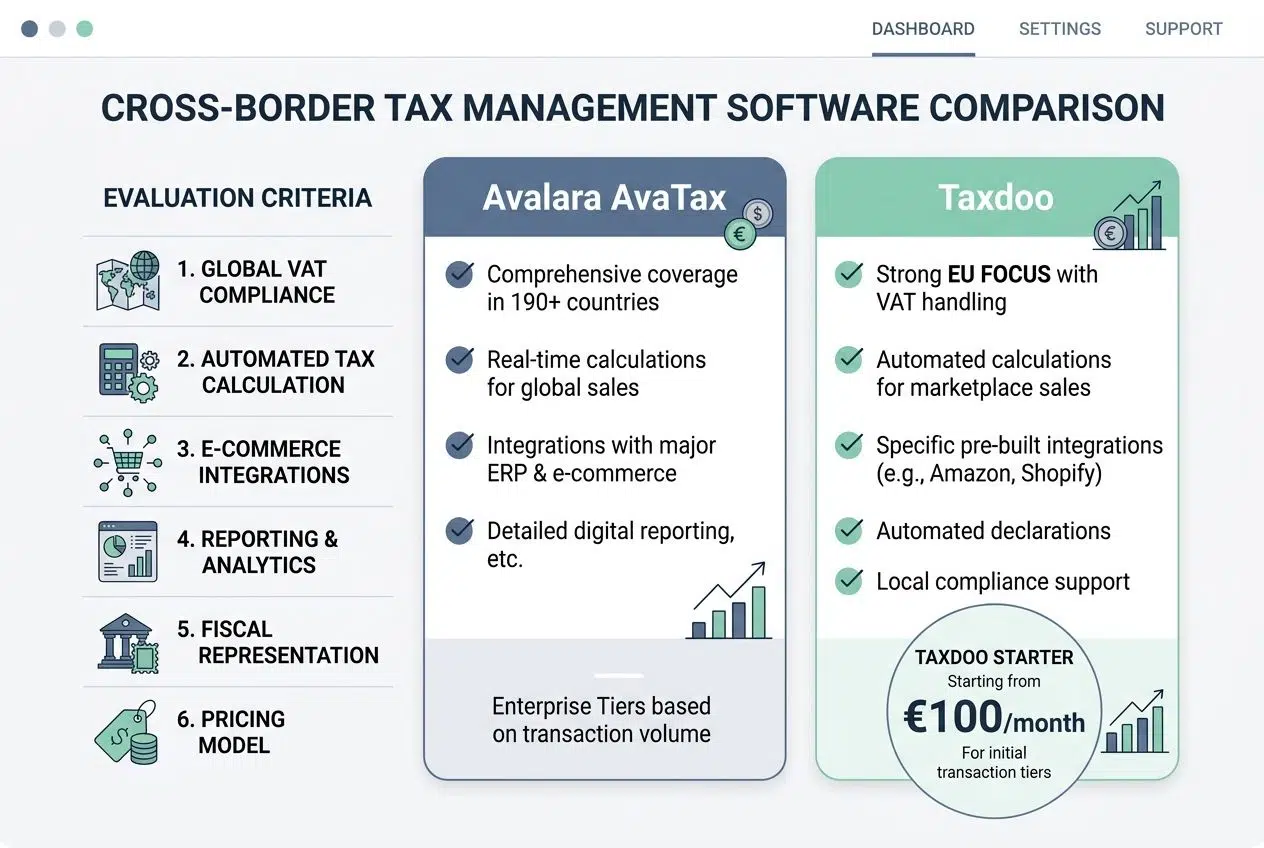
Two popular options lead the market for cross-border tax management:
| Software Tool | Key Benefit | Best For |
|---|---|---|
| Avalara AvaTax | Calculates VAT across all EU member states automatically. | Enterprise companies need deep platform integrations. |
| Taxdoo | Automates EU VAT filings starting around €100/month. | E-commerce startups are seeking an affordable, automated solution. |
Xero accounting software integrates with your e-commerce platform and tracks transactions in real time. QuickBooks Online connects to your bank accounts and payment processors, categorizing expenses automatically.
E-commerce platforms like Amazon Pan-European FBA
Amazon Pan-European FBA opens doors for entrepreneurs who want to sell across multiple European countries without the headache of managing separate warehouses. You store your products in Amazon’s fulfillment centers, and the company handles shipping, returns, and customer service.
This approach cuts your operational costs significantly, since you avoid renting space in each country. Your customers in Germany, France, Spain, and beyond can order your items with fast Prime delivery times.
The platform handles cross-border logistics automatically. Scaling your business becomes easier when you tap into Amazon’s infrastructure. You gain access to millions of shoppers through a single seller account.
Tax compliance and VAT management have become less complicated since Amazon provides tools to track these requirements. This setup lets you test new markets quickly and measure what works. You can expand your international efforts without massive upfront investments.
Overcoming Challenges in Pan-European Business
Running a business across Europe throws real obstacles your way. You will bump into different languages, varying customer tastes, and tricky rules that shift from country to country.
Cultural differences and consumer preferences
Europeans shop differently across regions, and this reality shapes your entire business strategy. You cannot simply copy a marketing campaign from London to Madrid and expect the same results.
Here is how specific regional preferences break down:
- Germany: Customers value precision, fast shipping, and high quality above all else.
- Italy: Buyers prioritize design, strong aesthetics, and brand storytelling.
- Spain: Consumers often prefer personal relationships and highly responsive customer service.
- Nordic Countries: Shoppers embrace digital-first experiences and demand eco-friendly packaging.
Food preferences vary dramatically; what sells in France might flop in Poland. Consumer preferences also shift based on income levels and historical shopping habits.
Eastern European markets respond well to value pricing and practical benefits rather than premium positioning. Test your assumptions early, gather feedback constantly, and adapt your approach accordingly.
Handling cross-border operational details
Cross-border operations demand careful attention to multiple regulatory systems, tax codes, and shipping rules. Each European country enforces different labor laws, product standards, and customs procedures.
New EU regulations proposed in 2025 make local operations even more vital. The European Commission is moving to apply stricter customs checks and handling fees on low-value parcels shipped directly from outside the EU. Setting up a local fulfillment center inside Europe protects you from these new border delays and fees.
Your team must track VAT rates that shift from nation to nation. Shipping delays happen at borders, paperwork piles up fast, and mistakes cost real money.
You need systems that monitor compliance in real time across all markets. Software tools help you manage inventory, track shipments, and calculate taxes automatically. Building redundancy into your supply chain prevents total collapse when one route fails.
Scaling Your Business Across Europe
You will hit growth walls fast if you do not plan your expansion carefully. Smart partnerships and strong alliances turn your European dream into a highly profitable operation.
Strategies for sustainable expansion
Growing your pan-European business takes smart planning and steady steps. Sustainable expansion means you build something that lasts, not just something that grows fast.
You should aggressively seek out regional grants to fund your growth. For example, the Horizon Europe program allocated over €650 million in 2025 specifically for cascade funding. They distribute grants typically ranging from €50,000 to €200,000 to startups and small companies launching innovative solutions.
Here are the core steps for scaling safely:
- Start with market research across different regions to spot where your products fit best.
- Invest in local teams who understand their own markets better than any outsider ever could.
- Scale your supply chain gradually instead of all at once.
- Keep your funding sources diverse so you do not depend on just one investor or bank.
- Use technology to manage operations across borders without losing control.
- Measure your progress with clear metrics in each market.
Importance of partnerships and alliances
Partnerships and alliances form the backbone of successful pan-European business development. You cannot build a continental operation alone, and trying to do so wastes time and money.
Strategic partners give you access to local markets, supply chains, and customer networks that took them years to build. A tech startup in Berlin might team up with a logistics company in Poland to reach Eastern European customers faster.
Another business could partner with established retailers across Spain, France, and Italy. This lets you skip the slow process of building retail relationships from zero.
These collaborations cut your startup timeline in half and reduce your financial risk significantly. Alliances with local distributors help you understand what customers actually want in each market. A fashion brand selling in Scandinavia needs different partners than one selling in Southern Europe.
Benefits of a Pan-European Business Model
A Pan-European business model opens doors to millions of customers across different countries. You tap into fresh markets, boost your sales, and build a brand that stretches from Portugal to Poland.

Expand Customer Reach
Operating across multiple European countries opens doors to millions of new customers you simply cannot reach from a single market. Your business taps into different consumer bases, each with its own spending habits and needs.
A retailer selling fitness equipment in Germany gains access to health-conscious buyers in France, Spain, and Poland simultaneously. You multiply your potential revenue streams without starting from zero in each location.
Your customer base grows exponentially when you spread operations across Europe’s diverse economies. The European market contains over 450 million people, and your products reach them through coordinated distribution.
You build brand recognition across borders, making your company a household name rather than a regional player. This expanded reach transforms how customers perceive your business, positioning you as a serious competitor in your industry. Your business scales faster because you capture market share across multiple regions simultaneously.
Enhance Revenue Opportunities
A pan-European business model opens doors to multiple revenue streams across diverse markets. You tap into 27 EU member states, each with millions of potential customers hungry for products and services.
The financial upside is massive. A 2024 Ecommerce Europe report noted that cross-border e-commerce within Europe surged to €326 billion in a single year. Consumers actively seek better prices and unique products outside their home countries.
This geographic spread means your sales do not depend on a single country’s economy. If one market slows down, other European nations keep your cash flowing.
Your business development accelerates when you sell to France, Germany, Poland, and Spain all at once. Pricing strategies shift, too. You charge what each market will bear, maximizing profits in wealthy regions while staying competitive in emerging ones.
Wrapping Up
Knowing exactly how to build a Pan-European business from scratch gives you a massive advantage over competitors who stay home. Your journey into international expansion starts right here. You now possess the exact roadmap to launch your business across the European market with complete confidence.
Building a pan-European business requires grit, smart planning, and a willingness to learn from your mistakes. The path tests your resolve, but the financial rewards speak volumes. You will tap into massive customer bases, drive real revenue growth, and establish your brand across multiple nations. Start small in one market, gather your data, and expand methodically.
FAQs on How to Build a pan-European business?
1. How do I start building a pan-European business from scratch?
Start by picking your main product and focusing on a single high-growth hub, like Germany, which a 2025 Cognitive Market Research report notes is the regional leader for digital market expansion. Once you establish a foothold there, you can research and expand into neighboring countries with different rules and tastes. Treating Europe like a patchwork quilt rather than a single blanket is the secret to a successful rollout.
2. What are the biggest challenges when growing across Europe?
The biggest hurdles for US businesses are strict local regulations, specifically the severe penalties tied to GDPR data protection laws and complex VAT registrations. Language barriers and changing local laws can trip you up fast, so you need patience and good local partners who know their specific market. Hiring compliance experts early on will save you from costly legal headaches down the road.
3. Do I need separate teams for each country?
You do not always need separate teams, because using a global Employer of Record like Remote or G-P allows you to compliantly hire local talent across Europe without setting up a legal entity in every single country.
4. How important is adapting my marketing for each market?
It is absolutely vital to adapt your marketing, as an industry report highlighted that localized campaigns respecting regional holidays and language nuances give brands a massive edge over generic global ads. What works in Spain might flop in Norway, so you must use stories people relate to locally instead of just copying your home base ads. Think of it as swapping soccer shoes for snow boots to perfectly match the local environment.