The Global Semiconductor Race 2026 is actively rewriting the geopolitical map, shifting the world’s power centers from the oil-rich deserts of the Middle East to the deep mineral mines and sterile silicon foundries of the global supply chain. For decades, geopolitical supremacy was dictated by who controlled the flow of crude oil, but as the world accelerates into the age of artificial intelligence, the true currency of power is compute. The cloud is not an invisible, ethereal entity; it is a massive, physical infrastructure built on high-performance processors, high-bandwidth memory, and highly conductive precious metals.
As nations and tech monopolies scramble to secure the resources required to build the physical brain of the AI revolution, the battleground has fundamentally changed from energy extraction to technological fabrication.
To navigate this new world order, we must move beyond the software-centric narrative of artificial intelligence and look closely at the physical atoms required to make bit-processing possible. The global transition from combustion engines to battery power was merely the preamble to a much larger conflict; the real war is over the microscopic transistors driving autonomous systems, generative AI models, advanced smartphones, and modern military infrastructure.
This monumental shift requires a massive retooling of global trade policies, moving away from the fragile efficiency of “just-in-time” logistics toward the defensive posture of “just-in-case” resource hoarding and supply chain ringfencing.
The following breakdown contrasts the fundamental shift in global dependencies, highlighting the legacy energy economy against the new silicon-based reality as we enter the Global Semiconductor Race 2026.
| Economic Era | Primary Resource Dependency | Geographic Center of Power | Ultimate End-Product |
| The Combustion Age (20th Century) | Crude Oil, Natural Gas | Middle East, Russia, USA | Mechanical Energy, Logistics |
| The Transition Age (Early 2020s) | Lithium, Cobalt, Nickel | South America, Africa, China | EV Batteries, Grid Storage |
| The AI Compute Age (2026) | Silicon, Gold, Rare Earths, Gallium | Taiwan, China, USA, Europe | AI Processors, High-Speed RAM |
The Alchemy of AI: Material Demand in the Global Semiconductor Race 2026
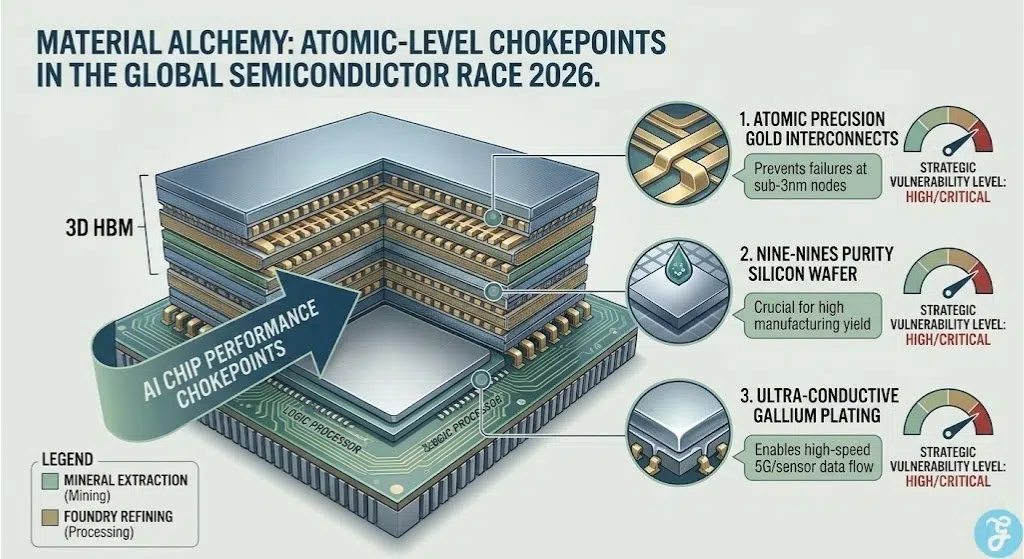
The physical cost of artificial intelligence is staggeringly high, and it is driving an unprecedented surge in demand for critical metals that traditional commodity analysts are only now beginning to fully comprehend. While much of the public’s attention remains fixated on the massive energy consumption and water cooling requirements of sprawling data centers, the hardware required to train and run these massive AI models relies heavily on specific, hard-to-refine elements from the earth’s crust. Gold, for instance, is highly ductile, completely resistant to corrosion, and provides flawless electrical conductivity at the microscopic level required for modern processors.
As chip architectures shrink to the sub-3-nanometer scale, the margin for error is absolutely zero, making gold a highly reliable and non-negotiable standard for plating, bonding wires, and specific interconnects inside high-end hardware.

However, the material squeeze goes far beyond traditional precious metals. Elements like gallium and germanium, which are crucial for specialized semiconductor manufacturing, compound semiconductors, and advanced optoelectronics, have recently been subjected to strict export controls by primary processing nations. This indicates a dangerous new era where countries are actively weaponizing the periodic table to starve competitors of essential inputs.
Tech giants and allied governments are no longer just software innovators and policy entities; they are effectively resource-hoarding institutions. By securing direct access to physical minerals to insulate their supply chains from market fluctuations and geopolitical embargoes, they are fundamentally altering the traditional investment and commodity landscape.
The specific materials required and their strategic values are detailed below, demonstrating the material foundations of the Global Semiconductor Race 2026.
| Critical Material | Role in Microchips & AI Hardware | Market Impact & Strategic Value |
| Gold & Palladium | Plating, bonding, and microscopic interconnects in memory and CPUs to prevent corrosion. | Steady physical demand; essential for long-term reliability in dense server environments. |
| Silicon (Si) | The foundational semiconductor wafer material. | Extremely abundant globally, but requires highly specialized foundries to refine to “nine nines” (99.9999999%) purity. |
| Gallium & Germanium | Compound semiconductors, high-frequency chips, and advanced optoelectronics. | Highly vulnerable to state-sponsored export controls and geopolitical trade restrictions. |
| Rare Earth Elements | Magnets, actuators, and precision polishing compounds (cerium) for silicon wafers. | Supply chain is heavily concentrated, requiring aggressive diversification by Western tech firms. |
RAM, Processors, and Lithography Bottlenecks in the Global Semiconductor Race 2026
The raw materials mined from the earth are only the first hurdle; the capacity to refine, process, and manufacture these materials into functioning processors is the ultimate bottleneck in the Global Semiconductor Race 2026. This is where the race transitions from a resource acquisition challenge into a high-stakes geopolitical standoff. A modern smartphone or an enterprise AI server requires a complex orchestration of high-bandwidth memory for short-term data retention and powerful CPUs and GPUs for heavy parallel processing. Currently, the engineering expertise and physical infrastructure to manufacture these advanced, leading-edge chips are isolated to an incredibly small handful of facilities on the planet, predominantly located in Taiwan and South Korea.
This extreme geographic concentration is a point of severe global vulnerability. Building a leading-edge fabrication plant, or “fab,” is no longer a matter of simply constructing a factory; it is a multi-year, multi-billion-dollar endeavor that requires some of the most complex engineering on earth. A single modern fab can cost upwards of twenty billion dollars, requiring hyper-clean environments that are thousands of times cleaner than a surgical operating room.
On top of that, the industry is suffering from a critical talent shortage. Yield engineers, lithography experts, and materials scientists with the exact experience required to run these facilities cannot be trained overnight, creating a human capital bottleneck that money alone cannot solve.
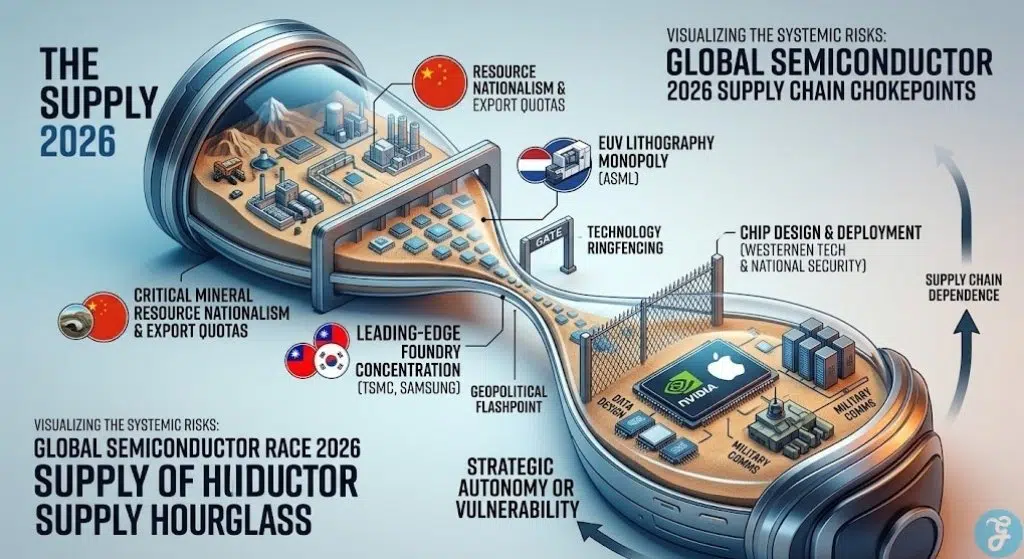
The framework below illustrates the chokepoints in the current semiconductor supply chain and who holds the leverage as we navigate the Global Semiconductor Race 2026.
| Supply Chain Stage | Dominant Geopolitical Players | Vulnerability Level |
| Mineral Processing | China (dominant in refining rare earths and critical metals) | High: Prone to export quotas, resource nationalism, and geopolitical leverage. |
| Lithography Equipment | Europe (ASML in the Netherlands), Japan | Critical: Monopolistic control over the only machines capable of extreme ultraviolet etching. |
| Fabrication (Foundries) | Taiwan (TSMC), South Korea (Samsung) | Critical: A single geographic flashpoint controls the vast majority of the global leading-edge chip supply. |
| Design & IP | USA (Nvidia, Apple, AMD), UK (Arm) | Moderate: Highly lucrative and dominant in architecture, but entirely dependent on foreign fabrication facilities. |
The Role of Extreme Ultraviolet Lithography in the Global Semiconductor Race 2026
Beneath the broader fabrication challenges lies a highly specific and entirely monopolized technological chokepoint: Extreme Ultraviolet (EUV) lithography. The manufacturing process for advanced semiconductors relies entirely on these machines to etch nanometer-scale transistor patterns onto silicon wafers. Currently, a single European company holds a functional, undeniable monopoly on the commercial production of EUV machines.
These devices, which cost hundreds of millions of dollars each, utilize lasers to blast droplets of tin into plasma, generating EUV light that is then bounced off the flattest mirrors ever created by humanity to print features almost at the atomic scale.
Without access to these specific machines, it is physically impossible for any nation or corporation to compete at the absolute frontier of semiconductor fabrication. Because of this, the export of EUV technology has become one of the most heavily regulated and contested aspects of international trade. Blocking a competing nation’s access to this lithography equipment is the most effective way to freeze their technological advancement, cementing the EUV machine as the most critical piece of hardware in the modern geopolitical arena.
The Geopolitical Flashpoints of the Global Semiconductor Race 2026
As the Global Semiconductor Race 2026 intensifies, the geography of global conflict and strategic posturing is shifting dramatically. Policymakers and military strategists no longer view the South China Sea merely as a heavily trafficked maritime trade route; they view it as the physical, beating heart of the world’s compute capacity. A modern “Silicon Iron Curtain” has effectively descended across the globe, splitting the world into distinct blocs: those that have secure access to leading-edge sub-3-nanometer chip technology, and those subjected to strict international export controls and sanctions. This widening technology gap is the modern equivalent of the nuclear threshold during the Cold War.
This stark reality has led to a flurry of new, aggressive industrial policies and strategic alliances designed to secure sovereign supply chains. Initiatives like the comprehensive U.S. CHIPS and Science Act and the European Chips Act represent concerted, multi-billion-dollar government interventions aimed at onshore advanced manufacturing capabilities and ringfencing vital intellectual property. Conversely, nations that find themselves restricted from purchasing advanced EUV lithography equipment are pivoting their strategies. They are doubling down on the mass production of mature-node or “legacy” chips and pursuing deep vertical integration.
By securing mineral rights across the global south, they ensure that even if they are blocked from producing the highest-end AI processors, they retain absolute control over the foundational materials and legacy chips required for the rest of the world to build automobiles, medical devices, and consumer appliances.
To understand the stakes of these regional competitions, the overview below examines the primary geopolitical strategies being deployed in the Global Semiconductor Race 2026.
| Region | Strategic Objective | Key Tactical Move |
| United States | Regaining domestic fabrication leadership and securing intellectual property. | Tens of billions of dollars in subsidies to incentivize major foundries to build plants on US soil. |
| China | Achieving supply chain resilience and global legacy chip dominance. | Expanding domestic production of mature-node chips while utilizing export controls on critical minerals. |
| European Union | Creating a sovereign hardware base to protect the digital single market. | Implementing industrial policy to double the region’s share of global semiconductor manufacturing. |
| Taiwan | Maintaining the “Silicon Shield” of global economic indispensability. | Continuous, aggressive R&D into next-generation fabrication nodes to ensure global dependence. |
National Security and the Global Semiconductor Race 2026
The intersection of microprocessor manufacturing and national defense is the primary accelerant for these geopolitical flashpoints. In modern warfare, brute force has been entirely supplanted by computational superiority. The chips that power our smartphones are cut from the same technological cloth as the processors that guide hypersonic missiles, manage autonomous drone swarms, and decrypt intercepted intelligence. A nation that cannot reliably produce or procure high-end processors will find its military capabilities severely disadvantaged, operating blind and slow against a computationally superior adversary.
Therefore, securing a domestic or closely allied supply of advanced semiconductors is no longer merely an economic goal; it is the absolute bedrock of national survival. The realization that a localized supply chain disruption could effectively ground a modern air force or cripple a nation’s cyber-defense grid has transformed semiconductor policy from a matter of commerce into the highest tier of classified national security doctrine.
Environmental Realities of the Global Semiconductor Race 2026
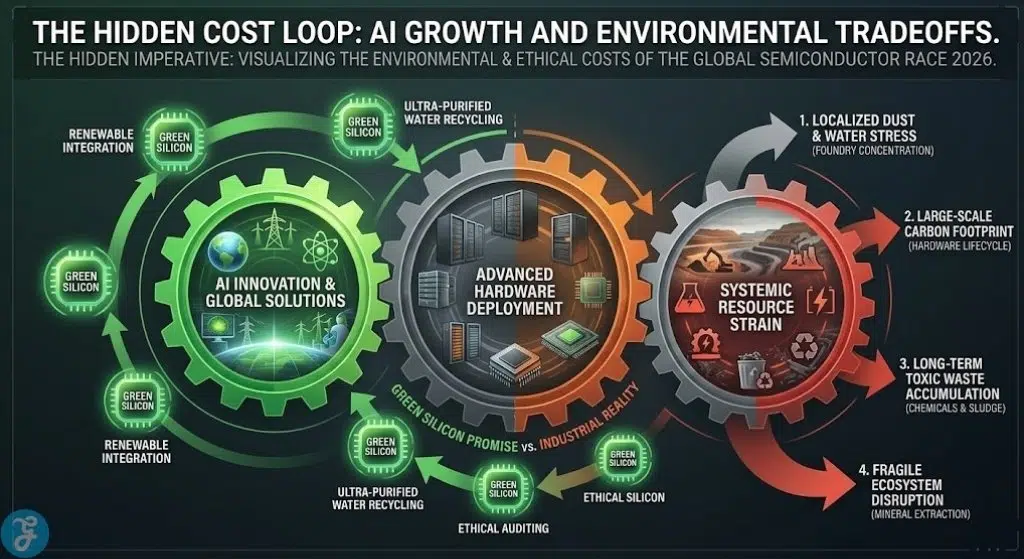
The relentless pursuit of technological sovereignty comes with a high, often underreported environmental price tag that is increasingly becoming a central point of friction in the Global Semiconductor Race 2026. Semiconductor fabrication is arguably one of the most resource-intensive manufacturing processes ever devised by humanity. A single, large-scale advanced foundry requires continuous, massive base-load electricity just to keep the cleanrooms pressurized and the lithography machines running.
It doesn’t end there; the manufacturing process consumes millions of gallons of ultrapure water every single day for the constant rinsing of silicon wafers, placing an enormous strain on local municipal water supplies, especially in the drought-prone regions where many of these mega-facilities are constructed.
The industry is currently facing a profound, unavoidable paradox. While artificial intelligence is frequently touted by tech executives as a vital tool necessary to model climate change and optimize global energy grids, the physical hardware required to train and run these AI models possesses a massive, expanding industrial footprint. The push for critical minerals is leading to intensified, often destructive mining operations across fragile ecosystems, raising serious questions about supply chain ethics and ecological preservation.
While forward-thinking firms are beginning to prioritize “Green Silicon” by investing heavily in dedicated renewable energy grids and advanced, closed-loop water recycling facilities, the technological and financial hurdles to achieving fully carbon-neutral chip manufacturing remain significant.
The data below outlines the broader environmental impacts associated with large-scale fabrication during the Global Semiconductor Race 2026.
| Resource Category | Industrial Impact of Advanced Fabrication | Long-Term Strategic Concern |
| Ultrapure Water | Large fabs consume millions of gallons daily for wafer rinsing and chemical dilution. | Strain on local municipal water supplies, exacerbating drought conditions in arid manufacturing hubs. |
| Energy (Electricity) | Requires massive, uninterrupted base-load power to run lithography machines and cleanrooms. | Increased carbon emissions unless foundries are paired with dedicated, large-scale renewable energy infrastructure. |
| Chemical Solvents | Heavy reliance on specialized fluorinated gases, acids, and photoresists for etching. | Requires highly complex, expensive hazardous waste management to prevent severe soil and groundwater contamination. |
| Mineral Extraction | Exponential demand for copper, silicon, and the aggressive refining of rare earths. | Ecological disruption in mining zones and the immense carbon footprint associated with global mineral shipping. |
Corporate Consolidation in the Global Semiconductor Race 2026
The traditional nation-state is no longer the only superpower maneuvering for dominance in this arena. Trillion-dollar tech monopolies have fully realized that whoever controls the foundational compute infrastructure will ultimately control the future of the entire digital economy. Consequently, these massive corporations are vertically integrating their operations to a degree never before seen in the Global Semiconductor Race 2026. Hyperscalers and tech giants are no longer content to just be software providers, cloud hosts, or hardware purchasers; they are aggressively transforming into bespoke silicon designers.

By designing proprietary chip architectures specifically tailored for their own ecosystems, these companies can optimize hardware directly for their specific AI workloads. This creates a closed feedback loop of efficiency, speed, and performance that general-purpose hardware purchased off the shelf simply cannot match. By controlling the stack from the silicon up to the software interface, they build an economic moat that is practically insurmountable.
This relentless consolidation creates a formidable, almost hostile environment for new entrants and innovators. If a startup wants to build a competitive AI product, they must rent their required compute power from the very monopolies that own the cloud infrastructure, the data centers, and the custom silicon running inside them. This dynamic is rapidly establishing a modern form of digital feudalism. The barrier to entry for the next generation of tech innovation is no longer just writing elegant code; it is gaining permission and paying rent to access finite, highly guarded computing resources controlled by a handful of corporate titans.
The following comparison contrasts the legacy hardware model with the vertically integrated model dominating the Global Semiconductor Race 2026.
| Attribute | Legacy Hardware Model | Monopolistic Hardware Model (2026) |
| Design Source | Third-party, specialized and independent chip vendors. | In-house, proprietary silicon designed specifically for internal corporate ecosystems. |
| Supply Chain | Fragmented, relying heavily on standard global outsourcing and multiple vendors. | Deep vertical integration, including direct, exclusive partnerships with foundries to reserve capacity years in advance. |
| Market Access | Off-the-shelf components readily available to any purchaser globally. | Advanced compute power is “rented” out via private cloud services rather than sold as physical hardware. |
| Innovation Driver | Broad, general-purpose performance improvements for the wider market. | Task-specific AI optimization designed to maximize performance-per-watt for proprietary software. |
Beyond Silicon: The Future of the Global Semiconductor Race 2026
The long-standing era of a frictionless, globally integrated, and highly optimized tech supply chain has irrevocably transformed into a fractured landscape of guarded fortresses. As we navigate the immense complexities of the Global Semiconductor Race 2026, it is abundantly clear that the processor residing inside a standard smartphone represents far more than mere consumer convenience; it is the physical manifestation of global economic leverage and sovereign capability. The historical transition from extracting fossil fuels from the ground to etching nanometer-scale transistors onto polished wafers has created a volatile new world order. In this new paradigm, the boundaries between national security apparatuses, industrial economic policy, and technological innovation have completely and permanently dissolved.
Looking toward the end of the decade and into the 2030s, the race will inevitably begin to move beyond the physical limitations of traditional silicon. As semiconductor manufacturers rapidly approach the absolute physical limits of Moore’s Law, where transistors cannot get any smaller without electrons jumping the gaps due to quantum tunneling, massive research and development budgets are pivoting. Innovation is accelerating in areas like advanced 3D packaging, silicon photonics that use light instead of electricity for data transfer, and alternative conductive materials.
However, even as these incredibly advanced future technologies come online, they will continue to rely on the exact same fundamental principles of resource control, intellectual property ringfencing, and manufacturing sovereignty that define the intense competition today.
A speculative roadmap for technological evolutions is provided below, outlining the next phases of the Global Semiconductor Race 2026.
| Technology Era | Foundational Focus | Strategic Bottleneck |
| The Silicon Era (Current) | Transistor density scaling utilizing EUV Lithography. | Access to advanced lithography machines and highly skilled fabrication engineers. |
| Advanced Packaging (Near-term) | Stacking multiple distinct “chiplets” vertically to bypass 2D spatial limits. | Extreme thermal management (heat dissipation) and advanced, flawless substrate manufacturing. |
| Alternative Materials (Long-term) | Photonics (data transfer via light) and novel superconducting compounds. | Maturing the highly theoretical manufacturing processes from lab-scale prototypes to commercial mass production. |
The Strategic Imperative of Tech Sovereignty in the Global Semiconductor Race 2026
Surviving and thriving in this era requires a fundamental shift in perspective, acknowledging the hard physical limits of our boundless digital ambitions. Software may indeed be running the modern world, orchestrating everything from global finance to local logistics, but it relies entirely on a physical, manufactured foundation to execute its commands. The nations and corporations that recognize the undeniable, unbreakable link between raw natural resources, advanced precision manufacturing, and artificial intelligence will dictate the terms of the global economy for the next century.
The Global Semiconductor Race 2026 is not simply an intellectual exercise in designing the most elegant algorithms; it is a brutal, physical scramble to secure the material supply chains, the rare lithography machines, and the multi-billion-dollar foundries required to make those algorithms a tangible reality.
For the individual professional, the enterprise executive navigating market volatility, and the geopolitical strategist planning for the next decade, the message is stark and uniform: physical compute infrastructure is the most valuable and contested strategic asset of our time. Understanding exactly where your essential hardware originates, how it is manufactured, and the myriad geopolitical risks associated with its production is no longer a niche concern relegated to supply chain analysts. It is a core, unavoidable necessity for survival in the modern digital economy.
The final strategic breakdown summarizes the action plan for enterprises navigating the immense volatility of the Global Semiconductor Race 2026.
| Business Function | Strategic Action | Long-Term Goal |
| Procurement & Operations | Map the exact origin of all critical hardware and cloud infrastructure dependencies. | Ensure deep operational resilience against localized geopolitical conflicts or sudden trade embargoes. |
| Product Design | Aggressively optimize software architectures for both energy and hardware efficiency. | Reduce total enterprise dependency on the scarce, highest-tier AI processors by doing more with less compute. |
| Risk Management | Account for severe semiconductor supply chain volatility in all long-term capital expenditure planning. | Maintain corporate financial stability amidst sudden hardware shortages or unpredictable price spikes. |
| Strategic Innovation | Investigate and fund decentralized, localized, or edge-computing hardware solutions. | Mitigate reliance on highly centralized server farms controlled by monopolistic, single-point-of-failure providers. |
As we move deeper into the decade, the urgency and intensity of this competition will only compound. The device resting quietly on your desk is the ultimate culmination of a fierce, globe-spanning competition for raw resources, brilliant engineering talent, and absolute strategic dominance. To secure the future, we must move away from the dangerous illusion that the digital world is an intangible cloud and fully embrace the reality of its physical roots.
The modern world is built entirely on purified silicon, rare metals, and flawless glass, and those who master the intricate logistics of the Global Semiconductor Race 2026 will undoubtedly hold the keys to the future.