Have you ever watched your business run perfectly one day, only to grind to a halt the next? Orders pile up, shipments get delayed, and costs climb higher than you expected. You watch your team scramble to fix problems that should never have happened. It is a frustrating cycle. Many companies face these exact struggles because they lack strong internal systems to keep things moving.
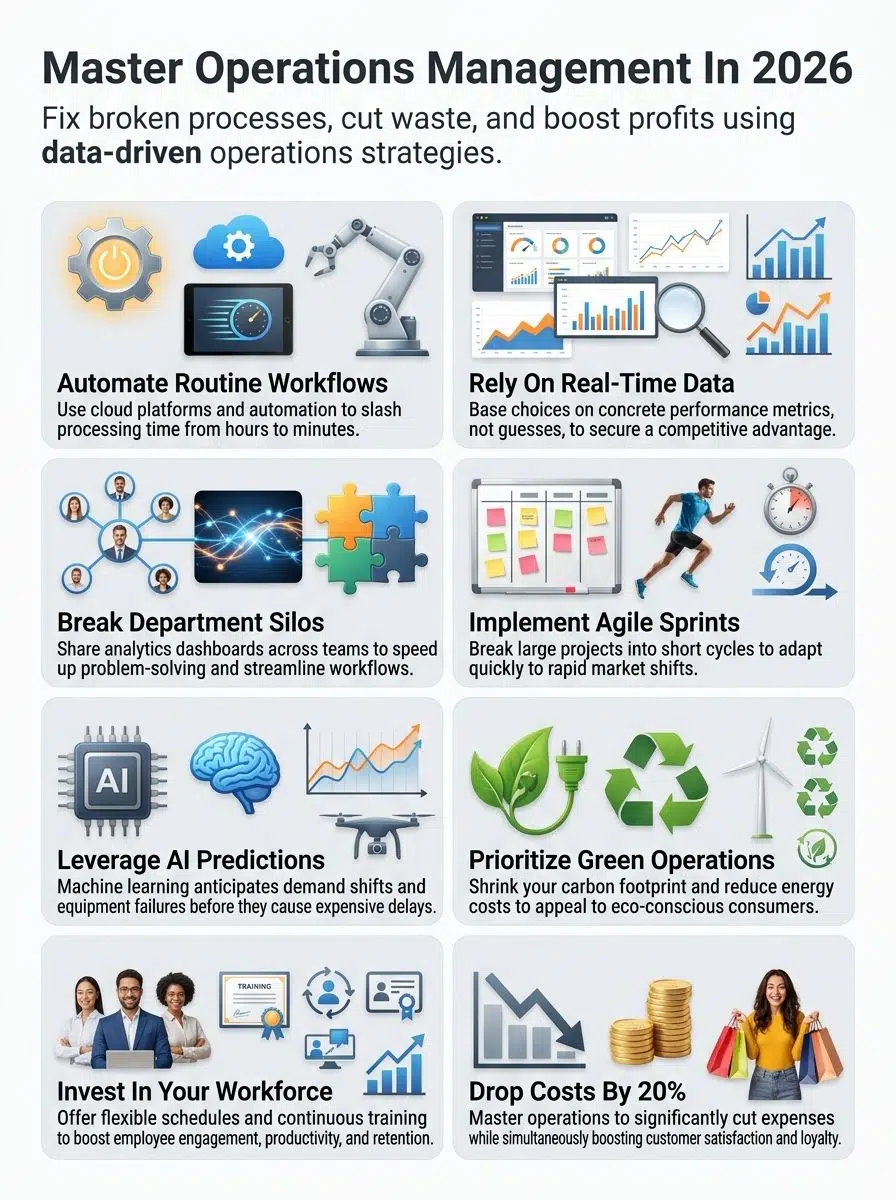
Here is the good news. Companies that master these processes often see their costs drop by up to 20 percent. They also boost customer satisfaction at the exact same time. This means real money stays in your pocket, and your customers actually want to work with you again.
I am going to walk you through operations management best practices for 2026. We will look at exactly how to fix broken processes, cut waste, and build a team that works like a championship squad.
What Is Operations Management?
Operations management controls the daily work that keeps a company running smoothly. It covers everything from planning production schedules to managing inventory, handling quality checks, and optimizing supply chains.
Think of it as the backbone of your organization. Operations managers make sure products get made on time, costs stay down, and customers receive what they ordered. They work across departments to align goals, track performance metrics, and solve problems before they grow.
A 2024 McKinsey report found that US companies implementing advanced operations management see up to a 20% increase in profit margins.
Data-driven decisions power modern operations management. You collect information about production rates, customer demand, and resource allocation to make smart choices. Tools like Microsoft Power BI allow teams to visualize this data instantly.
Process optimization efforts focus on removing bottlenecks that slow things down. Workforce management plays a huge role, too, as you invest in employee training so your team can perform at its best.
Key Functions of Operations Management
Operations managers juggle multiple moving parts every single day. From planning production schedules to managing suppliers, these core functions work together like a well-oiled machine. This setup helps US companies run smoothly and meet customer demands without breaking a sweat.
Operational Planning
Operational planning forms the foundation of your company’s success. This process maps out what your organization will do, how it will do it, and when it will get done. Your team sets goals, identifies resources needed, and creates timelines for achieving results.
To make this easier, many US businesses use dedicated project management software.
- Asana: Great for assigning tasks and tracking daily progress across multiple teams.
- Monday.com: Offers highly visual boards for clear resource allocation.
- Smartsheet: Perfect if your team prefers a spreadsheet-style layout for complex planning.
Strong operational planning connects your daily work to your bigger business vision. It helps you allocate resources smartly, so you avoid wasting money or time. Data-driven decisions guide this planning process, making sure you base choices on facts.
Your operational planning efforts directly impact efficiency metrics across the board. Demand forecasting plays a huge role here, letting you prepare for customer needs before they arrive.
Supply Chain Management
Your supply chain forms the backbone of your business operations. A strong supply chain management strategy keeps products moving smoothly from factories to store shelves. You track inventory levels, manage vendor relationships, and coordinate shipping routes.
According to a 2024 Gartner study, supply chain disruptions cost the average US organization over $184 million annually. Real-time visibility across your entire network lets you make quick adjustments when problems pop up. You catch bottlenecks before they freeze your entire system.
Technology tools automate routine tasks and cut down on manual errors. Tools like Oracle SCM help you gain better control over costs, delivery times, and product quality through smart supply chain optimization.
Accurate forecasts prevent overstocking, which ties up money in warehouses, and understocking, which frustrates customers. Lean management principles help you eliminate waste at every step.
Inventory and Logistics Management
Inventory and logistics management form the backbone of smooth operations. Smart inventory control means you track stock levels accurately, reduce waste, and avoid tying up cash in excess products. Logistics management handles the movement side, optimizing routes and managing transportation costs.
Many US companies struggle with this basic function. A recent Wasp Barcode Technologies report found top inventory challenges include:
- Manual tracking errors that skew stock counts.
- Lack of real-time visibility across different warehouses.
- Overstocking items that tie up vital business cash.
Data analytics transforms how teams handle inventory and logistics in 2026. Real-time tracking systems show exactly where products are, what demand forecasting reveals about future needs, and which supply chain optimization strategies work best. Automation handles routine tasks like sorting and packing, freeing your workforce to focus on problem-solving.
Upgrading to a dedicated system like Fishbowl or NetSuite changes the game entirely. Organizations that combine these tools see faster delivery times, happier customers, and stronger bottom lines.
Quality Control and Continuous Improvement
Quality control stops problems before they reach your customers. Your team catches defects early, saves money, and builds trust with clients. Performance metrics show you exactly where issues happen in real time.
“According to the American Society for Quality, true quality control is not about finding mistakes, but designing processes where mistakes are impossible to make.”
Manufacturing plants that track quality metrics see fewer complaints and higher profits. Many US facilities use the Six Sigma methodology, a famous process improvement strategy that aims to reduce defects to near zero. Your workforce needs training on these quality standards so everyone knows what good looks like.
Continuous improvement keeps your operations sharp and competitive. Small changes add up to big results over time. Your staff should suggest better ways to do things, because frontline workers spot inefficiencies that managers miss.
Why Operations Management Is Critical in 2026
Operations management shapes how companies respond to rapid market shifts and changing customer demands. Smart operations teams keep businesses competitive by cutting costs and speeding up delivery.
Adapting to Global Business Dynamics
Global markets shift fast, and companies that stand still fall behind. Your supply chain stretches across borders, your customers want faster shipping, and your competitors emerge from unexpected places. Adapting to these shifts means rethinking how you allocate resources and optimize your supply chain in real time.
One major trend in the US is bringing production closer to home. A 2024 Kearney Reshoring Index showed that over 90% of US manufacturing executives are considering reshoring or nearshoring operations to Mexico or domestic plants. This shortens the supply chain and reduces risk.
Data analytics reveals what customers want locally and nationally. AI integration lets you predict disruptions before they happen. Cross-department collaboration breaks down silos that slow you down, allowing teams to catch problems faster.
Companies that measure their efficiency strategies gain a competitive advantage because they make moves based on facts. Strategic planning builds systems that flex when the world changes.
Leveraging Technology for Efficiency
Technology acts as the engine of modern operations management. Companies that invest in automation, AI integration, and data analytics see real improvements in their bottom line. A 2024 PwC study noted that AI could boost US labor productivity by up to 40% in operations sectors.
Manufacturing facilities use robots to handle repetitive tasks, which frees up your workforce to focus on higher-value work. Real-time analytics tools give managers the information they need to spot problems fast and fix them.
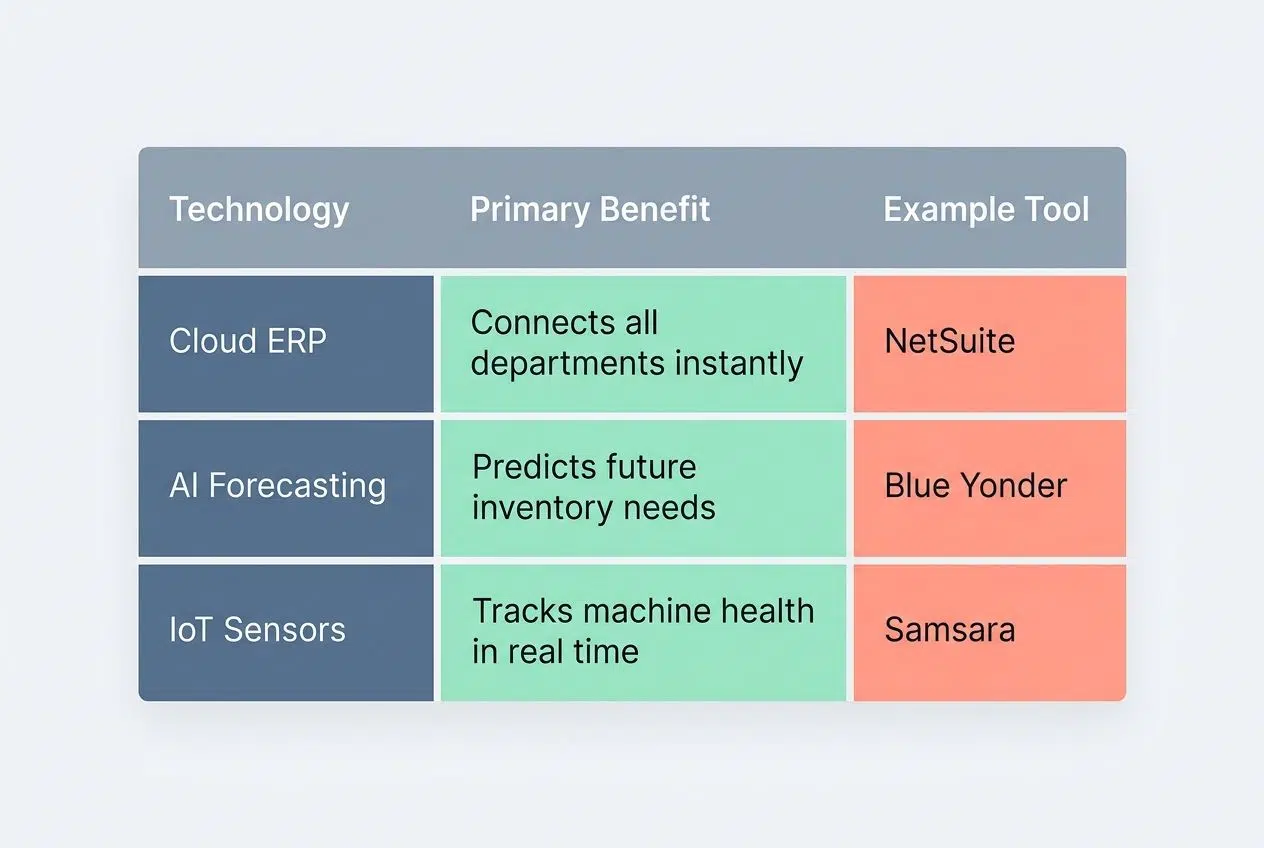
| Technology | Primary Benefit | Example Tool |
|---|---|---|
| Cloud ERP | Connects all departments instantly | NetSuite |
| AI Forecasting | Predicts future inventory needs | Blue Yonder |
| IoT Sensors | Tracks machine health in real time | Samsara |
Process optimization becomes easier when machines handle data collection. Operational efficiency jumps when your staff spends less time on paperwork and more time on work that matters.
Enhancing Sustainability Practices
Companies face mounting pressure to shrink their environmental footprint, and operations management plays a central role. Sustainable practices cut waste, lower energy costs, and appeal to customers who care about the planet.
A 2024 Nielsen survey found that 78% of US consumers prioritize buying from companies with clear sustainability practices. Your team can start by mapping supply chain operations to find where resources get wasted. Lean management principles help eliminate unnecessary steps that consume extra fuel and materials.
Data analytics reveals which processes drain the most energy. Switching to renewable energy sources, reducing packaging materials, and optimizing delivery routes all deliver real results. These moves boost your bottom line and strengthen your brand reputation.
Best Practices for Operations Management in 2026
Your operations team needs fresh strategies to stay competitive. Smart companies combine technology, data insights, and people-focused approaches to run smoother operations. Here are the Operations Management Best Practices for 2026 that you can start using today.
Use Technology to Gain Efficiency
Technology transforms how companies work right now. Smart tools and systems help teams produce more with less effort.
- Cloud-based platforms: Store all your data in one safe place, so employees can access information from anywhere. Platforms like Microsoft Azure make this simple.
- Automation software: Handles repetitive tasks like invoice processing, freeing your workforce for strategic work.
- Real-time analytics dashboards: Show you exactly what is happening in your operations. Tableau is a great option for spotting trends quickly.
- Artificial intelligence: Predicts demand patterns weeks ahead, so you order inventory at the exact right time.
- Mobile apps: Let your team manage projects and track shipments directly from job sites or warehouses.
Integrated software systems connect your sales, inventory, manufacturing, and customer service departments. Information flows smoothly, and everyone works toward the same goals.
Turn to Data for Decision-Making
Data transforms how companies make choices. Smart leaders collect information, analyze it, and act on what they find. Setting up clear Key Performance Indicators (KPIs) is the best way to start.
“Many users on the r/supplychain subreddit note that tracking too many metrics creates noise. Focus on 3 to 5 core KPIs, like Order Fulfillment Cycle Time, to get a clear picture of your operational health.”
Use data analytics tools to spot patterns in your supply chain. You will reveal where delays occur, which suppliers perform best, and where costs spike unexpectedly. Apply historical data to predict future demand, so you stock the right products in the right quantities.
Measure operational efficiency through concrete numbers like cycle time, waste percentages, and throughput rates. Guessing whether things run smoothly simply does not work anymore. Set specific performance metrics for each team, review them weekly, and adjust strategies when the data signals a change is needed.
Foster Cross-Department Collaboration
Data drives smart choices, but those choices need buy-in from across your organization. Strong cross-department collaboration transforms isolated data insights into company-wide strategic planning.
Create shared performance metrics that all departments track together. This ensures everyone moves in the same direction and understands how their work impacts the larger operation. Build communication channels where operations teams, manufacturing staff, and customer service reps talk regularly. Tools like Slack or Microsoft Teams make this instant and easy.
Develop cross-functional project teams that tackle specific challenges. Mixing perspectives from supply chain, quality assurance, and inventory control helps you solve problems faster. Share real-time analytics dashboards across departments, so finance, production, and logistics see the exact same performance data.
Implement continuous improvement initiatives where all departments contribute ideas for process optimization. Frontline workers must have a voice in shaping operations.
Focus on Employee Training and Development
Your workforce makes or breaks your operations. Strong training programs transform employees into skilled professionals who drive productivity and innovation across your organization.
In the US, companies that invest heavily in training see a 24% higher profit margin, according to the Association for Talent Development. Focus on these core areas:
- Certification in lean management principles to reduce waste.
- Hands-on sessions for new automation software and AI tools.
- Cross-department shadowing to build team empathy and understanding.
Invest in continuous learning programs that teach employees new skills in automation, AI integration, and data analytics. Create mentorship opportunities where experienced team members guide newer staff through complex processes.
Develop role-specific training modules that address supply chain optimization and inventory control. Measure training effectiveness through performance metrics that track productivity improvements and quality assurance outcomes.
Implement Agile and Flexible Processes
Agile and flexible processes form the backbone of modern operations management. Companies that shift their approach gain speed, adaptability, and the ability to respond to market changes faster than competitors.
Break large projects into smaller sprints that teams complete in two to four-week cycles. This allows your organization to deliver value quickly and gather feedback. The Project Management Institute (PMI) reports that agile projects are 28% more successful than traditional ones.
Use daily stand-up meetings where team members share what they accomplished and any obstacles blocking their progress. Establish clear performance metrics that track sprint completion rates and team velocity. Adopt a continuous improvement mindset where teams regularly review what worked and what did not after each sprint.
Invest in workforce training programs that teach employees agile methodologies like Scrum or Kanban. This ensures they understand how to work within flexible frameworks and contribute to process improvement efforts.
Operations Management Trends for 2026
The future of operations management hinges on smart technology and fresh thinking. Companies that stay ahead of the curve will master new tools and strategies that reshape how they work.
Apply AI and Machine Learning
Artificial intelligence and machine learning reshape how companies handle operations management. AI systems analyze massive amounts of data in seconds, spotting patterns that humans would easily miss.
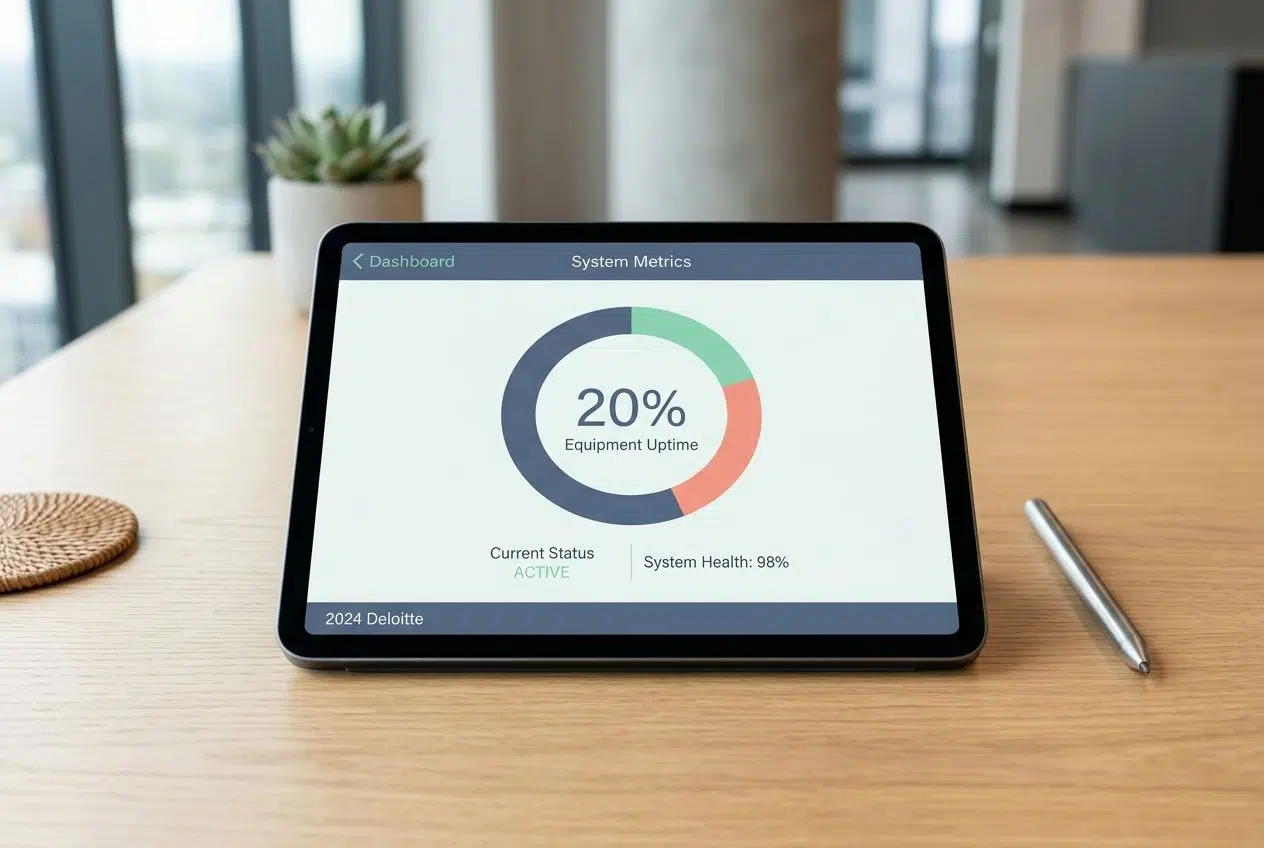
“A 2024 Deloitte study found that implementing predictive maintenance increases equipment uptime by up to 20%, saving US manufacturers millions annually.”
Your team can use machine learning for predictive maintenance. By analyzing data from machine sensors, AI can predict equipment failures before they happen, cutting downtime dramatically. These tools automate routine tasks like scheduling, inventory tracking, and demand forecasting.
Manufacturing plants now use AI to optimize production lines, reduce waste, and improve quality control. Machine learning models learn from your company’s past performance and continuously improve their predictions. Real-time analytics powered by machine learning help you spot bottlenecks in your processes instantly.
Focus on Sustainability in Operations
Sustainability practices shape how companies operate responsibly. Smart technology helps you cut waste and reduce costs at the exact same time. Companies that act now gain a real advantage over competitors who lag behind.
Many US facilities are pursuing LEED (Leadership in Energy and Environmental Design) certification to prove their commitment to green operations. Your supply chain optimization efforts should include green practices, energy-efficient processes, and waste reduction strategies.
Lean management principles work hand-in-hand with sustainability goals. You reduce unnecessary steps, cut down on materials, and lower your carbon footprint all at once. Demand forecasting tools help you order the right amount of inventory, which prevents overstock and waste.
Your workforce management strategies should highlight how employees contribute to sustainability efforts. Many workers care deeply about environmental responsibility, and companies that show this commitment attract better talent.
Use Real-time Analytics for Better Decisions
Real-time analytics transform how companies make decisions. Data flows into your systems constantly, and you see patterns instantly. This speed matters because markets shift fast, and delays cost serious money.
Platforms like Apache Kafka process live data so your dashboards update throughout the day. This immediate feedback loop offers several huge advantages:
- You catch supply chain hiccups before they cascade into disasters.
- Demand forecasting adjusts instantly to daily market swings.
- Resource allocation matches exact, up-to-the-minute business needs.
Actionable insights arrive faster than traditional reporting methods. Your workforce makes smarter choices when they have current information. Operational efficiency jumps when every choice rests on facts instead of assumptions.
Enhance Employee Well-being and Engagement
Your workforce makes or breaks your operations. Happy employees work harder, stay longer, and care more about product quality. Companies that invest in employee well-being see real gains in productivity and performance metrics.
Gallup’s 2024 State of the Global Workplace report revealed that highly engaged business units result in 21% greater profitability. Offer flexible work schedules, mental health support, and clear career paths. Listen to your team about what actually matters to them.
Engaged employees catch problems early, suggest improvements, and drive continuous improvement across your organization. Create a workplace where people feel valued and heard. Regular feedback sessions help workers understand exactly how they contribute to success.
Celebrate wins as a team. Employees who feel supported become your best advocates for operational efficiency and process optimization.
Benefits of Effective Operations Management
When you run your operations smoothly, your business makes more money and keeps customers happy. Smart operations management turns your company into a lean, highly competitive machine that outperforms rivals.

Improved Productivity
Effective operations management transforms how your team works. Better processes cut waste, reduce delays, and help workers do more in less time. Your staff completes tasks faster when you streamline workflows and remove obvious bottlenecks.
Data analytics reveal where slowdowns happen, so you can fix problems before they grow. For example, using time-tracking software like Toggl Track helps identify exactly which administrative tasks take up the most hours. Automation handles repetitive jobs, freeing your people to focus on high-value work.
Productivity gains stack up quickly when you invest in the right tools. Real-time analytics let managers spot issues the moment they appear. Supply chain optimization cuts delays and keeps materials flowing smoothly.
Enhanced Customer Satisfaction
Boosted productivity sets the stage for customers who feel genuinely valued. Operations management drives customer satisfaction by making sure products arrive on time, maintain consistent quality, and meet real expectations.
When operations run smoothly, customers notice the difference immediately. A 2024 Forrester report shows that customer experience leaders grow revenue much faster than their peers. Smooth operations directly improve the customer journey by providing:
- Faster, more predictable delivery times.
- Consistent product quality without defects.
- Accurate stock levels so items are always ready to ship.
Data analytics reveals what customers actually want, not what companies think they want. Real-time analytics help teams spot problems before customers do. Workforce management plays a key role in customer happiness, as trained employees always deliver better service.
Increased Competitive Advantage
Happy customers stick around. They also tell their friends about your business. This loyalty gives you a real edge over competitors who constantly struggle to keep people satisfied.
Strong operations management separates winners from the rest of the pack. Companies that use data analytics, AI integration, and process optimization move faster than their rivals. They cut costs, reduce waste, and deliver products exactly on time.
Supply chain optimization keeps your inventory control tight, so you never miss a sale. A great example is Amazon’s use of predictive fulfillment, moving inventory to local hubs before you even click buy. Demand forecasting lets you stock the right products before customers ask for them.
This combination of efficiency strategies, continuous improvement, and strategic planning builds a fortress around your market position.
Final Thoughts
You now grasp how technology, data, and smart people work together to transform operations. Implementing these operations management best practices for 2026 into your workflow does not require a complete overhaul. You can start small with one area and build momentum from there.
Ask yourself this question. Which strategy matches your current challenges, and how could you pilot it this month?
Companies that act on these insights will outpace competitors who delay, so the time to move forward is right now. Your operations team holds the power to drive real change, boost profits, and create a workplace where people actually want to show up.
Frequently Asked Questions
1. What are the top operations management best practices for 2026?
Your top priorities should be upgrading your digital tools, maximizing supply chain visibility, and focusing on cost optimization to offset unpredictable market shifts. With experts at FTI Consulting noting that sluggish US economic sectors are forcing tighter supply chains in 2026, adopting real-time data tracking is no longer optional. Just make sure you stay flexible and keep your team communicating seamlessly as you roll out these new changes.
2. How can companies improve workflow in their daily operations?
You can improve your workflow immediately by mapping out every single step of your daily processes to spot and eliminate hidden waste. Since a 2026 Richmond Fed CFO Survey shows 84% of large US firms have already implemented automation, adding time-saving software is your next best move. Just be sure to choose digital tools that actually fit your specific needs instead of grabbing whatever happens to be trendy.
3. Why is teamwork so important in modern operations management?
Teamwork is essential because a recent Gallup report showed only 32% of US employees are actively engaged, yet highly collaborative groups are 14% more productive, making open communication the fastest way to reduce mistakes.
4. What role does technology play in future-ready operations strategies?
Technology like artificial intelligence acts as your early warning system, helping you spot trends and track inventory long before minor issues become expensive headaches. A 2026 Gartner survey of operations leaders, including many in the US, found that 54% are currently adopting AI specifically to cut costs and speed up their workflows. With the right software setup, your managers can make fast, data-driven decisions that keep everything running smoothly.