Denmark has transformed from a regional player into a global powerhouse, with 2026 marking a historic decade for its financial technology ecosystem. As the nation celebrates the 10th anniversary of its primary innovation hub, the Danish “fintech model”—defined by high trust, rapid digitalisation, and deep-tech collaboration—is being exported across the European Union.
How We Selected Our 10 Best Denmark Fintech Boom 2026 Facts
To assemble this definitive list, we evaluated the latest 2026 performance reports from Copenhagen Fintech, examined the launch mandates of the new Nordic Fintech Center, and tracked venture capital flow into Danish-born unicorns. Our selection criteria focused on three key areas: the “deep-tech” integration of AI and quantum computing, the standardisation of cross-border payment networks, and the regulatory leadership Denmark has assumed within the EU’s MiCA and AML frameworks.
The 10 Most Essential Facts About Denmark’s Fintech Boom
The following points highlight why Denmark has become the “Silicon Valley of the Nordics” and what investors and entrepreneurs should watch as we move through 2026.
1. The Decennial Milestone of Copenhagen Fintech
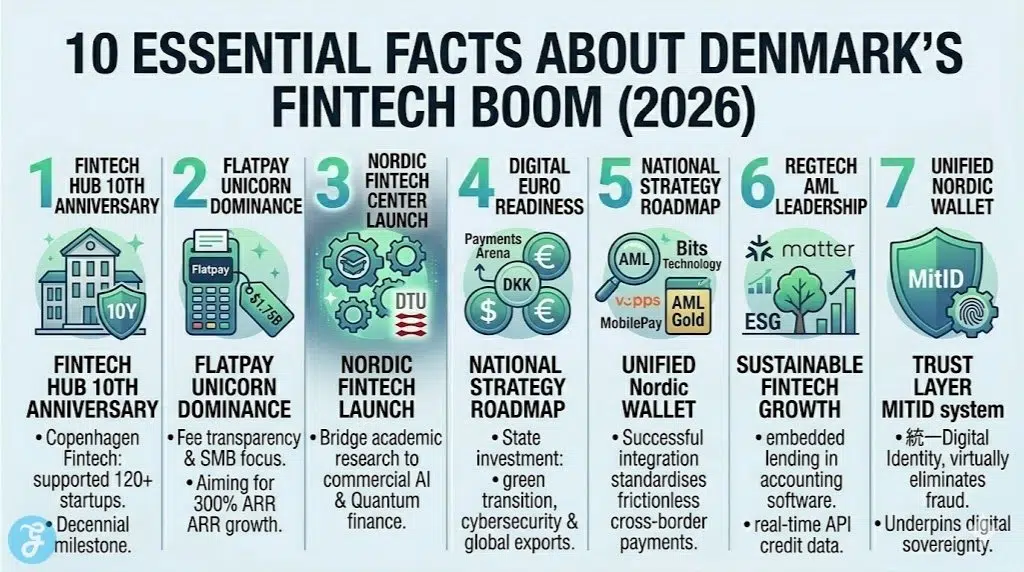
2026 marks ten years since the inception of Copenhagen Fintech. What began as a local co-working space has evolved into a societal infrastructure that supports over 120 active startups. This milestone is being celebrated with a massive expansion of the “Fintech Lab,” which now serves as the primary springboard for Nordic startups entering the global market.
Best for: Founders seeking the most established entry point into the European financial ecosystem.
Why We Chose It:
-
It represents the “systemic maturity” of the Danish market.
-
It is the central engine for the 2026 “Fintech as a growth engine” national initiative.
-
The hub has successfully scaled more unicorns per capita than almost any other European city.
Things to consider: Competition for space in the Copenhagen Lab is at an all-time high, with application waitlists extending into 2027.
2. Flatpay’s Dominance as the Fastest Fintech Unicorn
After reaching a $1.75 billion valuation in late 2025, Flatpay has entered 2026 with a goal to grow its annual recurring revenue (ARR) by 300%. By focusing on small and medium businesses (SMBs) with a transparent, “no-hidden-fee” terminal model, it has successfully challenged legacy providers like Adyen and Stripe across six European markets.
Best for: Investors tracking high-growth payment processors in the SMB sector.
Why We Chose It:
-
It validates the Danish “human-centric” sales model where staff meet merchants in person.
-
It highlights the shift toward fee transparency that is defining 2026 consumer expectations.
-
The company aims to double its headcount to 3,000 “Flatpayers” by the end of the year.
Things to consider: Despite rapid revenue growth, the company remains focused on aggressive expansion over immediate profitability.
3. The Launch of the Nordic Fintech Center
In a major 2026 development, Copenhagen Fintech has partnered with four leading universities—DTU, CBS, KU, and Aarhus University—to launch the Nordic Fintech Center. This initiative is designed to bridge the gap between academic research in quantum computing and commercial financial applications.
Best for: Deep-tech developers and “spin-out” startups looking for research-backed funding.
Why We Chose It:
-
It focuses on the next frontier: AI-pioneer centres and quantum-safe signature algorithms.
-
It creates a systematic “funnel” from university laboratories to commercial accelerators.
-
It strengthens Denmark’s digital sovereignty against increasing global cyber threats.
Things to consider: Most projects within the center are focused on 5-to-10-year horizons rather than immediate market entry.
4. Digital Euro Readiness and the “Payments Arena”
Denmark has positioned itself at the forefront of the Digital Euro transition. The 2026 Nordic Fintech Summit introduced the “Payments Arena,” a dedicated track for testing account-to-account (A2A) flows and instant payment rails that align with the latest EU Central Bank mandates.
Best for: Financial institutions looking to standardise their instant payment infrastructure.
Why We Chose It:
-
Denmark is already one of the world’s most “cashless” societies, making it the perfect testbed.
-
The “Pay by Bank” model is seeing record adoption among Danish entrepreneurs this year.
-
It ensures the Nordic region remains interoperable with the broader European digital currency landscape.
Things to consider: The integration of the Digital Euro requires significant legacy tech modernisation for older Danish banks.
5. The “National Fintech Strategy” 2026 Roadmap
The Danish government has officially adopted “Fintech as a growth engine” as a core pillar of its National Strategy for Digitalisation. This 2026 roadmap includes 2 billion DKK in state investment to strengthen cybersecurity, green transitions, and international fintech exports.
Best for: Policy analysts and corporate strategists planning long-term Nordic investments.
Why We Chose It:
-
It is a rare example of a government treating fintech as a critical national infrastructure.
-
It specifically targets the “talent gap” by integrating tech education into primary schools.
-
It provides a “safe harbour” for innovation through clearer regulatory sandboxes.
Things to consider: The strategy relies heavily on successful collaboration between the Ministry of Finance and private sector players.
6. RegTech Leadership and the AML “Gold Standard”
With the EU tightening Anti-Money Laundering (AML) requirements in 2026, Danish RegTech firms like Bits Technology have become essential partners for global banks. Denmark’s expertise in automating compliance has turned a regulatory burden into a high-value export.
Best for: Compliance officers looking for automated, AI-driven verification tools.
Why We Chose It:
-
Danish firms lead the “Agentic Era” of AI agents that can handle complex KYB (Know Your Business) checks.
-
It addresses the 2026 surge in first-party fraud and sophisticated “deepfake” identities.
-
The “AML Arena 2026” event has become the premier European forum for risk-based regulation.
Things to consider: Regulatory tools must be constantly updated to keep pace with evolving “Agentic” fraud techniques.
7. Vipps MobilePay and the Unified Nordic Wallet
The successful 2026 integration of Vipps MobilePay into a wider European wallet network has standardised frictionless cross-border payments. Users can now pay as easily in Berlin or Helsinki as they do in Copenhagen, using a single, unified interface.
Best for: Retailers and e-commerce platforms targeting the cross-border Nordic-Baltic market.
Why We Chose It:
-
It is a successful case study in cross-border M&A and technical infrastructure consolidation.
-
It provides a formidable regional competitor to global giants like Apple Pay and Google Pay.
-
It leverages Denmark’s MitID system to ensure near-zero transaction fraud.
Things to consider: Expanding this network further into Southern Europe remains a significant technical and cultural challenge.
8. Sustainable Fintech and the Rise of “Green” Reporting
Denmark is arguably the world leader in ESG (Environmental, Social, and Governance) fintech. In 2026, startups like Matter and others are providing the underlying data that European insurers and banks use to meet the strict new EU SFDR reporting requirements.
Best for: Impact investors and asset managers focused on sustainable capital allocation.
Why We Chose It:
-
It moves ESG from “marketing” to “math” through research-backed data insights.
-
It aligns with Denmark’s goal of accelerating the green transition through digital solutions.
-
Danish “Carbon Fintechs” are now being embedded directly into corporate accounting software.
Things to consider: The lack of global standardisation in ESG metrics still creates “data noise” for some international investors.
9. Alternative Lending and SME Capital Growth
The Danish P2P and alternative lending market has reached a maturity phase in 2026, with a focus on “embedded lending.” Instead of going to a bank, Danish SMEs are now accessing credit directly through their accounting software (like Dinero or Billy).
Best for: Small business owners seeking rapid, data-driven credit without traditional bank bureaucracy.
Why We Chose It:
-
It uses real-time API data to assess creditworthiness, bypassing slow manual audits.
-
It has filled the “funding gap” left by traditional banks during the 2025-2026 interest rate holds.
-
It reflects the “platformisation” of finance where accounting and banking merge.
Things to consider: Alternative lenders often charge higher interest rates than traditional banks for the convenience of speed.
10. Transition to MitID and Digital Sovereignty
The full maturation of the MitID system in 2026 has provided the “trust layer” that makes the Denmark Fintech Boom possible. By providing a secure, government-backed digital identity for every citizen, Denmark has virtually eliminated identity-based friction in financial services.
Best for: Startups requiring high-assurance customer authentication for complex products.
Why We Chose It:
-
It is the “golden key” that allows for instant account opening and secure digital signatures.
-
It serves as a model for the proposed “EU Digital Identity Wallet.”
-
It underpins the 2026 focus on digital sovereignty and cybersecurity.
Things to consider: Heavy reliance on a single ID system makes it a high-priority target for state-sponsored cyber-attacks.
An Overview Of Denmark Fintech Boom 2026 and Nordic Innovation
The 2026 landscape is defined by “consolidation and deep-tech.” While the 2020-2023 era was about “Neobanks” and apps, the current boom is about the “plumbing” of finance—AI agents, quantum security, and cross-border rails.
Overview Comparison Table
The table below outlines the three primary sectors driving growth in the Danish market this year.
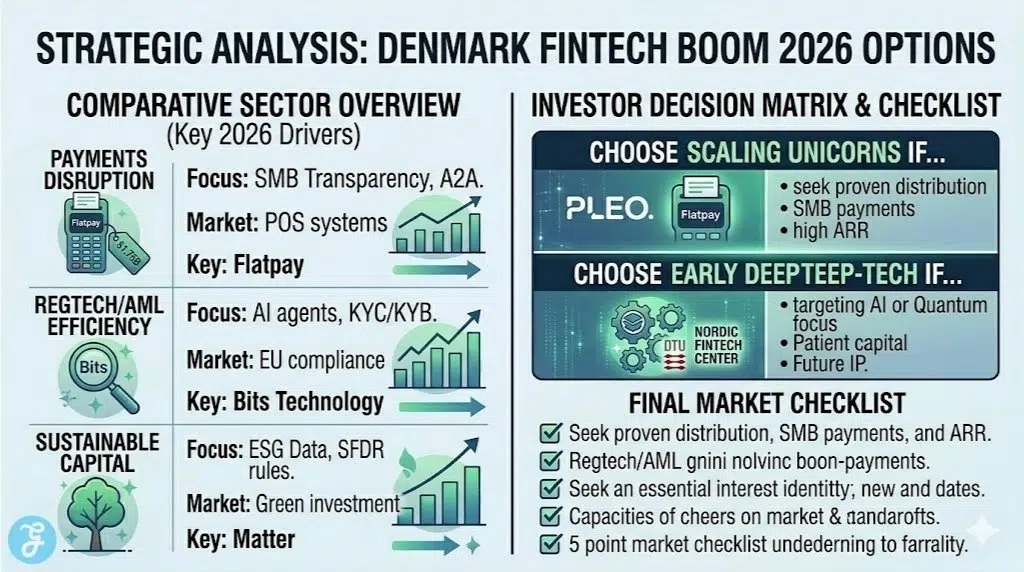
| Sector | Core 2026 Focus | Key Representative | Market Impact |
| Payments | SMB transparency & A2A | Flatpay | Disrupting legacy POS systems. |
| RegTech | AI-driven AML & KYC | Bits Technology | Standardising EU compliance. |
| Green Fintech | ESG data & SFDR rules | Matter | Driving sustainable investment. |
Our Top 3 Picks and Why?
Of the ten points discussed, Copenhagen Fintech’s 10th Anniversary, Flatpay’s Unicorn Growth, and the Nordic Fintech Center are the most critical. Together, they represent the past success, current momentum, and future research-based trajectory of the Danish ecosystem. They provide the physical infrastructure, the commercial proof of concept, and the academic talent pool required for long-term dominance.
Investing in the Danish market requires an understanding of “The Nordic Way”—a focus on sustainability, high social trust, and flat corporate hierarchies.
The Selection Framework:
-
B2B vs B2C: Currently, the “smart money” in Denmark is moving toward B2B infrastructure and RegTech rather than consumer-facing apps.
-
Sustainability Alignment: Every successful 2026 Danish startup must have a clear ESG or “Green Finance” component.
-
Talent Access: Evaluate startups based on their proximity to the Nordic Fintech Center university partners for a steady supply of deep-tech talent.
Decision Matrix (Table):
| Invest in Scaling Unicorns (e.g., Pleo, Flatpay) if… | Invest in Early-Stage Deep-Tech if… |
| You seek proven European distribution. | You are targeting AI or Quantum finance. |
| You want exposure to the SMB payments sector. | You have a 7-10 year “patient capital” horizon. |
| You value high recurring revenue (ARR). | You want to own the “IP” of future infrastructure. |
The Final Checklist: 5-point Checklist Before Entering the Danish Market
-
Have you verified if the startup is a member of the Copenhagen Fintech ecosystem?
-
Does the product integrate natively with MitID for secure authentication?
-
Is the firm’s AI strategy compliant with the EU AI Act (enforced as of 2026)?
-
Does the startup have a research partnership with one of the four founding Nordic Fintech Center universities?
-
Is the business model designed for cross-border Nordic interoperability (e.g., Vipps MobilePay ready)?
The Future of Nordic Finance and Global Leadership
As 2026 unfolds, Denmark is no longer just a “successful small nation”; it is a blueprint for the future of the global financial system. By prioritising trust, research, and regulatory clarity, the Denmark Fintech Boom 2026 has created an ecosystem that is both resilient to economic shocks and ready for the next wave of technological disruption.