Ever feel like the city is squeezing you out? You aren’t alone. Between the traffic jams that steal your evening and the gray concrete that seems to go on forever, city life can be exhausting. But imagine if your morning commute was a breeze on a silent electric bus. Picture walking your kids to a park that’s just two blocks away, every single time.
This isn’t a sci-fi movie. It is the very real goal of sustainable urban planning.
Here is a closer look at how cities are transforming right now. From practical frameworks like the “3-30-300 rule” for urban trees to smart bins that notify garbage trucks when they are full, innovative tools are reshaping urban living.
Curious how your neighborhood measures up? Grab a coffee and explore the changes redefining modern Sustainable cities.
What is a Sustainable City?
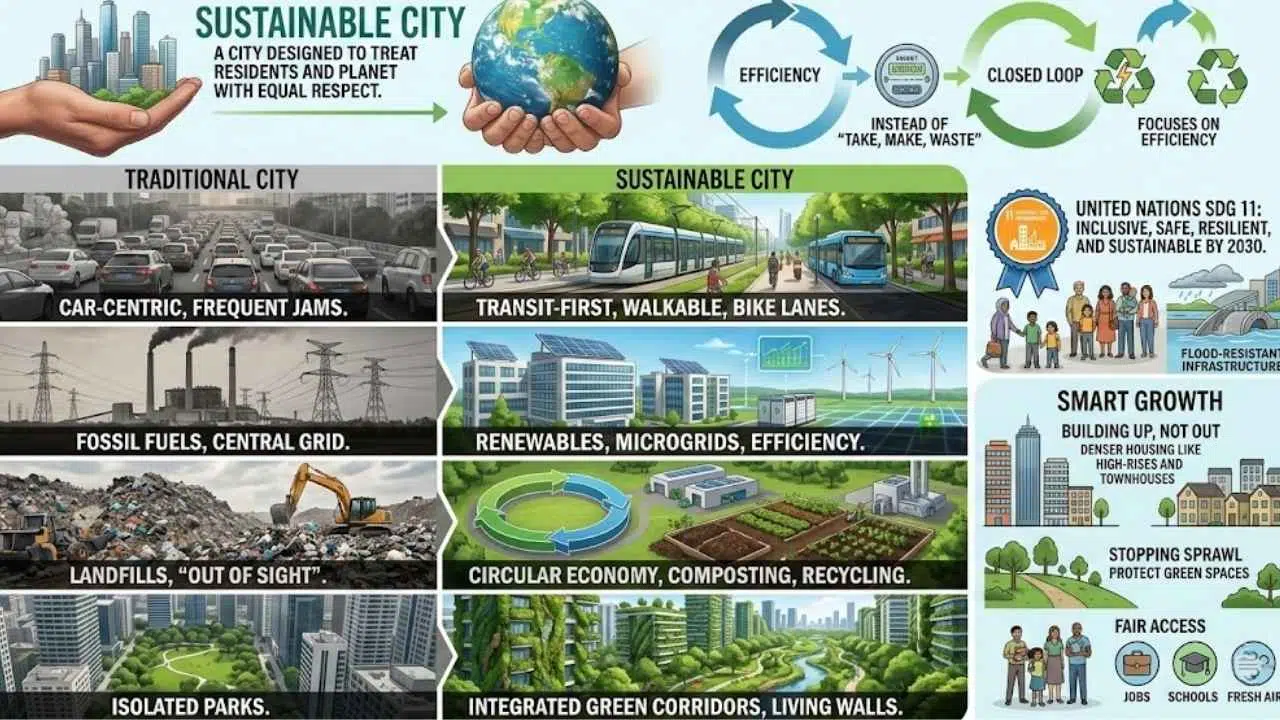
A sustainable city isn’t just about solar panels. It is a city designed to treat its residents and the planet with equal respect.
Think of it as a closed loop. Instead of “take, make, waste,” a sustainable city focuses on efficiency. It uses renewable energy to keep the lights on and green infrastructure to handle the rain. The United Nations Sustainable Development Goal 11 specifically targets making cities “inclusive, safe, resilient, and sustainable” by 2030.
But what does that actually look like on the ground? Here is a quick breakdown of how the approach changes things:
| Feature | Traditional City | Sustainable City |
|---|---|---|
| Traffic | Car-centric, frequent jams | Transit-first, walkable, bike lanes |
| Energy | Fossil fuels, central grid | Renewables, microgrids, efficiency |
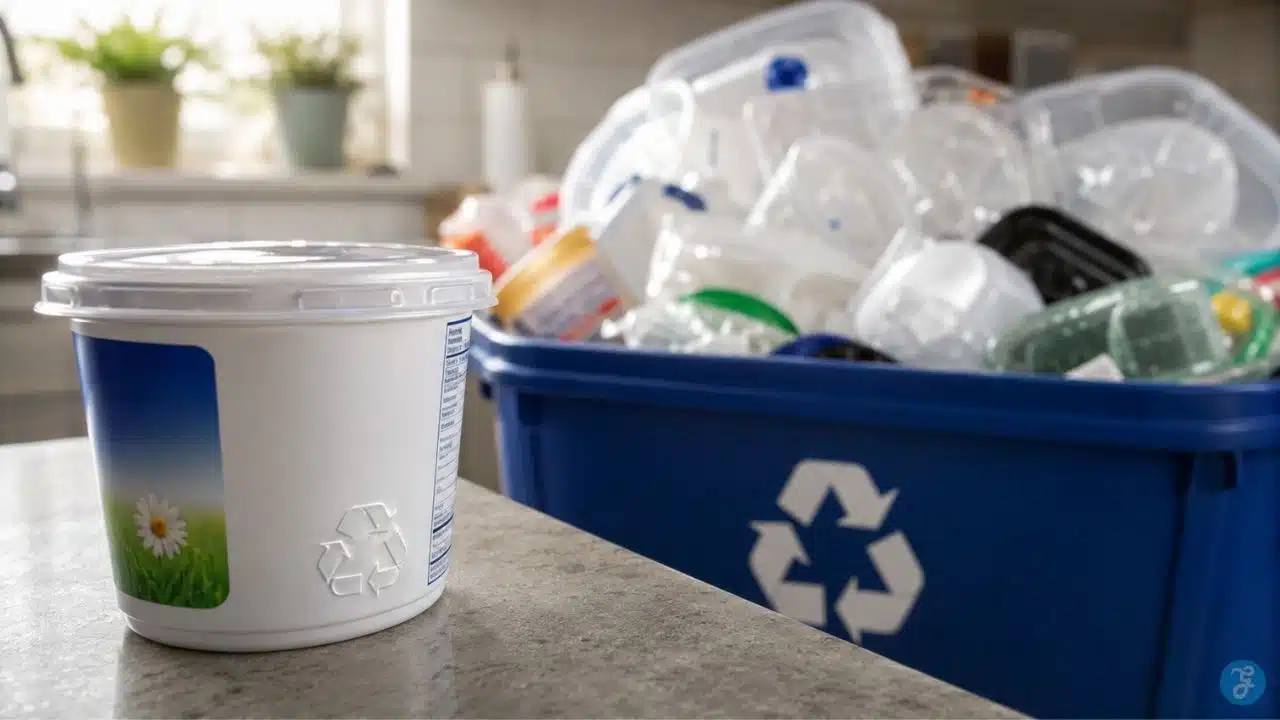
| Waste | Landfills, “out of sight” | Circular economy, composting, recycling |
| Nature | Isolated parks | Integrated green corridors, living walls |
City leaders are championing “smart growth.” This means building up rather than out to stop sprawl. It ensures that whether you are in a high-rise or a townhouse, you have fair access to jobs, schools, and fresh air.
Key Features of Sustainable Cities
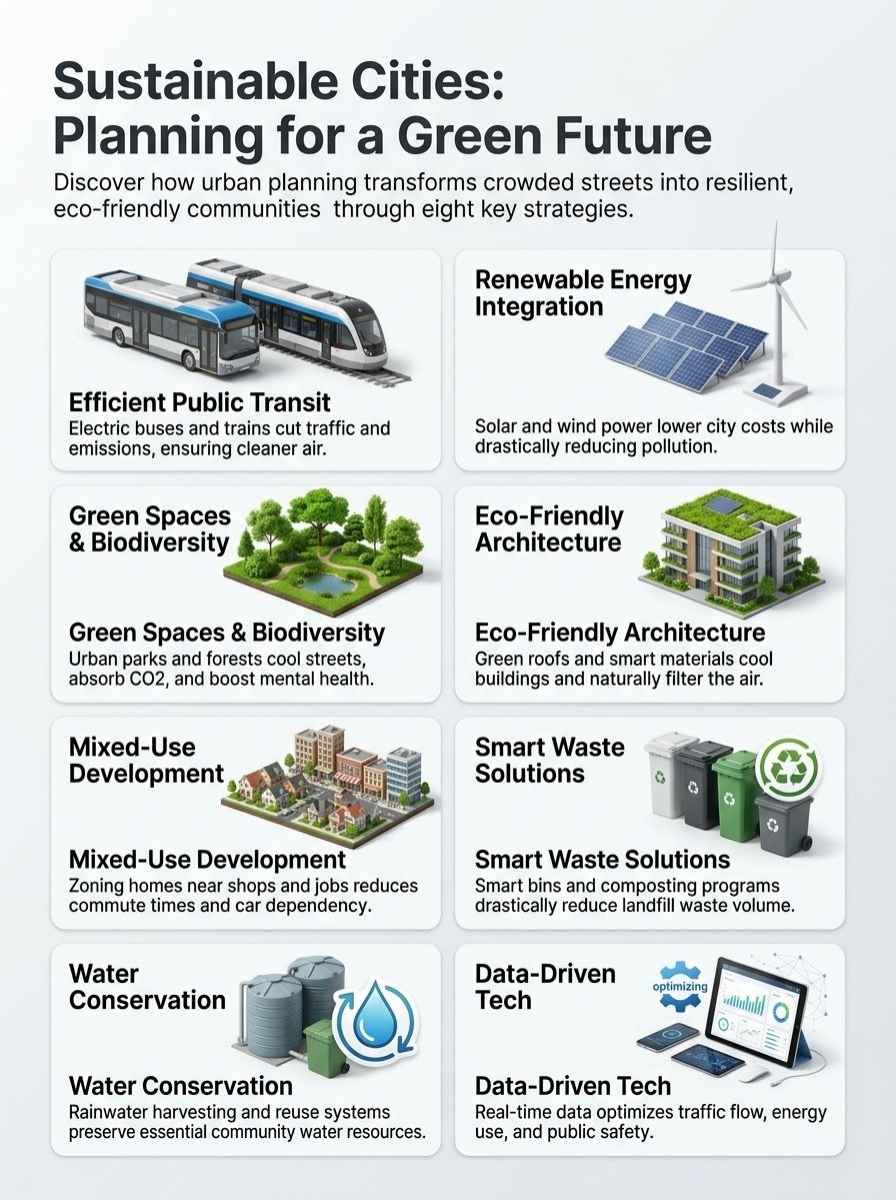
Sustainable cities feel different because they are built on a different set of rules. They prioritize health and efficiency over speed and sprawling growth.
Efficient Public Transportation
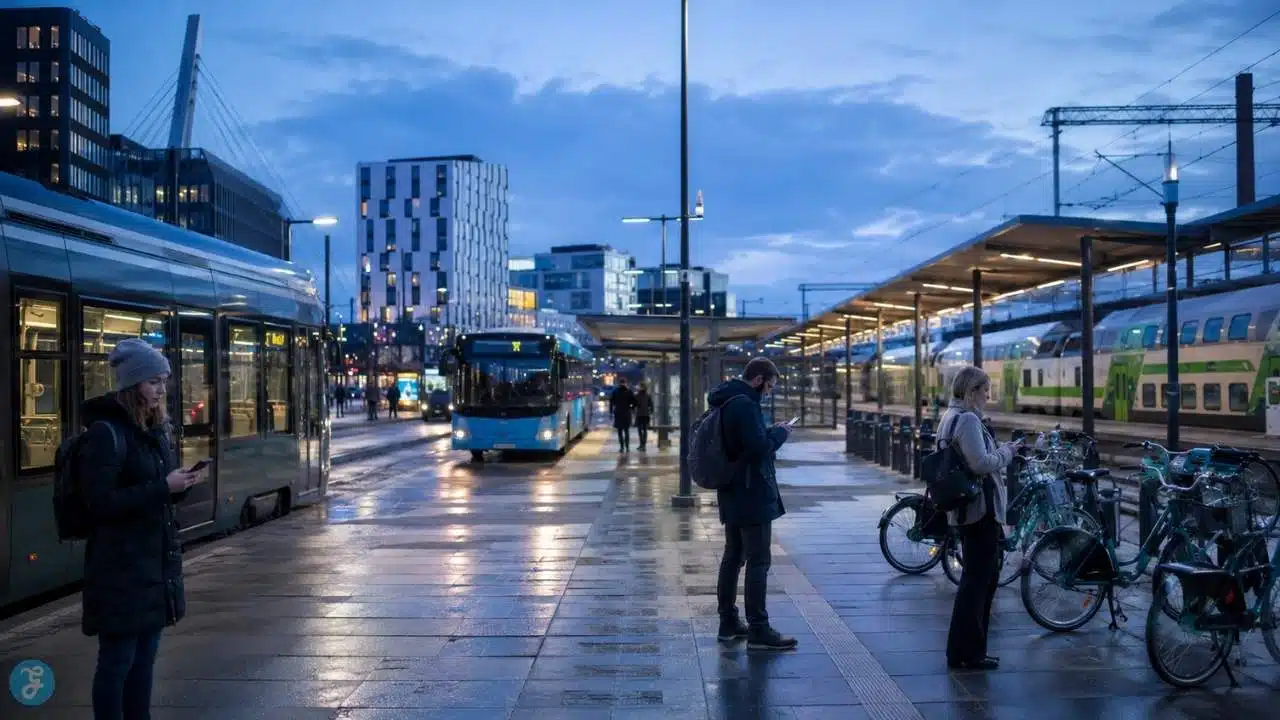
Great cities run on great transit. The goal is to make the bus or train the fastest option, not just the cheapest.
Take Cleveland, Ohio, for example. When they installed their HealthLine Bus Rapid Transit (BRT) system, they didn’t just paint a bus red. They gave it dedicated lanes and priority at traffic lights. The result? Wait times dropped by 63% and ridership jumped by 80%.
These systems work because they respect your time. Modern electric buses, like those used in Shenzhen, China (which has over 16,000 of them), cut noise and air pollution instantly. It makes the street pleasant enough that you might actually want to wait there.
Renewable Energy Integration
Cities are hungry for power, but they are changing what they eat. We are seeing a massive shift toward “microgrids” and local generation.
You might be surprised to know that Burlington, Vermont, runs on 100% renewable electricity. They use a mix of biomass, hydro, wind, and solar. The best part? Since making the switch, the city has reported that utility rates have remained stable or even effectively lower when adjusted for inflation compared to national spikes.
It isn’t just about giant wind turbines. It is about simple changes:
- Solar Streetlights: These charge all day and light up the sidewalk for free at night.
- Rooftop Solar: Schools and offices are turning unused roof space into mini power plants.
- EV Charging: Cities are installing public chargers at libraries and parks to encourage electric vehicle adoption.
Preservation of Green Spaces and Biodiversity
Green space is a public health necessity. Urban foresters often use the “3-30-300 Rule” developed by Cecil Konijnendijk to measure success. You can test your own home against it right now:
- Can you see at least 3 trees from your window?
- Does your neighborhood have 30% tree canopy cover?
- Do you live within 300 meters (about a 5-minute walk) of a park?
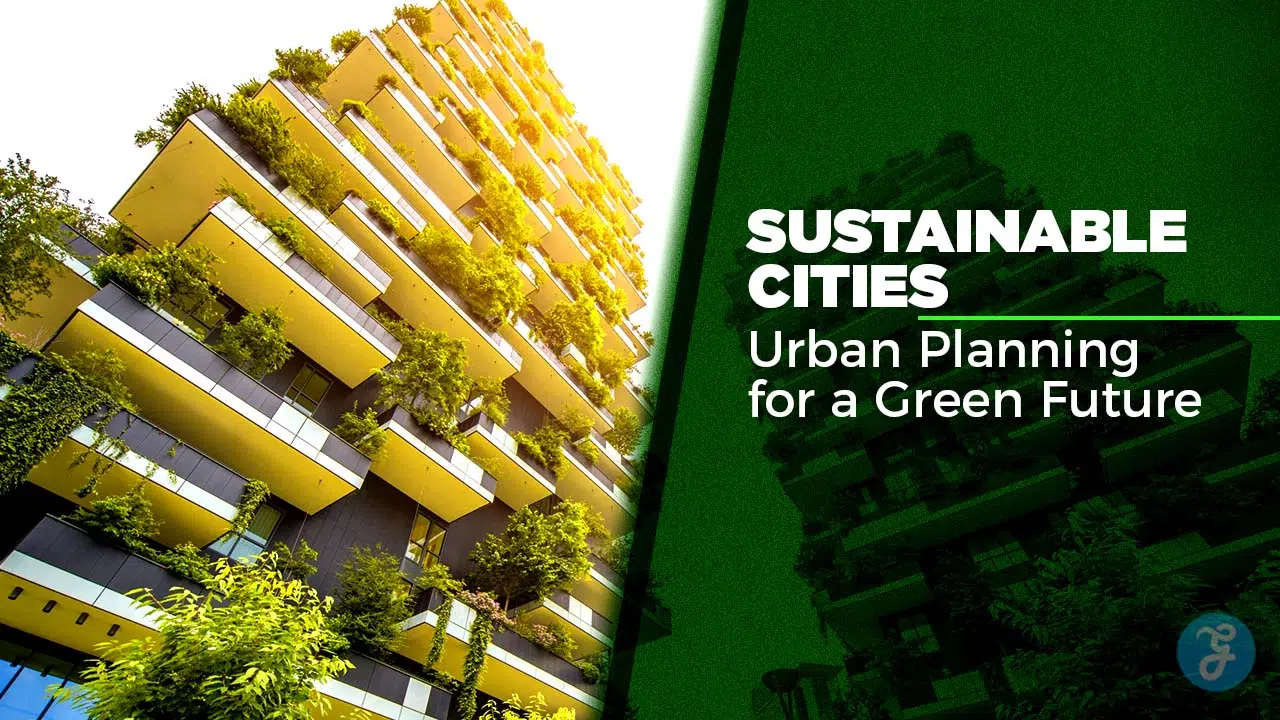
Meeting these numbers does more than look good. In Milan, Italy, the “Bosco Verticale” (Vertical Forest) towers host 20,000 plants that absorb 30 tons of carbon dioxide every year. These “living walls” cool the building and clean the air for the whole block.
Sustainable Architecture and Design
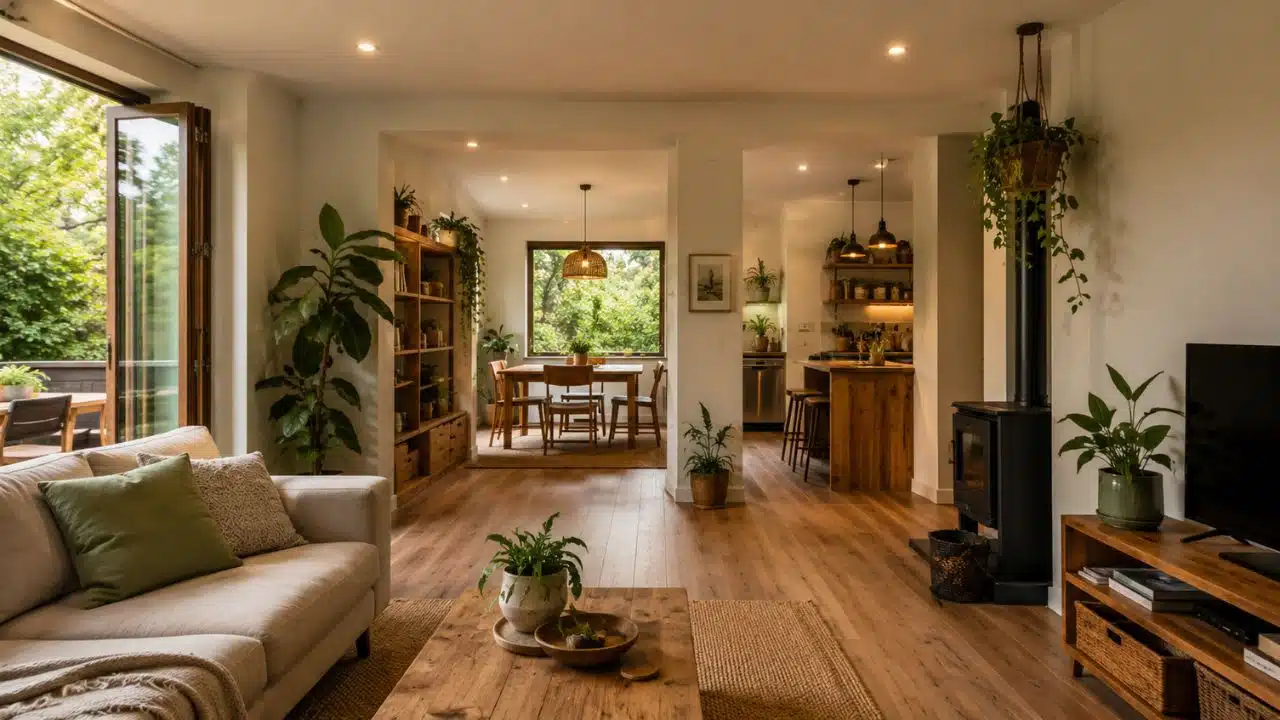
Green architecture focuses on doing more with less. This often means aiming for standards like LEED Platinum or Passive House certification, which virtually eliminates the need for heavy heating or cooling.
Key features often include:
- Green Roofs: Soil and plants on the roof insulate the building and soak up storm water.
- Smart Glass: Windows that tint automatically to block hot afternoon sun.
- Recycled Materials: Using reclaimed wood or recycled steel to lower the carbon footprint of construction.
Affordable housing projects are increasingly using these designs. Lower utility bills mean the housing stays affordable long after the tenants move in.
Urban Planning Strategies for a Green Future
Planners are solving the puzzle of how to fit more life into less space without it feeling crowded. Here are the strategies they are using.
Mixed-Use Development
This is the core of the “15-Minute City” concept. The idea is simple: you should be able to reach your doctor, grocery store, office, and school within a 15-minute walk or bike ride.
Mixed-use developments stack these needs. You might have a deli on the ground floor, a dentist on the second, and apartments on the top three. This drastically cuts down on car trips. When you don’t have to drive five miles for a gallon of milk, the whole city breathes easier.
Walkability and Cycling Infrastructure
If you build for cars, you get traffic. If you build for people, you get walkers.
Cities like Portland, Oregon, and Copenhagen have proven that if you build safe, separated lanes, people will cycle. Copenhagen’s famous “Cyerpelslangen” (Bicycle Snake) bridge makes biking faster than driving.
To make this work, planners use tools like:
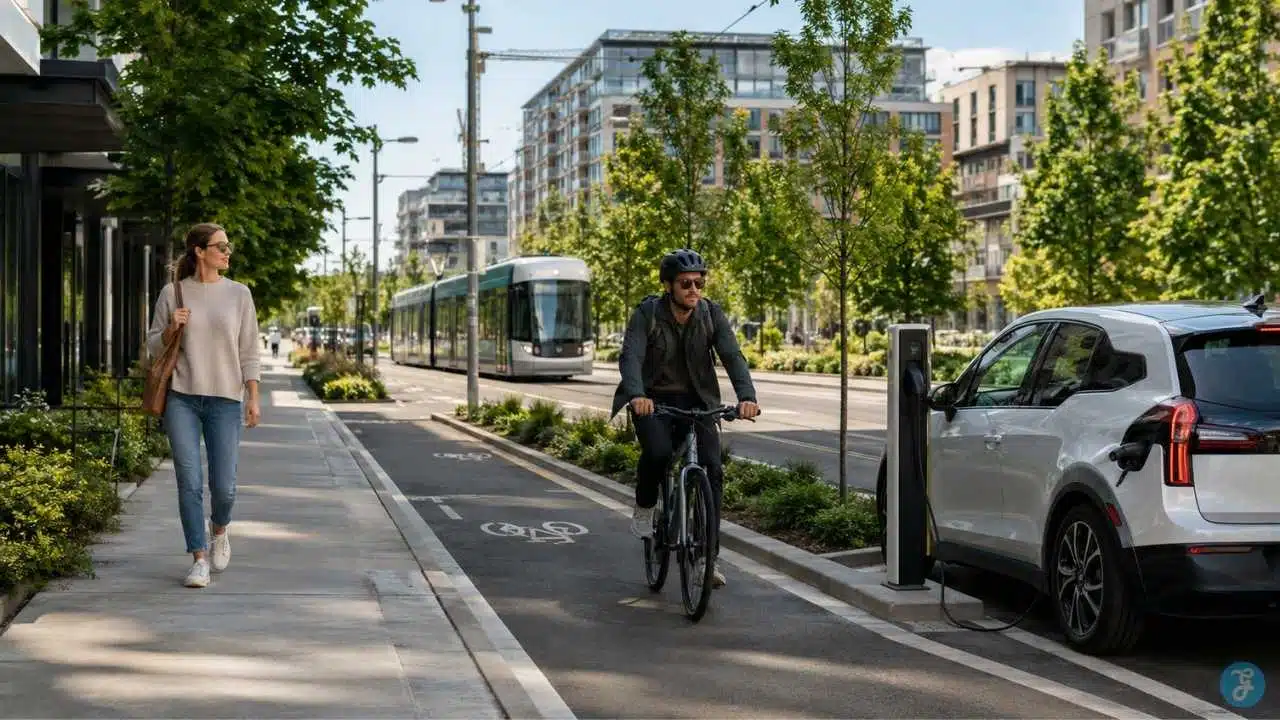
- Protected Bike Lanes: Using concrete barriers, not just paint, to separate bikes from cars.
- Wide Sidewalks: Enough room for a stroller and a couple walking side-by-side.
- Smart Lighting: LEDs that brighten when pedestrians are present to increase safety.
Innovative Waste Management Solutions
The days of the dumb trash can are numbered. Cities are rolling out smart bins like the Bigbelly solar compactor.
These bins use solar power to crush the trash inside, holding five times as much waste as a regular bin. Even better, they send a text message to the collection crew when they are full. This means garbage trucks stop driving meaningless routes to empty half-full cans, reducing fuel use and traffic congestion by up to 80%.
San Francisco has taken this further with aggressive composting laws, diverting 80% of its waste away from landfills. They turn food scraps into nutrient-rich soil for local farms, closing the loop entirely.
Water Conservation Practices
Concrete cities are terrible at handling rain. It hits the pavement, picks up oil, and floods the sewers. The solution is the “Sponge City” concept.
Philadelphia is a leader here with its “Green City, Clean Waters” program. Instead of building giant underground pipes, they installed over 2,800 green tools like rain gardens and porous pavement. These features soak up the water where it falls.
“Every drop of rain we keep out of the sewer is a drop we don’t have to pay to treat.”
This approach has kept billions of gallons of polluted water out of local rivers. It is a win-win: the city saves money on treatment, and the neighborhoods get beautiful gardens that manage the flood risk.
The Role of Technology in Sustainable Cities
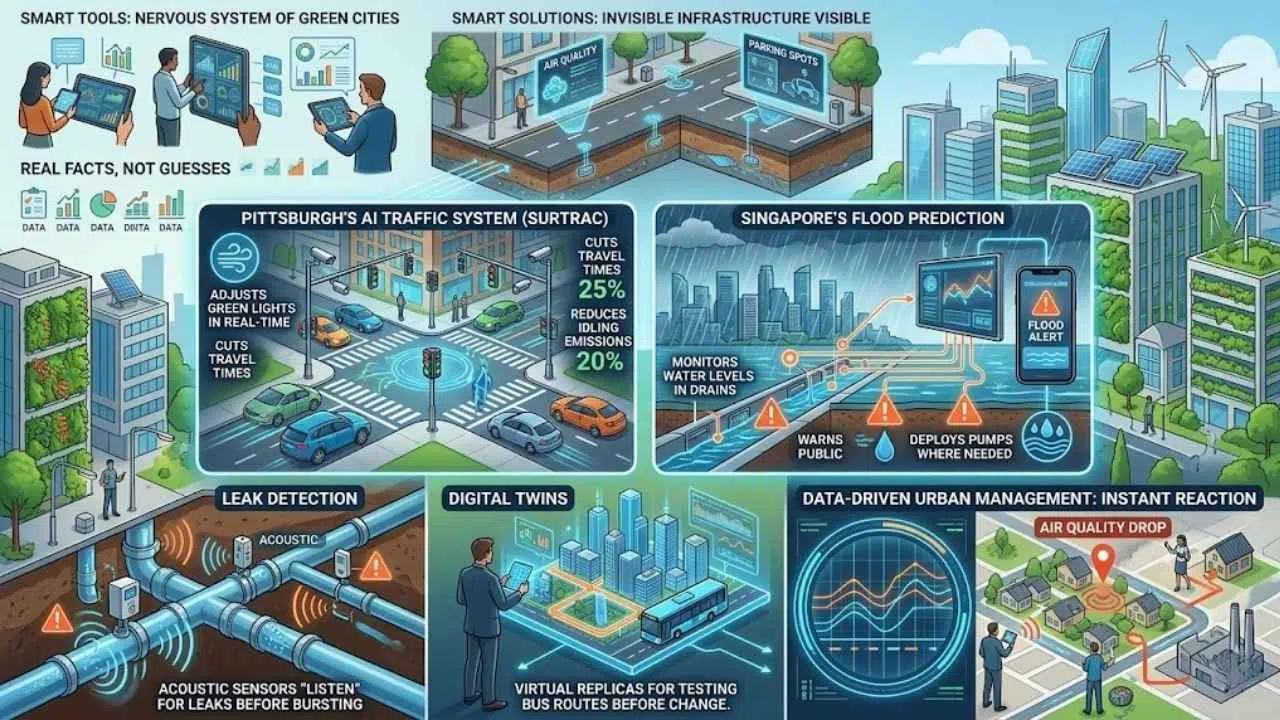
Smart tools act as the nervous system of a green city. They help leaders make decisions based on real facts, not just guesses.
Smart City Solutions
Technology is making invisible infrastructure visible. Cities are using IoT (Internet of Things) sensors to monitor everything from air quality to parking spots.
In Pittsburgh, an AI traffic system called Surtrac watches traffic in real-time. It adjusts the green lights to keep cars moving, which has cut travel times by 25% and idling emissions by 20%. You spend less time sitting at red lights, and the city gets cleaner air.
Other smart integrations include:
- Leak Detection: Acoustic sensors on water pipes that “listen” for leaks before they burst.
- Digital Twins: Virtual replicas of the city that let planners test new bus routes before they change a single sign.
Data-Driven Urban Management
Data allows cities to react instantly. If sensors show a sudden drop in air quality in a specific neighborhood, officials can alert residents or investigate local industrial sites immediately.
Singapore uses a massive sensor network to predict flooding. By monitoring water levels in drains during storms, they can warn the public and deploy pumps exactly where they are needed. This turns a potential disaster into a managed event.
Community and Policy Involvement
Technology is great, but people are the real engine of change. You don’t have to wait for city hall to get started.
Community-Driven Sustainability Initiatives
Grassroots movements often move faster than government. Tactical Urbanism is a great example. This involves citizens making small, temporary changes to show what is possible.
One famous event is Park(ing) Day, where people turn metered parking spots into tiny public parks for a day. It shows neighbors how much space is dedicated to cars and how it could be used for people instead.
Community gardens are another powerful tool. In Detroit, urban farming initiatives have turned thousands of vacant lots into productive food hubs. These don’t just grow carrots; they grow community resilience and lower local food costs.
Implementing Sustainable Policies
For long-term change, we need strong rules. City leaders use zoning laws and building codes to enforce sustainability.
Policies can include:
- Green Building Mandates: Requiring new large buildings to have solar panels or green roofs.
- Congestion Pricing: Charging cars a fee to enter the busiest city centers, like in London or Stockholm, to fund public transit.
- Plastic Bans: Eliminating single-use plastics to reduce landfill waste.
Global Examples of Sustainable Cities
Who is getting it right? Let’s look at three cities that are leading the pack.
Singapore
Singapore is the gold standard for “biophilic” design—design that loves nature. Despite being a dense metropolis, they have the Green Plan 2030.
One of their standout achievements is water independence. Through their “Four National Taps” strategy, they collect rainwater, recycle wastewater (which they call NEWater), and desalinate seawater. They have turned a vulnerability into a strength, ensuring they have water security regardless of the climate.
Copenhagen
Copenhagen is famously bike-friendly, but they are also pioneers in energy. They recently opened CopenHill, a waste-to-energy power plant that is so clean it has a ski slope on its roof.
While they recently had to adjust their aggressive 2025 carbon-neutral target due to carbon capture funding issues, their new goal is to be “climate positive” by 2035. This honesty and ambition keep them at the forefront of global innovation.
Curitiba
Curitiba, Brazil, proves you don’t need a massive budget to be smart. In the 1970s, Mayor Jaime Lerner invented the Bus Rapid Transit (BRT) system there.
Instead of building an expensive subway, they built “tube” stations and gave buses dedicated lanes. The system, known locally as the Ligeirinho, is used by 70% of the commuters. It is cheap, fast, and has been copied by over 150 cities worldwide.
Benefits of Sustainable Urban Development
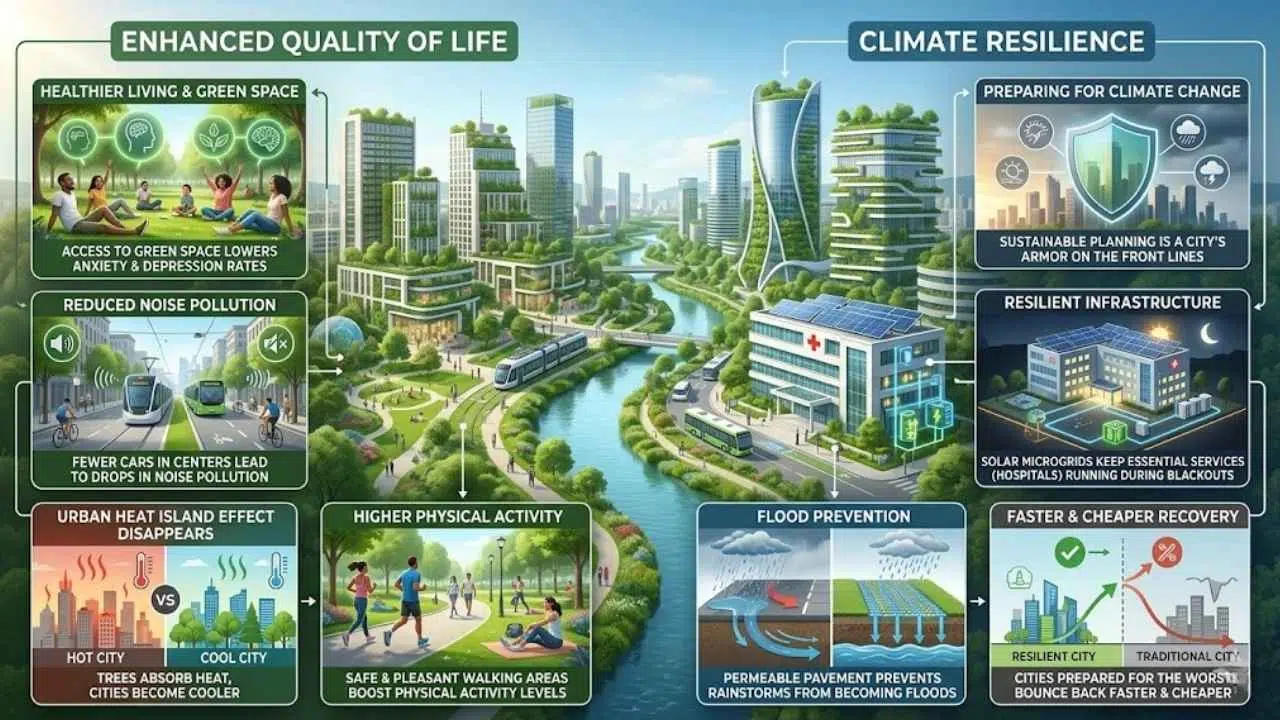
Why does all this matter? Because it makes life measurably better.
Enhanced Quality of Life
Living in a green city is simply healthier. Studies have shown that access to green space can significantly lower rates of anxiety and depression.
When you remove cars from the center, noise pollution drops. When you add trees, the “Urban Heat Island” effect (where concrete makes cities hotter than the countryside) disappears. Residents in sustainable cities often report higher physical activity levels because walking is safe and pleasant.
Climate Resilience
Cities are on the front lines of climate change. Sustainable planning is our armor.
Resilient infrastructure keeps the city running when disaster strikes. A solar microgrid can keep a hospital running during a blackout. Permeable pavement prevents a rainstorm from becoming a flood. By preparing for the worst, these cities ensure they can bounce back faster and cheaper than traditional ones.
Final Thoughts
Big ideas start with simple steps. Whether it is planting a tree, riding the bus, or choosing renewable energy, every action counts.
Urban planning for green cities makes our public transit better, our homes smarter, and our air cleaner. It transforms dull streets into lively places full of hope. So, take a look around your own neighborhood today. What is one small change you could advocate for tomorrow?