
Thinking about studying abroad can feel confusing. You probably have a million questions running through your head right now. Will I find a school that fits my goals? How will I handle the costs without a steady income? Can I actually fit into a place where I don’t speak the language?
Many students get stuck asking themselves where to start. You want a great education, but you also want an amazing life experience. It is a big decision.
Did you know that universities in Norway, Sweden, and Denmark rank among the best worldwide? These Nordic countries are famous for high-quality education and a modern, safe way of living.
This guide will walk you through exactly what you need. We will cover university choices, scholarship paths, and application steps. We will also break down daily costs and job tips for you as an international student.
Curious how Scandinavia could shape your future? Let’s get started.
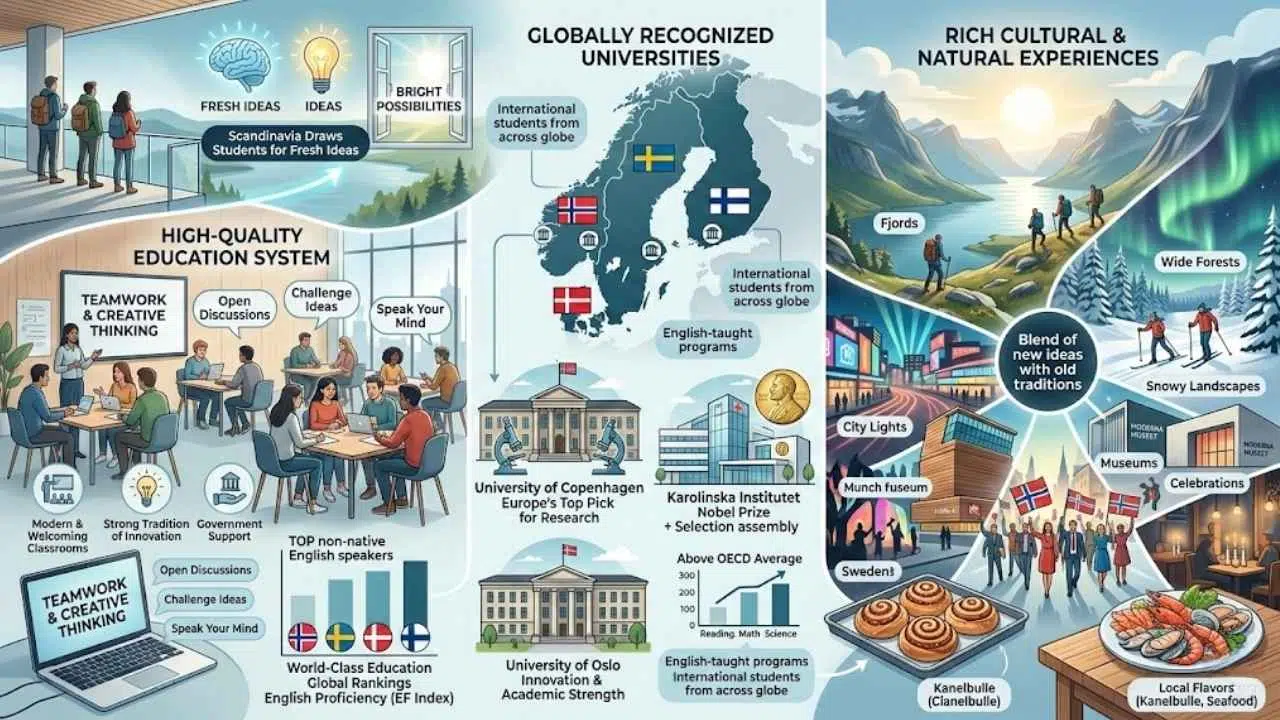
Scandinavia draws students from across the globe who are hungry for fresh ideas. Here, every day feels like opening a window to bright possibilities.
High-quality education system
Universities in Sweden, Denmark, Norway, and Finland rank among the best worldwide. A 2024 report by the EF English Proficiency Index consistently places these nations in the top tier for non-native English speakers. This means you can study and live comfortably without needing to be fluent in a Nordic language right away.
Students enjoy classes that focus on teamwork and creative thinking. Teachers here encourage open discussions instead of just lecturing at you. You are expected to challenge ideas and speak your mind.
Classrooms feel modern and welcoming. The education system follows a strong tradition of innovation all across Scandinavia. Government support keeps standards high while making higher education accessible.
Globally recognized universities
Scandinavian universities stand tall on the world stage. Schools in Norway, Sweden, Denmark, and Finland land high spots in global rankings every year.
For example, the University of Copenhagen shines as one of Europe’s top picks for research. If you are into medical sciences, Karolinska Institutet in Sweden is a powerhouse. They are the assembly that selects the Nobel Prize laureates in Physiology or Medicine.
Norway’s University of Oslo is known for innovation and a long tradition of academic strength. Education quality ranks above the OECD average in reading, math, and science across the Nordic countries.
“The teaching style here is very different from the US. It is less about memorizing facts and more about applying knowledge to solve real problems.” — A common sentiment shared by American exchange students on Reddit.
Modern campuses offer English-taught programs that attract international students from all corners of the globe. These places support fresh ideas and push the boundaries of discovery daily.
Rich cultural and natural experiences
Fjords, wide forests, and bright city lights fill Norway, Sweden, and Denmark. You can hike beneath the midnight sun in summer or ski across snowy landscapes in winter.
Art lovers find world-class museums like the Munch Museum in Oslo and Moderna Museet in Stockholm. Locals celebrate holidays with lively parades, cozy candlelight, and music.
Each country serves flavors you may have never tasted before. You must try a Kanelbulle (cinnamon bun) in Sweden or fresh seafood along Norway’s long coast. Life here blends new ideas with old traditions.
An Overview of Norway, Sweden, and Denmark
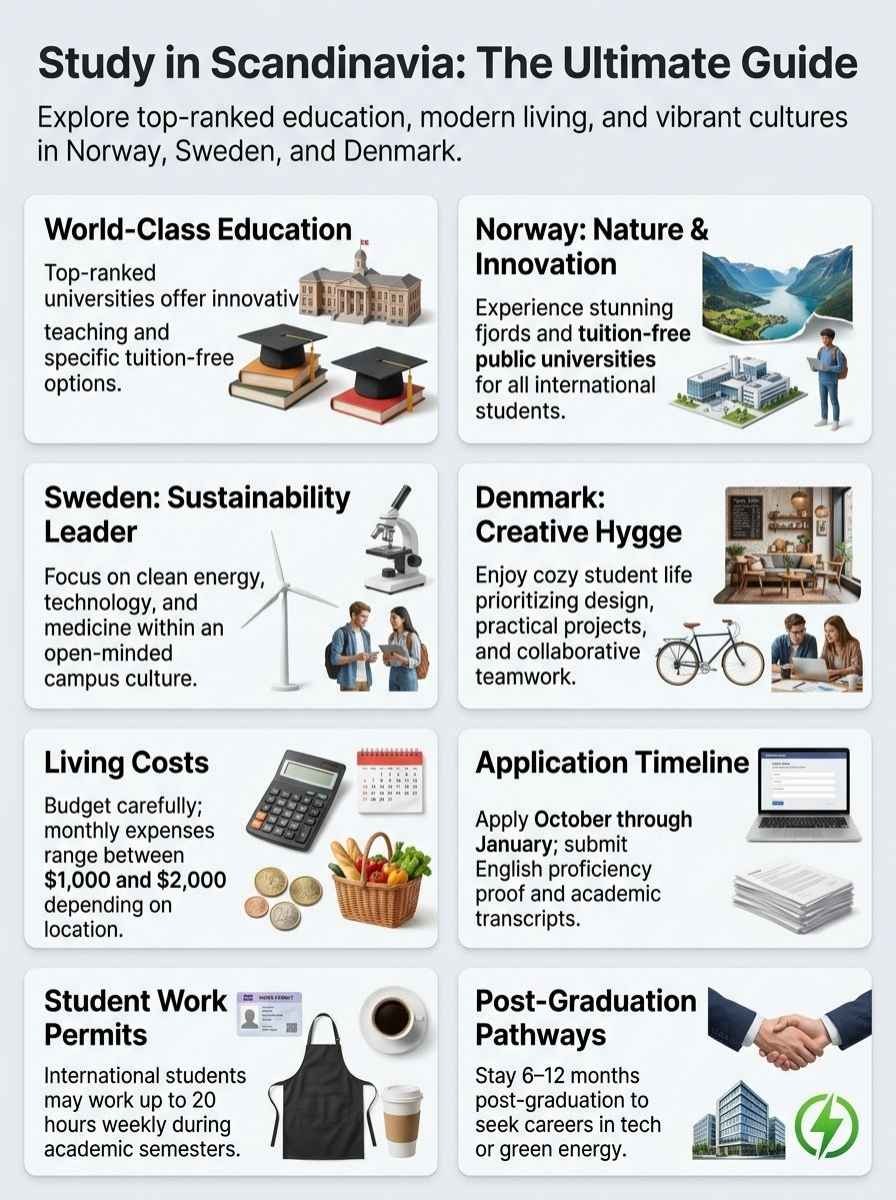
Each Nordic country shines in its own way. You will find fresh ways to live and learn in each one. There are stories waiting on every corner.
Norway: Land of fjords and innovation
Norway sits at the top for innovation and stunning views. Imagine crisp air, deep blue fjords, and green mountains stretching for miles.
The country offers world-class higher education. While Norway recently introduced tuition fees for students from outside the EU/EEA (like the US), the quality remains unmatched. A bachelor’s degree here opens doors to industries like marine biology and renewable energy.
Norwegian society values “Friluftsliv,” which translates to “open-air living.” This cultural concept means you are never far from nature, even when you are in the city center. It helps you balance hard study sessions with fresh air.
Living standards run high while cities blend technology with tradition. Norwegian society values creativity and research. This forward thinking filters right into university programs from engineering labs to art studios.
Sweden: Sustainability and cutting-edge research
Sweden puts the environment and clean energy at the top of its list. You will see recycling bins everywhere, from schools to city parks.
Swedish universities shine in areas like clean technology, medicine, and engineering. Research labs team up with big global names founded here, such as Spotify and Volvo. The country invests heavily in new ideas that help both people and nature.
Higher education here means learning how to solve real-world problems. International students often join projects about climate change or smart cities. Sweden’s universities use a flat hierarchy. You usually call your professors by their first name.
Life on campus feels open-minded and relaxed. A huge part of the culture is “Fika.” This is a mandatory coffee and cake break that happens daily. It is where the real networking and bonding happens, not just in the classroom.
Denmark: Creativity and hygge culture
Bright ideas bloom in Denmark. Students find innovation at every corner, from LEGO’s playful design to cool green technology.
Danish universities score high on global education charts. They place above the OECD average for reading, math, and science. The teaching style often uses Problem-Based Learning (PBL), so expect a lot of group work.
Life here feels cozy thanks to “Hygge.” This is a special Danish word that means warmth and comfort with friends or classmates. It makes the long winter nights feel welcoming rather than gloomy.
Cafés buzz with laughter as students gather after class. University programs often focus on practical projects. Tutors treat everyone equally. Your opinion counts whether you come from near or far.
You might sip cocoa during study sessions or join local events that celebrate art and music right in campus halls. Even rain can’t wash away the creative spirit thriving here.
Understanding the Cost of Living
Living costs in Scandinavia can surprise your wallet. It is important to peek ahead to find clever ways to stretch your budget.
Housing and accommodation
Student housing fills up fast in the Nordic countries. In Oslo, Stockholm, and Copenhagen, students often share apartments or live in university dorms.
Monthly rent can range from $400 to $1,000 USD depending on the city and location. For example, student housing organizations like SiO in Oslo or SSSB in Stockholm offer cheaper rates than the private market.
Dorm rooms might include basic furniture and shared kitchens. Private rentals cost more and can require a deposit of two or three months’ rent. Some universities offer help finding a place to stay, but choices may be limited for international students at first.
Pro-tip: Apply for student housing the moment you apply to the university. Do not wait for your acceptance letter, or you might end up at the bottom of a very long waiting list.
Food and transportation
Food prices in the Nordic countries can be high compared to the US. Eating out often costs $15 to $25 USD for a simple meal.
Cooking at home is the best way to save money. Grocery stores like Rema 1000 (Norway), Willys (Sweden), or Netto (Denmark) are popular spots for students. They offer fresh food without breaking the bank.
To save money on lunch, do as the locals do and pack a “Matpakke” (packed lunch). It is usually simple open-faced sandwiches. Buying lunch on campus every day will drain your bank account quickly.
Getting around is easy with public transit in cities such as Oslo, Stockholm, or Copenhagen. Monthly student passes usually cost between $50 and $80 USD. Make sure you download local apps like Ruter (Oslo) or SL (Stockholm) to buy tickets easily.
Biking is extremely common too. Flat streets make cycling safe and fast across Denmark and Sweden. Trains connect most major cities. Norway’s scenic routes show off mountains and fjords along the way.
University Application Process
Applying to universities in Norway, Sweden, and Denmark can feel like a puzzle. Here is how you can put the pieces together without the stress.
Key deadlines and requirements
Most universities in Scandinavia open their applications from October to January for the following academic year. The main round for Sweden usually closes in mid-January.
International students need a high school diploma and proof of English skills. You will likely need to submit scores from tests like TOEFL or IELTS unless you have exempted credentials. Check the specific requirements for each program carefully.
Each country has a centralized application portal that makes things easier:
- Sweden: Use Universityadmissions.se to apply to almost all courses.
- Denmark: Use Optagelse.dk for undergraduate programs.
- Norway: Use Samordna Opptak for undergrads, though some universities handle international applications directly on their own websites.
Deadlines for sending documents vary by country. Always check individual university dates to avoid missing out. Many scholarships have early deadlines that fall before the general application deadline.
Differences between Norway, Sweden, and Denmark
Studying in Scandinavia means you get three flavors of student life. Norway, Sweden, and Denmark each have features that stand out. Here is how they stack up for students:
| Aspect | Norway | Sweden | Denmark |
|---|---|---|---|
| Tuition Fees (Non-EU/US Students) | Approx. $12,000 – $35,000 USD per year (Fees introduced in 2023) | Approx. $8,000 – $25,000 USD per year depending on the program | Approx. $6,500 – $17,000 USD per year |
| Application Portal | Samordna Opptak / Local Uni Sites | Universityadmissions.se | Optagelse.dk |
| Language of Instruction | Masters mainly in English; Bachelors often in Norwegian | Over 1,000 programs in English (Masters & Bachelors) | Wide range of English programs, especially in business/design |
| Monthly Living Costs (Est.) | $1,200 – $2,000 USD | $1,000 – $1,800 USD | $1,200 – $1,800 USD |
| Culture & Vibe | Outdoor life (Friluftsliv), fjords, hiking | Progressive, sustainability-focused, Fika culture | Cozy living (Hygge), biking, design scene |
| Work Permit (Students) | Up to 20 hours/week | No hourly limit (but studies must come first) | Up to 20 hours/week |
Scholarships and Financial Aid
Worried about the price tag? Scholarships and grants might just open doors you never thought possible.
Government-funded scholarships
Scandinavian governments want talented international students. While tuition policies have changed, funding options still exist.
For US students, the Fulbright Program is a fantastic option for funding studies in Norway, Sweden, or Denmark. It is prestigious and covers a significant portion of costs.
Sweden offers the Swedish Institute Scholarships for Global Professionals. This covers full tuition and living expenses for master’s students from select countries. Denmark provides government scholarships to highly qualified non-EU/EEA students, which are often granted automatically by the university if you rank high enough in the application pool.
Application periods open during the year. Each has its own deadlines and rules. Scholarships give more people a chance to learn in top-rated universities.
University-specific grants
Many top universities in Norway, Sweden, and Denmark offer their own grants. These are often based on good grades or special talents.
For example, Lund University in Sweden has a Global Scholarship program that can cover 25%, 50%, or 100% of tuition fees. The University of Oslo may offer specific fellowships for PhD candidates.
Always check the “Tuition and Fees” section of each school’s website. Look for waivers or partial grants specifically for international students. A simple email to the admissions office can sometimes reveal funding sources that are not advertised loudly.
Working While Studying
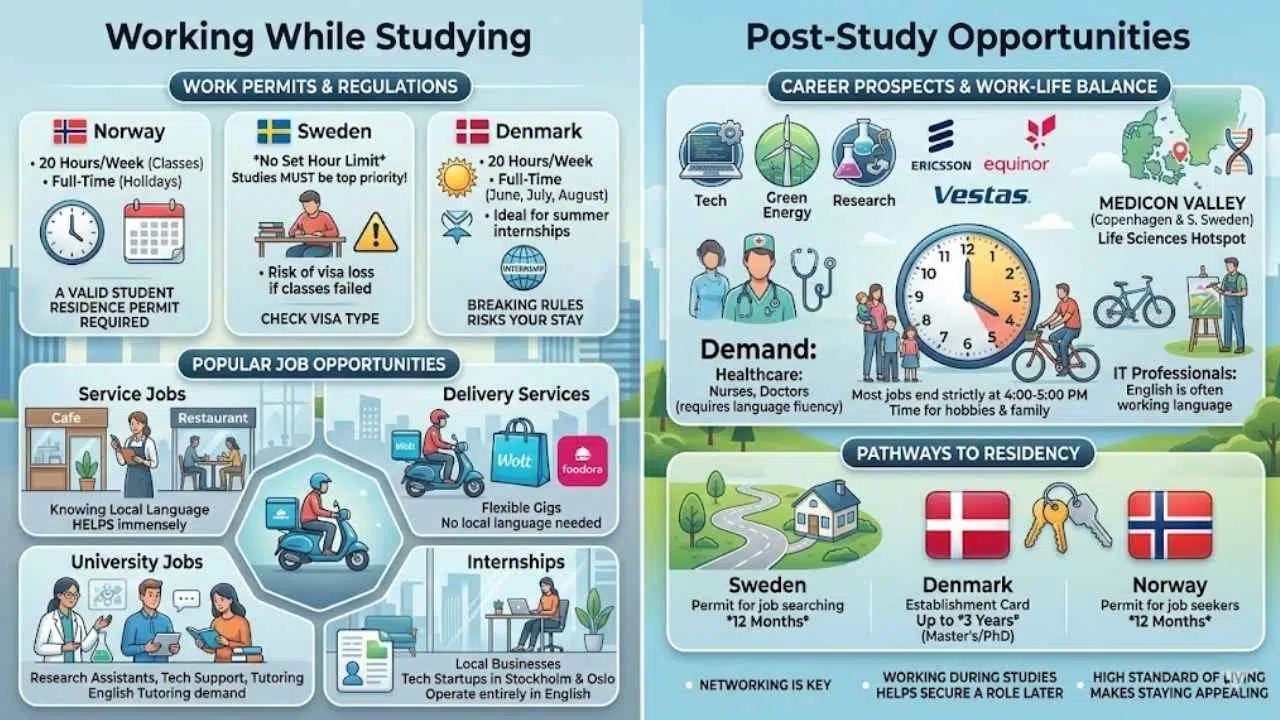
You can earn extra cash and gain work experience while studying in Scandinavia. It is a great way to offset costs.
Work permits and regulations
International students in Norway, Sweden, and Denmark need a valid student residence permit to work.
In Norway, students can work up to 20 hours per week while classes take place. You can work full-time during holidays.
Sweden is unique because it technically has no set hour limit for student work. However, your studies are expected to be your top priority. If you fail your classes, you risk losing your visa renewal.
Denmark allows 20 hours per week. During June, July, and August, you are allowed to work full-time. This is perfect for summer internships. Always check your visa type before beginning work. Breaking these rules can risk your stay as an international student.
Popular student job opportunities
Many students find work in cafes, restaurants, or shops. However, knowing a local language helps immensely in service jobs. Without local language skills, look for jobs in food delivery services like Wolt or Foodora. These are very popular flexible gigs for students in major Nordic cities.
Universities often post job offers for research assistants or part-time helpers. Tech support and tutoring are common options too. English tutoring is in demand, and native speakers often have an advantage.
You can also look into internships with local businesses. Many tech startups in Stockholm and Oslo operate entirely in English. This hands-on approach pays and helps build connections for your future.
Post-Study Opportunities
After your degree, doors swing open in Norway, Sweden, and Denmark. You might even find a place to call home.
Career prospects in Norway, Sweden, and Denmark
Graduates from universities here often land jobs fast. Tech companies, green energy firms, and research centers hunt for skilled workers.
Big names like Ericsson in Sweden, Equinor in Norway, or Vestas in Denmark hire international graduates every year. The “Medicon Valley” region spanning Copenhagen and southern Sweden is a global hotspot for life sciences jobs.
Nordic countries rank high for work-life balance. Most jobs end strictly at 4:00 PM or 5:00 PM. This gives you time for hobbies and family.
Public healthcare wants nurses and doctors, though this usually requires fluency in the local language. IT professionals are always needed, and English is often the working language in this sector.
Pathways to residency
Finishing your studies in Scandinavia can open doors to residency options. Each country wants to keep the talent it educated.
- Sweden: You can apply for a residence permit for looking for work after your studies. This gives you 12 months to find a job or start a business.
- Denmark: The “establishment card” allows you to stay and seek work for up to 3 years (for graduates with Master’s/PhD degrees) as of recent rule updates.
- Norway: Graduates can apply for a residence permit for job seekers for up to 12 months.
Working during your studies is the best way to secure a full-time role later. Networking is key in these small countries. The high standard of living makes staying appealing as you build your future here.
Final Thoughts
Choosing Scandinavia for your studies opens doors to quality education. You get to experience new cultures and amazing career paths. The steps are clear. The costs can be managed with good planning. There is strong support through scholarships and work options. Each country offers its own flavor of life. You get fjords in one place and cozy cafes in another. Tips from this guide help make big decisions easier.
For deeper insights, take a look at official government websites like Study in Sweden or Study in Denmark. Chatting with current students on forums like Reddit can also give you the real scoop. Your Scandinavian adventure could start today. Sometimes all it takes is that first bold click on an application form!