
Choosing where to study can feel like debugging a complex codebase without documentation. You worry about high tuition fees, language barriers, or simply being too far from your support network. You want a degree that acts as a solid backend for your career, but you also need a frontend experience, a daily life that feels welcoming and safe.
Here is a data point that might surprise you: Europe hosts over 4,000 higher education institutions. Many offer English-taught programs and charge tuition that is significantly lower than the heavy price tags you find in the United States or Australia. This guide functions as your documentation for the Best European Countries For International Students in 2026.
I will walk you through the student life metrics, post-graduation work protocols, and the integration scripts you need to fit in. Grab a coffee, and let’s optimize your study abroad plans.
Why Study in Europe?
Europe functions like an open-source framework for students. It offers modular opportunities where you can customize your experience, and the “API” between countries is seamless. Every street and classroom offers a new update to your personal growth.
Diverse educational opportunities
Germany treats education as a public good, offering tuition-free access at most public universities. France, Spain, and the Netherlands have deployed hundreds of English-taught degrees, removing the language barrier for global talent.
You can engineer systems at TU Munich in Germany or study design at Parsons Paris. The United Kingdom remains the gold standard for academic prestige, much like a legacy system that never loses value.
The Bologna Process is the underlying protocol here. It standardizes degrees across 49 countries, meaning a credit earned in Italy is valid in Sweden. This interoperability lets you build a network that stretches across borders.
Education is the passport to the future, for tomorrow belongs to those who prepare for it today.
Affordable tuition fees
Many European nations offer high-performance education without the enterprise-level costs. When you run the numbers, places like Germany or France offer incredible ROI.
In Germany, public universities charge zero tuition for undergraduate degrees as of 2026, requiring only a semester contribution of roughly €150 to €350. In France, the government subsidizes education heavily; even with recent adjustments, non-EU students often pay around €2,770 per year for a Bachelor’s, which is a fraction of US costs.
Spain keeps barriers low with public university fees averaging €1,500 annually. The Netherlands offers premium programs, with statutory fees for EU students around €2,500 and institutional fees for non-EU students starting at around €6,000.
Sweden and Finland maintain a “freemium” model: free for EU/EEA citizens, with fair pricing for global students that often includes full scholarships. This structure lightens the load on your wallet while delivering world-class output.
Rich cultural experiences
Students experience life beyond the documentation of textbooks. Art, music, and food are the user interface of Europe. In Spain, festivals like La Tomatina disrupt the routine. French cities offer a density of museums and cafés that is unmatched.
Germany’s castles and towns, like Heidelberg, provide a historical backdrop that informs modern life. Meeting new friends is as simple as joining a local “Stammtisch” or sharing an Italian espresso. Every country has unique protocols for celebration and living, allowing you to merge your culture with theirs effortlessly.
Next up: let’s debug the selection process to find a location that fits your budget and lifestyle.
Criteria for Selecting a European Country for Education
Picking the right country is like choosing your tech stack. It defines your workflow for the next few years. Small variables like cost of living or visa constraints can cause runtime errors if you don’t plan for them.
Evaluating Living Costs and Educational Expenses
You need to audit your financial inputs before committing. Costs vary wildly, so I have broken down the key metrics to help you forecast your budget.
- Tuition Range: Fees span from €0 in Germany to over $25,000 for premium UK programs.
- Housing Variance: A room in Paris might cost €900, while the same space in Valencia costs €400.
- Shared Economy: Using platforms like Kamernet in the Netherlands to find flatmates can cut housing costs by 30%.
- Funding Patches: Scholarships are your best bug fix for high costs; search for 2026 grants immediately.
- Work Rights: Countries like Sweden allow unlimited work hours, providing a critical income stream.
- Student ID Perks: The ISIC card grants discounts on transport and software essentials across borders.
- Budget Bands: Monthly spend ranges from $800 in Budapest to $2,000 in Zurich.
- Food Logic: Cooking at home is efficient; campus cafeterias like CROUS in France offer meals for as little as €1.
- Health Protocols: Mandatory insurance, like TK in Germany, costs around €120/month but provides full coverage.
- Transport: The Eurail Pass allows you to explore multiple countries on a student budget.
Researching Scholarship Opportunities
Scholarships are the venture capital of your study journey. They can lower your burn rate significantly. Many programs are designed specifically to attract international talent.
- University Portals: Check the “International Office” page of target schools first.
- Government Grants: Look for the DAAD in Germany, Campus France awards, or the Holland Scholarship.
- Regional Funding: Regions like Wallonia in Belgium often fund specific grants.
- Private Sector: Foundations like the Heinrich Böll Foundation support students in specific fields.
- Requirements: Each grant has strict validation rules. Check deadlines and document formats.
- Niche Awards: Some target specific demographics or fields like AI and engineering.
- Language Proof: High IELTS or TOEFL scores can trigger eligibility for merit-based aid.
- Early Execution: Apply as soon as the window opens; funds are limited resources.
- Network Data: Use Reddit threads on r/studyabroad to find past winners and get application tips.
Examining Work Options During and After Courses
Working while studying is a great way to offset costs and gain soft skills. Here is the current configuration for work rights in 2026.

| Country | Student Work Limit | Post-Grad Visa Duration |
|---|---|---|
| Germany | 20 hours/week | 18 months |
| France | 964 hours/year (~20h/week) | 12 months (RECE) |
| Spain | 30 hours/week (New Rule!) | 12 months |
| Netherlands | 16 hours/week | 12 months (Orientation Year) |
| Sweden | No official limit | 12 months |
| Ireland | 20 hours/week (40h on break) | 24 months (Master’s) |
| UK | 20 hours/week | 2 years (Graduate Route) |
Work experience adds immediate value to your resume. It enriches your daily life and boosts your career bandwidth across Europe.
Assessing Language Barriers and Cultural Integration
You do not always need to speak the local language to compile your code, but it helps with the user interface of life. In Germany, over 1,900 courses use English. The Netherlands and Sweden have English proficiency rates over 90%, making daily interactions frictionless.
However, edge cases exist outside the classroom. Bureaucracy often defaults to the local language. Joining student clubs helps break the ice. Experiencing local festivals and customs accelerates your integration and makes your profile more robust.
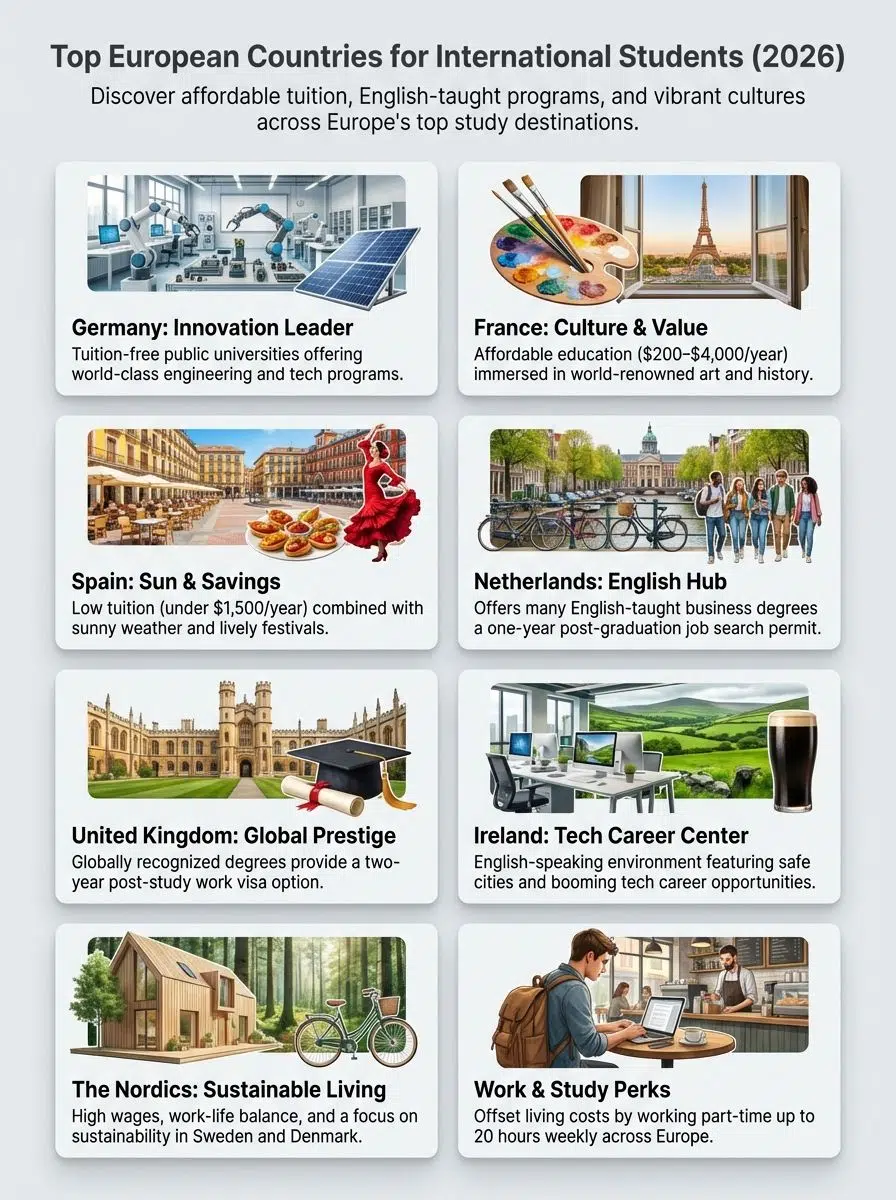
Top European Countries for International Students in 2026
Some countries in Europe have better operating systems for students than others. These nations stand out for their educational infrastructure, student scenes, and career throughput.
Germany: A leader in innovation and engineering
Germany is the powerhouse of European education. Public universities like RWTH Aachen and TU Berlin offer world-class engineering programs for effectively zero tuition. The only real cost is the semester contribution, which often includes a transport pass.
For 2026, you must prove you have financial stability through a Blocked Account (Sperrkonto). The required amount is €11,904 per year (or €992 per month). This money is yours to live on, but you must deposit it upfront to get your visa.
Students enjoy a rich life with efficient travel and cultural depth. Many companies, from Siemens to Berlin startups, actively recruit interns. The new Opportunity Card (Chancenkarte) also makes it easier for skilled workers to enter the market to look for jobs.
Pro-Tip: Health insurance is mandatory. Most students choose public providers like TK (Techniker Krankenkasse) because they offer excellent English support and digital services.
France: A blend of culture and world-class education
France offers a sophisticated architecture of culture and academics. Universities like Sorbonne University shine in global rankings. While public tuition has risen for non-EU students, it remains far cheaper than US alternatives, and many universities grant fee waivers.
A massive benefit in France is the CAF (Caisse d’Allocations Familiales). This housing subsidy can refund up to €200 of your monthly rent, even if you are an international student. Just be aware that administrative processing can have high latency, apply the moment you sign your lease.
Big cities like Paris and Lyon buzz with energy. Scholarship programs like Eiffel Excellence make studying affordable. You also get easy access to travel across Europe with your student visa.
Spain: Affordable education with vibrant student life
Spain has recently patched its immigration laws to be much friendlier. As of 2025/2026, international students in higher education can work up to 30 hours per week, a significant upgrade from the previous 20-hour limit. This makes it easier to support yourself financially.
Madrid and Barcelona are hubs of activity. You will need a NIE (Foreigner Identity Number) to do almost anything, from opening a bank account to getting a gym membership. Public universities charge low fees, often under €2,500.
Top spots like the University of Barcelona offer rigorous programs. The warm weather and endless festivals provide a user experience that is hard to beat. With affordable living costs, Spain is a high-value option.
Netherlands: A hub for technology and business education
The Netherlands is famous for its problem-based learning method, which encourages you to think like an engineer. Universities like Delft University of Technology are global leaders. However, you must be aware of the housing crisis. There is a shortage of about 410,000 homes, so finding a room in Amsterdam or Utrecht is extremely difficult.
Tuition for non-EU students is higher here, often ranging from €6,000 to €15,000. You will also need a BSN (Citizen Service Number) to work or open a bank account.
Warning: Do not wait until you arrive to find housing. Join waiting lists on sites like ROOM.nl months in advance, or use platforms like Kamernet. Some universities now advise students not to come if they haven’t secured housing by August.

Next up, explore what makes universities in the United Kingdom stand out worldwide.
United Kingdom: Renowned universities with global recognition
The UK hosts academic giants like Oxford, Cambridge, and Imperial College London. While tuition is high, the degree carries immense weight. The Graduate Route visa is a key feature, allowing you to stay and work for two years after graduation without a job offer.
Be prepared for the Immigration Health Surcharge (IHS), which costs students £776 per year on top of visa fees. This grants you access to the NHS.
Classes are in English, removing language friction. City life in Manchester or London offers a diverse, friendly student lifestyle. Public transport is excellent, making weekend trips to the countryside easy.
Sweden: Sustainability-focused education with excellent work conditions
Sweden is unique because it places no official limit on the number of hours an international student can work. As long as you keep your grades up, you can earn as much as you need. This is a rare feature in European immigration law.
You will need to budget for the residence permit maintenance requirement, which is approximately SEK 10,656 per month for 2026. Education emphasizes sustainability and flat hierarchies. Student life is organized around “Nations” (student clubs) in cities like Lund and Uppsala. English is spoken by everyone, so you will rarely face a communication error.
Best English-Speaking European Countries for International Students
If speaking English makes a place feel like home, these countries operate in your native language. Doors swing wide for global learners eager to hit the ground running.
Ireland
Ireland is the only English-speaking country in the EU post-Brexit, making it a strategic choice. The minimum wage is high, sitting at €13.50 per hour as of 2025, which helps offset living costs. You will register for a Stamp 2 visa, which permits work.
Dublin is the tech capital of Europe, hosting HQs for Google and Meta. While rent is high, cities like Cork and Galway offer a more affordable backend. Top universities include Trinity College Dublin and University College Cork.
The Third Level Graduate Scheme allows Master’s graduates to stay for 24 months to find work. This is a critical window for launching your career.
Denmark
Denmark offers free higher education to EU students, while international students pay between €8,000 and €21,000. The education style is flat and project-based, similar to working in a modern agile team.
Public universities like the University of Copenhagen offer extensive English catalogs. The “Establishment Card” allows graduates to stay and look for work. Denmark consistently ranks as one of the happiest countries, offering a safe and well-designed environment. English fluency is practically universal here.
Finland
Finland offers a streamlined approach to education. The Finland Scholarship is a massive perk for 2026; it often covers 100% of tuition and adds a €5,000 relocation grant for top applicants.
Students can work up to 30 hours per week, providing a good balance. Helsinki buzzes with a startup scene (home of Slush), while tuition fees for non-EU students range from €6,000 to €18,000.
Living costs in Helsinki are manageable compared to London or Paris. The Migri (immigration service) processes student residence permits quickly, often within a month.
Benefits of Studying in Europe
Studying in Europe refactors your mindset. It opens doors to new ideas, friendships, and career paths—keep reading to spark your curiosity!
Networking opportunities across borders
Europe is a dense network of cultures. You might collaborate on a project with a peer from Brazil and a professor from Japan. Events like Erasmus+ mixers bring diverse nodes together.
Job fairs connect you to industry giants like Airbus and ASML. LinkedIn groups and local meetups allow you to find mentors. These connections are the dependencies that will support your future career stack.
Access to diverse career paths
European degrees have high transferability. A Master’s from Germany is respected in Asia and the Americas. Graduates often find work faster because they possess the soft skill of adaptability.
Hubs like Berlin, Dublin, and Amsterdam are desperate for tech and engineering talent. Visa pathways for graduates are designed to retain this talent.
Enhanced global perspective
Living abroad forces you to update your internal operating system. You learn to handle ambiguity and adapt to new protocols daily. Employers value this “cultural latency”, the ability to switch contexts without crashing. You grow as a person while earning your degree, building a profile that is ready for the global market.
Wrapping Up
Choosing the best European countries for international students is a major decision in your life. Countries across Europe offer robust degree programs, helpful support services, and exciting travel options. Scholarships can significantly reduce your financial load.
Cities like Berlin, Paris, and Dublin provide a vibrant backdrop that keeps you learning outside the classroom. Many universities allow you to work, giving you hands-on experience and cash flow. Remember to check the specific visa requirements, like the blocked account in Germany or the housing situation in the Netherlands. You will meet friends from around the world and build a network that lasts a lifetime.
Student visas are easier to get in some countries than others, so always verify the latest 2026 rules on official government sites before applying.