
Solarpunk aesthetic: definition and origin history (2008, Republic of the Bees Solarpunk manifesto by Adam Flynn); difference between solarpunk and cyberpunk; agrivoltaics benefits and U.S. statistics (2024–2025). Biophilic design productivity statistics (Terrapin Bright Green); Babcock Ranch solar hurricane survival (2024).
The Kendeda Building for Innovative Sustainable Design features. Renewable energy job growth in the U.S. (2025, Bureau of Labor Statistics wind technician data). Cost of residential solar panel installation in the U.S. (2025). Green gentrification and the High Line effect statistics. Chobani “Dear Alice” solarpunk commercial; solarpunk art and Studio Ghibli influence; solarpunk literary examples (The Dispossessed, Ecotopia); solar energy growth in the U.S. (2024 Solar Energy Industries Association report).
Have you ever looked at a crowded highway or a gray city street and wondered if there is a better way to live? I certainly have. It’s easy to feel overwhelmed when the news is full of climate warnings and pollution stats. But here is a thought that keeps me going: what if the future isn’t a disaster, but a garden?
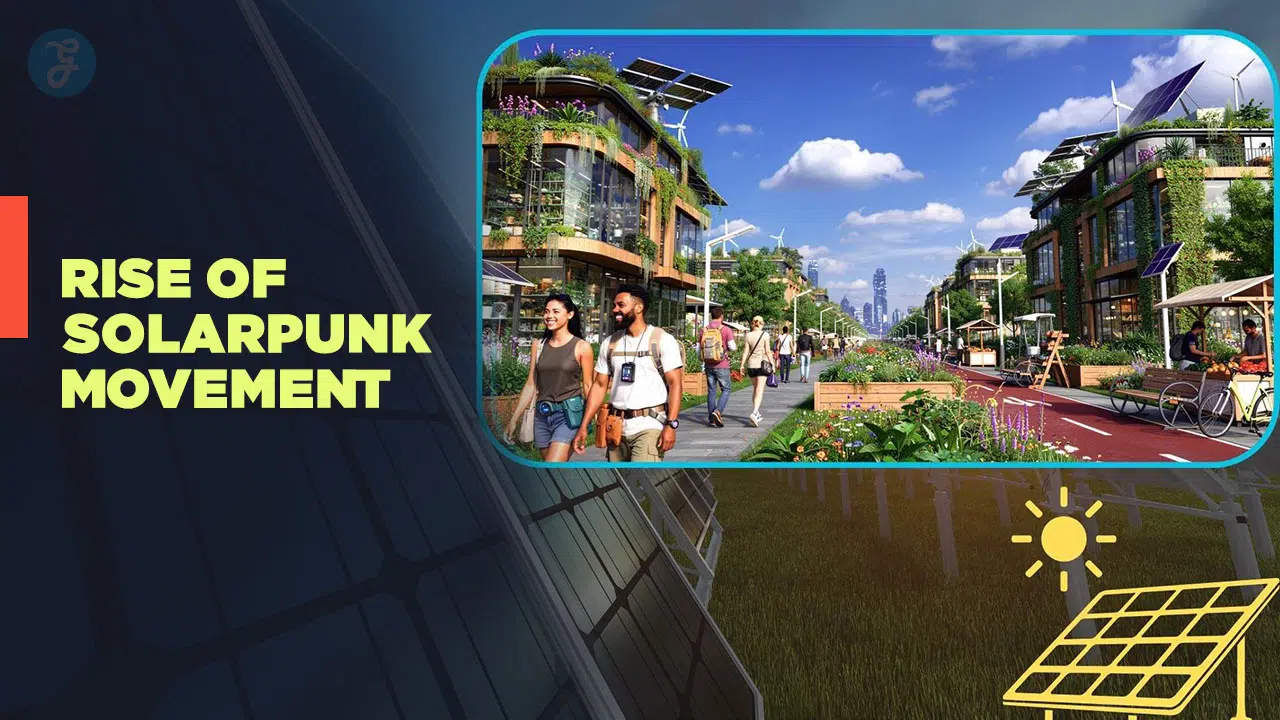
That is the core question behind the solarpunk aesthetic. Artists and writers have started dreaming up a world where technology and nature actually get along.
Imagine neighborhoods where the rooftops are green, the power comes from the sun, and the birds are just as welcome as the people.
Here is exactly what this movement is all about.
We will look at the tech, the style, and the community spirit that makes it tick. Grab a comfortable seat, and let’s explore this bright green vision together.
What is the Solarpunk Aesthetic?

Solarpunk is more than just pretty art; it is a movement that envisions a future where humanity solves its biggest environmental problems. It paints a picture where high-tech innovation meets the wildness of the natural world.
Instead of fearing the future, solarpunk asks us to build a version of it that we actually want to live in.
Definition and core principles
At its heart, solarpunk is a genre of speculative fiction and art that rejects the “doom and gloom” of typical sci-fi. It imagines a world powered entirely by renewable energy like solar and wind. But it goes deeper than just energy.
It creates a visual language of “agrivoltaics,” where farming and solar panels coexist on the same land to boost efficiency. The aesthetic borrows heavily from the Art Nouveau movement of the early 20th century.
You will see lots of organic curves and stained glass, but updated with modern eco-tech.
According to the Solarpunk Manifesto, a foundational text by the community, the goal is to emphasize “ingenuity, generativity, independence, and community.”
It is about decentralization. This means neighborhoods managing their own power grids and food sources rather than relying on massive, distant corporations.
Connection between technology and nature
In a solarpunk world, technology doesn’t dominate nature; it mimics it. This concept is often called biomimicry. Designers look to biological systems to solve engineering problems, like cooling buildings the way termite mounds release heat.
For example, you might see “smart glass” windows that adjust their tint based on sunlight to reduce the need for air conditioning.
Nature is not just decoration here.
It is infrastructure.
Green walls do the heavy lifting of filtering air pollution and lowering city temperatures.
A 2024 report by the Solar Energy Industries Association (SEIA) highlighted that solar capacity in the US has grown enough to power millions of homes, proving this tech is ready for prime time.
The aesthetic blends these functional technologies with lush greenery.
It creates a visual style where a wind turbine looks as natural as the tree standing next to it.
The Origins of Solarpunk
Solarpunk didn’t just appear out of nowhere.
It grew from a collective desire to see a future that wasn’t a wasteland.
People wanted stories that offered solutions, not just warnings.
Early inspirations and influences
The movement has deep roots in the environmental activism of the 1960s and 70s.
Two major literary works laid the groundwork.
Ursula K. Le Guin’s The Dispossessed explored anarcho-collectivist societies that live in scarcity but with great social wealth.
Similarly, Ernest Callenbach’s Ecotopia imagined the Pacific Northwest seceding to form a stable-state ecosystem.
The term “solarpunk” itself gained traction online around 2008.
It started with a blog post on Republic of the Bees titled “From Steampunk to Solarpunk.”
The author suggested that while steampunk focused on the industrial past, we needed a new genre to focus on a sustainable future.
This sparked a wave of creativity on platforms like Tumblr.
Users began sharing images of vertical gardens and stained-glass solar panels, giving the movement its distinct visual identity.
Rise of the movement in literature and art
By the early 2010s, solarpunk evolved from a blog topic into a full literary subgenre.
Anthologies like Solarpunk: Ecological and Fantastical Stories in a Sustainable World began to appear.
These stories focused on “MacGyver-ing” solutions to climate change using existing technology.
Visual inspiration also came from unlikely places.
Many fans point to the films of Hayao Miyazaki and Studio Ghibli.
Movies like Nausicaä of the Valley of the Wind depict societies trying to heal a broken world and live alongside nature.
More recently, the Chobani “Dear Alice” commercial became a viral example of the aesthetic.
It showed a futuristic farm where robots and people worked in harmony under a bright blue sky.
This mix of high-culture literature and pop-culture visuals helped solarpunk reach a much wider audience.
Key Elements of the Solarpunk Vision
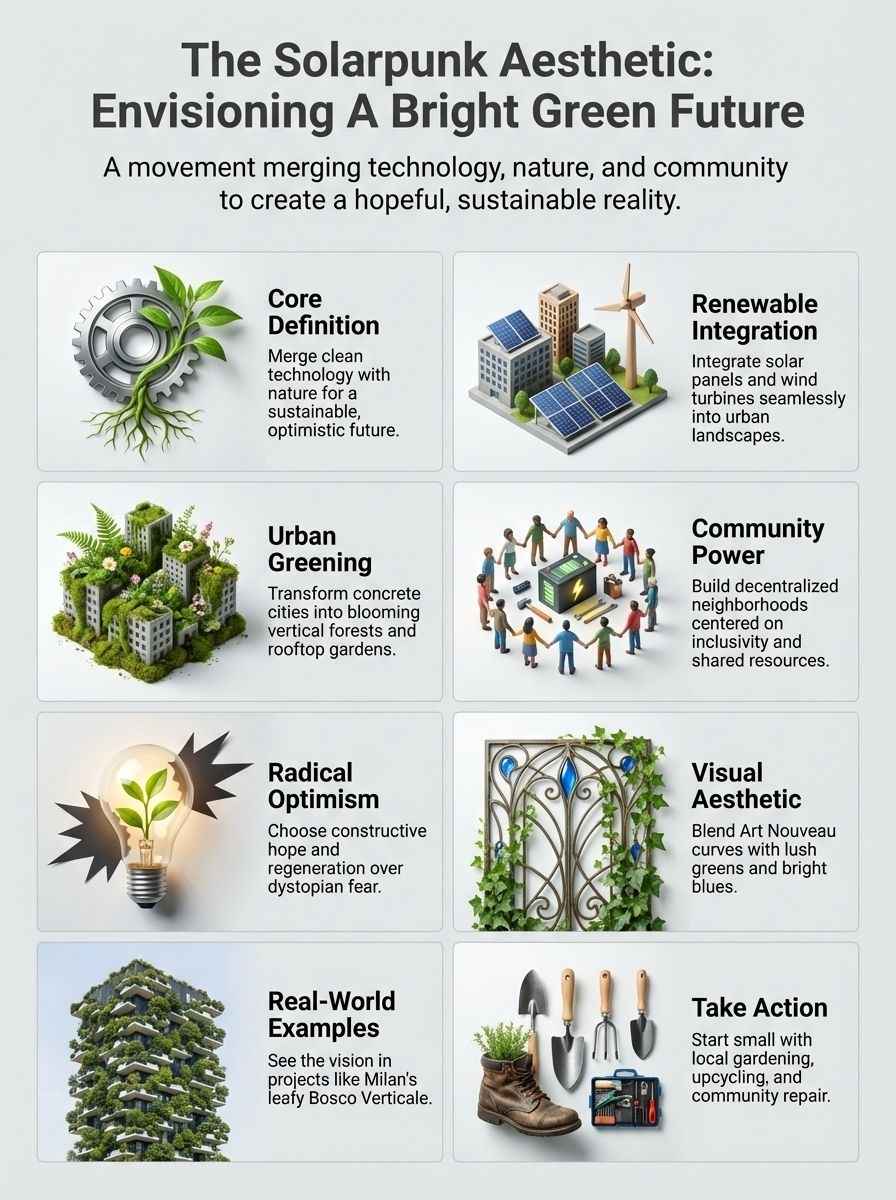
Imagine walking through a city where the air smells like rain and jasmine instead of exhaust.
That is the vibe solarpunk aims for.
It combines three main pillars to build this reality.
Renewable energy and sustainable design
The most obvious element is the energy source.
You see solar panels everywhere, but they aren’t just ugly black rectangles.
They are integrated into windows, roof shingles, and even clothing.
Passive House design principles are standard here.
This construction standard reduces a building’s ecological footprint by requiring ultra-low energy for heating and cooling.
Water is another huge focus.
Rainwater harvesting systems are visible artistic features, not hidden pipes.
Designers use biophilic design to boost mental health.
A report by Terrapin Bright Green found that incorporating nature into design can improve cognitive function and well-being by over 15%.
It turns out that seeing green leaves while you work actually helps you think better.
Community-focused living and inclusivity
Solarpunk is deeply social.
It assumes that we survive the climate crisis by helping each other, not by hiding in bunkers.
You will often read about “maker spaces” and “repair cafes.”
These are local spots where neighbors teach each other how to fix electronics or mend clothes to reduce waste.
Inclusivity is non-negotiable in this vision.
Public spaces are designed for all bodies and abilities.
Sidewalks are wide and shaded by fruit trees that anyone can harvest from.
The philosophy is that technology should lift everyone up.
It rejects the idea that a green future is only for the wealthy who can afford it.
Integration of nature into urban spaces
In solarpunk cities, concrete is the exception, not the rule.
Skyscrapers act as vertical forests.
This isn’t just a fantasy; it fights the “Urban Heat Island” effect.
Plants release moisture that cools the air, replacing the need for massive AC units.
You might see moss graffiti on walls or mycelium (mushroom) bricks being used for construction.
Even the lighting is different.
Bioluminescent plants or low-pollution LED streetlights keep the stars visible at night.
It is a deliberate attempt to make the city feel like a living organism.
Solarpunk in Practice
You might think this is all just drawings and daydreams, but real-world projects are already proving the concept works.
Engineers and architects are building the future right now.
Green architecture and urban planning
We are seeing a shift toward “regenerative architecture.”
This means buildings that give back more than they take.
They treat their own wastewater and generate their own power.
In the US, the Living Building Challenge sets the bar for this kind of construction.
To pass, a building must produce more energy than it consumes and collect all its own water.
Urban planners are also rethinking the street.
“Superblocks” are gaining popularity.
This idea groups several city blocks together and bans through-traffic, turning the streets into pedestrian parks.
It gives the city back to the people and the plants.
Examples of solarpunk-inspired projects
You can visit places today that feel like they jumped straight out of a solarpunk novel.
Here are some standout examples that bridge the gap between dream and reality.
- Babcock Ranch, Florida: This is America’s first solar-powered town. It was built to withstand climate change. When Hurricane Ian hit in 2022, the town never lost power and suffered minimal damage, proving that resilient design works.
- The Kendeda Building, Atlanta: Located at Georgia Tech, this building generates 225% of the energy it needs. It captures rainwater for all its uses and even has a rooftop garden that doubles as a lab.
- Bosco Verticale, Milan: The famous “Vertical Forest” towers host 900 trees and 20,000 plants. They act as a lung for the city, filtering dust and creating a microclimate.
- Gardens by the Bay, Singapore: The Supertrees here are massive vertical gardens that harvest solar energy and collect rainwater. They are a perfect example of high-tech biomimicry.
- Vauban District, Germany: A neighborhood where cars are rare. Most people walk or bike, and houses are built to “plus-energy” standards, meaning they make money by selling power back to the grid.
- Via Verde, Mexico City: A project that turned highway pillars into vertical gardens. It uses recycled rainwater to keep over 60,000 plants alive, filtering smog from the heavy traffic.
- CopenHill, Copenhagen: A waste-to-energy plant that is so clean, they built a ski slope on top of it. It turns trash into power while providing a recreational space for locals.
- Solar Trees at George Washington University: These structures in Washington, D.C., look like trees but provide shade and solar power for students to charge their devices.
- Michigan Urban Farming Initiative, Detroit: This group transformed vacant urban lots into a productive “agrihood.” It provides fresh, free produce to the community and fights food insecurity.
- Valley, Amsterdam: A mixed-use building that looks like a rocky canyon covered in greenery. It was designed by MVRDV to bring the human scale back to high-rise living.
The Philosophy Behind Solarpunk
Solarpunk is unique because it is a rebellion based on hope.
It refuses to accept that our destruction is inevitable.
The focus on optimism and regeneration
We often hear the phrase “it is easier to imagine the end of the world than the end of capitalism.”
Solarpunk challenges that directly.
It focuses on regeneration—fixing what we have broken.
This aligns with the concept of “Hopepunk,” a literary genre where kindness and optimism are weapons against cynicism.
It is not blind optimism, though.
It acknowledges the damage we have done to the climate.
But instead of despair, it offers a toolkit.
It champions the idea that human beings can be a healing force on the planet, not just a virus.
Rejecting dystopian futures for hopeful solutions
To understand solarpunk, it helps to compare it to its darker cousin, cyberpunk.
Cyberpunk warns us about a future of high tech and low quality of life.
Solarpunk strives for high tech and high quality of life.
| Feature | Cyberpunk | Solarpunk |
|---|---|---|
| Environment | Polluted, rainy, concrete | Lush, sunny, green |
| Technology | Oppressive, surveillance-heavy | Liberating, eco-friendly |
| Atmosphere | Cynical, corporate-ruled | Hopeful, community-led |
This comparison clarifies the choice we have.
Solarpunk argues that we can use our incredible technology to liberate ourselves rather than enslave ourselves.
It is a choice to plant a garden in the ruins rather than just taking a picture of the wreckage.
The Role of Art and Storytelling in Solarpunk
Art has a job to do here.
It makes the future feel possible.
Before we can build a better world, we have to be able to see it in our minds.
Influence of speculative fiction and visual arts
Artists like Teagan White and Victo Ngai have popularized the aesthetic with intricate illustrations of nature overtaking industry.
Their work often features soft, warm colors and intricate details that celebrate biodiversity.
In literature, anthologies like Glass and Gardens: Solarpunk Summers give writers a space to explore these themes.
These stories move away from the “hero’s journey” of one person saving the world.
Instead, they often focus on communities working together to solve local problems.
It shifts the narrative from individual glory to collective survival.
How narratives shape perceptions of the future
Stories act as blueprints.
When we read about a city that successfully composts all its waste or a neighborhood that owns its power grid, it stops sounding like magic.
It starts sounding like a plan.
This is crucial for mental health.
“Climate anxiety” is a real struggle for many people today.
Solarpunk narratives offer a psychological refuge.
They remind us that the future is not written in stone and that our actions today can actually steer the ship in a better direction.
Challenges and Criticisms of Solarpunk
Of course, no movement is perfect.
Solarpunk faces valid questions about how realistic it really is.
We need to look at these challenges honestly.
Balancing idealism with realistic implementation
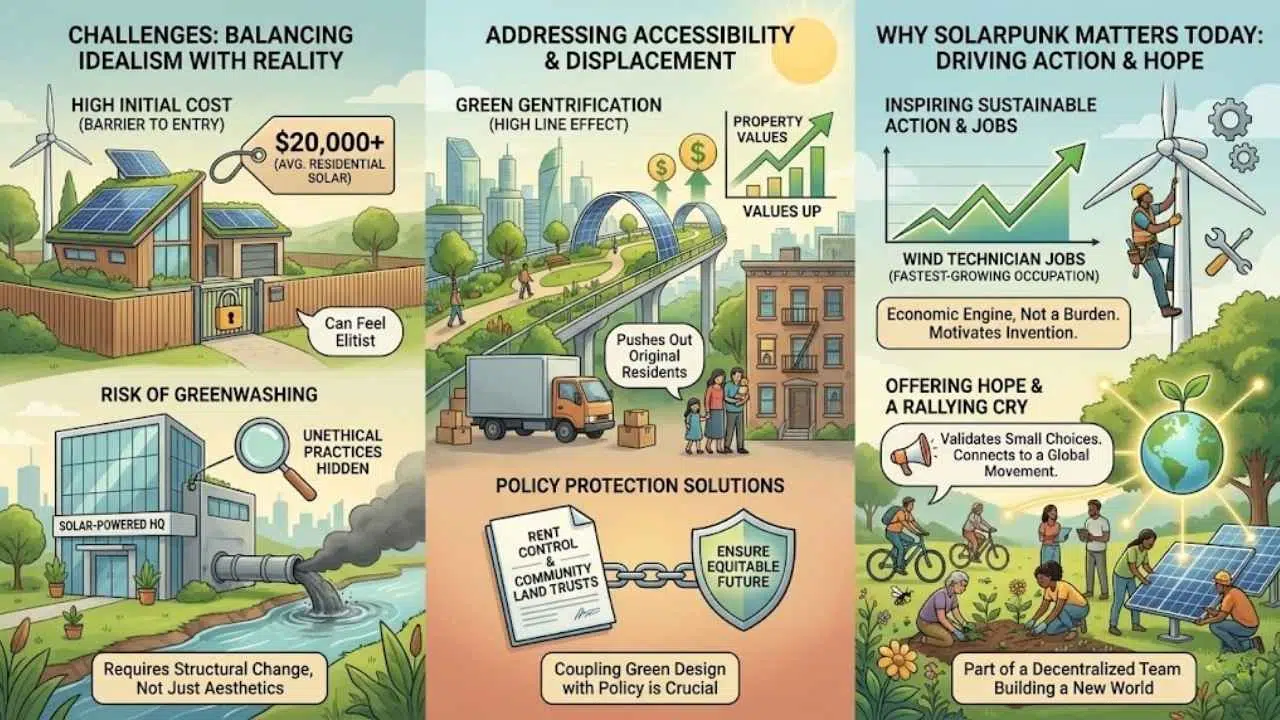
One major critique is the cost.
Green technology is expensive.
In the US, the average cost of a residential solar panel system is over $20,000 before incentives.
This creates a barrier to entry that can make the movement feel elitist.
There is also the risk of “greenwashing.”
This happens when corporations use the solarpunk look—plants in the lobby, solar panels on the roof—to hide unethical practices.
A pretty building doesn’t matter if the company inside is still polluting the river.
True solarpunk requires structural change, not just a coat of green paint.
Addressing accessibility and global application
Another issue is “green gentrification.”
This is a phenomenon where adding green spaces, like the famous High Line in New York, drives up property values.
It can end up pushing out the original low-income residents the project was meant to help.
Solarpunk advocates argue that we must couple green design with policy protection.
Rent control and community land trusts are just as important as the solar panels.
The goal is to ensure that a green future doesn’t become a luxury product reserved for the few.
Why Solarpunk Matters Today
You might be asking, “Why does a sci-fi genre matter to my real life?”
The answer is that it drives the economy and the culture toward solutions.
Inspiring action toward sustainability
The vision is creating real jobs.
According to the US Bureau of Labor Statistics, “wind turbine service technician” is projected to be the fastest-growing occupation in the country over the next decade.
This proves that the transition to green energy is an economic engine, not a burden.
Solarpunk inspires makers and engineers to invent the tools we need.
From 3D-printed houses to neighborhood composting apps, the aesthetic provides the “why” that motivates the “how.”
It turns the dry topic of sustainability into something exciting and desirable.
Offering hope in the face of climate challenges
We need hope to keep working.
If we believe the planet is doomed, we will stop trying to save it.
Solarpunk functions as a rallying cry.
It validates the small choices you make.
Planting a pollinator garden or biking to work connects you to a larger global movement.
It tells you that you are not just one person acting alone; you are part of a massive, decentralized team building a new world.
Final Thoughts
Solarpunk is an invitation to dream bigger. It asks us to envision a world where technology heals the planet instead of hurting it. We have looked at the incredible buildings, the smart technology, and the community spirit that defines this movement. But the most important part is what you do next. You don’t have to wait for the future to arrive.
You can start a small garden, fix something instead of throwing it away, or advocate for green policies in your town. The bright green future isn’t far away. In fact, if you look closely, you can see the first seeds of it sprouting right now. Why not grab a watering can and help them grow?