Some anime characters are remembered because they win fights. Death Note characters are remembered because they turn silence into a weapon. That is the strange power of Death Note. It does not need giant battles, glowing transformations, or endless fight scenes to feel dangerous. A name, a face, a lie, a missing camera angle, a potato chip, a phone call, or one small hesitation can shift the entire story.
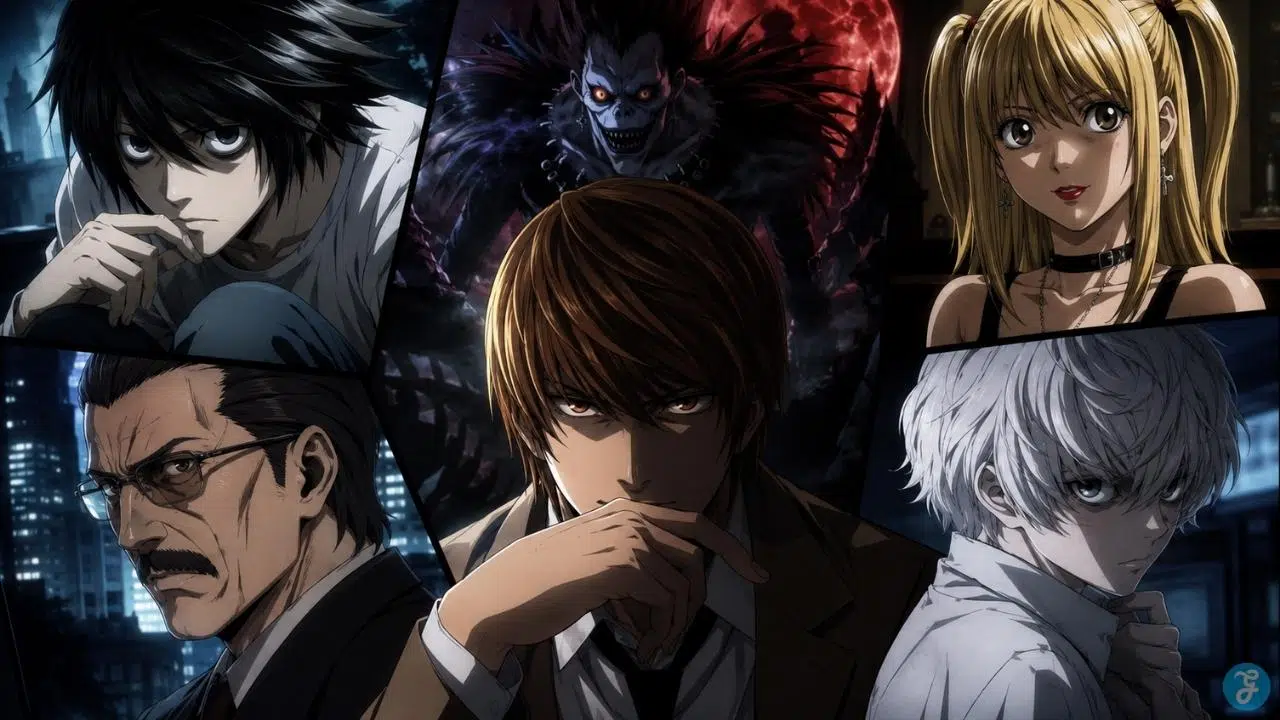
The best Death Note anime characters are not simply “cool.” They matter because they change the rules of the game. Light Yagami, L, Ryuk, Misa Amane, Near, Mello, Rem, Soichiro Yagami, and the Task Force all pull the story in different directions. Some chase justice. Some abuse it. Some worship it. Some are destroyed by it.
This ranking looks at Death Note characters through story impact, intelligence, moral complexity, emotional weight, and long-term legacy. It is not just a popularity contest. If it were, L and Light would swallow the whole article, and Ryuk would sit in the corner eating apples while everyone else fought for third place.
This ranking focuses mainly on the original anime storyline, not the live-action adaptations.
Spoiler warning: This article discusses major character roles and late-story developments from the Death Note anime.
Why Death Note Characters Still Feel Different
Death Note works because its characters are dangerous in ways that feel personal. Light does not become terrifying because he can throw a punch. He becomes terrifying because he can justify almost anything once he believes he is right. L does not challenge him with force. He challenges him with patience, suspicion, and the kind of intelligence that makes every conversation feel like a trap.
Then there is Ryuk, the Death Note shinigami Ryuk, who starts the chaos but refuses to carry human guilt. Misa Death Note fans remember her for her gothic style and devotion, but her role is much darker than “girl obsessed with Light.” Near and Mello split L’s legacy into two very different methods. Soichiro Yagami brings the story back to human morality when the game becomes too clever for its own good.
That is why these characters still hold up. They are not just names in a supernatural thriller. They are arguments.
Light asks what happens when justice becomes ego. L asks whether truth can survive obsession. Misa asks how trauma can be manipulated. Ryuk asks whether humans need much help becoming monsters. Soichiro asks what justice looks like when it refuses to become cruelty.
That is a stronger cast than people sometimes give Death Note credit for.
The Masterminds Who Controlled the Game
Death Note is strongest when it feels like two impossible minds are trying to corner each other in a room full of witnesses. That is why the top of this ranking belongs to the characters who shape the mental battlefield.
L: The Detective Who Made Death Note Legendary
L is the best Death Note character overall because he changes the entire energy of the anime.
Before L fully enters the game, Light is frightening, but he is mostly testing the limits of his power. Once L challenges him, Death Note becomes something sharper. Every move has a countermove. Every confident smile becomes suspicious. Every small mistake feels deadly.
L is strange, funny, cold, brilliant, awkward, and deeply unsettling. He sits oddly, eats sweets constantly, avoids normal social behavior, and somehow still feels more threatening than almost anyone in the series. His eccentricity is not a gimmick. It makes him unreadable.
What makes L so effective is that he does not need proof to make Light uncomfortable. Suspicion is enough. He understands that Kira is proud, reactive, and desperate to be seen as righteous. So he does not just investigate Light. He pressures his ego.
That is why L deserves the top spot. Light may be the engine of Death Note, but L is the character who turns the engine into a war.
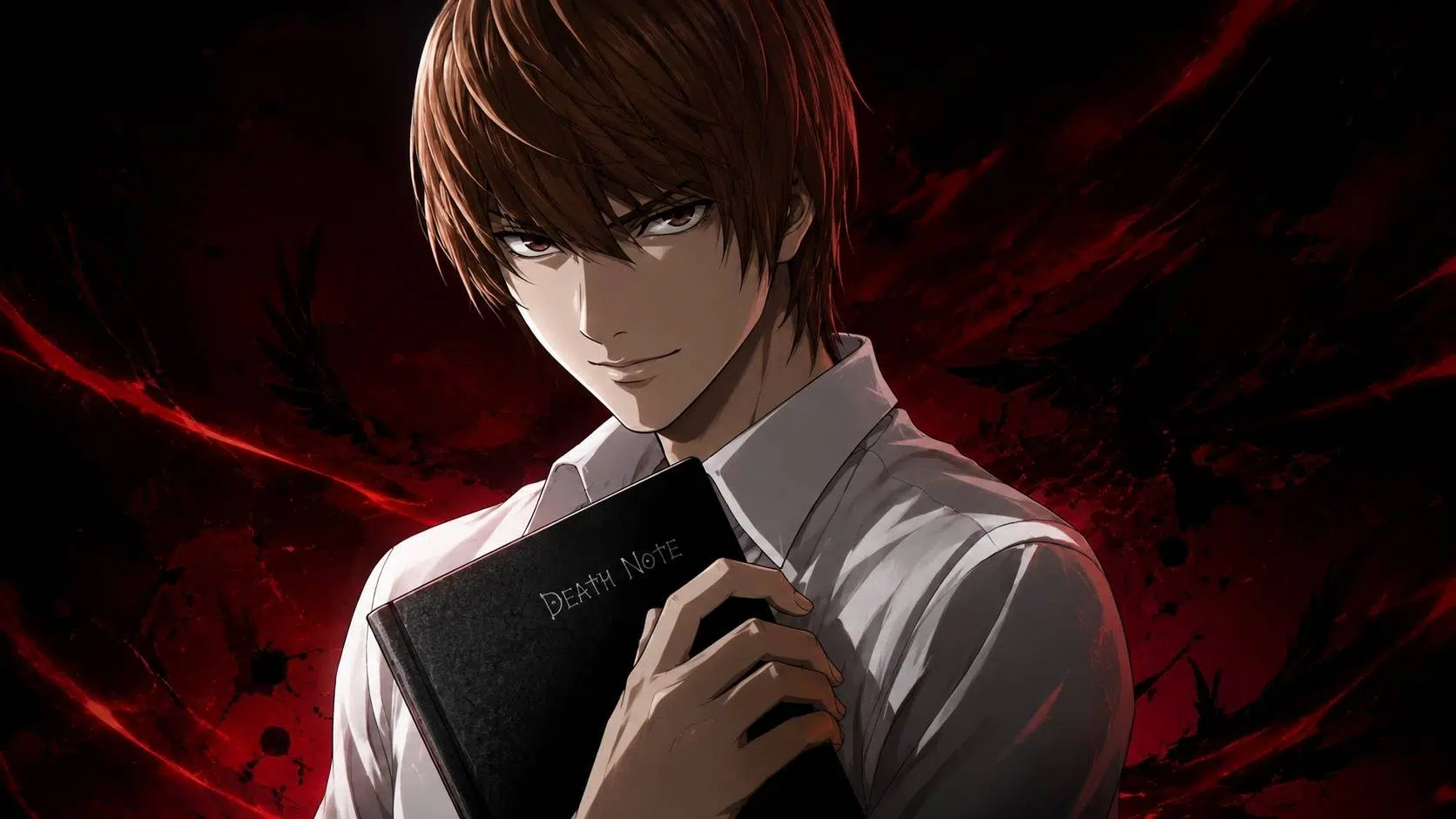
Light Yagami: The Genius Who Mistook Control for Justice
Light Yagami is one of anime’s most fascinating fallen geniuses because he does not begin as a simple villain.
At the start, Light is brilliant, bored, disciplined, and disgusted by the world around him. When he finds the Death Note, he tells himself he is using it to create justice. That is what makes him interesting. He does not see himself as evil. He sees himself as necessary.
But the notebook does not create Light’s arrogance. It reveals it. The longer he uses the Death Note, the more his idea of justice becomes inseparable from control. Criminals are not enough. Investigators become acceptable targets. Innocent people become obstacles. People who love him become tools. Eventually, the mission matters less than Light’s need to win.
That is what makes him terrifying. Light is not ranked below L because he is less important. He is the most important character in the plot. Without him, there is no Kira, no case, no moral collapse, no central conflict. But as a character experience, L slightly edges him out because L changes how viewers feel about the entire story.
Light makes Death Note happen. L makes Death Note unforgettable.
Near and Mello: The Divided Legacy of L
Near and Mello are often judged unfairly because they arrive after L. That is a brutal position for any character. L is so iconic that anyone following him would feel colder, smaller, or less electric by comparison. But the anime’s final act makes more sense when Near and Mello are seen together rather than separately.
Near is calm, clinical, and almost emotionless. He studies Kira like a puzzle. He does not have L’s eerie charisma, but he has discipline and patience. He is the one who carries L’s investigation to its final conclusion.
Mello is the opposite. He is aggressive, wounded, competitive, and willing to use dangerous methods. He does not solve the Kira case through clean deduction alone. He creates pressure. He forces movement. He makes the board unstable.
Near ranks higher because he delivers the final intellectual trap, but Mello matters because the ending needs his disruption. Near alone may not have pushed the truth into the open the same way. Mello alone may have burned everything down before reaching it.
Together, they complete what L left behind. That is the point. Neither is L. They are fragments of what made L dangerous.
The Supernatural Wildcards Who Changed Everything
Death Note has human detectives, criminals, police officers, idols, and strategists, but the story begins because a bored death god drops a notebook into the human world. The Shinigami are not just a fantasy decoration. They expose the human characters more than they control them.
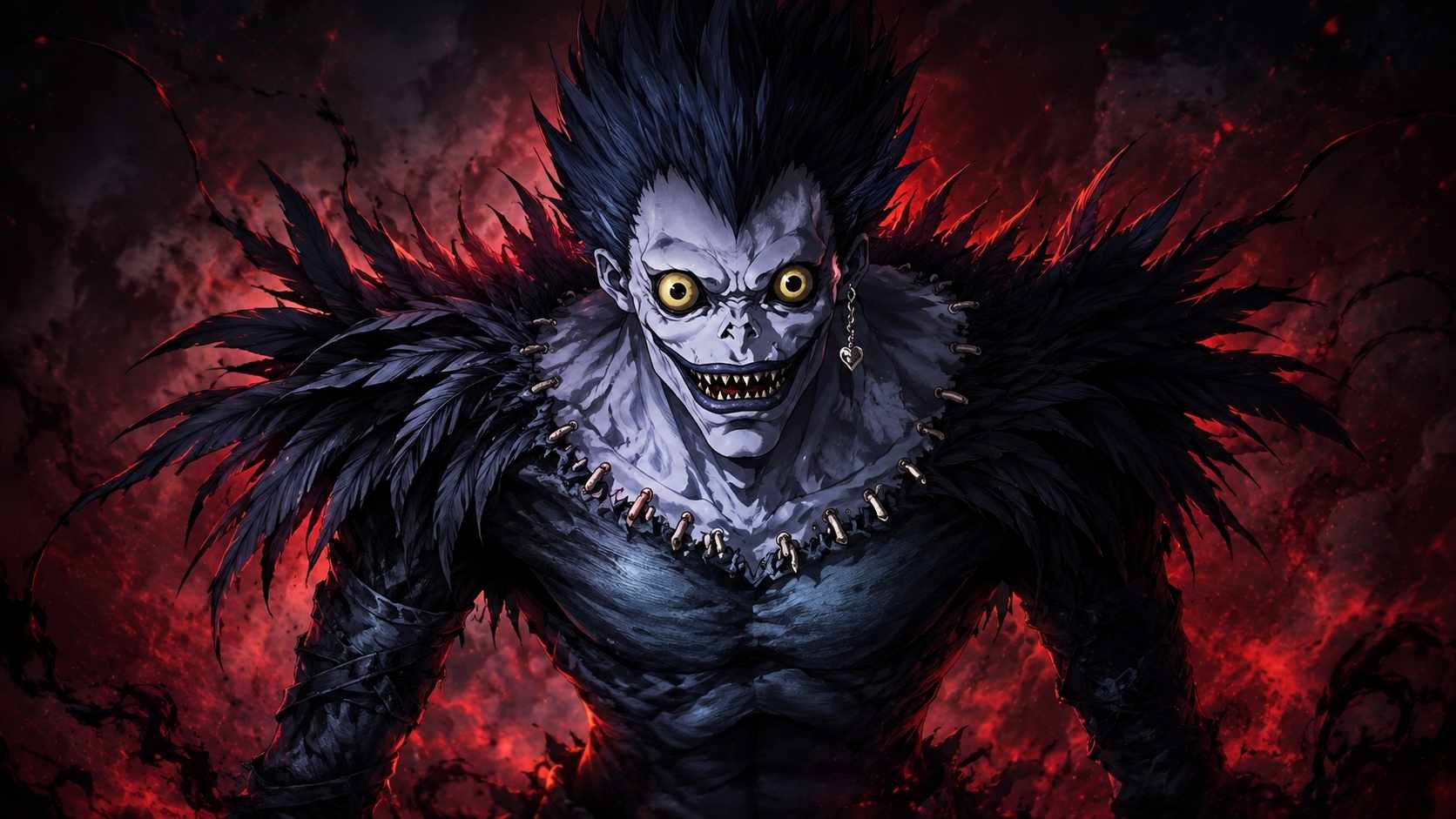
Ryuk: The Bored Shinigami Who Started the Nightmare
Ryuk is one of the most iconic Death Note characters because he is both central and detached. He drops the Death Note because he is bored. That is it. No grand plan. No divine punishment. No moral mission. Just boredom.
That makes him horrifying in a quiet way. The entire human disaster begins as entertainment for him. Light turns the notebook into ideology. The police turn it into a case. The public turns Kira into a symbol. Ryuk watches it all with the emotional investment of someone enjoying a strange show.
His love of apples gives him dark humor, but it also makes him more memorable. He is monstrous, but not in a loud way. He does not need to manipulate Light much because Light does most of the damage himself.
That is Ryuk’s real function. He proves that the supernatural object is not the scariest thing in Death Note. The scariest thing is what humans decide to do with it.
Rem: The Shinigami Who Actually Cared
Rem is powerful because she is everything Ryuk is not. Ryuk watches. Rem feels. Her connection to Misa gives the Shinigami side of Death Note emotional weight. She is not just another death god explaining rules. She has loyalty. She has concern. She has a line she does not want crossed.
That makes her one of the most important supporting characters in the anime. Rem’s choices dramatically affect the story because she is willing to act from attachment. In a world where Light treats people like pieces, Rem’s care for Misa becomes both her strength and her weakness. Light understands that and uses it.
Her role also makes Misa’s story more tragic. Misa has supernatural protection, but even that protection becomes something Light can exploit.
Rem ranks below Ryuk because Ryuk defines the show’s premise and tone, but Rem gives the Shinigami side something Ryuk never does: heartbreak.
The Believers and Victims of Kira’s World
Kira’s influence does not only work through fear. It works through belief. Some characters support him because they are manipulated. Some because they are damaged. Some because they genuinely think Kira is justice. These characters show how dangerous an idea becomes once people start worshiping it.
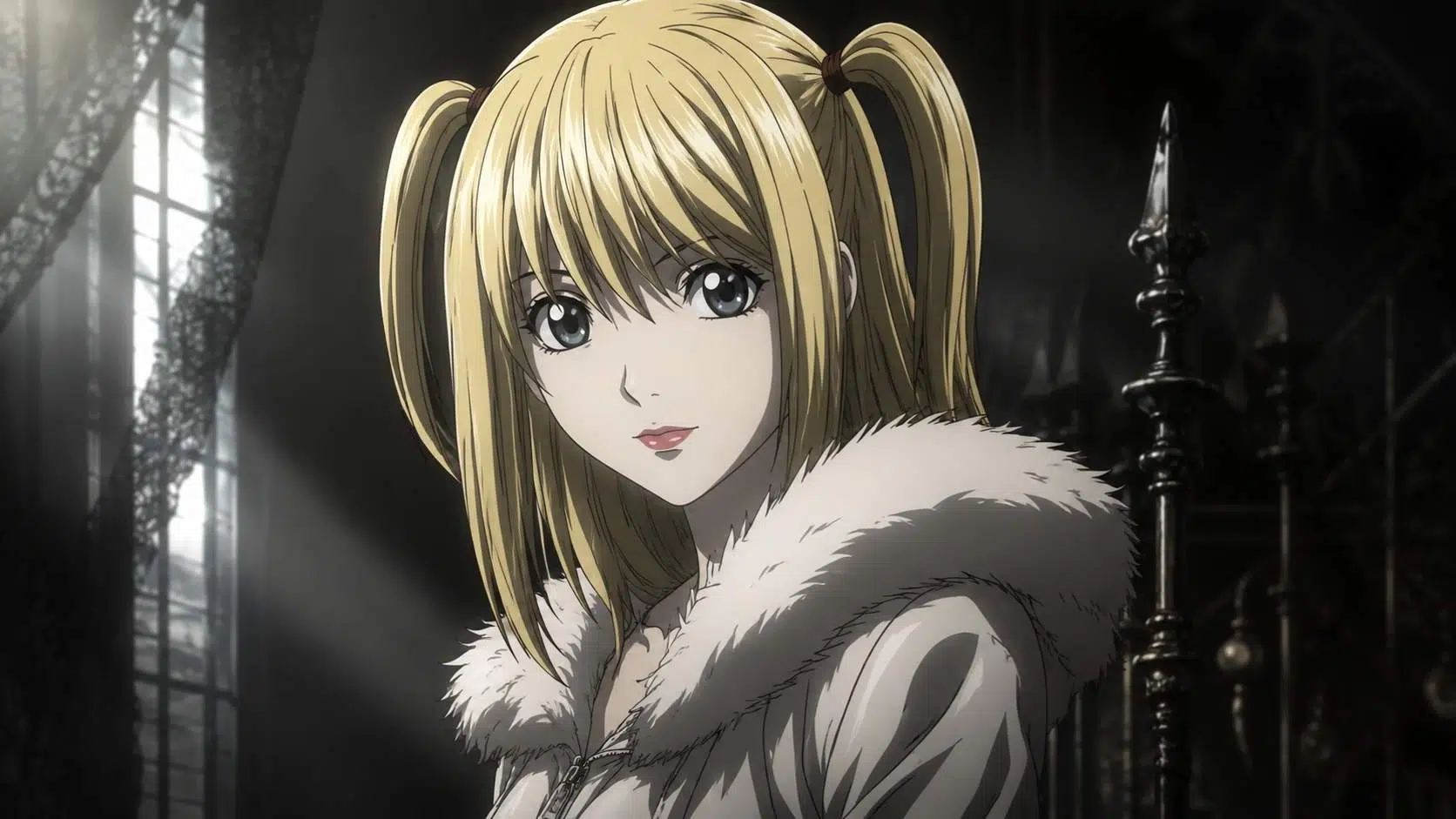
Misa Amane: More Than Light’s Devoted Follower
Misa Amane is one of the most recognizable Death Note anime characters, but she is also one of the easiest to oversimplify.
Yes, she is devoted to Light. Yes, she makes reckless choices for him. Yes, her love for him can be frustrating to watch. But reducing Misa to “obsessed girlfriend” misses why she matters.
Misa enters the story with power, fame, trauma, and vulnerability all tangled together. She has her own Death Note. She has the Shinigami Eyes. She can identify names in a way Light cannot. On paper, Misa is extremely dangerous. Emotionally, though, she is vulnerable to the exact kind of person Light is.
That contrast makes her tragic. Misa has power that could change the game, but her need for love and meaning makes her easy for Light to control. In the Misa Death Note storyline, she is not just a supporter of Kira. She is proof that Kira’s world consumes even the people who think they are choosing it freely.
She ranks high because the story changes the moment she appears. A second Kira creates new pressure, new risk, and new opportunities for Light and L. She also brings the series closer to celebrity culture, public worship, and emotional manipulation.
Misa is not the smartest character in Death Note, but she is one of the most important.
Teru Mikami: The Most Frightening Kira Believer
Teru Mikami is what happens when belief becomes mechanical.
He does not simply support Kira. He worships Kira as a moral absolute. That makes him deeply unsettling. Light may be arrogant and manipulative, but he still sees himself as the one in control. Mikami gives himself completely to the idea. That is why he matters.
Mikami shows that Kira is no longer just a secret identity. Kira has become a worldview. A religion. A system of judgment that attracts people who want certainty more than justice.
His rigid thinking makes him useful, but it also makes him dangerous. He is disciplined, intense, and committed, but his devotion leaves little room for doubt. And in Death Note, the inability to doubt is often fatal.
Mikami ranks below Misa because he arrives later and has less emotional range, but thematically, he is one of the anime’s strongest warnings.
A person who believes they are righteous can be dangerous. A person who worships someone else’s righteousness can be worse.
Kiyomi Takada: The Public Face of Kira’s Final Game
Kiyomi Takada is not as iconic as Misa, but her role in the late story is important. She represents a different kind of Kira supporter. Misa is emotional and openly devoted. Takada is polished, intelligent, and public-facing. She gives Kira a more respectable voice.
That matters because Kira’s influence grows beyond secret killings. It becomes media. Messaging. Public legitimacy. Takada helps show how Light’s private god complex can move into public belief.
She is also another example of how Light uses people who admire or trust him. Takada is not unintelligent. That is what makes her role uncomfortable. She is capable, but she still becomes part of Light’s machinery.
Her ranking reflects her importance to the final act rather than pure fan appeal.
The Human Side of Death Note
Without the Task Force and the human investigators, Death Note would become too cold. These characters remind viewers that Kira’s game is not just a battle between geniuses. Real people are trapped inside it.
Soichiro Yagami: The Moral Center of Death Note
Soichiro Yagami is one of the most important characters because he represents justice without corruption. He is not as brilliant as L. He is not as strategic as Light. He does not dominate the story through mind games. But emotionally and morally, he anchors the anime.
Soichiro believes in law, duty, family, and doing the right thing even when it costs him. That makes his role painful because he is investigating Kira while standing closer to the truth than he realizes.
His tragedy is not ignorance. It is trust. He wants justice, but he also wants to believe in his son. That tension gives Death Note some of its strongest emotional weight. In a story full of manipulation, Soichiro is one of the few characters who feels genuinely honorable.
That is why he ranks above many smarter characters. Death Note needs someone who shows what justice looks like before Light corrupts the word.
Touta Matsuda: The Character Fans Underestimate Until It Hurts
Matsuda often feels like the least serious member of the Task Force, and that is part of why he works. He brings awkwardness, emotion, and occasional comic relief into a story that can become suffocatingly tense. At first, it is easy to see him as naive. He doubts himself. He gets overwhelmed. He does not always read the room.
But Matsuda matters because he reacts like a human being. He is not built like L, Light, Near, or Mello. He does not treat the case as a perfect intellectual exercise. He feels the betrayal, confusion, and horror of what Kira represents. His emotional payoff near the end hits because it comes from someone who spent so much of the story wanting to believe in the people around him.
Matsuda is not ranked this high because he is the smartest. He is ranked here because Death Note needs his humanity.
Shuichi Aizawa: The Quiet Doubter
Aizawa is not flashy, but his gradual suspicion gives the Task Force more credibility. He represents the uncomfortable middle ground between loyalty and doubt. He wants justice. He respects the investigation. But he also begins to notice that things around Light do not fully add up.
That matters because it prevents the Task Force from looking completely passive. Aizawa shows that ordinary investigators can still sense when something is wrong, even if they cannot immediately prove it.
He is not one of the anime’s biggest personalities, but he plays an important role in making the human investigation feel alive.
Watari: The Silent Backbone Behind L
Watari is easy to overlook because he does not demand attention. That is exactly why he works.
He is L’s handler, support system, and logistical anchor. He gives L the ability to operate at a global scale without pulling focus from the mystery. His calm presence adds class and control to L’s side of the investigation.
Watari is not ranked higher because the anime does not explore him as deeply as the main players. But in terms of function, he is essential.
L feels almost mythic partly because Watari helps maintain that distance.
The Short-Run Characters Who Still Matter
Some Death Note characters do not need long arcs to leave a mark. A few supporting figures matter because they reveal something important about Light, the notebook, or the investigation.
Naomi Misora: The Character Who Almost Ended Light Early
Naomi Misora is one of the most impressive short-run characters in Death Note.
She does not need much screen time to prove her intelligence. As a former FBI agent, she investigates with sharp instincts and comes dangerously close to exposing Light early in the story. Her presence creates one of the anime’s most tense early sequences because Light has to improvise under pressure. That is what makes her so memorable.
Naomi shows that Light is not untouchable. If someone smart, focused, and emotionally driven gets close enough to the truth, he can be threatened. The fact that Light escapes that danger does not make Naomi weak. It makes the scene more disturbing.
Her arc proves how ruthless Light can be when cornered.
Kyosuke Higuchi: What the Death Note Looks Like Without Genius
Kyosuke Higuchi is not a beloved character, and he is not supposed to be. His value is structural. During the Yotsuba arc, he shows what the Death Note looks like in the hands of someone greedy, careless, and far less elegant than Light. That contrast matters.
Light uses the notebook with strategy and ideology. Higuchi uses it with selfishness. He is not trying to create a new world. He is trying to climb, profit, and protect himself.
That makes him less compelling as a person but useful as a mirror. The Death Note does not create the same kind of monster every time. It amplifies the person holding it.
Higuchi is ranked last here because he lacks the depth and legacy of the others, but the Yotsuba arc would not work without him.
Death Note Characters Names Fans Should Remember
These are the key Death Note characters names grouped by role for a quick reference.
| Group | Characters |
| Main players | Light Yagami, L Lawliet, Ryuk, Misa Amane |
| L’s successors | Near, Mello |
| Task Force | Soichiro Yagami, Touta Matsuda, Shuichi Aizawa, Kanzo Mogi, Hideki Ide |
| Shinigami | Ryuk, Rem, Gelus, Sidoh |
| Key supporting characters | Naomi Misora, Raye Penber, Kiyomi Takada, Teru Mikami, Kyosuke Higuchi, Watari |
This cast is smaller than many long-running anime casts, but it feels larger because each important character changes the pressure around Light and the Kira investigation.
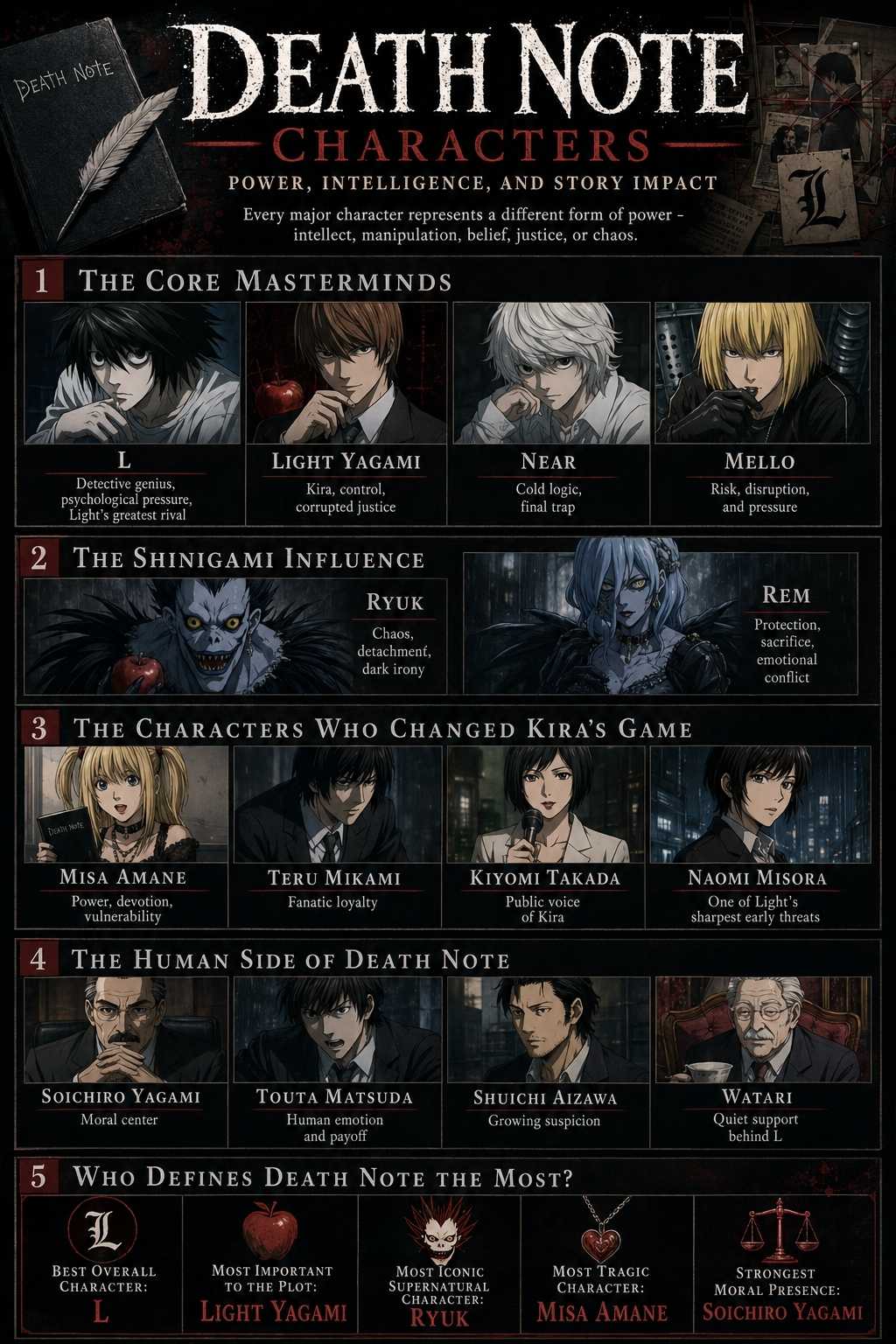
The Full Death Note Character Ranking at a Glance
Here is the full ranking of the major Death Note characters names included in this article.
| Rank | Character | Why They Matter |
| 1 | L | Turns Death Note into one of anime’s greatest mind games |
| 2 | Light Yagami | Drives the entire story as Kira |
| 3 | Ryuk | Starts the chaos and frames the story’s dark irony |
| 4 | Misa Amane | Changes the Kira case through devotion, power, and vulnerability |
| 5 | Near | Finishes what L started |
| 6 | Mello | Forces the final game forward through risk and pressure |
| 7 | Soichiro Yagami | Gives the anime its moral center |
| 8 | Rem | Adds emotional conflict to the Shinigami side |
| 9 | Teru Mikami | Shows what blind Kira worship looks like |
| 10 | Touta Matsuda | Brings humanity, doubt, and emotional payoff |
| 11 | Naomi Misora | Becomes one of Light’s sharpest early threats |
| 12 | Watari | Supports L’s operation with quiet loyalty |
| 13 | Kiyomi Takada | Becomes a major part of Light’s late-game plan |
| 14 | Shuichi Aizawa | Represents the Task Force’s growing suspicion |
| 15 | Kyosuke Higuchi | Shows the Death Note in greedy, careless hands |
The ranking starts with the people who control the game, then moves through the gods, believers, victims, investigators, and supporting figures who make the story more than a two-man rivalry.
Who Is the Best Death Note Character Overall?
L is the best Death Note character overall from a ranking perspective. Light is the most important character in the plot. Ryuk is the most iconic supernatural presence. Misa is one of the most recognizable characters in the series. Near and Mello matter more than some fans admit.
But L gives Death Note its greatest tension.
He is the character who makes Light nervous. He changes the story from “what will Light do with this power?” into “can Light survive being seen?” His suspicion, methods, habits, and mind games give the anime its strongest stretch.
That is why L takes the top spot. Death Note begins with Light and Ryuk, but it becomes legendary when L enters the game.
Why Light, L, Ryuk, and Misa Still Define Death Note
The reason these four characters remain so central to Death Note’s legacy is simple: each one represents a different kind of danger.
- Light is the danger of intelligence without humility.
- L is the danger of obsession in the pursuit of truth.
- Ryuk is the danger of detached power.
- Misa is the danger of devotion mixed with trauma and manipulation.
Together, they create the anime’s core tension. Light wants control. L wants proof. Ryuk wants entertainment. Misa wants love and purpose.
That combination gives Death Note its lasting appeal. The story is not only asking who will win. It is asking what each person is willing to become in order to get what they want.
That is why the characters still feel alive years later. They are not just moving through a plot. They are exposing it.
Death Note Works Because Every Character Is a Test of Power
Death Note remains one of anime’s most talked-about psychological thrillers because its characters make viewers argue.
- Was Light ever truly just, or was he always waiting for permission to become Kira?
- Was L heroic, or was he also addicted to the game?
- Was Misa foolish, or was she a victim of grief and manipulation?
- Was Ryuk evil, or simply detached from human morality?
- Was Near a worthy successor, or just the person cold enough to finish the job?
That is the mark of strong character writing. The best Death Note characters are not memorable because they are morally clean. Most of them are not. They are memorable because they force the audience to sit with uncomfortable questions about justice, ego, loyalty, belief, and power.
In the end, Death Note is not really about a notebook. It is about what people reveal when they think they have the right to decide who deserves to live. That is why these characters still matter.
Frequently Asked Questions About Death Note Characters
1. Who is the main character in Death Note?
Light Yagami is the main character of Death Note. He finds the Death Note and becomes Kira, using the notebook to kill people he believes deserve punishment. The story follows his rise, manipulation, and battle against L and later investigators.
2. Who are the most important Death Note characters?
The most important Death Note characters are Light Yagami, L, Ryuk, Misa Amane, Near, Mello, Soichiro Yagami, Rem, Teru Mikami, Touta Matsuda, Naomi Misora, Kiyomi Takada, and the Task Force members connected to the Kira investigation.
3. Who is smarter, Light or L?
Light and L are both extremely intelligent, but in different ways. Light is better at manipulation, long-term deception, and adapting under pressure. L is better at deduction, psychological pressure, and reading patterns. Many fans consider them near equals, but L often feels more impressive because he challenges Light with far less supernatural knowledge.
4. What is the name of the Shinigami in Death Note?
The most famous Shinigami in Death Note is Ryuk. He drops the Death Note into the human world, where Light Yagami finds it. Other important Shinigami include Rem, Gelus, and Sidoh.
5. Who is Misa in Death Note?
Misa Amane is a popular model and actress who becomes the Second Kira. She receives a Death Note from Rem and makes the Shinigami Eyes deal, allowing her to see people’s names and lifespans. Her devotion to Light makes her powerful, vulnerable, and tragic.
6. Who is the best Death Note character?
L is often considered the best Death Note character because he defines the anime’s strongest psychological conflict. Light is the most important to the plot, but L’s intelligence, mystery, eccentric personality, and rivalry with Kira make him the most unforgettable character overall.