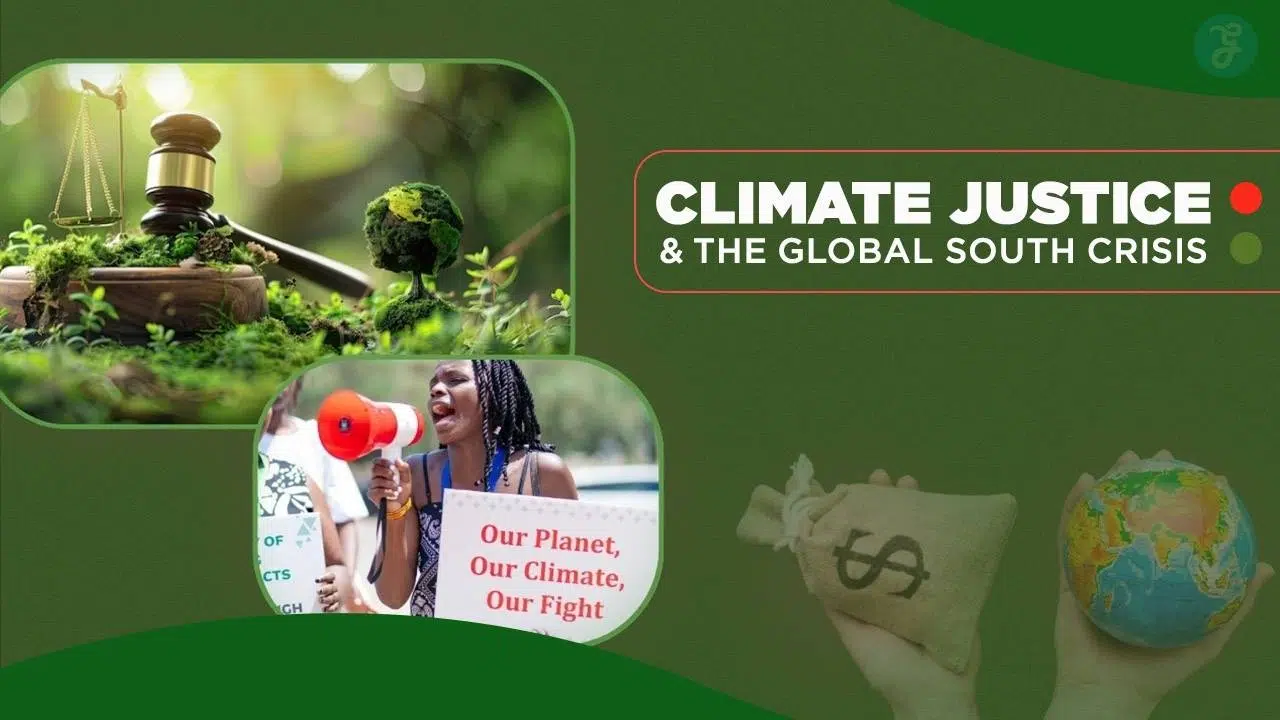
Every year, floods, droughts, and heat waves tear through communities, destroying homes and taking lives. You’ve likely seen the headlines and wondered: Why do some places seem to get hit so much harder than others? For many of us in the U.S., a storm might mean higher insurance premiums or a power outage. But for families in vulnerable regions, that same storm often means losing everything.
Here is the hard truth: Wealthy nations like the United States have generated the vast majority of historical carbon emissions. Yet, it is the Global South, countries in Africa, Asia, and Latin America, that pays the steepest price.
This isn’t just bad luck; it’s a systemic imbalance. We’re going to walk through exactly what Climate Justice means and why fixing this unfair burden is the only way forward.
What is Climate Justice?
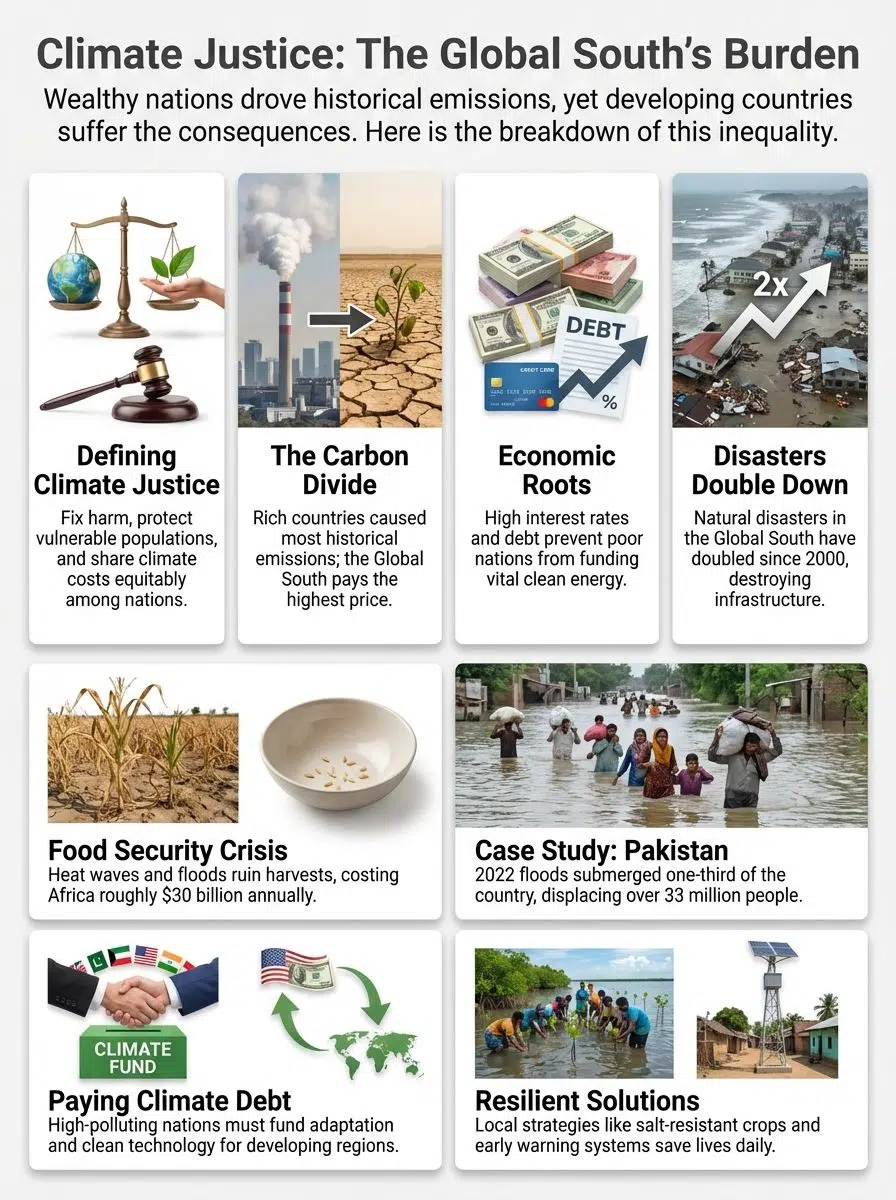
Climate justice is the simple idea that no group of people should suffer disproportionately from environmental hazards. It shifts the conversation from just “lowering emissions” to “protecting people.”
Definition and objectives
At its core, climate justice recognizes that the people who did the least to cause the climate crisis are the ones suffering the most from it. The objective is to balance the scales.
This means wealthy nations, which built their economies on fossil fuels, must support poorer nations that are now facing the consequences. According to the UNEP 2024 Adaptation Gap Report, developing countries currently need about $387 billion per year to adapt to climate change. Yet, they receive only a tiny fraction of that amount.
Principles of equity and fairness
Equity isn’t about treating everyone exactly the same; it’s about giving everyone what they need to survive.
“Equity means sharing the burden based on who caused the damage and who has the capacity to fix it.”
Fairness demands that we look at history. Since 1850, the United States alone has been responsible for roughly 25% of all cumulative CO2 emissions. In contrast, the entire continent of Africa has contributed less than 4%.
Justice requires that the “polluter pays.” This principle insists that nations with the financial muscle and historical responsibility should fund the transition to clean energy and pay for the damages their emissions have caused.
Causes of Climate Injustice
The reason the Global South suffers more isn’t geography alone; it’s economics. Deep-rooted global money systems make it nearly impossible for poorer nations to protect themselves.
Economic systems and systemic causes
The global financial system is stacked against developing nations. When a country in the Global South wants to build a solar farm or a sea wall, they often have to borrow money to do it.
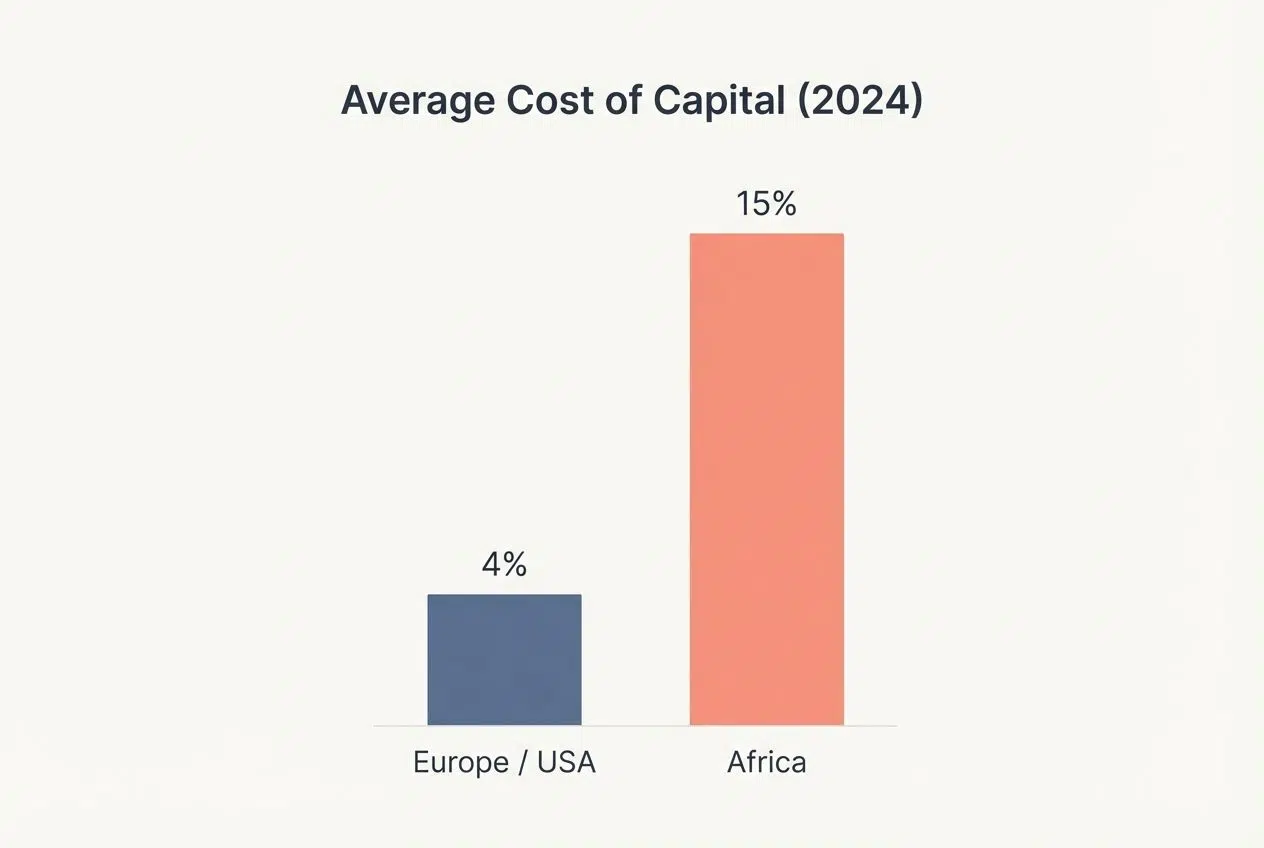
Here is the trap that lies: The cost of capital (the interest rate paid on loans) is drastically higher for them.
| Region | Average Cost of Capital for Clean Energy Projects (2024) | The Result |
|---|---|---|
| Europe / USA | ~4% | Projects are cheap and easy to build. |
| Africa | ~12-15% | Projects cost 2-3x more, making them “risky.” |
Because of these high rates, many countries are forced to stick with cheaper, dirtier fossil fuels or take on crushing debt just to survive.
Disproportionate burden on the Global South
This economic reality creates a vicious cycle. When a disaster strikes, a wealthy nation borrows money cheaply to rebuild. A poor nation must borrow at high rates, sinking further into debt.
Small island nations like Tuvalu and Grenada are effectively paying for a crisis they didn’t create. In 2024, the Prime Minister of Barbados pointed out that many island nations are forced to choose between paying their national debt and paying for disaster recovery.
They literally cannot afford to save their own citizens because the global banking system deems them “high risk”, a risk caused by the very climate change driven by rich nations.
Intergenerational equity and its implications
We are also borrowing from the future. Children born today in the Global South will face three to four times as many extreme climate events as their grandparents did.
This is intergenerational theft. Young people in places like Pakistan or Brazil are inheriting economies shattered by storms and weighed down by debt. They are being handed a bill for a party they were never invited to.
Impacts of Climate Change on the Global South
Life in vulnerable regions often feels like living on a knife-edge. One storm can wipe out a decade of progress, sending families back into poverty overnight.
Increased frequency of natural disasters
The frequency of disasters is not just a prediction; it is happening now. In May 2024, catastrophic floods hit Rio Grande do Sul in Brazil.
The waters submerged entire cities, displaced over 600,000 people, and caused economic losses estimated at over $13 billion. While the U.S. might face a hurricane and rebuild within a year, a hit like this can cripple a developing regional economy for a decade.
Threats to agriculture and food security
Farming is the backbone of many Global South economies, and it is breaking under the heat. In the Sahel region of Africa, temperatures in 2024 soared so high that crops withered before harvest.
- Crop Failure: Staples like maize and wheat are seeing yields drop by up to 20% in some regions.
- Price Spikes: When local harvests fail, families must buy imported food, which is often too expensive.
- Livestock Loss: Droughts in the Horn of Africa have killed millions of cattle, destroying the savings of pastoralist families.
Health risks and displacement
Climate change is also a public health emergency. Warmer temperatures allow diseases to travel to new places.
Mosquitoes carrying dengue fever and malaria are now reaching higher altitudes in South America and Africa, where people have no immunity. Following the 2024 floods in East Africa, cholera outbreaks surged because clean water infrastructure was washed away.
When you can’t farm and you can’t stay healthy, you move. This drives “climate migration,” forcing millions to leave their ancestral homes to survive.
Examples of Climate Injustice
Statistics can feel abstract, but the stories of real communities clarify the stakes. These examples show exactly how unfair the climate crisis has become.
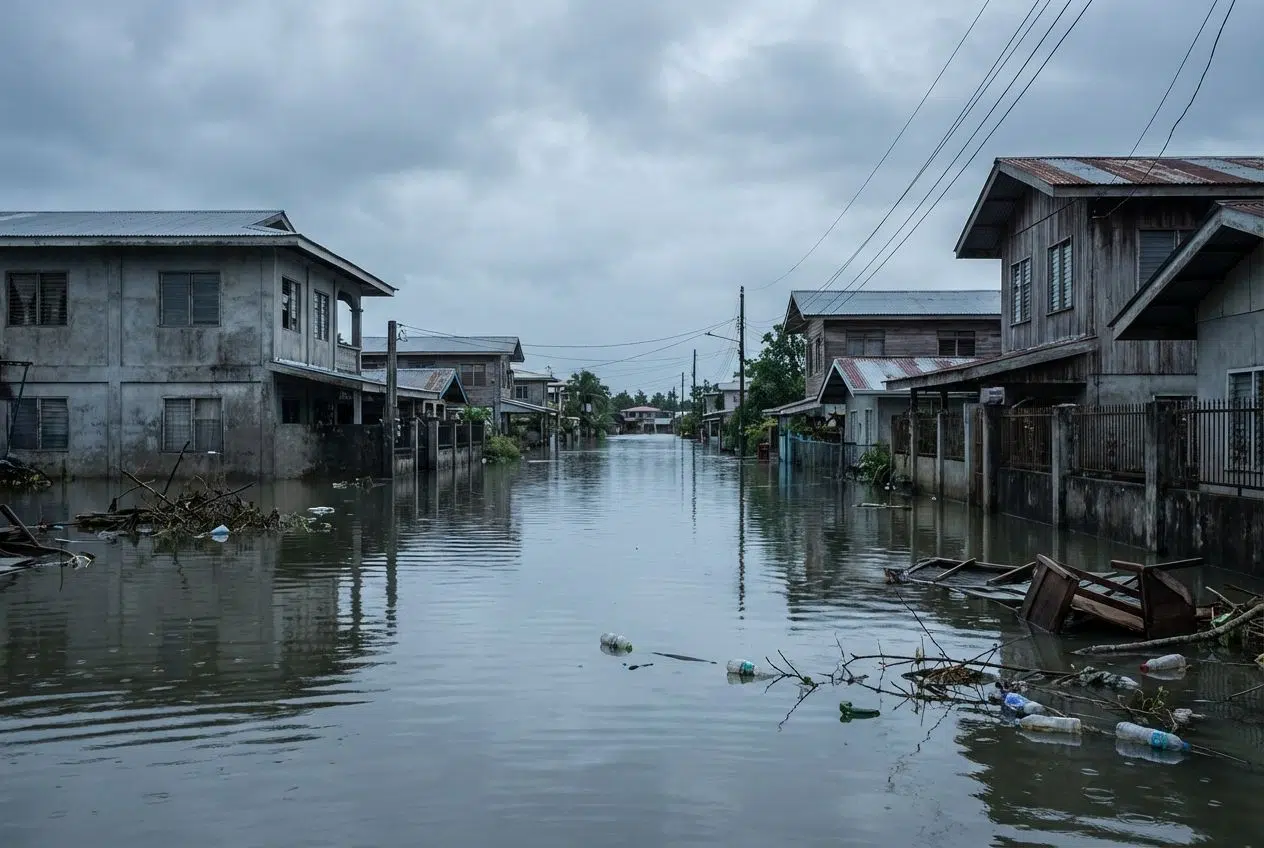
Hurricane Beryl in the Caribbean (2024)
In July 2024, Hurricane Beryl became the earliest Category 5 storm ever recorded in the Atlantic. It slammed into the Caribbean, devastating islands like Grenada and St. Vincent.
On the islands of Carriacou and Petite Martinique, 98% of buildings were damaged or destroyed. These islands have near-zero carbon footprints, yet they were wiped off the map economically in a matter of hours.
The 2022 Pakistan Floods & Lingering Debt
While the headlines have moved on, Pakistan is still paying for the 2022 floods that left one-third of the country underwater. The disaster caused over $30 billion in damages.
To rebuild, Pakistan had to take on more loans. Today, a huge chunk of the country’s national budget goes to repaying foreign creditors rather than building schools or hospitals. This is the “debt trap” of climate injustice in action.
Chlordecone Pollution in the French Antilles
Sometimes the injustice is chemical. In the French Antilles (Guadeloupe and Martinique), a toxic pesticide called Chlordecone was used on banana plantations for decades, largely to serve the French market.
Even though the chemical was known to be dangerous, its use continued until 1993. Today, over 90% of the adult population there has traces of it in their blood, leading to some of the highest prostate cancer rates in the world. The locals bear the health cost; the profits went elsewhere.
Addressing Climate Justice
People are demanding real action, not just polite speeches. The movement for fair treatment has scored some recent victories, but the road ahead is long.
Common principles for burden-sharing
If you break something, you fix it. This principle led to the creation of the Loss and Damage Fund, which was finally operationalized at COP29 in late 2024.
The Philippines was selected to host the fund board, giving the Global South a voice. However, the initial pledges totaled only around $730 million. To put that in perspective, the damage from the Brazil floods alone was nearly 20 times that amount.
Role of human rights in climate policies
We need to view climate change as a human rights violation. The UN has explicitly stated that a clean, healthy, and sustainable environment is a human right.
“Climate justice links human rights and development to achieve a human-centered approach, safeguarding the rights of the most vulnerable people.” – United Nations
When a government approves a new oil project, they are actively endangering the rights of people in low-lying nations to life, food, and housing.
Community resilience and adaptation strategies
Communities aren’t waiting for help; they are adapting now.
- Bangladesh: Farmers are reviving floating gardens (old techniques) to grow food even when lands are flooded.
- Kenya: Villages are building sand dams to trap water during rainy seasons for use during droughts.
- Global Tech: New open-source weather data helps remote farmers know exactly when to plant to avoid wasted seeds.
The Responsibility of Wealthy Nations
Rich countries hold the purse strings and the history of big emissions. They can tip the scales toward fairness or keep their wallets shut.
Emission history and climate debt
Wealthy nations have accrued a “climate debt.” By using up the atmosphere’s capacity to absorb carbon, they have denied developing nations the same cheap path to industrialization.
Calculations suggest that for the U.S. and EU to pay their fair share of this debt, they would need to transfer hundreds of billions of dollars annually to the Global South. This isn’t charity; it’s reparations for damage done.
Commitments to funding and loss compensation
In 2009, rich nations promised to mobilize $100 billion a year by 2020 for climate action. They missed that deadline, finally hitting the number in 2022, years late and largely through loans, not grants.
According to a 2025 Oxfam report, nearly two-thirds of climate finance comes as loans. This means we are “helping” poor countries by charging them interest. True responsibility means providing grants that do not need to be repaid.
Solutions and Global Responsibility
Change starts with fair choices and bold action. Real progress happens when we stop seeing climate action as a cost and start seeing it as a global safety net.
Transition to sustainable economic systems
We need to fix the financial plumbing. The Bridgetown Initiative, led by Barbados Prime Minister Mia Mottley, proposes a massive overhaul of how the IMF and World Bank work.
The goal is to unlock trillions in funding with low interest rates for climate projects. If a country is hit by a hurricane, its debt payments should be paused automatically. This simple change would prevent disasters from becoming financial death sentences.
Support for vulnerable communities
Direct support works best. Instead of filtering money through dozens of middlemen, funds should go directly to local organizations.
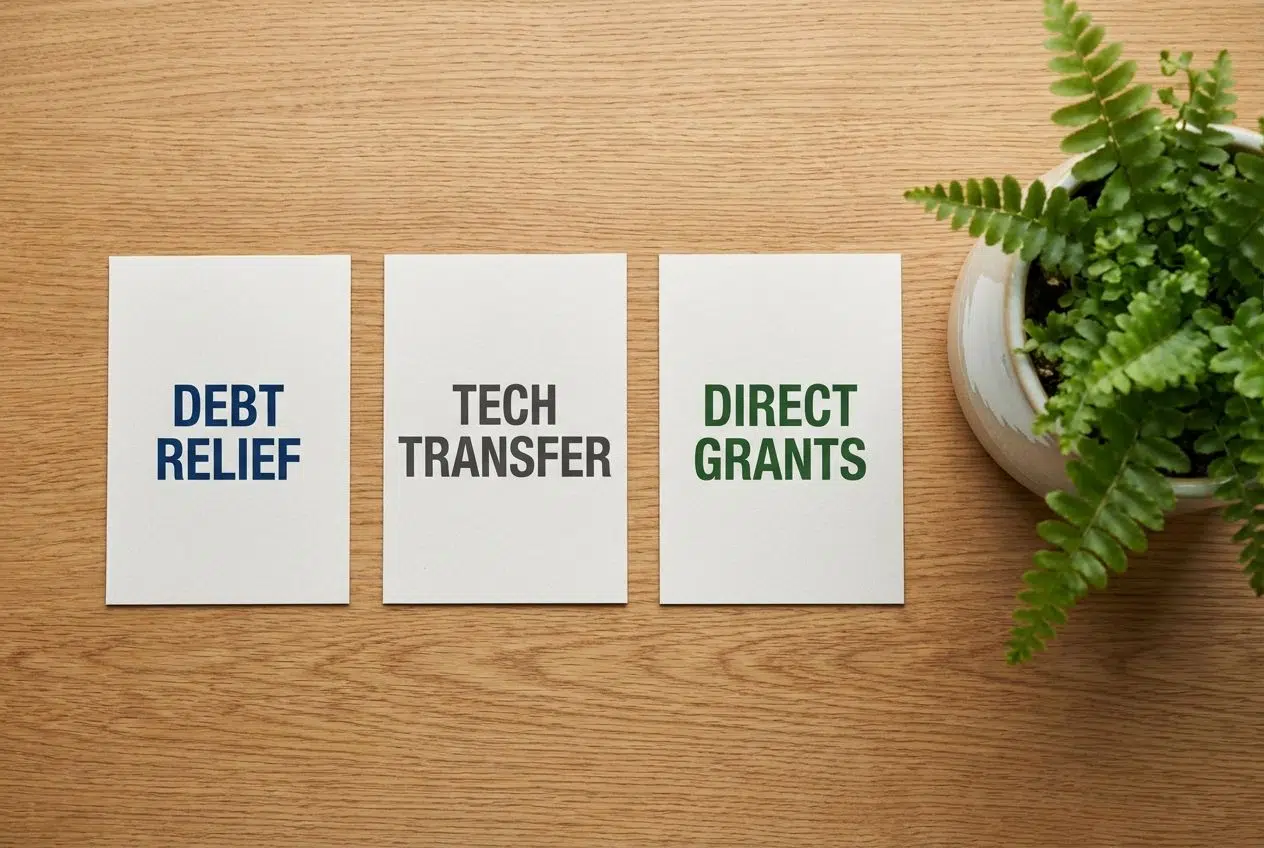
| Action Type | What It Looks Like | Why It Matters |
|---|---|---|
| Debt Relief | Canceling debt for green projects. | Frees up national budgets for immediate healthcare and safety. |
| Tech Transfer | Sharing solar patents freely. | Allows poor nations to build their own energy independence. |
| Direct Grants | Cash for adaptation, not loans. | Prevents the “climate debt trap” from growing larger. |
Collaboration between the Global North and South
We are all in the same boat, but some of us are in first class while others are bailing water in the hold. Collaboration means the Global North must provide the technology and capital, while the Global South provides the leadership on where it is needed most.
Partnerships like the Just Energy Transition Partnerships (JETPs) in Indonesia and South Africa are trying to do this by paying countries to retire coal plants early. It’s a start, but we need to move faster.
The Final Thoughts
Climate justice isn’t just about being “nice.” It is about survival. As long as the Global South is too burdened by debt to adapt, the global economy remains unstable, and millions remain at risk.
We can fix this by demanding our governments fulfill their funding promises and support initiatives like the Loss and Damage Fund. It’s about ensuring that a child in Grenada has the same chance at a safe future as a child in New York.
If you want to help, look into groups like the Climate Justice Alliance or 350.org. Your voice matters more than you think.