


You have likely felt it in your own schedule: the calendar that is double-booked, the budget that is tighter than last year, and the team that needs more guidance than ever. In conversations with peers across the industry, the sentiment is the same. We are not just “busy” anymore; we are structurally overloaded.
This isn’t just a rough patch. It is a fundamental shift in how companies operate.
Recent data from 2025 confirms what many of us suspect. Middle managers are being asked to act as “player-coaches,” handling individual contributions while overseeing larger teams. In fact, the average number of direct reports has jumped significantly in just the last two years. If you feel like you are doing two jobs for the price of one, you are right on the mark. But understanding the data behind this trend is the first step to mastering it.
Let’s break down exactly why this “squeeze” is happening and look at the practical, evidence-based strategies you can use to regain control.
What is the Middle Management Squeeze
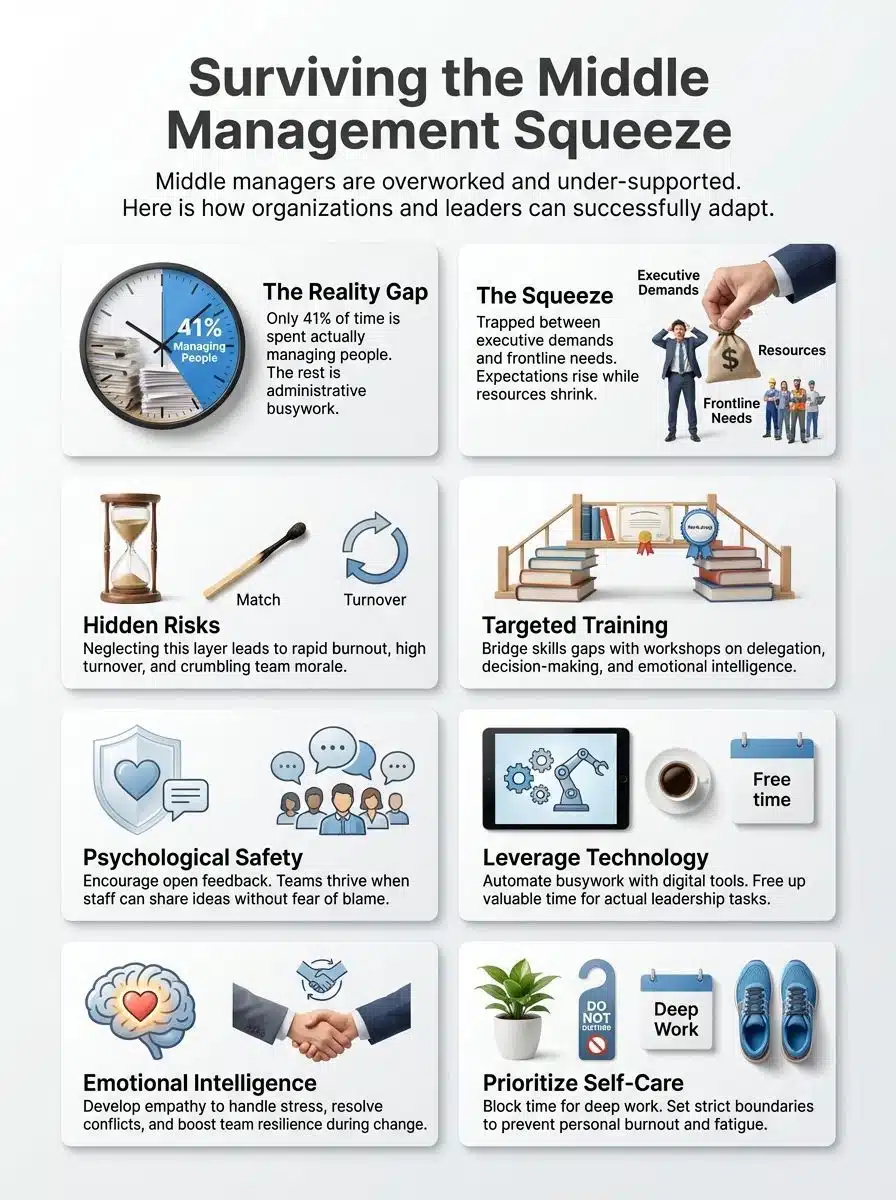
The role of the middle manager is undergoing its most significant transformation in decades. Industry experts have even coined a term for the recent wave of restructuring: “The Great Unbossing.”
Definition and context of the squeeze
The “squeeze” refers to the pressure applied by flattening organizational structures. Companies like Meta, Bayer, and Citigroup have recently moved to reduce management layers, aiming for agility and efficiency. While the goal is faster decision-making, the result for remaining managers is often a dramatic increase in “span of control.”
According to Gallup’s 2025 data, the average manager now has 12.1 direct reports, up nearly 50% from 2013 levels. This increase physically limits the time available for meaningful one-on-one coaching, forcing managers into a reactive posture.
Key factors driving the squeeze
Three main forces are colliding to create this pressure cooker:
- The “Player-Coach” Model: Companies increasingly expect managers to perform individual contributor (IC) work alongside their leadership duties. Recent studies show managers now spend a median of 40% of their time on IC tasks, leaving less than two-thirds of their day for actual leadership.
- AI and Automation: Tools like Microsoft Copilot and Zoom AI Companion promise efficiency but often raise expectations. Leadership assumes AI will handle the admin work, immediately filling that “saved” time with higher strategic demands.
- Fiscal Tightening: As interest rates and market volatility impacted budgets in 2024 and 2025, the “do more with less” mantra became policy. Middle management roles were often the first target for cost-saving, redistributing their workload to the survivors.
Challenges Faced by Middle Managers
The modern manager is stuck in a difficult position, acting as the shock absorber between aggressive executive goals and an anxious workforce. This dynamic creates specific, measurable challenges that go beyond general stress.
Increasing workload and responsibilities
With the span of control widening to over 12 people per manager, the mathematics of leadership breaks down. If you spend just 30 minutes a week with each report, that is six hours of meetings before you have even opened an email or started a project.
Limited resources and support
The “unbossing” trend often removes administrative support before new tools are fully adopted. Managers report spending nearly a full day each week on purely administrative tasks—managing spreadsheets, scheduling, and compliance boxes—that adds zero strategic value. Without a budget for tools or headcount, you are often left to bridge the gap with your own personal time.
Pressure from both senior leadership and team members
“Middle managers are the exhausted glue holding the organization together.” — Common sentiment in 2025 HR forums
Senior leadership demands instant execution of new strategies, often pivoting quarterly. Simultaneously, frontline employees, who are also facing burnout, look to their managers for psychological support and career pathing. You are expected to be a strategist to the top and a therapist to the bottom, often without the authority to solve the root causes of the stress on either side.
The Hidden Risks of Neglecting Middle Management
When organizations ignore the health of their management layer, the costs are not just emotional; they are financial and severe. Ignoring this squeeze creates a fragile operational structure.
| Risk Factor | The Data Point | The Business Impact |
|---|---|---|
| Manager Burnout | 75% of middle managers report feeling overwhelmed or burned out (Capterra 2025). | Critical decision-making slows down; error rates in strategy execution increase. |
| Talent Drain | Replacing a manager costs ~200% of their annual salary (SHRM estimate). | Loss of institutional knowledge that AI cannot replace; projects stall for 3-6 months. |
| Pipeline Collapse | 52% of Gen Z professionals do not want to become middle managers (Robert Walters). | A future leadership gap where no internal candidates are willing to step up. |
Impact on team performance and morale
Managers account for 70% of the variance in employee engagement. When a manager is in survival mode, they stop coaching and start commanding. This shift causes team engagement to plummet, leading to “quiet quitting” and lower productivity across the entire unit.
Gaps in communication and strategy execution
A squeezed manager becomes a bottleneck. Information from the C-suite gets stuck in an inbox, and feedback from the frontline never makes it up the chain. This disconnect means strategy is executed poorly, if at all, because the person responsible for translation is too buried in admin work to communicate effectively.
How Organizations Can Adapt to Support Middle Management
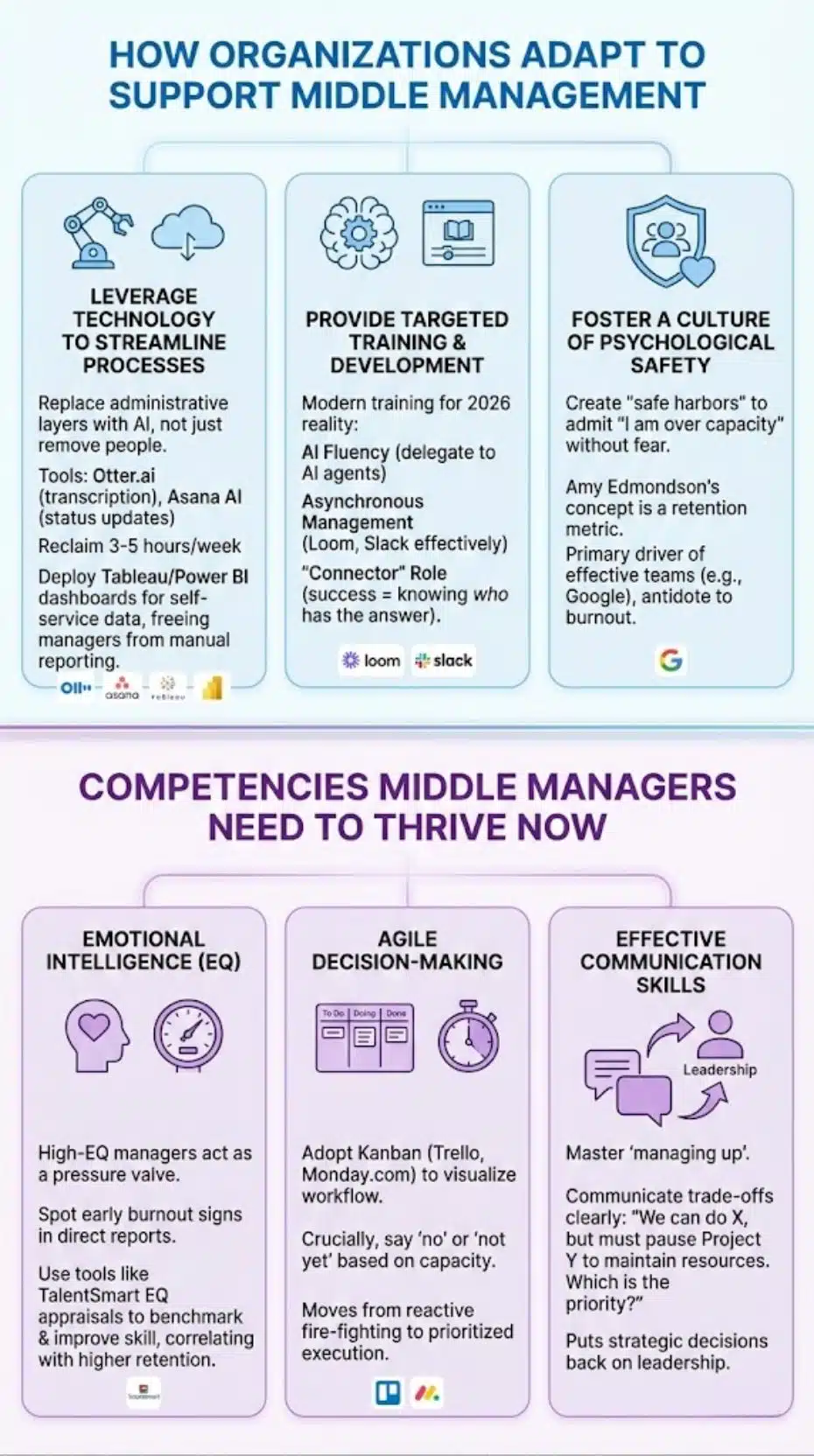
Smart organizations are realizing that they cannot simply cut their way to growth. They are pivoting to support the “unbossed” manager with better tools and clearer boundaries.
Leverage technology to streamline processes
The most effective companies are replacing administrative layers with AI, not just removing people. Tools like Otter.ai for meeting transcription and Asana’s AI features for project status updates can reclaim 3-5 hours a week.
Instead of manual reporting, organizations are deploying dashboards using Tableau or Power BI that allow leaders to pull their own data, freeing middle managers from being human report-generators.
Provide targeted training and development programs
Legacy training focused on “how to hire” or “how to fire.” Modern training must address the reality of 2026:
- AI Fluency: Teaching managers how to delegate tasks to AI agents to reduce their own workload.
- Asynchronous Management: Training leaders to manage performance without constant meetings, utilizing tools like Loom or Slack effectively.
- The “Connector” Role: Shifting the definition of success from “knowing the answer” to “knowing who has the answer.”
Foster a culture of psychological safety
Harvard expert Amy Edmondson’s concept of psychological safety is now a retention metric. Organizations must create “safe harbors” where managers can admit, “I am over capacity,” without fear of being labeled a low performer. Companies like Google have long found this to be the primary driver of effective teams, and it is the only antidote to the burnout epidemic.
Competencies Middle Managers Need to Thrive
Waiting for organizational change can be slow. To succeed right now, you need to cultivate a specific set of skills that act as armor against the squeeze.
Emotional intelligence (EQ)
In a high-stress environment, EQ is your pressure valve. High-EQ managers can spot the early warning signs of burnout in their direct reports before resignation letters land. Tools like TalentSmart’s EQ appraisals can help you benchmark and improve this skill, which is directly correlated with higher retention rates.
Agile decision-making
Agile isn’t just for software developers; it is a survival mechanism. Adopting a Kanban approach (using tools like Trello or Monday.com) allows you to visualize your workflow and, crucially, say “no” or “not yet” based on capacity. It moves you from reactive fire-fighting to prioritized execution.
Effective communication skills
You must master the art of “managing up.” This means communicating trade-offs clearly to leadership. Instead of saying, “We can’t do that,” effective managers say, “We can do that, but to maintain our current resources, we will need to pause Project X. Which is the priority?” This puts the decision back where it belongs: on the strategy makers.
Practical Tips for Middle Managers to Adapt
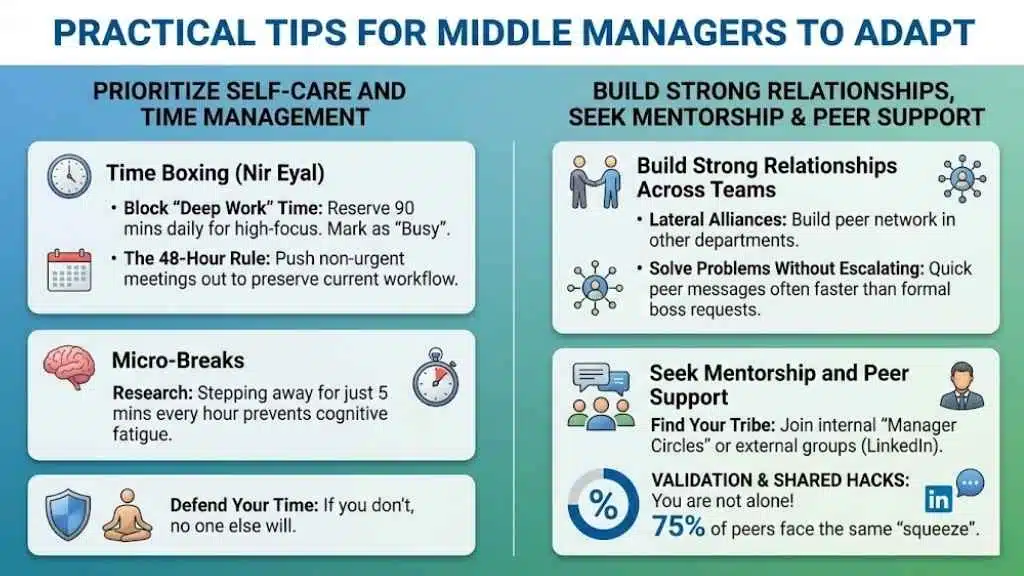
You cannot fix the system overnight, but you can change your daily operating rhythm to protect your sanity and your career.
Prioritize self-care and time management
If you don’t defend your time, no one else will. Adopt the practice of Time Boxing (popularized by Nir Eyal).
- Block “Deep Work” Time: Reserve 90 minutes daily on your calendar for high-focus work. Mark it as “Busy.”
- The 48-Hour Rule: Do not agree to new non-urgent meetings within 48 hours. Push them out to next week to preserve your current workflow.
- Micro-Breaks: Research suggests that stepping away for just 5 minutes every hour prevents cognitive fatigue.
Build strong relationships across teams
Isolation amplifies stress. Build a network of peers in other departments. These “lateral alliances” help you solve problems without escalating them up the chain. A quick message to a peer in Finance is often faster than a formal request through your boss.
Seek mentorship and peer support
Find your tribe. Whether it is an internal “Manager Circle” or an external group on LinkedIn, connecting with others facing the same “squeeze” validates your experience and provides a safe space to share hacks. You are not alone in this; 75% of your peers are right there with you.
Final Thoughts
The squeeze on middle management is real, driven by structural changes like the “Great Unbossing” and the rise of the player-coach model. However, it is not a dead end.
By leveraging new AI tools to handle the drudgery, setting hard boundaries on your time, and shifting your focus from “doing” to “enabling,” you can adapt to this new reality.
The future belongs to the managers who stop trying to be heroes and start acting as strategic conductors. Start today by auditing your calendar, blocking your time, and having that honest conversation about capacity with your leadership.

























