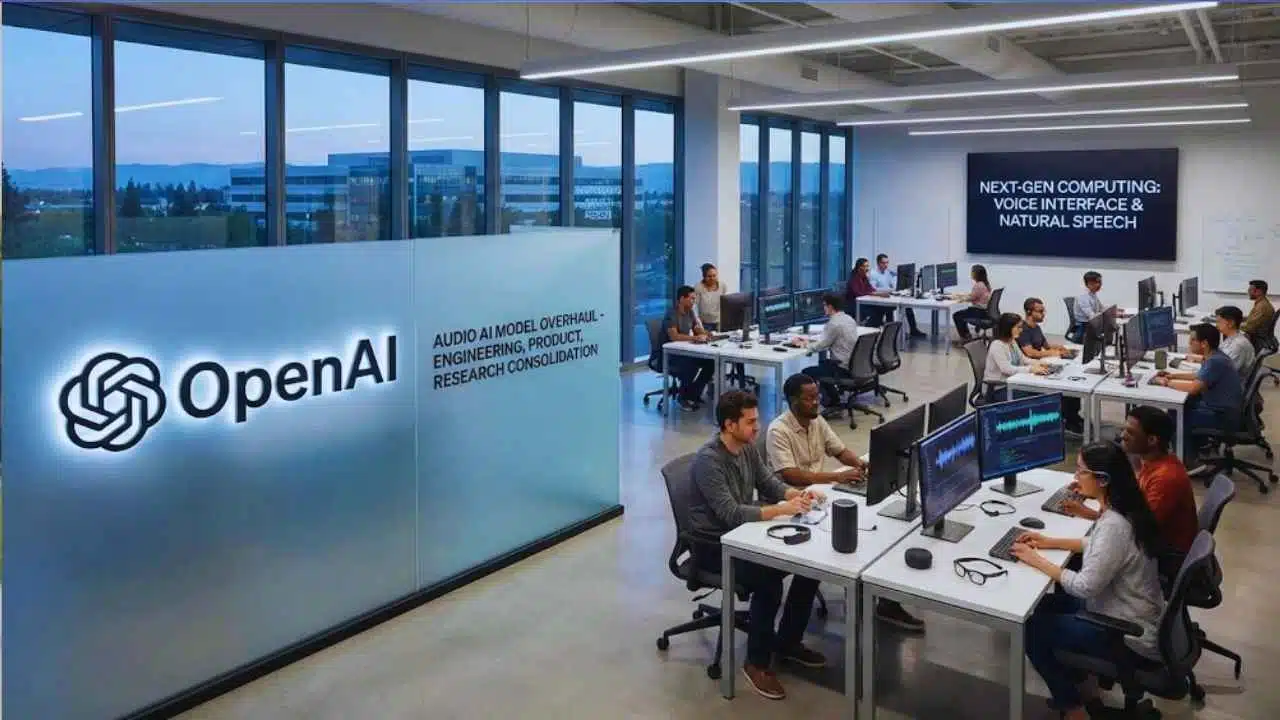
OpenAI audio AI models are being rebuilt as the company reorganizes teams and accelerates work on more natural, interruptible, real-time speech—moves that line up with plans for an audio-first personal device expected in 2026.
What’s Changing Inside OpenAI—and Why It Matters
OpenAI has recently consolidated multiple engineering, product, and research groups around a single goal: closing the quality and speed gap between its audio systems and its best-performing text models. The internal shift matters because voice is increasingly viewed as the most “native” interface for AI assistants—fast, hands-free, and always available.
A new audio model architecture is reportedly targeted for release in Q1 2026, with an emphasis on:
- More natural speech and better prosody (how speech flows)
- Real-time interruption handling (users can cut in naturally)
- Lower-latency conversation that feels less turn-based
In plain terms: the aim is to make voice feel less like talking to a phone tree and more like talking to a person.
The Technical Bet: Speech That Doesn’t Wait Its Turn
Today’s AI voice experiences often behave like walkie-talkies: you talk, then the system responds. OpenAI’s real-time voice work has already moved beyond that model—its speech-to-speech systems are designed to stream audio in and out, reducing delays and allowing more natural back-and-forth.
OpenAI has publicly positioned its latest real-time voice model as production-ready for tasks like customer support, personal assistance, and education, with improvements spanning audio quality, instruction-following, and tool/function calling. It has also described its Realtime API approach as a way to keep conversations fluid by streaming audio rather than waiting for full chunks of speech to finish.
The reported next step—audio that can respond even while a user is still speaking—pushes the experience closer to how humans communicate (quick acknowledgments, interruptions, clarifying questions mid-sentence). If executed well, this can make voice assistants feel dramatically more “present.”
Audio-First Hardware: The Strategic Context
The retooling of voice AI is unfolding alongside OpenAI’s hardware ambitions.
In May 2025, OpenAI announced it was acquiring io Products, a startup tied to former Apple design chief Jony Ive, in a deal widely reported at $6.5 billion. The acquisition put design and hardware at the center of OpenAI’s long-term consumer strategy. Public reporting has also described OpenAI’s ambition to ship a large number of devices quickly—an aggressive benchmark that signals the company is thinking beyond experimental prototypes.
There has also been legal friction around naming and branding related to “io,” adding uncertainty to how the hardware effort is marketed, even if the product roadmap continues moving.
What an Audio-First Device Could Look Like
OpenAI has not formally detailed the final product. However, industry reporting indicates multiple form factors have been considered, including:
- Wearable form factors (such as glasses)
- Screenless smart speakers
- Other compact devices designed for ambient, always-ready interaction
The common theme: reduce reliance on screens and make AI more accessible in everyday moments—walking, driving, cooking, commuting, or working hands-free. That goal fits a broader Silicon Valley narrative: the “next computer” may not be a new phone screen, but a voice-first companion that’s always within reach.
Industry-Wide Shift: Voice Interfaces Are Getting Serious
OpenAI is not alone. Across major tech companies, voice experiences are becoming richer and more context-aware.
Meta’s Smart Glasses Bet
Meta’s Ray-Ban smart glasses have leaned heavily into audio: open-ear speakers, multi-microphone capture, and voice-driven controls. Recent updates have highlighted “conversation boosting” features designed to make speech clearer in noisy places—an example of how audio processing can be a core feature, not an add-on.
Google Turns Search Into Listening
Google has been testing Audio Overviews inside Search Labs—AI-generated spoken summaries that convert search results into a more conversational, podcast-like experience. The bet is that many users want answers while multitasking, without reading a screen.
Tesla Adds Conversational AI in the Car
Tesla has rolled out Grok as an in-car, hands-free conversational assistant in beta, positioning voice as an interface for navigation and other driving tasks. Whether users love it or not, it reinforces the trend: voice is becoming the default control layer in environments where screens are inconvenient—or risky.
Lessons From Failure: Humane’s AI Pin as a Warning
Audio-first hardware has also produced some high-profile disappointments.
Humane’s AI Pin was marketed as a phone alternative, but faced criticism for slow performance, weak battery life, and limited practical usefulness. In February 2025, Humane effectively ended the AI Pin business as HP acquired many of its assets for $116 million, and services for the device were scheduled to shut down soon after.
The takeaway for OpenAI is clear: great AI demos don’t guarantee great consumer hardware. The product has to be reliable, fast, and useful in the first 10 seconds of use—not just impressive in a staged demo.
Audio-First Moves Across Big Tech
| Company | Audio-First Product/Feature | What It’s Trying To Solve | Key Risk |
| OpenAI | Next-gen audio architecture (reported Q1 2026), real-time voice models | Make voice natural, interruptible, low-latency | Reliability, privacy, and real-world robustness |
| Meta | Ray-Ban smart glasses audio features + conversation boosting | Hands-free capture + clearer conversations | Privacy concerns, social acceptability |
| Search “Audio Overviews” (Labs) | Turn search into listenable summaries | Accuracy, publisher impact, trust | |
| Tesla / xAI | Grok in-car assistant | Hands-free conversational control | Safety, quality control, controversy risk |
| Humane (failed) | AI Pin | Screenless assistant wearable | Battery, speed, usefulness, cost |
What Comes Next for OpenAI
To make an audio-first device work, OpenAI must solve several hard problems at once:
- Latency and turn-taking: People notice even small delays in conversation. Voice needs to feel immediate.
- Interruptions and overlapping speech: Handling “barge-in” (user interrupting) is difficult in real environments with noise.
- On-device vs. cloud trade-offs: Cloud AI can be powerful but introduces delay, connectivity dependence, and privacy concerns. On-device AI can be faster and more private, but limited by power and heat constraints.
- Trust and privacy: A microphone-forward device raises concerns—especially for wearables. Clear indicators, tight permissions, and transparent data handling matter.
- Usefulness beyond novelty: The biggest risk is building a device people talk about—but don’t keep using.
Final Thoughts
OpenAI’s internal reorganization and reported Q1 2026 audio architecture push are not just model upgrades—they’re a strategic step toward voice becoming the main way people interact with AI. The industry momentum is real, but so are the pitfalls. If OpenAI can deliver fast, natural, interruption-friendly speech while proving the value of an audio-first device in daily life, it could reshape consumer computing. If not, it risks repeating the “cool demo, hard reality” story that has already ended other audio-first gadgets.