The era of the “smart” device is officially ending, making way for the age of the “intelligent agent.” If you have been following the Future Smartphone Technology Trends for 2026, you already know that this year represents a fundamental shift in how we interact with our mobile companions.
We are no longer just looking at faster processors or slightly better cameras; we are witnessing a hardware and software metamorphosis that turns the phone from a passive tool into a proactive partner.
In this comprehensive guide, we explore the 10 breakthrough technologies defining the mobile landscape in 2026, detailing how they work and why they matter to your daily life.
Key Takeaways
-
Agentic AI is the new standard: Phones now perform complex tasks autonomously, not just answer questions.
-
Battery anxiety is cured: Silicon-Carbon anodes allow for 6000mAh+ capacities in thin devices.
-
The screen is limitless: Tri-fold designs and Under-Display Cameras offer maximum versatility and immersion.
-
Connectivity is omnipresent: SatCom 2.0 ensures you are connected even without cell towers.
-
Health tracking is medical-grade: Non-invasive sensors turn the phone into a personal lab.
The 2026 Paradigm Shift: Efficiency Over Excess
Before we dive into the specific technologies, it is crucial to understand the driving force behind this year’s innovation. For the better part of a decade, the “flagship” smartphone battle was a numbers game: manufacturers competed on higher megapixels, brighter nits, and faster clock speeds. However, as we settle into 2026, the industry has hit a point of diminishing returns with raw specs. The focus has shifted from “Hardware Excess” to “Intelligent Efficiency.”
This year’s trends are a direct response to the “Digital Fatigue” that plagued the early 2020s. Users no longer want devices that demand their constant attention; they want devices that give them their time back. The innovations listed below are not just random upgrades; they are a cohesive effort to solve the three biggest pain points of the modern mobile era: Battery Anxiety, Information Overload, and Digital Privacy.
We are witnessing a unique convergence where the hardware (such as new battery chemistry and sensor tech) has finally caught up to the ambitious demands of the software (AI agents and spatial computing). This is the year the smartphone stops being a distraction machine and starts being a solution engine.
Quick Summary: The 2026 Innovation Snapshot
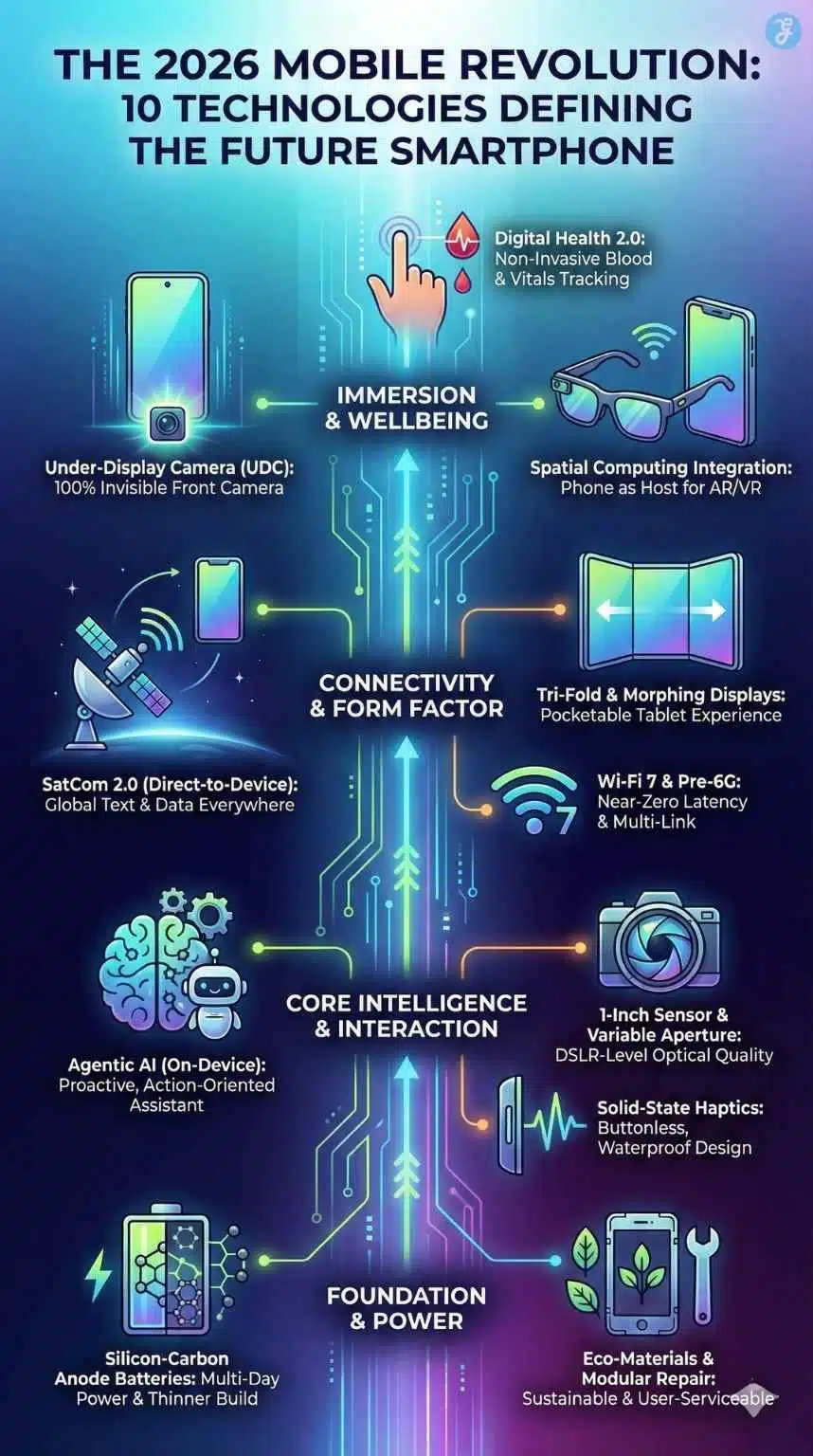
For those who need the critical details at a glance, here is how the mobile landscape is transforming this year.
| Feature Category | 2025 Standard | 2026 Future-Ready Standard |
| Core Intelligence | Generative AI (Chatbots) | Agentic AI (Action-Oriented Doers) |
| Battery Tech | Lithium-Ion (Max ~5000mAh) | Silicon-Carbon Anode (6000mAh+) |
| Form Factor | Single Fold / Flat Slab | Tri-Fold “Z” Shapes & Morphing Screens |
| Connectivity | 5G / SOS Satellite | Wi-Fi 7 & SatCom 2.0 (Data/Text) |
| Front Camera | Dynamic Island / Punch Hole | Invisible Under-Display Camera (UDC) |
| Photography | Computational Bokeh | Variable Aperture (Physical Depth) |
The Rise of Agentic AI and On-Device Intelligence
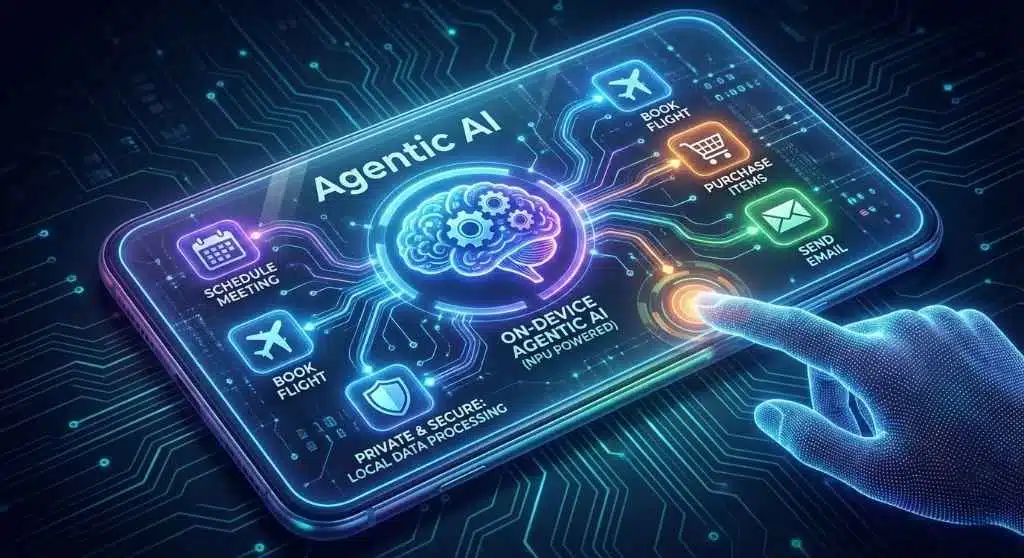
The most significant shift in Future Smartphone Technology Trends for 2026 is undoubtedly the transition to Agentic AI. For the past few years, we have grown accustomed to “Generative AI”—chatbots that can write a poem or summarize an email. While impressive, these tools were passive; they waited for you to ask a question.
2026 introduces “Agentic AI,” powered by the latest NPU (Neural Processing Unit) architectures found in chips like the Snapdragon 8 Elite and Apple’s A19 series.
What is Agentic AI?
Unlike a chatbot, an AI Agent has the authority and capability to perform multi-step actions across different apps without your direct intervention. It doesn’t just tell you how to book a flight; it opens the travel app, selects the flight based on your calendar availability, chooses your preferred seat, and presents the “Confirm” button for your approval.
The Hardware Enabler: Local SLMs
This level of intelligence requires massive processing power. To achieve this without killing battery life or compromising privacy, 2026 smartphones are utilizing Small Language Models (SLMs). These are condensed, highly efficient AI models that live entirely on your device.
Why On-Device Matters:
-
Privacy: Your personal data (calendar, health records, emails) never leaves the phone to be processed in the cloud.
-
Latency: Actions happen instantly. There is no “lag” while the phone talks to a server.
-
Reliability: Your AI assistant works perfectly even when you are in Airplane Mode.
| Feature | Cloud-Based AI (Old) | On-Device Agentic AI (New) |
| Data Handling | Sends data to external servers | Processes data locally on the NPU |
| Speed | Dependent on the internet connection | Instant, zero-latency response |
| Capability | Information retrieval & text gen | Complex task execution & app control |
| Security | Vulnerable during transmission | Encrypted and isolated on-device |
Hardware Revolutions: Batteries and Displays
While AI provides the brain, the body of the smartphone is undergoing its own revolution. The physical constraints that have held phones back for a decade—battery life vs. thickness, and screen size vs. pocketability—are finally being broken.
1. Silicon-Carbon Anode Batteries
For over a decade, the industry relied on Lithium-Ion batteries with graphite anodes. They were reliable but had hit a chemical ceiling. You simply couldn’t pack more energy into them without making them dangerous or heavy. Enter the Silicon-Carbon Anode.
By replacing the graphite anode with a silicon-carbon composite, manufacturers can increase the energy density by approximately 20-30%. Silicon can hold significantly more lithium ions than graphite, but pure silicon expands and breaks during charging. The “Carbon” scaffold prevents this expansion, offering the best of both worlds.
-
The Result: A phone the same size as an iPhone 15 or Galaxy S24 can now hold a 6,000mAh battery instead of 4,000mAh.
-
Real-World Impact: We are seeing the return of the “two-day phone.” Heavy users can game, stream, and use GPS navigation for a full 24 hours without reaching for a charger.
2. Tri-Fold and Morphing Screens
Foldable phones are no longer a novelty; they are a standard category. However, 2026 pushes the boundaries with Tri-Fold architectures.
Imagine a standard-sized phone that unfolds not once, but twice, expanding into a legitimate 10-inch tablet with a 16:9 or 4:3 aspect ratio. This is the “Z-fold” or “gatefold” design.
The Mechanics of the Tri-Fold:
These devices use dual-hinge systems that allow one part of the screen to fold inward (protecting it) and another to fold outward (acting as a cover screen).
-
Productivity Unlocked: You can run three full-sized apps side-by-side.
-
Desktop in Your Pocket: When paired with a portable keyboard, these devices genuinely replace the need for a laptop for 90% of users.
Connectivity Beyond the Grid
In 2026, the concept of “No Service” is becoming an anachronism. Two major technologies are reshaping how our devices connect to the world: SatCom 2.0 and Wi-Fi 7.
3. Direct-to-Device Satellite Data (SatCom 2.0)
In previous years, satellite connectivity on phones was limited to emergency “SOS” beacons—sending a tiny packet of location data to rescue services.
SatCom 2.0 changes the game. Thanks to partnerships between mobile carriers and LEO (Low Earth Orbit) satellite providers like Starlink and others, 2026 smartphones can send and receive SMS text messages and utilize low-bandwidth data anywhere on the planet with a clear view of the sky.
Use Cases for SatCom 2.0:
-
Remote Work: Sending emails from the middle of the ocean or a mountain top.
-
Navigation: Downloading map updates in dead zones.
-
Communication: Chatting on WhatsApp or iMessage during a cellular outage or natural disaster.
4. Wi-Fi 7 and Pre-6G Architecture
While 6G is still in the research labs (expected around 2029-2030), Wi-Fi 7 is the standard for 2026 flagships.
Wi-Fi 7 introduces “Multi-Link Operation” (MLO). Previously, your phone connected to the router via the 2.4GHz or 5GHz band. Wi-Fi 7 allows the phone to connect to 2.4GHz, 5GHz, and 6GHz bands simultaneously.
-
Throughput: Speeds up to 46 Gbps (theoretical), which is faster than most wired Ethernet connections.
-
Latency: Near-zero latency, which is critical for the next trend on our list: Spatial Computing.
Visual & Sensory Immersion
The display and the camera are the primary ways we interact with content. 2026 brings us closer to the “perfect” viewing experience and “professional” imaging.
5. The Invisible Front: Under-Display Cameras (UDC)
The “notch,” the “dynamic island,” and the “punch hole”—these were all compromises. Manufacturers needed a place to put the selfie camera. In 2026, the technology for Under-Display Cameras (UDC) has matured.
How it Works:
The area of the screen covering the camera uses a specialized cathode material and a different pixel structure that can become transparent on demand. When you aren’t taking a selfie, the pixels light up, matching the rest of the screen perfectly. When you activate the camera, they turn off, allowing light to pass through to the sensor beneath.
-
AI Restoration: The key breakthrough in 2026 is the AI ISP (Image Signal Processor) that instantly corrects the diffraction caused by the screen layers, resulting in selfies that are indistinguishable from those taken with a standard lens.
6. 1-Inch Sensors & Variable Aperture
Computational photography (software improving images) has been the crutch of mobile photography for years. But physics still matters.
The trend for 2026 flagships is the widespread adoption of 1-inch camera sensors. A larger sensor captures more light, provides better dynamic range, and creates natural background blur.
Variable Aperture Mechanics:
To control this massive sensor, phones now use mechanical shutters that can switch the aperture.
-
f/1.4: Wide open for low light and creamy bokeh (blurred background).
-
f/4.0: Stopped down for sharp landscapes or group photos where everyone needs to be in focus.
| Photography Aspect | Software Solution (Old) | Hardware Solution (2026) |
| Background Blur | Portrait Mode (often misses hair strands) | Natural optical bokeh via 1-inch sensor |
| Low Light | Night Mode (long exposure + heavy processing) | High light intake via f/1.4 aperture |
| Focus Area | Fixed focus plane | Variable Aperture control (f/1.4 – f/4.0) |
7. Spatial Computing Integration
Smartphones are evolving into “host” devices. With the rise of lightweight AR glasses (Augmented Reality), your phone acts as the compute core.
Using ultra-wideband (UWB) chips and proprietary high-speed wireless protocols, the phone stays in your pocket while beaming a 3D interface to your glasses. This allows for heads-up navigation, real-time translation subtitles in your field of view, and private screen viewing on a virtual 100-inch monitor.
Health & Security Innovations
Your smartphone is becoming the guardian of your health and your digital identity.
8. Digital Health 2.0: The Non-Invasive Lab
We are moving beyond simple step counting and heart rate monitoring. 2026 devices are introducing non-invasive blood monitoring.
Using advanced spectroscopy and optical sensors, new flagships can estimate blood pressure (without a cuff) and blood glucose trends (without a needle).
How Spectroscopy Works:
The phone emits specific wavelengths of light into the skin (usually the fingertip). The way the light is absorbed and reflected changes based on the density of glucose or the pressure of the blood flow. AI algorithms analyze these minute light changes to provide clinical-grade data.
-
Note: While not a replacement for emergency medical equipment, these tools are revolutionary for preventative health and managing chronic conditions like hypertension or pre-diabetes.
9. Quantum-Resistant Security
With the rise of quantum computing on the horizon, standard encryption methods (like RSA) are at risk of being cracked.
2026 smartphones are the first generation to implement Post-Quantum Cryptography (PQC) standards at the hardware level. This ensures that the data you lock away today cannot be decrypted by the supercomputers of tomorrow. It is a silent but vital upgrade for anyone who uses their phone for banking or storing sensitive documents.
The Green Imperative: Bio-Materials & Modular Repair
In 2026, sustainability is no longer just a marketing buzzword; it is a regulatory requirement and a consumer demand. The days of the “disposable flagship” are numbered as manufacturers pivot toward the Circular Economy.
10. Biodegradable & Recycled Builds
Your next phone is likely part “trash.” Leading manufacturers are now using up to 50% recycled materials in their chassis, including aluminum, cobalt, and “ocean-bound” plastics (like discarded fishing nets).
-
Bio-Polymers: We are also seeing back panels made from corn-based or algae-based bioplastics that are as durable as polycarbonate but fully biodegradable at the end of their lifecycle.
The “Right to Repair” Standard
Driven by strict EU regulations that took full effect in late 2025, smartphones in 2026 are designed to be opened.
-
Modular Architecture: Batteries are no longer glued in with permanent adhesive; they use pull-tabs or electrical release systems.
-
Parts Pairing: Software locks that prevented independent repair shops from swapping screens or cameras have been legally removed. This extends the average device lifespan from 3 years to 5+ years.
What This Means for Users in 2026
The convergence of these technologies means that the device in your pocket is no longer just a communication tool; it is a Life Operating System. The friction of technology is disappearing.
-
You don’t worry about battery life because of Silicon-Carbon.
-
You don’t worry about the signal because of SatCom.
-
You don’t worry about mundane tasks because of Agentic AI.
-
You don’t worry about image quality because of Variable Aperture.
The “Future Smartphone Technology Trends” of 2026 are not about adding more features; they are about adding better features that remove the barriers between your intent and the action.
Frequently Asked Questions (FAQs)
1. Will Agentic AI on 2026 phones compromise my privacy?
Actually, it improves it. The trend for 2026 is “On-Device AI.” Because the Neural Processing Units (NPUs) are so powerful, the AI runs locally on your phone. Your personal queries, calendar data, and emails do not need to be sent to the cloud to be processed, meaning your data stays in your pocket.
2. Is a Tri-Fold phone actually durable enough for daily use?
Durability has improved drastically. 2026 foldables use “Super-Ceramic” glass composites and dust-resistant hinge designs that are rated for over 400,000 folds. While they are still more fragile than a standard slab phone, they are now robust enough for the average user.
3. Do I need a special subscription for Satellite (SatCom) connectivity?
Likely, yes. While some premium carriers are bundling “Satellite Texting” into their top-tier plans, data-heavy usage via satellite will likely remain an add-on service due to the high cost of satellite bandwidth.
4. Can the new blood glucose monitoring replace my diabetic testing kit?
Not entirely. The 2026 optical sensors are designed for “trend tracking” and preventative wellness. They are excellent for seeing spikes after a meal, but for insulin-dependent diabetics, traditional medical-grade testing is still required for calibration and critical dosing decisions.
5. Why is Variable Aperture better than “Portrait Mode”?
Portrait mode is a software filter that tries to guess what should be blurry. It often makes mistakes, like blurring out strands of hair or the rim of your glasses. Variable Aperture creates optical blur using physics (light), resulting in a perfect, natural transition between the subject and the background, just like a professional camera.
Final Thought: The Invisible Tech Revolution
As we embrace these Future Smartphone Technology Trends, it becomes clear that the best technology is the kind you don’t notice. The goal of 2026’s mobile innovation is invisibility. The camera hides under the screen; the AI works silently in the background; the battery lasts so long you forget to charge it.
We are moving into an exciting future where our devices are less intrusive and more supportive, allowing us to spend less time staring at our screens and more time living our lives, with a powerful, intelligent agent tucked safely in our pocket.