

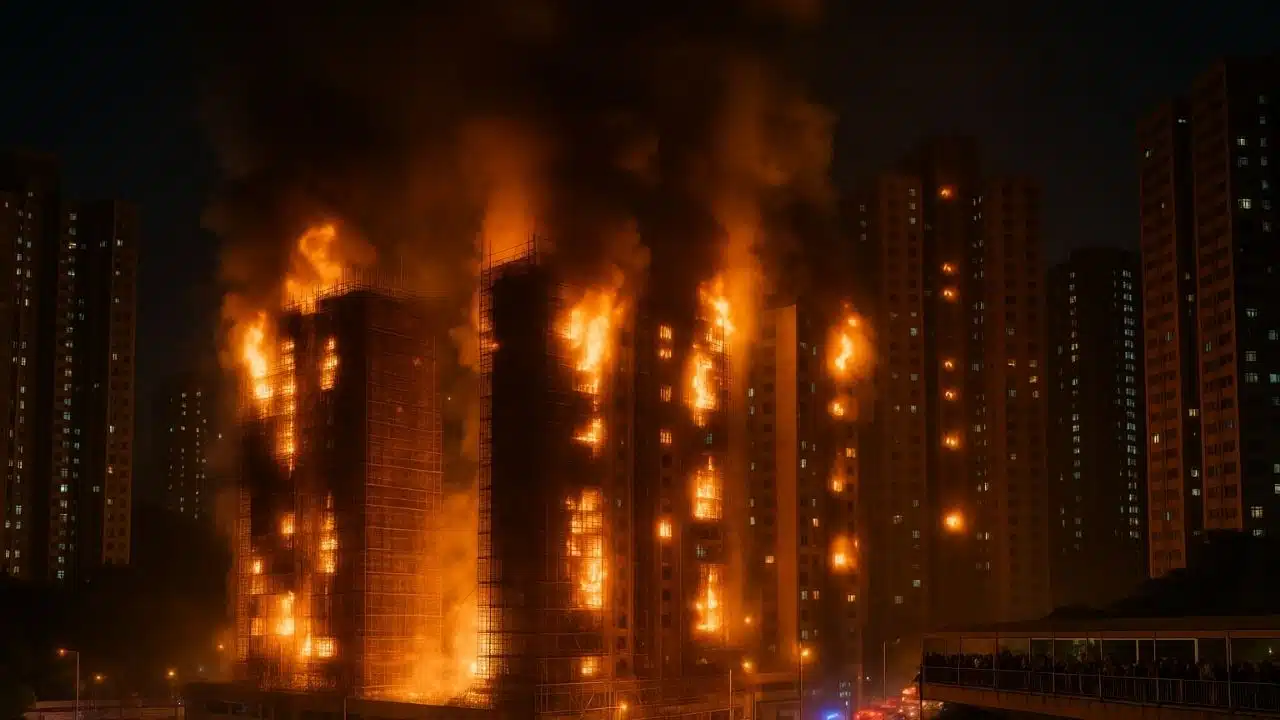
On Wednesday afternoon, a massive fire broke out at Wang Fuk Court, a residential estate in the northern Tai Po district of Hong Kong. Flames spread quickly through multiple high-rise towers, and thick black smoke poured out, lighting up the skyline as dusk fell. The fire department raised the alarm to level “No. 5” — the highest severity rating — by early evening, mobilizing all available resources to fight the blaze.
Authorities confirmed at least 13 people have died so far. Several more are badly injured: among them, three are in critical condition, one is in serious condition, and others — including some firefighters — have sustained various injuries. Meanwhile, an unknown number of residents may still be trapped inside the burning buildings. Rescue operations are ongoing under difficult circumstances, as collapsing scaffolding and intense flames complicate efforts.
Eyewitness accounts from nearby walkways described harrowing scenes: people watching in horror as smoke and flames engulfed the towers; scaffolding frames — some wrapped around the buildings for renovations — collapsing and crashing down; fire engines and ambulances lining the roads below, their crews working to control the inferno. One elderly resident, surnamed Wong, wept on the street, saying his wife was still trapped inside one of the buildings.
What we know about the Wang Fuk Court and why the fire spread so fast
Wang Fuk Court is part of Hong Kong’s subsidised housing scheme. The estate dates back to 1983, and comprises eight blocks containing a total of 1,984 residential units. According to the most recent census data, some 4,600 people live across the estate — a tightly packed, high-density community.
At the time of the Hong Kong High-rise fire, at least some buildings in the complex were undergoing renovation. Scaffolding — made of bamboo and wrapped in construction netting — surrounded several towers. Bamboo scaffolding remains common in Hong Kong’s construction tradition despite ongoing efforts to phase it out, because it is lightweight, relatively inexpensive, and can be erected quickly even on tall structures.
However, bamboo is highly combustible. In this case, the external scaffolding likely contributed to the rapid spread of flames across multiple floors and buildings, turning a localized blaze into a full-scale fire that consumed entire towers. As the fire roared, parts of the scaffolding collapsed, sending burning debris down and complicating rescue efforts.
The soaring density of the estate, narrow corridors typical of older high-rise public housing, and possibly outdated fire safety infrastructure may have worsened the disaster, leaving many residents with limited escape routes. Given the speed and ferocity of the fire, it’s possible the building’s fire alarms or safety systems may not have given residents enough time to evacuate — though authorities have yet to release full details on that.
Broader context & what this disaster signals for Hong Kong’s future
Hong Kong is one of the last major cities globally where bamboo scaffolding is still widely used for high-rise construction or renovation — a throwback to earlier eras when it was the default for building maintenance. But over the past few years, safety authorities have increasingly raised red flags over its risks: bamboo scaffolding is more vulnerable to fire and collapse than modern metal alternatives. In response, the government has started to phase out bamboo, pushing for metal scaffolding in public works projects.
This fire — one of the deadliest in Hong Kong in recent memory — may accelerate that transition. Public outrage is likely to grow, as survivors and families of victims demand accountability, stricter oversight of renovation works, and better enforcement of fire safety standards in buildings.
This tragedy underscores the risks of high-density public housing combined with aging infrastructure and informal renovation practices. For a city like Hong Kong, where many residents live in older estates and space is at a premium, ensuring safety — especially during renovation — is critical. The scale of destruction at Wang Fuk Court may prompt government and regulatory agencies to re-examine building codes, emergency-response protocols, and the pace of phasing out combustible construction materials.
Authorities have not yet determined what triggered the fire. Investigators will begin a detailed inspection once the blaze is fully extinguished and the structures are safe to enter. For now, teams continue to work through the night to rescue those still trapped and ensure the fire does not reignite.
Moreover, it has struck a deep emotional chord across Hong Kong, raising urgent questions about safety standards, renovation oversight, and the future of traditional construction methods. As families wait for news of their loved ones, the city braces for what may become one of its most scrutinized building safety investigations in years.





















