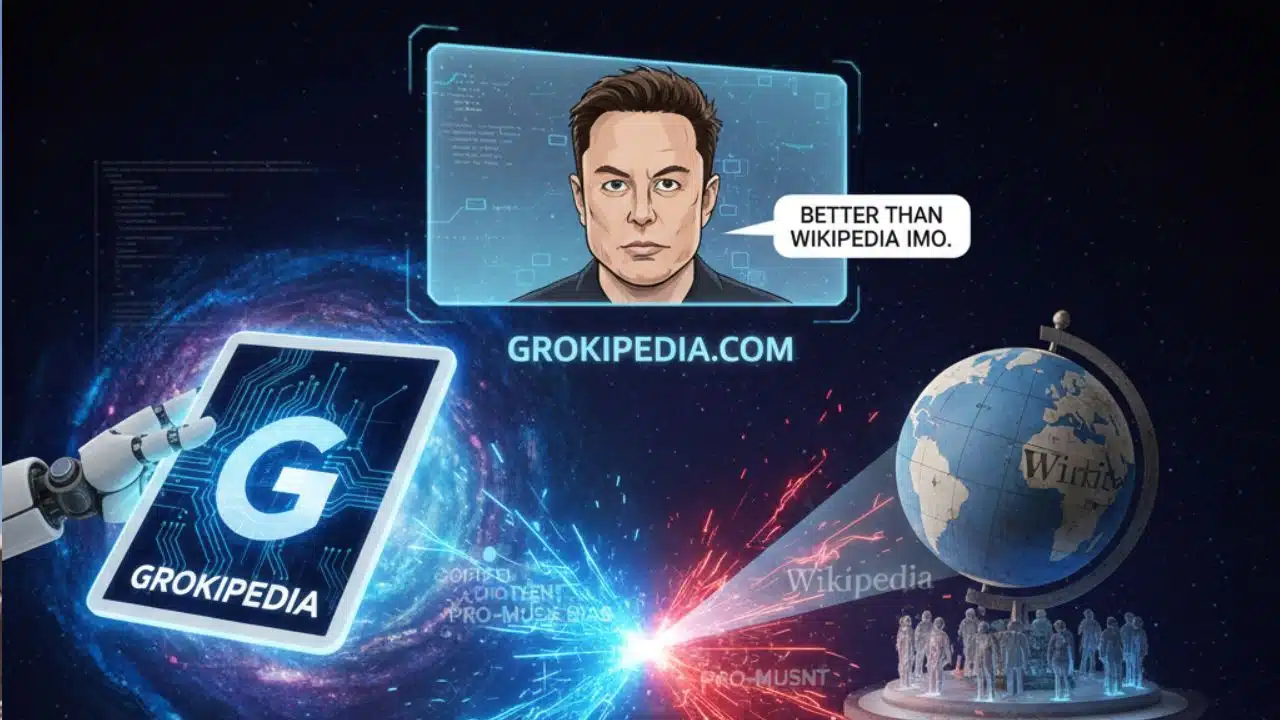
Elon Musk, the billionaire technologist, escalated his long-simmering war with Wikipedia by launching Elon Musk Grokipedia on Monday, October 27. The new, AI-powered online encyclopedia from his xAI firm aims to be a “less biased” alternative, but it launched to immediate accusations of simply reflecting Musk’s own worldview, “sanitizing” his biography, and copying large sections of text from the very platform it seeks to replace.
The Launch of Grokipedia v0.1
- What It Is: An AI-generated online encyclopedia (https://www.google.com/search?q=Grokipedia.com) powered by xAI’s Grok large language model (LLM). It is not edited by human volunteers.
- The ‘Truth’ Pitch: Musk launched the site, dubbed “version 0.1,” promising “Version 1.0 will be 10X better.” He stated the goal is “the truth, the whole truth and nothing but the truth.”
- Initial Scale: Grokipedia launched with approximately 885,000 articles. This is a fraction of the English Wikipedia’s over 7 million articles.
- Immediate Controversy 1 (Bias): Early analysis by journalists shows entries on sensitive topics like “gender,” “Jan. 6 attack,” and “Elon Musk” are framed with a distinct right-leaning or pro-Musk perspective.
- Immediate Controversy 2 (Copying): Reports confirm that many Grokipedia articles are “adapted from Wikipedia” or “copied… verbatim,” with a small-print citation to Wikipedia’s “Creative Commons Attribution-ShareAlike 4.0 License.”
- Wikipedia’s Rebuttal: The Wikimedia Foundation stated: “This human-created knowledge is what AI companies rely on to generate content; even Grokipedia needs Wikipedia to exist.”
The ‘Truth’ According to Musk: Grokipedia Goes Live
After months of anticipation and railing against what he calls Wikipedia’s “hopelessly biased” nature, Elon Musk’s xAI pulled the trigger on Monday, launching https://www.google.com/search?q=Grokipedia.com. The site, which briefly crashed after its debut, presents users with a minimalist, Wikipedia-esque search bar.
The project is the culmination of Musk’s increasingly vocal criticism of the Wikimedia Foundation, the non-profit that runs Wikipedia. In a post on X (formerly Twitter) following the launch, Musk claimed that even at its nascent “v0.1” stage, Grokipedia is “better than Wikipedia imo [in my opinion].”
The launch was delayed from a planned September release, with Musk stating at the time that his team needed to “purge out the propaganda.
This new platform represents a fundamental challenge to Wikipedia’s 24-year-old model. Instead of a global community of human volunteer editors debating content and enforcing policies like “Neutral Point of View” (NPOV), Grokipedia’s content is generated and “fact-checked” by Grok, the same generative AI that powers xAI’s chatbot. It is a direct bet that an AI, trained on vast data and Musk’s “truth-seeking” mandate, can be a better arbiter of facts than human consensus.
However, the irony of the launch was not lost on observers. Stephen Harrison, a journalist who has covered Wikipedia extensively, noted the project’s core contradiction. “The irony is that Grokipedia will be built on the unpaid labor of the volunteer Wikipedia editors Musk has gone out of his way to vilify,” Harrison said.
Indeed, numerous reports confirmed that Grokipedia articles often include a discreet notice that the content is “adapted from Wikipedia.” This suggests that rather than building a knowledge base from scratch, Grokipedia is, in its current form, acting as an AI-powered filter, re-processor, and potential re-mixer of Wikipedia’s own content.
A Battle of Bias: First-Day Analysis Reveals Slant
Musk’s primary justification for Grokipedia was to eliminate a perceived “left-leaning slant” on Wikipedia. Yet, a review of the new site’s v0.1 articles, conducted by multiple news organizations, reveals that it has not eliminated bias, but arguably just swapped one for another.
The ‘Gender’ Entry
The source reported a stark contrast in definitions.
- Wikipedia’s entry for “Gender” begins: “Gender is the range of social, psychological, cultural, and behavioral aspects of being a man (or boy), woman (or girl).”
- Grokipedia’s entry, in contrast, begins: “Gender refers to the binary classification of humans as male or female based on biological sex….”
This framing aligns closely with conservative social views and immediately positions the platform as an ideological counterpoint to the sociological consensus represented on Wikipedia.
The ‘Elon Musk’ Entry
Unsurprisingly, the platform’s handling of its founder is a key point of analysis. Reporters at The Washington Post and Yahoo News described Grokipedia’s entry on “Elon Musk” as “breathless” and “sanitized.”
- It reportedly extols his “long-term vision” and describes his push for artificial intelligence as emphasizing “AI safety through truth-oriented development.”
- It frames his ownership of X as prioritizing “content moderation reforms amid criticisms from legacy media outlets that exhibit systemic left-leaning tilts in coverage.
- This contrasts with Wikipedia’s entry, which, while detailing his accolades, also includes robust, heavily sourced sections on his numerous controversies and criticisms.
The ‘Jan. 6’ Entry and Sourcing Failures
The ideological tilt extends to political events. The Washington Post’s review of the Grokipedia article on the Jan. 6, 2021, U.S. Capitol attack found that it “blended factual accounts of the event with suggestions that Democrats and the mainstream media had exaggerated both its severity and President Donald Trump’s culpability.
Furthermore, the site’s academic rigor is being questioned. The Associated Press noted that Grokipedia’s entries are “thinly sourced.” As an example, its article on the “Chola Dynasty” of southern India listed just three linked sources, while the corresponding Wikipedia article has 113 linked sources plus dozens of referenced books.
‘LLMs Make Stuff Up’: Wikipedia and Experts Respond
The launch drew a sharp, swift response from the Wikimedia Foundation and its co-founder, Jimmy Wales.
Wikimedia: ‘Even Grokipedia Needs Wikipedia’
In a statement to source and other outlets, a Wikimedia Foundation spokesperson, Gwadamirai Majange, delivered a pointed message highlighting the parasitic nature of AI models.
Wikipedia’s strengths are clear: it has transparent policies, rigorous volunteer oversight, and a strong culture of continuous improvement… This human-created knowledge is what AI companies rely on to generate content; even Grokipedia needs Wikipedia to exist.”
The foundation’s argument is that LLMs, including Grok, are trained on data largely scraped from the internet, with Wikipedia being a primary, high-quality source. Without Wikipedia’s human-curated data, Grokipedia would have no foundation to build upon.
Jimmy Wales’s Takedown: ‘Plausible but Wrong’
By coincidence, Wikipedia co-founder Jimmy Wales was speaking at a CNBC Technology Executive Council Summit on Tuesday, October 28, where he dismissed Musk’s new venture.
Wales argued that LLMs are fundamentally unsuited for encyclopedic work because they are designed for “plausible” rather than “accurate” answers. “LLMs Make Stuff Up,” he stated flatly.
He gave an example of testing chatbots by asking about his wife, who is “not famous but known,” and finding the results are consistently “plausible but wrong,” with the AI “very happily” inventing details like fake book citations.
Wales directly addressed Musk’s “woke bias” claims, defending Wikipedia’s model:
“He is mistaken about that. His complaints about Wiki are that we focus on mainstream sources and I am completely unapologetic about that. We don’t treat random crackpots the same as The New England Journal of Medicine and that doesn’t make us woke.
Wales also highlighted the staggering economic disparity, noting Wikipedia runs on an annual budget of around $175 million, while AI hyperscalers are projected to spend $550 billion in 2026, largely to produce content that is, in his view, unreliable.
The launch of Grokipedia v0.1 is not the end, but the first shot in a new war for digital knowledge.
- The ‘Version 1.0’ Promise: Musk has already set expectations for a “10X better” version. This will likely involve deeper integration with xAI’s latest models and real-time data from X, but it remains to be seen if it can solve the core problems of bias and “hallucination.
- The Licensing Battle: The fact that Grokipedia is using Wikipedia’s content under a Creative Commons license—while simultaneously attacking Wikipedia’s credibility—is a point of legal and ethical tension that will likely escalate.
- The ‘Splinternet’ of Truth: The public is now faced with two dueling “sources of truth.” One is a flawed, human-run project that strives for (and sometimes fails at) neutrality. The other is an AI-generated project that openly admits to “purging propaganda” based on its founder’s definition, backed by xAI’s $6 billion in Series B funding raised in May 2024.
This conflict is more than a simple business rivalry. It is a battle for epistemic supremacy—a fight over who gets to write the first draft of history, and whether that draft will be written by human consensus or a billionaire’s algorithm.
The Information is Collected from The Economic Times and Japan Today.