

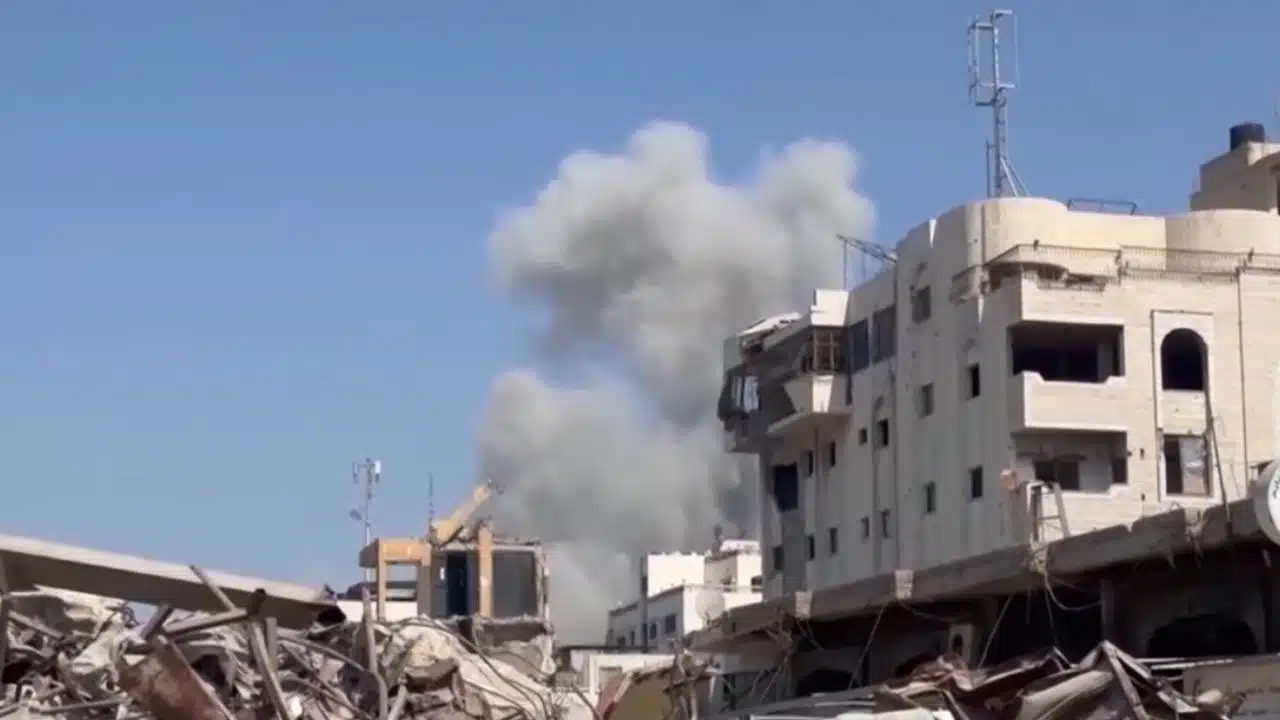
A fragile 19-day-old ceasefire in Gaza has been shattered after Israel strikes Gaza with “powerful” force, killing at least 30 people, according to Palestinian officials. The strikes, which began late Tuesday and intensified into Wednesday, October 29, 2025, were ordered by Israeli Prime Minister Benjamin Netanyahu, who accused Hamas of two “clear violations” of the truce: staging a “fake” discovery of a hostage’s remains and attacking Israeli troops in southern Gaza.
- New Strikes: At least 30 people were killed and dozens wounded in fresh Israeli airstrikes on the Gaza Strip on Wednesday, October 29, 2025.
- Israeli Justification: The strikes were ordered after Israel accused Hamas of staging a “fake discovery” of the partial remains of hostage Ofir Tzarfati on October 27. Mr. Tzarfati’s body had already been recovered by the IDF in December 2023.
- Second Violation: Israel also cited an attack on its troops in Rafah on October 28, where Hamas fighters allegedly used anti-tank weapons and sniper fire.
- Hamas Denial: Hamas denied involvement in the Rafah attack, accused Israel of “fabricating false pretexts” for escalation, and postponed the handover of another hostage’s remains in protest of the Israeli strikes.
- Ceasefire in Jeopardy: The violence is the most significant challenge yet to the U.S.-brokered ceasefire that began on October 10, 2025, mediated by the administration of President Donald Trump.
- Total Human Cost: The Gaza Health Ministry reports at least 68,531 people have been killed in the enclave since the war began in October 2023. Israel states 1,221 people were killed in Hamas’s initial attack.
Ceasefire Collapses Under ‘Powerful Strikes’
The overnight calm in Gaza was broken by a series of heavy explosions. By 7:30 AM local time on Wednesday, October 29, Gaza’s civil defence agency spokesman, Mahmud Basal, confirmed the devastating toll.
Emergency crews are still working to recover the dead and wounded from under the rubble,” Basal told, reporting at least 30 fatalities. The strikes reportedly hit multiple areas, including one near the heavily damaged Al-Shifa hospital in Gaza City and another that struck a vehicle in Khan Younis, killing five people.
The strikes followed a direct order from Israeli Prime Minister Benjamin Netanyahu late Tuesday. Prime Minister Benjamin Netanyahu instructs the IDF to carry out immediate and powerful strikes in the Gaza Strip,” his office said in a statement following a security consultation.
Israel’s Defence Minister, Israel Katz, issued a stark warning, linking the strikes directly to the two alleged violations. Hamas’s attack today on IDF soldiers in Gaza... is a crossing of a glaring red line,” Katz said. “Hamas will pay dearly, with interest, for attacking the soldiers and for violating the agreement on the return of the deceased hostages”.
In an immediate response, Hamas’s armed wing, the Al-Qassam Brigades, announced it was postponing the planned handover of another hostage’s body, which had been scheduled for Tuesday night, blaming Israel’s “violations” for the delay.
The ‘Staged’ Discovery: A ‘Clear Violation’
The escalation was triggered by a deeply contentious event surrounding the return of hostage remains. On Monday, October 27, Hamas handed over a casket to the International Committee of the Red Cross (ICRC), purporting to contain newly discovered remains.
However, Israeli officials, including the Prime Minister’s Office, announced Tuesday that the remains were identified as belonging to Ofir Tzarfati, a hostage whose body had already been recovered by the IDF during operations in December 2023 and buried in Israel.
The Israel Defense Forces (IDF) then released what it described as drone footage from Monday, October 27, allegedly showing the incident. The IDF claimed the footage showed Hamas operatives “removing body remains from a structure that had been prepared in advance and burying them nearby,” and then staging “a false display of discovering a deceased hostage’s body” in front of Red Cross representatives.
A ‘Disgraceful Deception’
The accusation of manipulation was echoed by both the hostage’s family and the ICRC, which had facilitated the transfer.
The Tzarfati family released a statement, shared by the Hostages and Missing Families Forum, calling the event an “abhorrent manipulation.” “This morning we were shown video footage of our beloved son’s remains being removed, buried, and handed over to the Red Cross — an abhorrent manipulation designed to sabotage the deal and abandon the effort to bring all the 1hostages home,” the family said.
The ICRC, often neutral, issued a rare and strong condemnation. It is unacceptable that a fake recovery was staged, when so much depends on this agreement being upheld and when so many families are still anxiously awaiting news of their loved ones,” s2aid Sarah Davies, an ICRC spokesperson.
This was the second such incident. Israeli officials noted that in the first week of the ceasefire, one of the “bodies” Hamas released was identified as an unknown Palestinian.
Accusations Traded Over Rafah Attack
Compounding the crisis over the remains, the IDF reported a direct attack on its forces in southern Gaza on Tuesday, October 28. An Israeli military official stated that Hamas fighters targeted Israeli troops positioned near Rafah with anti-tank weapons and sniper fire.
This attack, which Israeli officials said crossed an agreed-upon disengagement line, was labeled the “crossing of a glaring red line” by Defence Minister Katz.
Hamas, however, forcefully denied any responsibility. In a press statement, the group said it had “no connection to the shooting incident in Rafah and affirms its commitment to the ceasefire agreement.
The group flipped the accusation, claiming Israel was the one violating the truce. Hamas accused Israel of “seeking to fabricate false pretexts in preparation for taking new aggressive steps against our people” and of systematically obstructing the search for the remaining hostage bodies by refusing to allow heavy machinery into rubble-filled areas.
A ‘Pretext for War’ or a Justified Response?
The rapid spiral of events has placed the entire U.S.-brokered peace plan, which began on October 10, in mortal danger. The agreement’s first phase depends on the successful return of all hostage remains—13 of which are still believed to be in Gaza—before moving to more complex issues like the disarmament of Hamas and the future governance of the strip.
The View from Washington
Mediators in the U.S. administration, which has invested significant political capital in the truce, appeared to be scrambling to de-escalate. Speaking to reporters, U.S. Vice President JD Vance maintained that the ceasefire “is holding” despite what he characterized as “little skirmishes.
“We know that Hamas or somebody else within Gaza attacked an IDF soldier. We expect the Israelis are going to respond, but I think the president’s peace is going to hold,” Vance said.
Pressure from the Far-Right
This view contrasts sharply with the political reality in Israel. Far-right ministers in Netanyahu’s coalition, such as National Security Minister Itamar Ben-Gvir, seized on the violations to call for a full resumption of the war.
The fact that Hamas continues to play games and does not immediately transfer all the bodies of our fallen, is in itself evidence that the terror organisation is still standing,” Ben-Gvir posted on X, formerly Twitter. Now we don’t need to ‘exact a price from Hamas’ for the violations..
The View from Gaza
For residents in Gaza, the strikes are a terrifying echo of the two-year war that has devastated the enclave.
Now they accuse Hamas of stalling, and that is a pretext for renewed escalation and war,” Abdul-Hayy al-Hajj Ahmed, a Gaza resident, told . “We want to rest. I believe the war will come back”.
A War’s Staggering Toll
The new strikes add to a staggering human cost from the conflict, which began with Hamas’s attack on October 7, 2023.
As of October 29, 2025, renewed violence in Gaza has resulted in at least 30 new fatalities, according to the Gaza Civil Defence, cited by source. Since the start of the conflict in October 2023, the Gaza Health Ministry reports that total deaths have climbed to at least 68,531. On the Israeli side, 1,221 people were killed during the October 7, 2023 attacks, when over 250 hostages were taken by Hamas, according to the Israeli government. As of October 28, 2025, 13 hostages are still believed to remain in Gaza, Israeli officials told sources..
The “powerful” nature of the strikes suggests a punitive, rather than defensive, action. Whether this expands into a wider operation depends on Hamas’s response and pressure from Israeli hardliners.
VP Vance’s comments suggest a desire to contain the situation, but it is unclear if the Trump administration can exert enough pressure on Netanyahu’s government to halt the retaliation. With Hamas postponing the next handover, the core mechanism of the ceasefire is now frozen.
The “staged” discovery of Ofir Tzarfati’s remains has obliterated the fragile trust required for the ceasefire to function, plunging Gaza back into violence and uncertainty.
The Information is Collected from CNN and BBC.






















