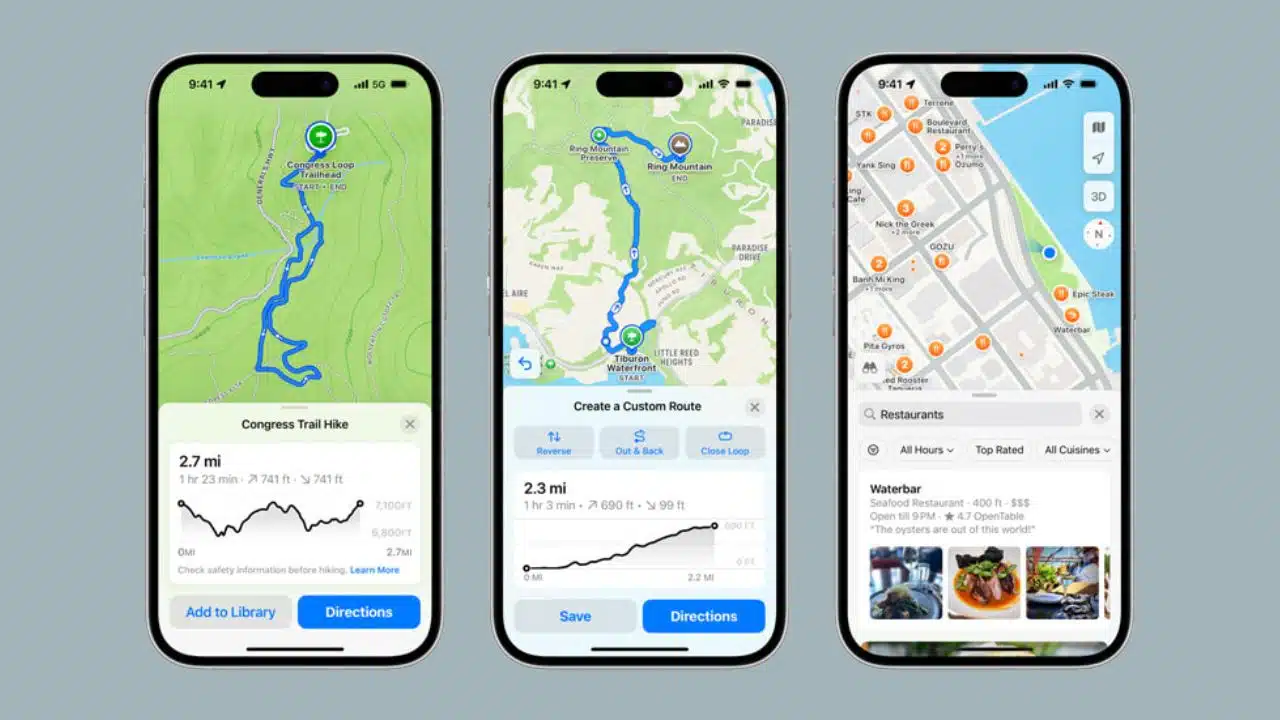
Apple is reportedly developing plans to integrate paid advertisements directly into its Apple Maps application as early as 2026, according to highly reliable reports. The move, part of a broader, accelerating push to expand its multi-billion-dollar advertising business, would transform the currently ad-free navigation tool into a new revenue stream, aligning it more with competitors like Google Maps but risking significant backlash from its premium user base.
Key Facts: What You Need to Know
- What’s Happening: Apple is reportedly planning to introduce paid search advertisements into the Apple Maps app.
- When: The new ad slots could roll out “as early as next year” (2026), according to a report from Bloomberg’s Mark Gurman on October 26, 2025.
- How It Would Work: The system would function similarly to App Store ads. Businesses, such as restaurants or local shops, could pay to have their listings featured more prominently at the top of search results within the Maps app.
- The ‘Apple’ Spin: The company reportedly plans to leverage AI (likely Apple Intelligence) to ensure ads are relevant and to design an interface that is “better” and cleaner than Google’s offering.
- The Motive: Money. Apple’s advertising business is a growing pillar of its high-margin Services division. A recent industry report projected Apple’s US ad revenue to hit $7.42 billion in 2025.
- The Conflict: The move places Apple’s pursuit of new revenue in direct conflict with its long-held brand identity of offering a premium, private, and ad-free user experience, prompting concerns of a “money grab.
The latest development comes from Bloomberg’s Mark Gurman, who stated in his “Power On” newsletter on Sunday, October 26, 2025, that Apple’s engineering teams are actively working on the project. According to the report, the plan to bring ads might be coming to Apple Maps next year is “gaining traction” and is a key part of Apple’s strategy to generate more advertising revenue beyond its lucrative App Store.
The system would not, according to initial reports, involve obtrusive pop-up banners or video ads. Instead, it would be a “paid search” model.
When a user searches for “pizza” or “coffee shop,” for example, a restaurant group or chain could pay Apple to have its location appear as the top-promoted result. This is a direct parallel to the model Apple perfected with its “Apple Ads” platform (formerly Apple Search Ads) in the App Store, where developers bid for top placement in search results for keywords like “photo editor” or “puzzle game.”
This integration would be a logical, if controversial, extension of Apple’s “Business Connect” platform, a free tool Apple launched to allow businesses to claim and manage their “place cards” in Maps with photos, hours, and special offers. An advertising layer would essentially create a premium, paid tier for that existing system.
How Apple Plans to Make Ads ‘Apple-Like’
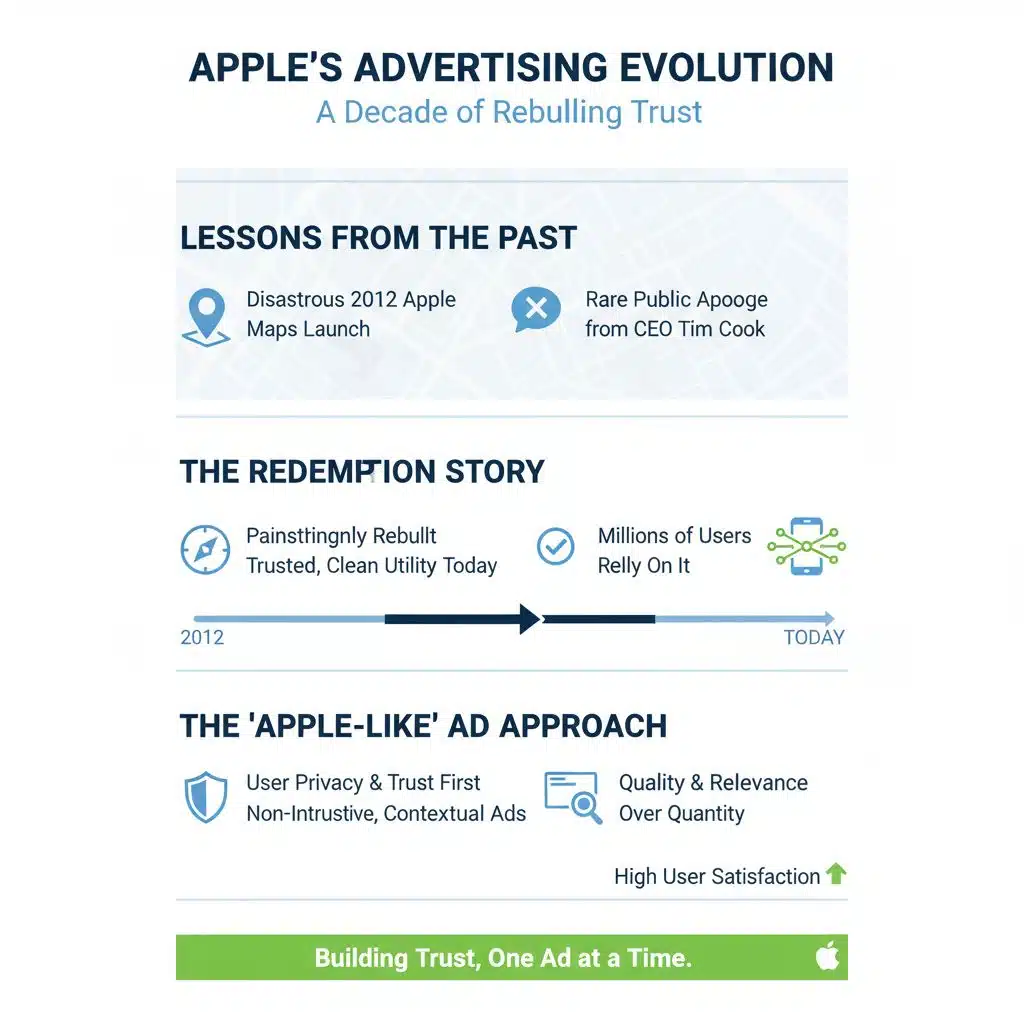
Apple is acutely aware of the potential user backlash. The company has spent the last decade painstakingly rebuilding Apple Maps from its disastrous 2012 launch—a failure so significant it prompted a rare public apology from CEO Tim Cook. Today, the app is a trusted, clean utility for millions.
To mitigate this, Apple is reportedly planning to differentiate its ad platform in two key ways:
1. The ‘Apple Intelligence’ Factor
Unlike competitors who rely on broad user data tracking, Apple is expected to lean heavily on its on-device AI, “Apple Intelligence.” The goal is to use on-device context and user intent—not a cross-app personal profile—to serve relevant ads. Gurman’s report suggests Apple is designing an interface it believes will be “better than what Google and other companies offer. This implies ads that feel more like useful, highlighted suggestions rather than invasive promotions.
2. A ‘Search-First’ Model
The most common ad format on Google Maps is the “Promoted Pin,” a branded, square-shaped logo that appears directly on the map itself, even when a user isn’t searching.
Apple’s reported model appears to be focused within the search results list. This is a crucial distinction. It means a user’s map view would likely remain clean and ad-free, with the commercial content only appearing when the user explicitly demonstrates intent by searching for a business or category.
The Multi-Billion Dollar Motive: Apple’s Growing Ad Ambitions
This potential move into Maps is not happening in a vacuum. It is the most visible step yet in Apple’s deliberate and highly successful strategy to build a major advertising business.
While Apple’s hardware sales for iPhones and Macs remain its core, the “Services” division—which includes the App Store, Apple Music, iCloud, and advertising—is its fastest-growing and highest-margin category. Wall Street investors look to Services growth as the key to Apple’s future.
Apple’s advertising arm has been quietly expanding for years, aided significantly by its own 2021 App Tracking Transparency (ATT) policy. That policy, which requires apps to ask for permission to track users, devastated the ad-targeting models of rivals like Meta (Facebook) while simultaneously making Apple’s own ad slots within the App Store more valuable.
Here is a look at the platform’s rapid maturation:
- Massive Revenue Growth: While Apple doesn’t break out ad revenue specifically, industry analysts have tracked its growth. Omdia reported Apple’s ad business grew a staggering 264% year-over-year in 2021 to hit $3.7 billion. More recently, a Digiday report cited projections of Apple’s US ad revenue reaching $7.42 billion in 2025.
- Platform Rebrand: Signaling its ambitions, Apple officially rebranded “Apple Search Ads” to the simpler, broader “Apple Ads” on April 14, 2025. This name change explicitly shed the “Search” limitation, paving the way for ads in other surfaces—like Maps.
- Global Expansion: The “Apple Ads” platform is no small operation. As of late 2024, it was already available in 91 different countries and regions, providing a ready-made global infrastructure for a Maps rollout.
Adding paid search to Maps would open up an entirely new, highly lucrative inventory: local business advertising, a market long-dominated by Google and Yelp.
Walking a Tightrope: The ‘Premium’ vs. ‘Profit’ Conflict
The primary obstacle for Apple is not technical; it’s philosophical. The company has built one of the world’s most valuable brands on a promise of user-centricity, privacy, and a premium, ad-free experience.
The Risk of User Backlash
Apple’s user base pays a significant premium for its hardware. The introduction of ads, no matter how subtle, risks cheapening that “premium” feel. This is already a sore point for many users who have noted the increasing number of “ads” for Apple’s own services (like Apple TV+, Apple Music, and AppleCare+) inside native apps like Settings and the App Store.
Mark Gurman’s report directly addresses this friction, noting the move could trigger a “potential backlash from consumers.”
The Privacy Paradox
The move also complicates Apple’s primary marketing message against its chief rival, Google. For years, Apple’s stance has been simple: “What happens on your iPhone, stays on your iPhone.” It has positioned itself as the “anti-Google,” a company that doesn’t need to “monetize its users” by selling their data to advertisers.
Introducing “relevant” ads into Maps, even if powered by on-device AI, forces Apple to walk a perilously thin line. It must convince users that its ad platform is fundamentally different and does not compromise the privacy principles it espouses, all while pursuing the same ad revenue as its competitors.
What to Watch Next
Apple has not officially confirmed any of inese reports. If the 2026 timeline is accurate, a formal announcement could come during Apple’s Worldwide Developers Conference (WWDC) in June 2026, when the company typically previews its next-generation operating systems.
Key questions remain:
- Will these ads be clearly labeled?
- Will there be a setting for users to opt out, perhaps as part of an “Apple One” subscription bundle?
- How will this impact small, local businesses competing for visibility against large, deep-pocketed chains?
The plan to monetize Apple Maps represents a logical and financially tempting evolution for Apple’s Services division. However, it is also a high-stakes gamble that will test the loyalty of its user base and the integrity of its privacy-first brand.
The Information is Collected from MSN and Yahoo.