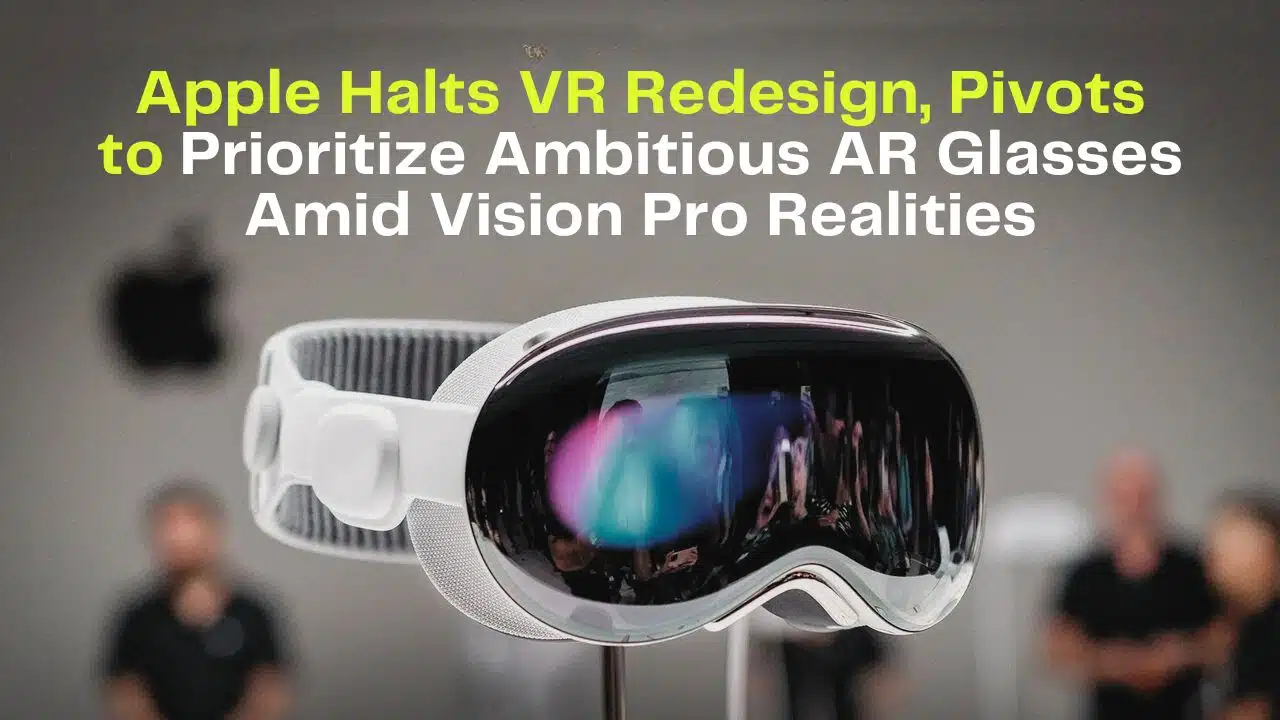
Apple has reportedly halted development on its next-generation, lower-cost Vision virtual reality (VR) headset, a significant strategic pivot to prioritize resources for a lighter, more ambitious augmented reality Apple Halts VR Redesign glasses project. This move, reported by sources familiar with the company’s internal roadmap, signals a major reassessment of its multibillion-dollar XR strategy following the launch of the high-priced Apple Vision Pro.
The decision to shelve the more accessible VR device underscores the immense technical and market challenges facing the nascent spatial computing category and reinforces CEO Tim Cook’s long-held belief that AR, not VR, is the ultimate destination. This shift could delay Apple’s mass-market XR debut by years, ceding the immediate ground to competitors like Meta while the company pursues its “holy grail” product: a pair of unobtrusive, everyday smart glasses
Key Facts: The Strategic Pivot
- Project Halted: Development of a more affordable successor to the Vision Pro, internally codenamed “N109,” has been suspended, according to internal sources. The goal was to bring the price down from $3,499 to a sub-$2,000 price point.
- Focus Shift: Resources and top engineering talent are being reallocated to a far more challenging, long-term project: true, lightweight AR glasses that resemble conventional eyewear.
- Market Reality: The decision follows lower-than-expected sales momentum for the Apple Vision Pro, which, despite technological acclaim, has struggled to find a mainstream audience due to its high cost, weight, and limited “killer applications.”
- Timeline Impact: This pivot means a consumer-focused Apple headset is unlikely before late 2026, while the AR glasses remain a distant prospect, potentially not arriving until the end of the decade.
- R&D Investment: The move comes as Apple’s Research & Development spending continues to climb, exceeding $30 billion annually, with a significant portion dedicated to the secretive Vision Products Group (VPG).
Context: The Weight of a Technological Marvel
When Apple unveiled the Vision Pro at its Worldwide Developers Conference in June 2023, it was hailed as a monumental feat of engineering. Launched to the public in February 2024, the $3,499 “spatial computer” seamlessly blended digital content with the physical world, offering an experience far superior to anything on the market.
However, from the outset, the device was dogged by fundamental questions about its market fit. Its premium price tag placed it firmly in the hands of early adopters, developers, and enterprise clients. For consumers, the device’s physical weight, the need for a tethered battery pack, and a still-nascent app ecosystem proved to be significant barriers to adoption.
The Unfolding Strategy: What Happened
According to sources within Apple’s supply chain and its VPG, the plan was always two-pronged. The first-generation Vision Pro was a statement piece to establish the visionOS platform. The follow-up, the N109 project, was intended to be the real volume driver. This device would have retained the high-end internal displays of the Vision Pro but scaled back on other features, such as external camera quality, and potentially used a simpler headband design to reduce costs.
The decision to halt this project reportedly came after months of internal debate. Leadership concluded that even a “cheaper” model would still require too many compromises, landing at a price point (~$1,500-$2,000) that was still too high for mainstream success while failing to deliver a demonstrably better experience than Meta’s much cheaper Quest 3.
Instead of an incremental step, Apple’s leadership, including Tim Cook, has reportedly decided to double down on the long-term vision: AR glasses. This project aims to solve what many in the industry see as the ultimate technological challenge—packing the power of a computer into a device that looks and feels like a regular pair of glasses.
Latest Data & Statistics
The market data provides critical context for Apple’s decision. While the initial launch saw a flurry of activity, sales have reportedly slowed significantly.
- Vision Pro Sales Estimates: Initial sales estimates for the Vision Pro in 2024 were once as high as 800,000 units. However, prominent analyst Ming-Chi Kuo of TF International Securities revised his forecast downwards significantly, with current estimates suggesting Apple will ship between 400,000 and 450,000 units in its first year. This is a fraction of the tens of millions of iPhones sold per quarter.
- Market Share Disparity: The VR market remains dominated by Meta. In Q4 2024, Meta’s Quest lineup held an estimated 65% market share of the global VR headset market, having sold over 20 million Quest 2 units life-to-date. Apple’s entry, while technologically superior, has yet to make a significant dent in overall market share due to its price and niche positioning
- Apple R&D Expenditure: Apple’s commitment to new product categories is evident in its financial filings. For the fiscal year ending September 2024, Apple reported R&D expenses of $31.5 billion, a year-over-year increase of approximately 6%. A substantial portion of this is believed to be funneled into the VPG and its long-term AR/VR ambitions. This enormous spend highlights the pressure to deliver a product with a return on investment on the scale of an iPhone or Apple Watch.
Official Response & Expert Analysis
When reached for comment, an Apple spokesperson stated, “Apple does not comment on rumors or speculation.” This is the company’s standard policy regarding future products.
However, CEO Tim Cook has been vocal about his enthusiasm for augmented reality for years. In a 2022 interview, he noted, “I’m incredibly excited about AR… I think that it’s a profound technology that will affect everything.” This long-standing position aligns with the strategic pivot away from bulky VR headsets.
Anshul Gupta, a senior research director at Gartner, commented on the broader market dynamics. “The challenge for any company in the XR space, including Apple, is moving from a niche, enthusiast product to a mainstream consumer device,” Gupta stated in a recent industry report (paraphrased for context). “The path to mass adoption requires not just a lower price but a compelling, daily-use case that doesn’t yet exist. Forgoing an incremental VR update to solve the fundamental form-factor problem with AR glasses is a high-risk, high-reward strategy typical of Apple.”
Impact on Developers and Consumers
For developers who have invested heavily in creating apps for visionOS, the news brings uncertainty. The dream of a rapidly expanding user base via a cheaper headset is now on hold.
“We bet big on visionOS, believing a more affordable model was about 18 months away,” said a lead developer at a European gaming studio, who spoke on the condition of anonymity. “This shift to a far-future AR device means we have to rethink our entire investment in the platform.”
For consumers, the message is clear: the accessible Apple “spatial computer” is not coming anytime soon. The Vision Pro will remain a luxury, developer-focused product, while the true successor may be a completely different type of device arriving many years from now.
What to Watch Next
- Competitor Moves: Meta will likely capitalize on Apple’s pause to further entrench its Quest ecosystem. With the Quest 4 expected in late 2026, Meta has a clear runway to dominate the sub-$1,000 VR market for the foreseeable future.
- visionOS Updates: Apple will continue to issue software updates for the existing Vision Pro, likely focusing on enterprise and professional use cases to justify its price and maintain developer interest.
- Technology Milestones: The key technological hurdles for AR glasses remain battery life, display technology (microOLEDs vs. waveguide), and processing power in a tiny form factor. Any public demonstration of breakthroughs in these areas will be a key indicator of progress.
A High-Stakes Bet on the Future
Apple’s decision to halt its cheaper VR headset is a candid admission of the market realities it faces. The Vision Pro proved that Apple could build the world’s best mixed-reality device, but it also proved that the world may not be ready for it.
By pivoting to AR glasses, Apple is skipping the intermediate step and aiming directly for the endgame. It is a monumental gamble that trades near-term market share for a chance to define the next major computing platform. Just as it did with the iPhone, Apple is betting that it can wait, perfect the technology in secret, and emerge with a revolutionary product that makes all previous attempts seem obsolete. But in the fast-moving world of tech, it’s a race against time, and for now, the future of spatial computing remains just out of focus.