

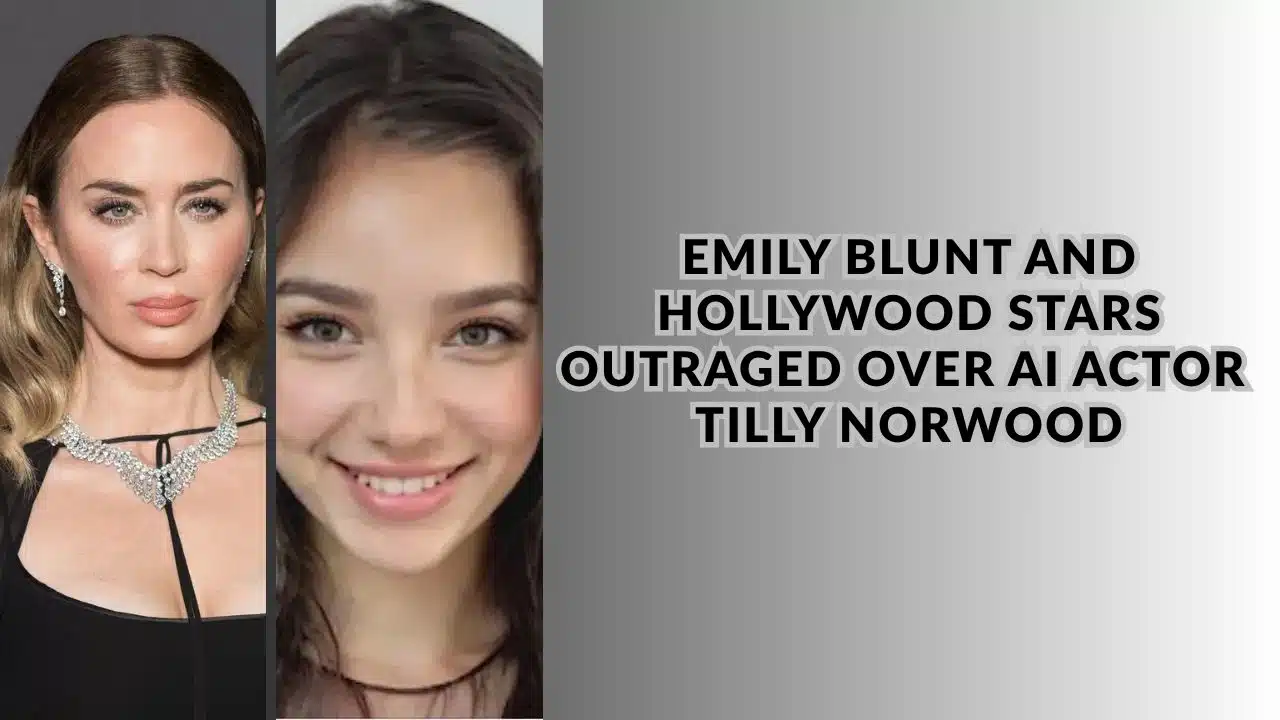
A firestorm has erupted in Hollywood following the emergence of ‘Tilly Norwood,’ a fully AI-generated actor, prompting sharp condemnation from A-list stars including Emily Blunt and a stark warning from the actors’ union, SAG-AFTRA. The digital creation, promoted by AI production studio Xicoia, is being shopped to talent agencies, a move that many industry veterans see as an existential threat to their craft and a direct challenge to the human element of cinema.
The controversy centers on what creators call the world’s first AI actor, a synthetic performer capable of delivering lines and expressing emotion, which has reignited deep-seated fears that were central to the protracted 2023 Hollywood strikes. For many actors, the theoretical danger of being replaced by a digital replica has now become a tangible reality, embodied by Tilly Norwood’s digital headshot and curated social media presence.
Key Facts: The Tilly Norwood Controversy
- Who is Tilly Norwood?: An entirely synthetic performer created by Eline Van der Velden’s AI production companies, Particle6 and Xicoia. Norwood was unveiled at the Zurich Summit, a film industry event, in late September 2025.
- Hollywood’s Reaction: Leading actors have expressed outrage. Emily Blunt called the creation “really, really scary,” while others like Natasha Lyonne and Melissa Barrera have called for a boycott of any agency that signs the AI entity.
- SAG-AFTRA’s Stance: The powerful actors’ union issued a formal statement on September 30, 2025, declaring that Tilly Norwood “is not an actor” but a “character generated by a computer program that was trained on the work of countless professional performers—without permission or compensation.” (Source: SAG-AFTRA Statement)
- The Creator’s Defense: Eline Van der Velden has defended her creation as a “new tool, a new paintbrush,” arguing it is a work of art and not intended as a replacement for human actors.
- Industry Context: This debate comes just two years after the 118-day SAG-AFTRA strike of 2023, where protections against the non-consensual use of AI to replicate actors’ likenesses and performances were a cornerstone of the final agreement.
“Good Lord, We’re Screwed”: Actors Voice Their Anger
The backlash from the creative community has been swift and severe. Speaking on a Variety podcast, Oscar-nominated actress Emily Blunt did not mince words when shown a video of the AI creation.
Her sentiment was echoed across social media. Natasha Lyonne, the star of “Russian Doll,” urged a collective industry response, posting on Instagram: “Any talent agency that engages in this should be boycotted by all guilds. Deeply misguided & totally disturbed.”
Melissa Barrera, known for her roles in the “Scream” franchise, posted a similarly pointed message, writing, “Hope all actors repped by the agent that does this, drop their a$$. How gross, read the room.”
Latest Data & Statistics: The Unsettling Rise of AI in Film
The anxiety over AI is not merely philosophical; it is rooted in the rapid, measurable growth of artificial intelligence within the entertainment sector.
- Market Growth Projection: The global AI market in media and entertainment was valued at approximately $15.11 billion in 2024. It is projected to surge to $195.7 billion by 2033, expanding at a compound annual growth rate (CAGR) of 27.6%. This reflects a massive investment and integration of AI technologies across the industry.
- Studio Adoption: As of early 2025, an estimated 65% of film studios have already adopted AI-driven workflows for various aspects of content creation, from pre-production to visual effects and post-production.
- A Strike’s Central Issue: The 2023 SAG-AFTRA strike, which lasted 118 days, brought Hollywood to a standstill. A primary demand from the union was securing contractual protections requiring “informed consent and compensation” before a studio could create or use a digital replica of an actor. The Tilly Norwood case is seen by many as a test of the spirit and letter of that hard-won agreement.
Official Response: SAG-AFTRA Condemns Synthetic Performers
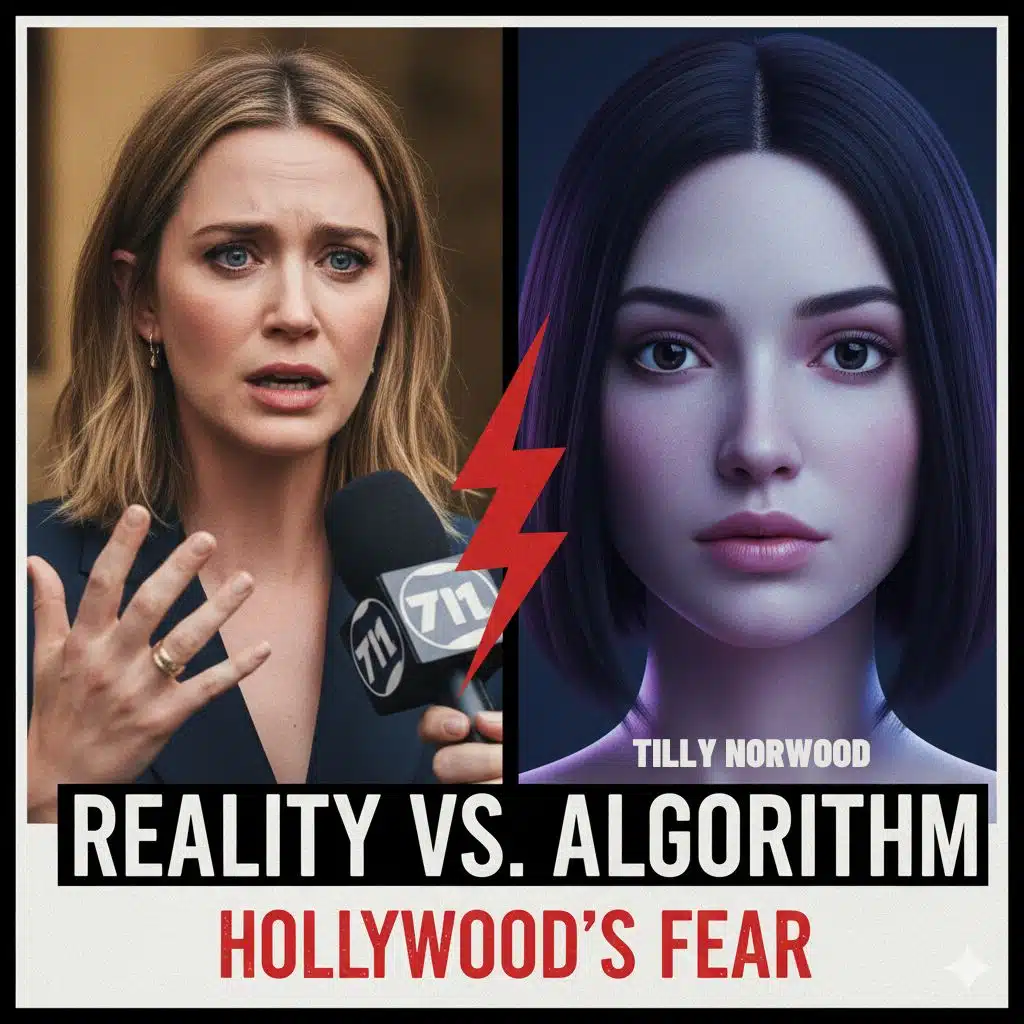
Hollywood’s most powerful union, SAG-AFTRA, issued a forceful and unequivocal condemnation of Tilly Norwood. In a statement released on Tuesday, September 30, 2025, the union drew a clear line between human artistry and machine learning.
The statement reads: “To be clear, ‘Tilly Norwood’ is not an actor, it’s a character generated by a computer program that was trained on the work of countless professional performers—without permission or compensation. It has no life experience to draw from, no emotion and, from what we’ve seen, audiences aren’t interested in watching computer-generated content untethered from the human experience.”
The union argued that such creations do not solve a problem but rather “create the problem of using stolen performances to put actors out of work, jeopardizing performer livelihoods and devaluing human artistry.”
Expert Analysis: A Legal and Ethical Minefield
The emergence of a viable AI actor pushes the industry into complex legal and ethical territory. While the 2023 contract provides some safeguards, the technology is evolving faster than regulation. Legal experts point out that the data used to “train” AI models like Tilly Norwood is a major point of contention. If an AI is trained on the performances of thousands of actors without their consent or payment, it raises profound questions about intellectual property, copyright, and the very definition of a performance.
Dr. Amelia Vance, a specialist in technology ethics, notes, “The core issue is one of provenance and permission. An actor’s performance—their voice, their mannerisms, their emotional delivery—is their work product. When an AI ingests this data en masse to create a new, synthetic performer, who owns that resulting performance? The actors whose work was used for training have a strong claim to being uncredited, uncompensated co-creators.” This unresolved question is likely to be the subject of future legal battles.
Impact on People: The Fear of Devaluation
For working actors, from background performers to seasoned stars, the threat is deeply personal. One veteran background actor, speaking on condition of anonymity, expressed a common fear: “For years, the talk was about studios wanting to scan our likenesses for a one-time fee to use us in perpetuity. We fought that. But this is different. This isn’t about replicating me; it’s about creating a ‘perfect’ digital being that never tires, never asks for a raise, and never has a bad day. How do you compete with that?”
This sentiment goes beyond job security. It strikes at the heart of what actors believe their profession is about: drawing on human experience to tell stories that connect with an audience. The idea that this connection can be synthesized by an algorithm is, for many, a devaluation of their life’s work.
What to Watch Next
The immediate future of this controversy will hinge on several key developments. The industry will be closely watching to see if any major talent agency, such as CAA, WME, or UTA, chooses to represent Tilly Norwood.
Such a move would be seen as a major betrayal by the acting community and could trigger widespread protests. Furthermore, SAG-AFTRA is likely to pursue legal and contractual challenges against any production that attempts to use a synthetic performer like Norwood without negotiating with the union. The debate is no longer theoretical; it has arrived, and Hollywood’s response will shape the future of creative work for years to come.
























