The internet was once imagined as a seamless, borderless network—an invisible web that connected every corner of the globe. But that vision is splintering. In its place, we’re witnessing the rise of what experts call the “splinternet”—a fractured digital landscape where your location can determine what you’re allowed to see, hear, and say online.
The fragmentation is subtle in some places—just a few blocked platforms here, a news site or two there. In others, it’s dramatic, with entire services disappearing overnight under the weight of political decisions, security laws, or economic sanctions. Yet, in the cracks of this digital wall-building, a quiet resistance is thriving. According to this research, Mirror links—replicas of blocked sites—are emerging as one of the most effective tools in keeping the internet whole.
The New Borders of Cyberspace
For decades, the internet defied the rules of nation-states. Now, those states are striking back. From the “Great Firewall” of China to Russia’s Sovereign Internet Law, and from Iran’s filtered web to India’s selective platform bans, governments are increasingly asserting control over what their citizens can access.
The methods vary:
- IP blocking to deny connections to certain servers.
- DNS manipulation to redirect traffic away from banned domains.
- Deep Packet Inspection (DPI) to identify and filter specific content types.
- Service throttling to make certain sites unusable without outright banning them.
The result? An internet that looks and feels different depending on where you are—a far cry from the universal network of the early web.
Mirror Links: The Patchwork Solution
A mirror link is exactly what it sounds like—a perfect copy of a site, hosted on a different domain or server. When the original site is blocked, the mirror steps in as a substitute doorway.
The practice is not new; in fact, mirror sites date back to the early days of the web, when universities and software distributors used them to handle heavy download traffic. But in the age of digital censorship, their role has shifted from convenience to necessity.
Modern mirror link networks have evolved into dynamic, AI-assisted systems:
- Automated Domain Generation: Software creates new domain names for mirrors in real time, faster than authorities can block them.
- Global Content Distribution Networks (CDNs): Content is cached across hundreds of servers worldwide, allowing mirror links to pop up in multiple jurisdictions at once.
- Encrypted Access Points: Some mirrors are embedded within secure portals or accessed via encrypted tokens, making them harder to detect.
How They Hold the Internet Together
Think of the internet as a massive library, and censorship as a process of locking certain doors. Without mirrors, those doors stay closed indefinitely. With mirrors, a new door appears—often just around the corner—leading to the same information.
Mirror links preserve:
- Information Flow – Critical during elections, protests, or crises when timely updates matter.
- Cultural Access – From music and films to academic resources, mirrors prevent knowledge loss.
- Digital Continuity – Keeping businesses, NGOs, and journalists online despite political barriers.
In countries experiencing frequent shutdowns, mirrors have become lifelines. Independent newsrooms in Belarus, Myanmar, and Turkey have maintained readership numbers by distributing mirror links through encrypted messengers, email newsletters, and even QR codes on printed flyers.
The Human Network Behind the Tech
Mirrors don’t run themselves. Behind each link is a network of developers, system administrators, and digital rights activists working around the clock. These teams coordinate across borders, using secure collaboration tools to:
- Spin up new domains before old ones are blacklisted.
- Monitor traffic patterns to detect new censorship attempts.
- Share safe access instructions with communities on the ground.
In many cases, the distribution of mirror links is as strategic as the creation of them. A blocked site might post its new mirrors on foreign-hosted social accounts, encrypted chat channels, or through volunteer email chains.
Risks, Ethics, and the Next Evolution
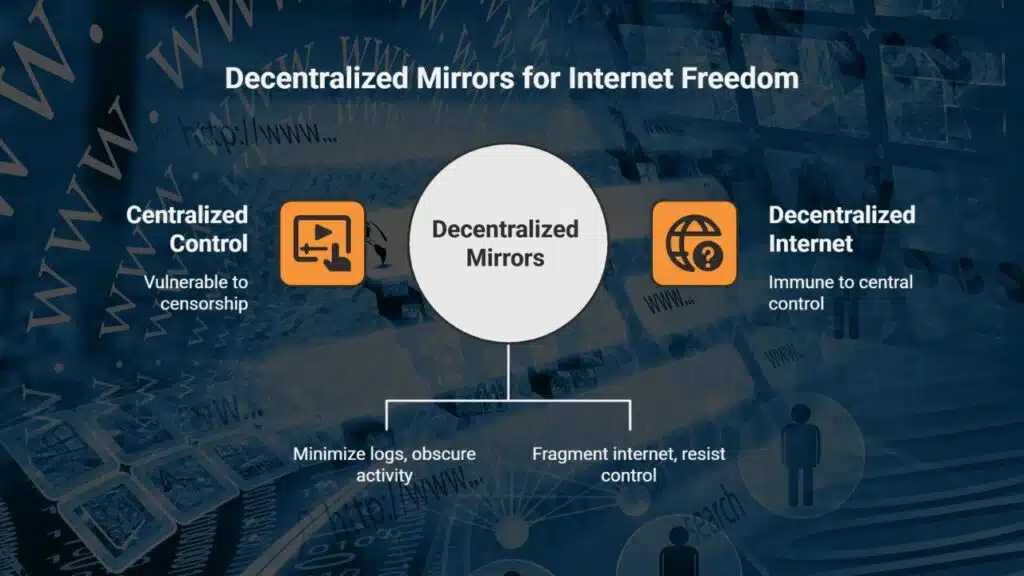
Operating or using mirror links can be risky. In some countries, circumventing a block is illegal and can result in fines or imprisonment. This has driven innovation toward privacy-by-design mirrors that minimize logs, obscure user activity, and blend traffic with legitimate web browsing.
Looking ahead, experts predict mirror technology will merge with decentralized web protocols such as IPFS (InterPlanetary File System) and blockchain-based domain registries. This would make mirrors far harder to take down—not just copies of sites, but fragments of an internet immune to central control.
A Fragile Unity Worth Defending
The splintering of the internet is real, and accelerating. But thanks to mirror links and the resilient communities that sustain them, the fractures haven’t yet broken the web beyond repair.
In a sense, mirrors are more than just technical workarounds—they’re statements of principle. Each one says: You can build borders, but we’ll find ways to cross them.
If the internet is to remain a truly global commons, mirrors may well be the stitching that holds it together.