

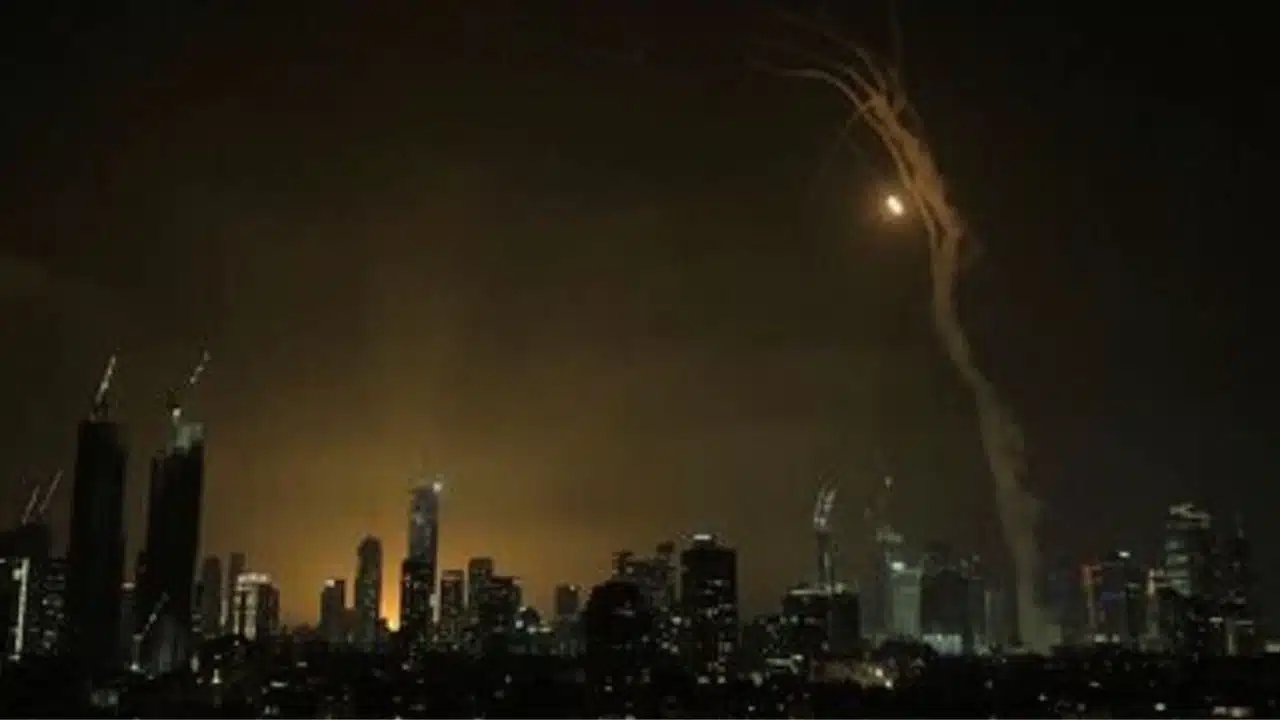
The death toll from Iran’s overnight missile strikes on central Israel has risen to four, according to Israeli emergency services on Monday. The attack, which marks the fourth consecutive day of open conflict between Iran and Israel, targeted urban centers across Israel in retaliation for earlier Israeli strikes on Iranian military assets.
The victims include two elderly men and two elderly women, as confirmed by Magen David Adom (MDA), Israel’s national emergency medical response organization.
In addition to the fatalities, at least 87 individuals were injured in the strikes. Medical personnel at multiple sites reported trauma ranging from minor wounds to life-threatening conditions. One of the most seriously injured victims is a 30-year-old woman who suffered severe facial trauma and is currently undergoing emergency care.
MDA spokespersons noted that five other victims are in moderate condition, while 81 sustained lighter injuries, including bruises, lacerations, and minor burns caused by falling debris and shockwave impacts from the missile blasts.
Multiple Cities Targeted: Tel Aviv and Haifa Among the Hardest Hit
The missile barrage struck several major Israeli cities, including Tel Aviv, Haifa, and surrounding urban areas. Residents reported hearing multiple air raid sirens followed by loud explosions during the early morning hours, prompting panic and mass evacuations to shelters.
In Haifa, emergency teams recorded approximately 30 injuries, including two people who were trapped inside a collapsed building near the city’s port. Fires also broke out in the Haifa power plant zone, raising concerns about energy supply disruptions. Firefighters managed to contain the flames, but damage assessments are still underway.
Tel Aviv, Israel’s financial capital, was also significantly impacted. Although the city’s Iron Dome missile defense system intercepted several incoming projectiles, some missiles penetrated Israeli airspace, causing blasts in populated neighborhoods and commercial districts. Emergency crews have been working nonstop to clear rubble, rescue trapped individuals, and stabilize damaged infrastructure.
Israel’s Retaliation: Airstrikes on Iranian Military Sites
The Iranian attack was in direct response to Israeli airstrikes over the weekend that targeted high-value Iranian military sites. These included surface-to-surface missile launch facilities, military training compounds, and command-and-control centers believed to be linked to Iran’s Revolutionary Guards (IRGC).
One of the most significant outcomes of the Israeli operation was the confirmed death of a senior Iranian intelligence official, Brigadier General Mohammad Kazemi, who played a pivotal role in coordinating Iran’s regional military strategy.
According to Israel Defense Forces (IDF), their precision strikes aimed to “degrade Iran’s ability to launch future attacks” and neutralize immediate threats to Israeli civilians and national security.
Iran Confirms Civilian Deaths and Promises More Retaliation
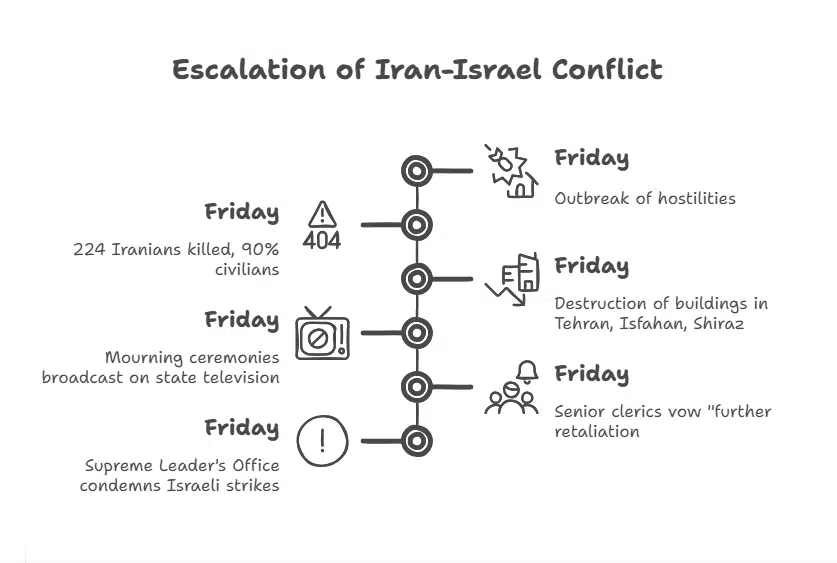
Iran’s Health Ministry released updated casualty figures indicating that since the outbreak of hostilities on Friday, at least 224 Iranians have been killed, with around 90% identified as civilians. Dozens of buildings, including residential complexes and public markets, were reportedly destroyed in Israeli drone and missile attacks on Tehran, Isfahan, and Shiraz.
Iranian state television broadcast scenes of mourning ceremonies for victims, particularly in cities like Qom, where civilian losses were reportedly highest. Senior clerics have vowed “further retaliation” and declared the Israeli attacks as “acts of state terrorism.”
In a televised statement, the Supreme Leader’s Office condemned the Israeli strikes as “brutal,” accusing Israel of violating international law and escalating a conflict that could engulf the region.
“New Method” of Attack Claimed by Iran’s Revolutionary Guards
According to Iranian military sources, the recent strikes used a “new method” of missile targeting intended to bypass Israel’s famed Iron Dome defense system. Military analysts speculate that Iran may have deployed precision-guided munitions, hypersonic weapons, or even drone swarms as part of a hybrid strategy to test Israel’s response capabilities.
A statement from the Islamic Revolutionary Guard Corps (IRGC) claimed the missile barrage was Operation True Promise III, part of a series of coordinated strikes demonstrating Iran’s evolving missile and drone technology.
While Israeli officials declined to comment in detail on the new tactics, security experts confirmed that “a small number” of missiles breached air defenses, which is rare in previous conflicts between the two nations.
Global Reaction and Diplomacy: G7 Leaders on High Alert
The unfolding crisis has drawn immediate international attention. At the Group of Seven (G7) summit currently being held in Canada, the escalating Iran-Israel conflict has become the top agenda item for world leaders.
European nations, including France, Germany, and Italy, have issued urgent calls for de-escalation. United Nations Secretary-General António Guterres described the situation as “extremely dangerous,” warning that a full-scale war could destabilize the broader Middle East and result in catastrophic civilian casualties.
The U.S. State Department issued a statement expressing deep concern and emphasized the need for “restraint and immediate ceasefire.” President Joe Biden has reportedly been in contact with regional allies to contain the fallout and protect American interests in the region.
Meanwhile, former U.S. President Donald Trump took to Truth Social, saying he hopes Iran and Israel can reach a deal. However, he added that “sometimes nations have to settle things through war,” a comment that has drawn both criticism and support across political lines. Trump also noted that backchannel diplomatic efforts were underway, even as fighting continued.
Economic Impact: Israeli Markets Resilient but Shaken
Despite fears of a prolonged war, Israel’s economy has shown surprising resilience. The Tel Aviv Stock Exchange opened lower Monday but quickly rebounded as investor confidence stabilized. Israel’s Finance Ministry issued a statement assuring the public that emergency fiscal measures are in place to prevent inflation or supply chain disruption.
The shekel weakened slightly against the U.S. dollar in early trading, reflecting market unease, but analysts say the central bank is prepared to intervene if needed.
In Iran, however, economic instability has deepened as sanctions, supply disruptions, and civilian unrest pressure the government. The Iranian rial continues to slide, and oil exports are under threat amid regional insecurity.
What’s Next: A Fragile Moment With No Clear Path Forward
With both Israel and Iran showing no signs of backing down, analysts warn that the conflict could expand rapidly to include proxy militias, U.S. forces, and other regional players like Hezbollah and the Syrian regime.
Humanitarian organizations are calling for international mediation to ensure the safety of civilians and prevent mass displacement. Experts from institutions like Brookings, Chatham House, and The International Crisis Group urge urgent diplomacy to prevent the region from tipping into a larger, multi-state war.
The Iran-Israel conflict, now in its fourth day, represents the most direct military confrontation between the two nations in modern history. With civilian casualties mounting and military losses on both sides, global powers are on edge.
As the missile strikes continue and diplomatic efforts struggle to catch up, the world watches a crisis that could reshape the future of the Middle East—and beyond.
























