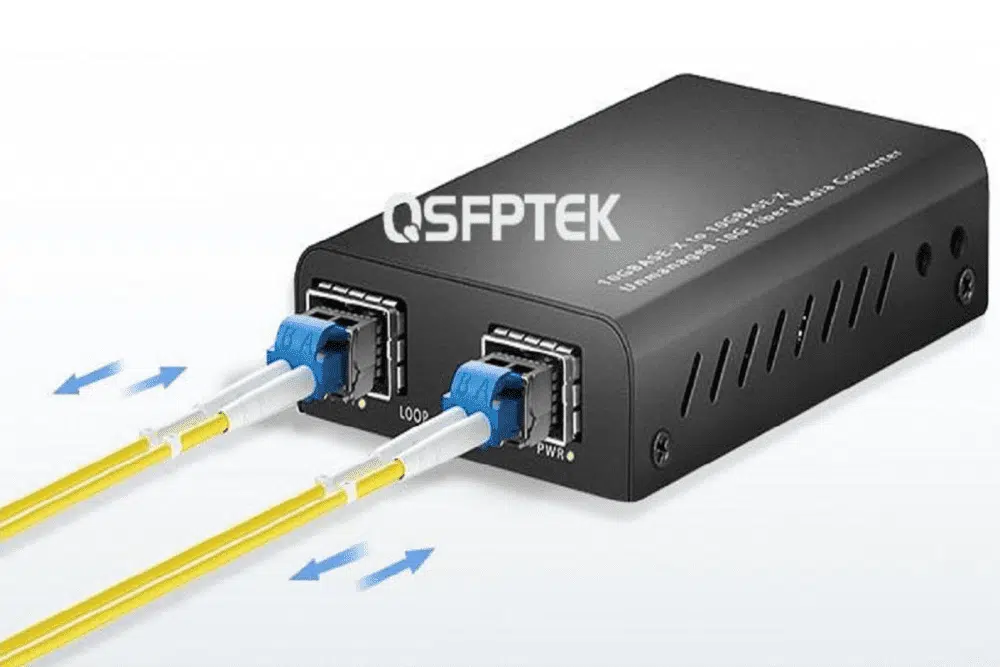
In order to ensure full compatibility with network cards, repeaters, hubs, switches, and other network equipment of other manufacturers, media converters must strictly comply with 10Base-T, 100base TX, 100base FX, and IEEE802 3 and IEEE802 3U, and other Ethernet standards. In addition, EMC anti-electromagnetic radiation shall comply with FCC Part 15. Nowadays, as major domestic operators are vigorously building community networks, campus networks and enterprise networks, the consumption of media converters is also increasing to better meet the construction needs of the access networks. According to different classification standards, there are various types of media converters on the market.
Classification by Fiber Type
Multimode Media Converter & Single-mode Media Converter
It can be divided into multimode media converters and single-mode media converters. Due to the different optical fibers used, the transmission distance of the media converter is also different. The transmission distance of the multi-mode media converter is generally between 2km and 5km, while the coverage of the single-mode media converter can range from 20km to 120km. It should be noted that due to different transmission distances, the transmission power, receiver sensitivity, and wavelength of the media converter will be different. For example, the transmitting power of the 5km media converter is generally between -20~-14dB, the receiver sensitivity is less than -30dB, and the wavelength is 1310nm. However, the transmitting power of the 120km media converter is mostly between -3~0dB, the receiver sensitivity is less than -36dB, and the wavelength is 1550 nm.
Classification by Structure
Desktop Media Converter & Rack Media Converters
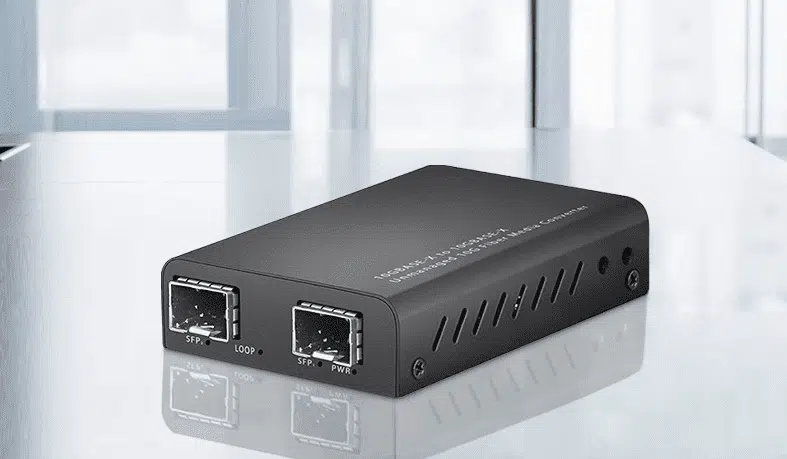
According to different structures, media converters can be divided into desktop (independent) media converters and rack media converters. Desktop media converter is suitable for a single user (and built-in power transceiver and external power transceiver), such as the uplink of a single switch in the corridor. Rack-type media converters are suitable for multi-user convergence. For example, the central machine room of the community must meet the uplink of all switches in the community. Using the rack is convenient to realize the unified management and unified power supply of all modular media converters. The media converter rack of Confederation communication is a 16 slot product, that is, at most 16 modular media converters can be inserted into one rack.
Classified by Network Management Function
Managed Media Converter & Unmanaged Media Converter
According to whether it has a network management function, media converters can be divided into managed media converters and unmanaged media converters. With the development of the network towards the direction of operation and management, most operators hope that all equipment in their network can be remotely managed. Media converters, like switches and routers, are also gradually developing in this direction. The unmanaged media converter supports plug and play, and the electrical interface working mode is set through the hardware dial switch. The managed type media converter supports carrier-level network management.
Classification by Working Mode
Full-duplex Media Converter & Half-duplex Media Converter
According to the different working modes, media converters can be divided into full-duplex media converters and half-duplex media converters. Full duplex means that when the transmission and reception of data are shunted and transmitted by two different transmission lines, both sides of communication can transmit and receive at the same time. This transmission mode is full-duplex. In the full-duplex mode, the transmitter and receiver are set at each end of the communication system, so the data can be controlled to be transmitted in both directions at the same time. The full-duplex mode does not require direction switching, so there is no time delay caused by switching operation. Half-duplex mode refers to the use of the same transmission line for both reception and transmission. Although data can be transmitted in two directions, both sides of communication cannot send and receive data at the same time. Such transmission mode is the half-duplex system. When the half-duplex mode is adopted, the transmitter and receiver at each end of the communication system are transferred to the communication line through the receive/send switch to switch the direction. Therefore, a time delay will be generated.
Conclusion
This paper comprehensively introduces various types of media converts according to different fiber types, structures, network management functions, and working modes. QSFPTEK provides various high-reliable and high-stable network converters at low prices, such as 1G copper to fiber media converter, 10G copper to fiber media converter, 10G fiber to fiber media converter, and PoE media converter. Welcome to consult via sales@qsfptek.com.