
These days, law firms face unprecedented challenges concerning the management, analysis, and security of vast amounts of electronic data. Legal professionals must meticulously balance the integrity of evidence with operational efficiency, ensuring compliance while minimizing risk exposure. Central to achieving these outcomes is the disciplined approach to selecting relevant data for legal use and discarding extraneous information, a practice vital for enhancing productivity and safeguarding legal integrity.
Managing Legal Compliance through Strategic Data Practices
Effective data culling serves as an essential process in maintaining compliance with evolving regulatory frameworks. By identifying and preserving only legally pertinent information, firms avoid unnecessary complexities and potential compliance pitfalls associated with data retention laws.
Over-retention of unnecessary information increases the burden on firm resources and exposes the organization to heightened legal scrutiny and risks of violating client confidentiality. Through precise selection, firms ensure adherence to regulations like GDPR, CCPA, and other jurisdiction-specific privacy laws, thereby reducing the potential for costly compliance infractions.
Mitigating Risks Associated with Data Overload
Unchecked accumulation of electronic information significantly elevates risks within legal practices. Excess data storage amplifies vulnerabilities, including inadvertent disclosure of confidential client information or evidence mishandling.
A systematic approach to managing and discarding irrelevant documents mitigates these risks by limiting data exposure to security breaches and minimizing opportunities for data corruption or accidental leaks. Additionally, streamlined data management enhances a firm’s capability to respond swiftly and effectively to legal discovery requests, ensuring accuracy and accountability.
Enhancing Efficiency in Legal Workflows
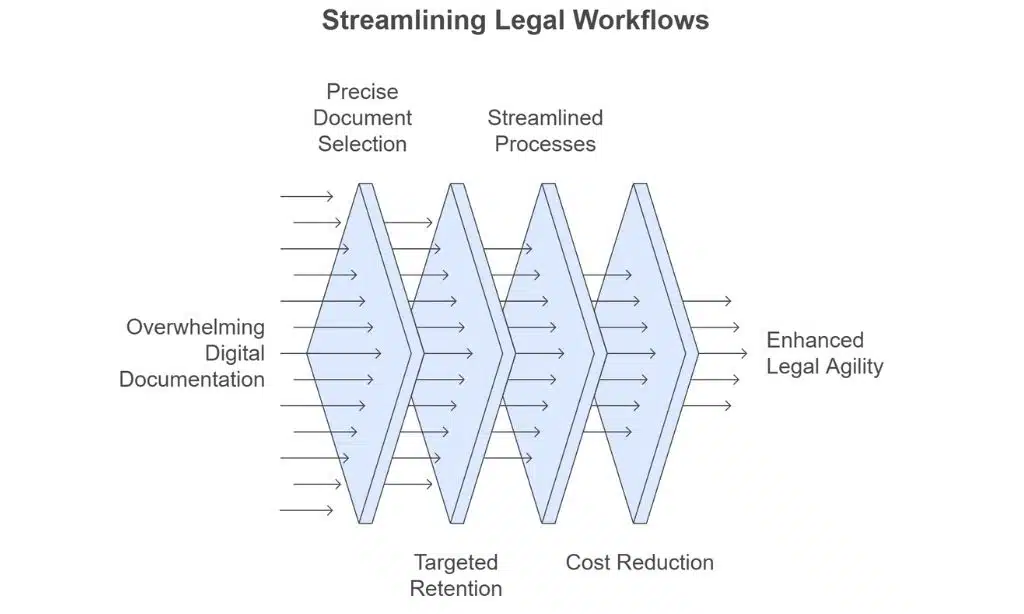
Optimizing legal workflows relies significantly on focused and relevant information management. Legal teams frequently encounter overwhelming amounts of digital documentation that must be reviewed meticulously. The presence of extraneous documents complicates eDiscovery, lengthening timelines and inflating client costs.
Precise selection and targeted retention of legally critical documents significantly streamline processes, making evidence management faster and reducing unnecessary expenditures. Firms thus become more agile and responsive, enabling attorneys to concentrate on higher-value analytical tasks, strategic litigation planning, and delivering superior client service.
Strengthening Data Security Measures
Robust security measures are increasingly crucial within the legal sector, where sensitive information is routinely handled. Implementing disciplined data management practices substantially enhances the effectiveness of data security protocols.
By minimizing the volume of data retained, firms narrow the attack surface available to cyber threats and unauthorized intrusions. Moreover, simplifying data management allows for more straightforward monitoring and audit processes, enhancing overall cybersecurity posture and enabling swift detection and response to any anomalies or breaches that may occur.
Improving Cost Management
Law firms must consistently navigate the pressure of reducing operational costs while maintaining exceptional service standards. Retaining superfluous data drives storage expenses higher and complicates management, resulting in escalating overhead costs.
By precisely identifying and discarding unnecessary information, firms optimize storage use and reduce reliance on costly digital storage solutions. This strategic approach to document management directly translates into improved cost-efficiency, allowing resources to be redirected towards growth initiatives and client-focused improvements.
Client-Specific Solutions
Data culling is a critical process for organizations that deal with large volumes of electronic information. By partnering with experienced providers, businesses can ensure that only relevant data is retained while unnecessary information is efficiently discarded.
This approach helps mitigate compliance risks, improve data security, and streamline workflows. Providers can assist organizations in implementing best practices that align with industry regulations, ensuring effective legal compliance and risk management without overwhelming internal resources.
Law firms operate within a complex, highly regulated, and data-intensive environment. Adopting a structured and disciplined approach to data culling streamlines processes and reinforces compliance frameworks and robust risk management strategies. By prioritizing the retention of relevant legal documentation and actively discarding extraneous data, firms strengthen their ability to mitigate risks, maintain security, optimize workflows, and significantly reduce operational costs. Ultimately, this selective data management approach empowers law firms to uphold high standards of legal excellence and client trust in an increasingly digital world.