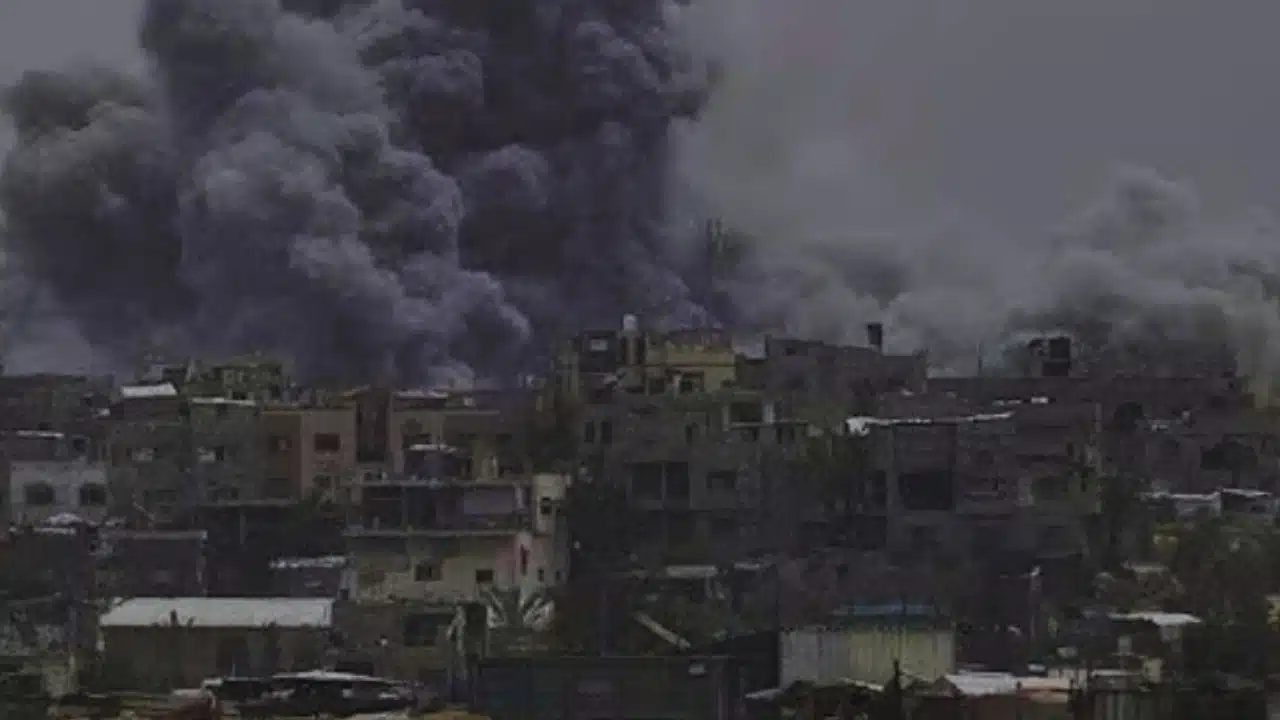
At least thirteen Palestinians were killed early Saturday after Israeli airstrikes devastated parts of Gaza City, leaving dozens trapped under the rubble of collapsed buildings. Residents described harrowing scenes in the Sabra neighborhood, where a home was directly targeted, killing at least four individuals.
In the absence of proper rescue tools, civilians used bare hands, shovels, and simple tools to dig through massive piles of debris in desperate efforts to reach survivors. Mahmoud Basal, spokesperson for Gaza’s Civil Defense agency, said rescue operations were severely hampered by a critical lack of equipment.
“Our crews cannot reach the people trapped under the rubble because we simply don’t have the necessary machinery,” Basal told AFP.
Adding to the challenge, Israeli air raids earlier this week destroyed around 40 engineering and heavy-duty rescue vehicles that Gaza’s emergency teams had been using for debris clearance and rescue missions. Without these essential tools, emergency workers and civilians alike are left virtually powerless in the face of ongoing attacks.
Israel Expands Strikes Across Gaza Strip
The strikes were not limited to Gaza City alone. Israeli forces also launched attacks on the southern areas of the Strip, including al-Mawasi and Khan Younis. In al-Mawasi, a region previously designated as a “humanitarian safe zone” by Israeli authorities, civilians were stunned as bombings continued despite no prior warning, according to local witnesses speaking to Al Jazeera.
Gaza residents say nowhere feels safe anymore, with bombings hitting both urban centers and makeshift shelters housing displaced families.
Gaza’s Starvation Crisis Reaches Breaking Point
The Israeli bombings come amid a catastrophic humanitarian disaster. According to the United Nations (UN) and the World Food Programme (WFP), the entire population of Gaza — nearly two million people — is now at imminent risk of famine.
On Friday, WFP officials said that community kitchens across Gaza, which had been a lifeline for thousands, are expected to run out of food supplies within the next few days. Without these kitchens, there will be no remaining large-scale food source in Gaza, after most bakeries, farms, and supermarkets were either destroyed by bombings or shut down due to lack of supplies.
The food blockade, enforced by Israel since early March 2025, has completely cut off the entry of basic necessities including food, fuel, and medical supplies.
“The situation is rapidly deteriorating into a full-scale famine,” a WFP statement warned.
Philippe Lazzarini, head of the United Nations Relief and Works Agency (UNRWA), stressed that the humanitarian crisis is “man-made”, a direct result of deliberate policies blocking humanitarian aid.
“This level of suffering is not a natural disaster; it is created by humans,” Lazzarini said.
Israel Accused of Using Starvation as a Weapon of War
Experts within the United Nations have voiced grave concerns that Israel’s blockade strategy amounts to using starvation as a weapon of war. Michael Fakhri, the UN Special Rapporteur on the Right to Food, condemned the tactics:
“Israel is executing this starvation campaign with complete impunity and no consequences,” Fakhri said in an official statement.
According to international humanitarian law, particularly the Geneva Conventions, deliberate starvation of civilians is classified as a war crime.
Despite international appeals, Israel has so far continued its blockade and bombardment, justifying its actions as necessary for defeating Hamas forces entrenched within Gaza.
Medical Supplies at Critical Shortage, WHO Warns
The food crisis is compounded by a simultaneous collapse of Gaza’s healthcare system. The World Health Organization (WHO) reported that hospitals and clinics are running out of essential supplies, including anesthetics, surgical tools, antibiotics, and fuel needed to power generators.
Tedros Adhanom Ghebreyesus, WHO Director-General, issued an urgent appeal on social media platform X (formerly Twitter):
“The aid blockade must end. Immediate access is needed to save lives.”
Hospitals across Gaza are being forced to make impossible choices, often prioritizing who receives the last remaining oxygen tanks or the final vials of antibiotics, according to field doctors cited by Médecins Sans Frontières (Doctors Without Borders).
Death Toll Mounts as Conflict Enters Eighteenth Month
The situation continues to spiral as Israeli operations in Gaza intensify. Since the latest escalation resumed on March 18, 2025, at least 2,062 Palestinians have been reported killed, with many more wounded, according to the Gaza Ministry of Health.
The broader conflict, which erupted after Hamas’s attack on Israel on October 7, 2023, has resulted in more than 51,000 Palestinian deaths to date.
The initial Hamas attack claimed 1,218 lives in Israel, mainly civilians, prompting a massive Israeli military retaliation.
The human cost in Gaza, however, has drawn growing international outrage, with critics arguing that Israel’s tactics amount to collective punishment of civilians.
Global Outcry and Calls for Immediate Action
Human rights groups, including Amnesty International and Human Rights Watch, have repeatedly condemned the Israeli blockade and bombardment of civilian areas, calling for accountability and urgent humanitarian access.
International pressure is mounting. The United Nations, European Union, International Committee of the Red Cross (ICRC), and numerous states have issued statements demanding an immediate ceasefire and the unconditional opening of crossings to allow food, medicine, and humanitarian aid into Gaza.
Grassroots protests have erupted worldwide — from London, Paris, New York, to Johannesburg — demanding an end to the siege and accountability for war crimes.
Despite diplomatic efforts, no significant breakthrough has been achieved yet. Meanwhile, aid organizations warn that every hour of delay costs more lives.
The Information is Collected from Al-jazeera and BBC.